Why Accuracy Lies and SMOTE Breaks Down: The Technical Limits of Imbalanced Learning
ELI5
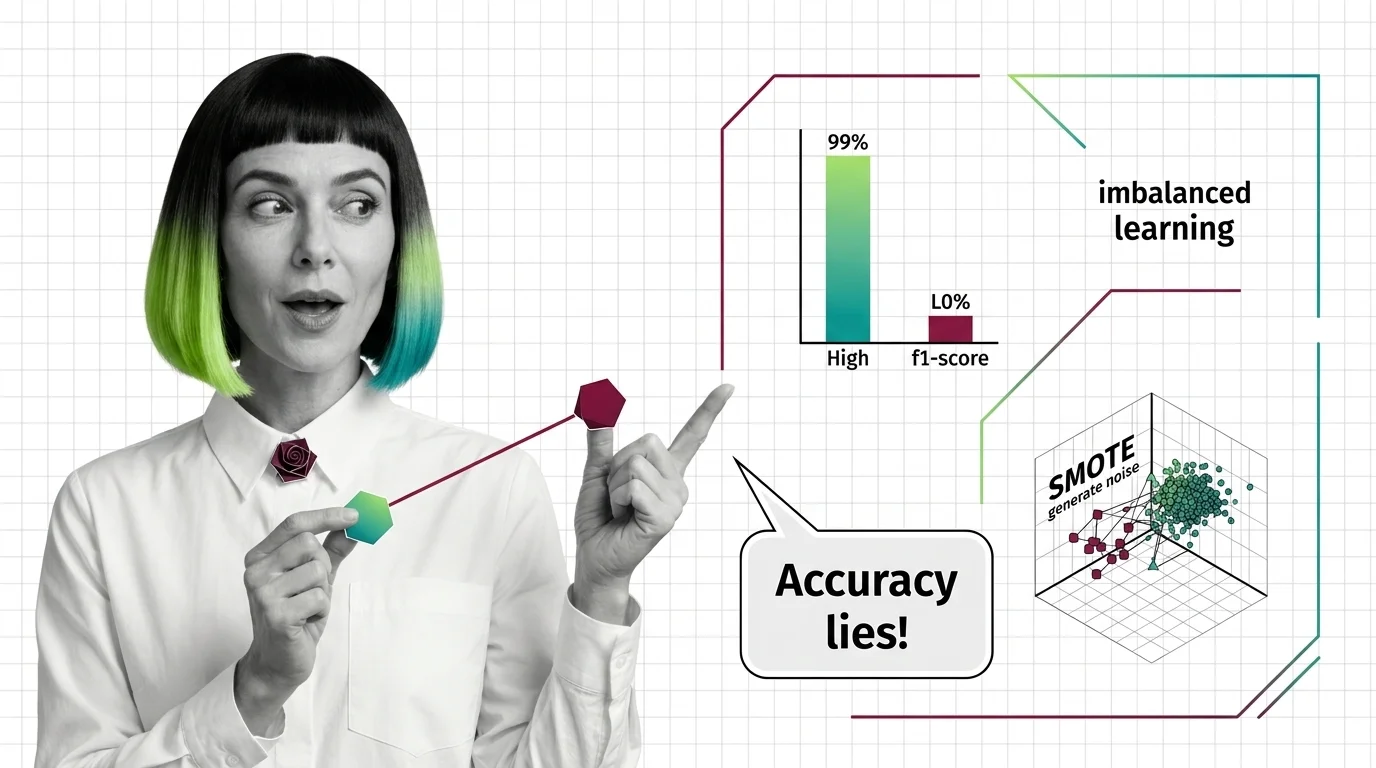
Class imbalance is when one outcome dominates your data — 999 normal transactions for every fraud. A model can ignore the rare class entirely, score 99.9% accuracy, and be useless. The rare case was the one you cared about.
A fraud-detection model comes back from training with 99.7% accuracy. The team signs off and rolls it out. Three weeks later it has flagged nothing — not a single fraudulent transaction — while fraud kept moving through the system untouched. The model never broke. It did exactly what the math rewarded: it learned that answering “normal” every single time is the most accurate strategy available to it.
The Arithmetic That Rewards Doing Nothing
Class Imbalance is not a bug in the model. It is a property of the data: the labels you care about are rare, and the labels you do not care about are everywhere. The trouble starts when you grade the model with a metric that does not know the difference. Accuracy treats every example as equally important, and in an imbalanced dataset, that assumption quietly hands the majority class a victory before training even begins.
Why is accuracy a misleading metric for imbalanced datasets?
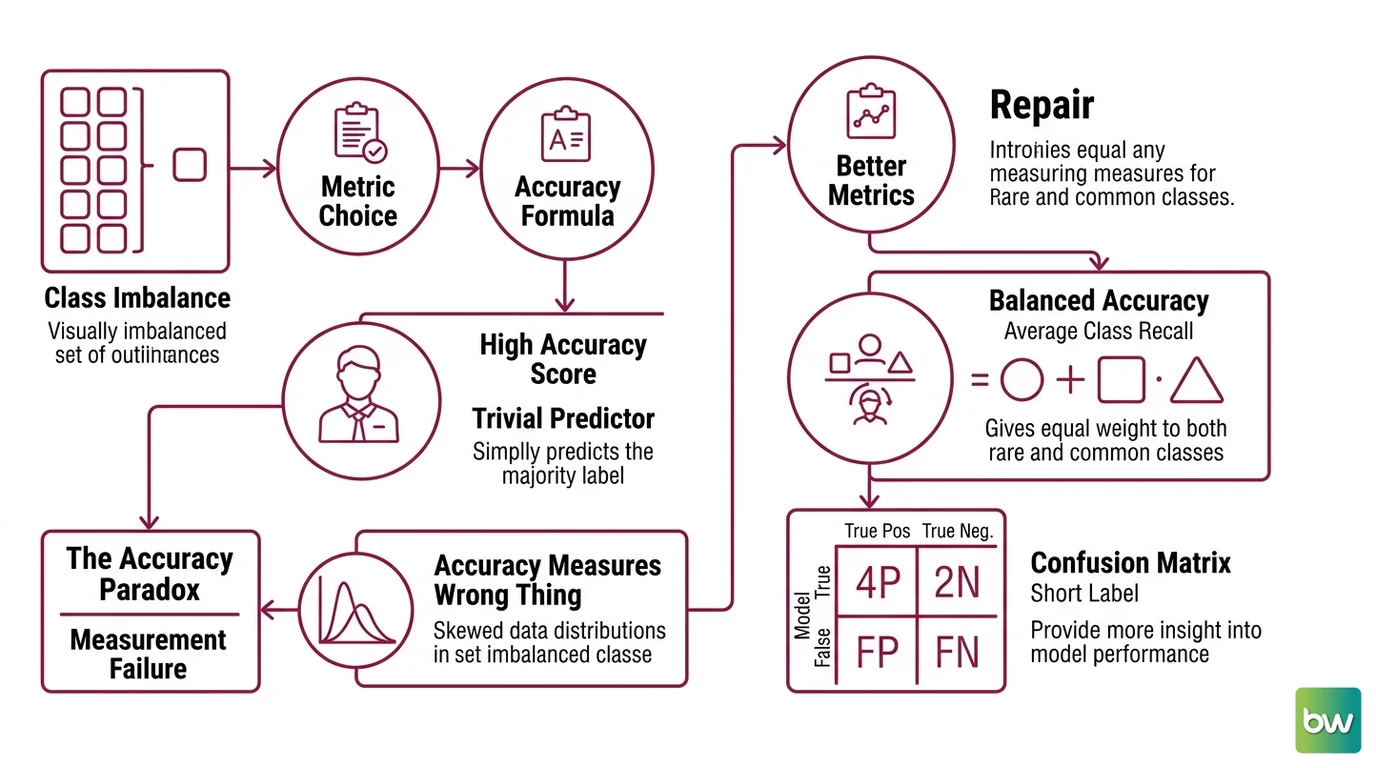
Accuracy is the fraction of all predictions that were correct: true positives plus true negatives, divided by everything. Read that formula against a dataset that is 99.7% one class. A classifier that predicts the majority label unconditionally — a function that has learned nothing — scores 99.7% by construction. The metric rewards it for the one thing it can do without modeling anything at all.
This is the failure mode often called the accuracy paradox: the dataset is so skewed that a trivial majority-class predictor posts a near-perfect score while detecting none of the minority cases that motivated the project. It is a well-documented consequence of the formula, not a named theorem, and it appears the moment imbalance gets steep enough.
The mistake is to read the high number as a statement about the model. It is really a statement about the data. The accuracy is high because the class distribution is skewed, and the metric measures the wrong thing. Not a modeling failure. A measurement failure.
The repair is to stop averaging over examples and start averaging over classes. Balanced Accuracy, in scikit-learn’s definition, is the average of the recall obtained on each class — a macro-average that gives the rare class and the common class equal weight. Under that metric, the do-nothing classifier collapses to 0.5, exactly where it belongs. The full Confusion Matrix tells you more still: Precision, Recall, and F1 Score expose the trade-off between catching the minority class and crying wolf, and the precision-recall curve stays honest where Roc Auc can look deceptively healthy when positives are scarce.
| Metric | What it measures | Behavior under heavy imbalance |
|---|---|---|
| Accuracy | Fraction of all predictions correct | Inflated by the majority class; a do-nothing model scores near the majority’s share |
| Balanced accuracy | Average recall across each class | Falls to 0.5 for a do-nothing model — the majority cannot hide the minority |
| Precision / Recall | Correctness vs. coverage on the positive class | Exposes the trade-off accuracy conceals |
| F1 score | Harmonic mean of precision and recall | Penalizes a model that ignores the minority class |
| PR-AUC | Precision across all decision thresholds | More informative than ROC-AUC when positives are rare |
Change the metric and the “99.7% model” stops looking like a success and starts looking like what it is. Which raises the next question: if the data is the problem, why not just fix the data?
What SMOTE Draws in the Empty Space
The intuitive fix is to rebalance the training set so the model can no longer win by ignoring the minority. Undersampling throws away majority examples until the classes match, which discards information you paid to collect. Oversampling goes the other way and duplicates minority examples, which teaches the model to memorize a handful of points. SMOTE was designed to escape that dilemma — and understanding what it actually does to your feature space is where the second illusion lives.
SMOTE — Synthetic Minority Over-sampling Technique, introduced by Chawla et al. (2002) — does not copy minority points. It invents new ones. For a given minority example, it finds its nearest minority neighbors (five by default), picks one, and places a synthetic point somewhere on the straight line between them. Repeat until the classes are balanced. The premise is geometric: the region between two real minority examples is probably also minority territory, so a point drawn there is a plausible new member of the class. It interpolates, it does not discover — every synthetic point is a weighted average of data you already had.
What are the technical limitations of SMOTE in high-dimensional data?
That straight-line assumption is exactly what fails as dimensions multiply. In a high-dimensional feature space, the nearest neighbors of a minority point are not reliably close in any meaningful sense — distances concentrate, and the “between” region that SMOTE fills can lie far outside the real minority distribution. Blagus & Lusa (2013) tested this directly on high-dimensional data and found that SMOTE does not reduce a classifier’s bias toward the majority class for most learners, and is frequently less effective than simply undersampling the majority. Worse, it leaves the class means essentially unchanged while shrinking variance and inducing correlation between the synthetic samples — it makes the minority cloud look artificially tight, not better defined.
The damage is not limited to high dimensions. Elor & Averbuch-Elor (2022), evaluating across dozens of datasets, found that with a strong, consistent classifier — gradient boosting, for instance — balancing via SMOTE is generally not beneficial; the measurable gains appear mainly with weaker learners such as a single decision tree, an SVM, or a shallow network. The honest reading is not “SMOTE never works.” It is that SMOTE earns its keep on weak models and tends to do nothing — or quietly hurt — once your classifier is already strong. The popular default has a narrow band where it actually helps.
There is also a quieter trap that has nothing to do with dimensions. SMOTE generates synthetic neighbors from the data it is given, so if you resample the entire dataset before splitting, synthetic points built from test-set neighbors bleed into training. That is textbook Data Leakage, and it inflates your score the same way the accuracy paradox does — by letting the model see what it is about to be graded on.
What These Two Failures Predict
Once you see imbalance as a measurement problem first and a data problem second, the behavior of your own pipeline becomes predictable rather than mysterious.
- If you report a single accuracy number on a skewed dataset, expect it to track the majority class share and tell you almost nothing about the rare class you built the model to find.
- If you apply SMOTE and your validation score jumps but production performance does not, suspect that you resampled before splitting and leaked synthetic neighbors across the boundary.
- If SMOTE helps a weak model but stops helping once you switch to gradient boosting, that is the expected pattern, not an anomaly — strong learners already extract most of what resampling was trying to inject.
- If your features are high-dimensional, expect interpolation-based oversampling to under-deliver, and treat random undersampling or a metric-and-loss fix as the more reliable baseline.
Rule of thumb: Fix the metric before you touch the data. A model graded by balanced accuracy or PR-AUC removes most of the incentive that made imbalance dangerous in the first place.
When it breaks: Every resampling method, SMOTE included, assumes the minority examples you already have are representative of the minority examples you have not seen. When the rare class is rare because it is genuinely heterogeneous — many distinct failure types, each with a few examples — interpolating between them manufactures points that belong to no real subgroup, and no amount of balancing recovers a signal the data never contained.
The Fix Lives in the Loss, Not the Sample
Resampling edits the data so the model will pay attention to the minority class. The alternative is to leave the data alone and edit the objective so the model pays attention on its own. This is usually the more direct route, because it changes what the model optimizes rather than what it observes.
Class Weighting multiplies the penalty for misclassifying the minority class, so a single missed fraud costs the optimizer as much as many missed normal transactions — most libraries expose this as a one-line class_weight argument.
Focal Loss, from Lin et al. (2017), goes further by reshaping cross-entropy with a modulating factor that down-weights the easy, already-correct majority examples and concentrates gradient on the hard minority cases. Both attack imbalance at the level of the loss, where it originates, instead of fabricating new rows.
When resampling genuinely is the right tool, ADASYN — He et al. (2008) — refines SMOTE by generating more synthetic samples in the sparse, hard-to-learn minority regions rather than spreading them uniformly. And the simplest lever is the most overlooked: tune the decision threshold. A classifier’s default 0.5 cutoff is an assumption, not a law, and moving it shifts the precision-recall balance without retraining anything. Whatever you choose, do the resampling inside each Cross Validation fold, never before the split — the scikit-learn-contrib library Imbalanced Learn provides pipeline objects built precisely so synthetic samples never cross into the data used to score you.
The Data Says
Class imbalance punishes two comfortable habits at once: trusting a single accuracy number, and reaching for SMOTE as a reflex. Accuracy on a skewed dataset measures the class distribution, not the model, and balanced accuracy or PR-AUC restores the honest picture. SMOTE interpolates rather than discovers, so it weakens in high dimensions and tends to add little once your classifier is already strong. The reliable fixes are upstream and downstream of resampling — an imbalance-aware metric, a weighted or focal loss, and a threshold you chose deliberately.
AI-assisted content, human-reviewed. Images AI-generated. Editorial Standards · Our Editors