Whose Documents Get Found? The Ethical Stakes of Contextual Retrieval in High-Recall Search
The Hard Truth
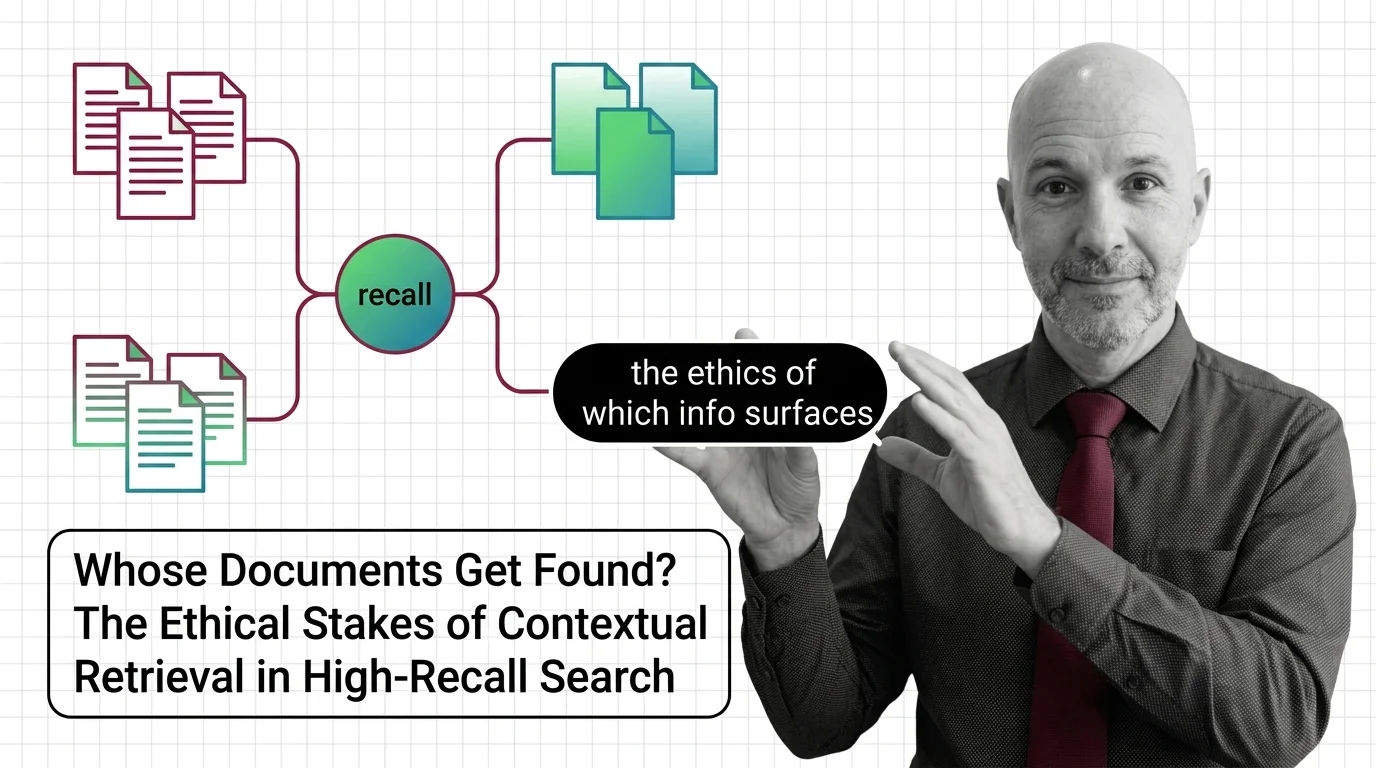
What happens when the technology we use to “find the right document” is also the technology that quietly decides which documents are findable at all? Recall is not a neutral metric. It is a curatorial decision — and at the scale of contextual retrieval, that decision is being delegated to an opaque preprocessing step nobody voted for.
In September 2024, Anthropic published a recipe that has since been quietly absorbed into enterprise search stacks across hiring platforms, claims processors, internal policy chatbots, and clinical decision support tools. It was framed as an engineering improvement — a way to make retrieval-augmented generation less stupid. But the question we should be asking is not how much better the recall got. It is who, exactly, gets found when the system gets better at finding.
The Question Behind the Recall Numbers
There is a particular intellectual seduction in benchmarks. When a research note reports that retrieval failure rates fell by a measurable margin, the reader’s attention slides toward the engineering — toward Retrieval Augmented Generation pipelines, embedding models, ranking heuristics. What slides out of view is the prior question: failure to retrieve what, on whose behalf, against which definition of relevance?
Contextual Retrieval answers a real problem. Naïve chunking strips passages from their source documents and indexes them as orphans. The retriever then has to guess what the orphan is about. That guess is often wrong. Anthropic’s fix is elegant: before indexing, generate fifty to a hundred tokens of “situating context” for each chunk using Claude 3 Haiku, then prepend that context to the chunk. The retriever now sees the chunk as a librarian would have catalogued it — with its provenance, its parent topic, its place in the larger document.
That is a lovely description of an engineering improvement. It is also an admission that we have automated cataloguing, and that we have done so without naming the cataloguer.
What Anthropic Is Selling Is Real
It is worth steelmanning the technique before critiquing it, because the case for contextual retrieval is genuinely strong. Anthropic reports that contextual embeddings alone reduced top-twenty retrieval failure rate by 35 percent, that combining them with contextual BM25 reduced failure 49 percent, and that adding a reranker reduced failure 67 percent (Anthropic’s research note). The one-time indexing cost lands around $1.02 per million document tokens with prompt caching — cheap enough that teams stop arguing about whether to do it.
The technical lineage is honest, too. Contextual BM25 is just BM25 with better-prepared inputs. Hybrid Search has been the consensus production architecture for years. Anthropic’s contribution is not a new retriever; it is an acknowledgment that the bottleneck was never the retriever, it was the chunks. Fixing the chunks fixes the retrieval. That is good engineering, and dismissing it would be intellectually dishonest.
But the same announcement that proves the recipe works contains exactly zero discussion of who gets surfaced and who does not. The omission is not malicious. It is structural. A product post about retrieval quality is not the place where we audit retrieval ethics. The problem is that no place exists where we do.
Where the Bias Actually Lives
The empirical literature on RAG fairness arrived after Anthropic’s announcement, and it is unkind to the assumption that better retrieval is automatically more equitable. The “No Free Lunch” paper at EMNLP 2025 Findings reaches a conclusion that should disturb anyone running these systems in consequential settings: fairness degradation in RAG originates in the retrieval stage, not in generation. The retriever acts as a biased semantic filter — and even a small fraction of unfair samples, such as twenty percent, is sufficient to elicit biased responses (No Free Lunch, Hu et al., EMNLP 2025 Findings).
Read that again. Twenty percent. Not a poisoned corpus, not an adversarial attack, not a corner case — a routine corpus with a routine minority of skewed documents is enough to tilt outputs across BBQ, PISA, and HolisticBias benchmarks. The same paper documents a confidence-shift mechanism: retrievals raise the model’s confidence on biased questions, shifting answers from “I don’t know” toward definitive — and often biased — outputs. The system stops hedging precisely where hedging would be the ethically responsible response.
A separate line of work shows that small demographic perturbations to queries reveal systematic ranking shifts in RAG retrievers, even for small language models (Fairness Testing in RAG). The retriever is not just biased. It is sensitive in ways the user cannot predict and the operator does not measure. Standard evaluation stacks check faithfulness, context recall, and answer relevancy. They do not, by default, include demographic-disaggregated retrieval-fairness metrics. Teams have to add them by hand, and most do not.
The Card Catalogue Is Now an Algorithm
There is a useful historical parallel. For most of the twentieth century, the card catalogue was a piece of contested infrastructure. Librarians fought over subject headings — over whether a book about the Vietnam War belonged under “Vietnam Conflict” or “Vietnam War,” over whether “homosexuality” belonged under abnormal psychology. These choices looked clerical. They were political. The catalogue decided which books a curious patron would find, and the patrons rarely noticed the catalogue at all.
The Library of Congress eventually published its subject heading standards. Critics could write papers about them. Librarians could lobby for changes. The cataloguing layer was visible, auditable, and contestable — slow, imperfect, and human, but legible.
Contextual retrieval is the card catalogue’s algorithmic descendant. The fifty-to-one-hundred-token “situating context” that Claude 3 Haiku generates per chunk is doing exactly what a cataloguer once did: deciding what each piece of text is “about” before it gets indexed. The difference is that no library science journal will publish those decisions. They are ephemeral, undocumented, and embedded in vector geometry rather than human-readable headings. The Reranking layer that follows — the architectural lever that demonstrably improves recall — is, by the same evidence, the lever that redistributes whose content surfaces. ReFaRAG (FEHDA 2025) shows that re-ranking can be used either to mitigate or to inject bias in RAG pipelines. The same instrument cuts both ways.
The Position This Argument Forces
Thesis: contextual retrieval improves recall by deciding more aggressively what each document means — and that decision is governance dressed as efficiency. It is not a neutral preprocessing step. It is a worldview compressed into vector space, scaled to millions of queries, and exempted from the kind of public scrutiny we used to apply to far less consequential curatorial choices.
Why does this matter beyond library theory? Because retrieval pipelines have stopped being decoration on chatbots. Agentic RAG systems now feed retrieval results into autonomous decision loops. Query Transformation layers rewrite the user’s question before retrieval even begins. Where these stacks feed downstream systems used in employment screening, credit decisioning, education access, justice, or essential services, EU AI Act Article 13 transparency obligations begin applying on August 2, 2026 — the date the high-risk-system rules take effect (European Commission’s AI Act page). Retrieval components inherit those obligations through downstream use. The retrieval layer was not asked whether it wanted that responsibility. It is acquiring it anyway.
What We Owe the People We Cannot See
The healthcare literature is already articulating what this looks like in practice. JMIR Medical Informatics names three core imperatives for clinical RAG: accuracy plus fairness plus bias mitigation; transparency plus explainability plus trust; responsibility plus accountability plus oversight (JMIR Medical Informatics). Notice the structure. Each imperative is plural. None of them admit the kind of “release it and measure recall later” workflow that produced contextual retrieval as a recipe in the first place.
So what would we owe — not as compliance, but as ethical practice — to the people whose documents either surface or do not? We would owe them disaggregated retrieval-fairness metrics that the standard evaluation stacks do not yet provide. We would owe them inspection of the contextualization step itself, since the model that generates “situating context” can hallucinate or smuggle in framing that no one audits. We would owe them visibility into reranker behavior, given that the same lever that lifts recall can redistribute who is heard. And we would owe them, at minimum, the institutional honesty to say: this system decides who is found, and we have not yet built the mechanism to ask whether it decides fairly.
Where This Argument Is Weakest
Intellectual honesty requires naming the conditions under which this critique is overstated. No public CVE, regulator finding, or named audit report has identified contextual retrieval as the proximate cause of a discrimination incident as of mid-2026. The “popularity bias” critique is well-established for recommender systems and web search, and structurally plausible for dense retrieval, but it predates contextual-retrieval-specific empirical work. If standard evaluation stacks include demographic-disaggregated retrieval metrics by default, if reranker behavior becomes inspectable as a matter of platform norms, and if the contextualization step is audited like a cataloguing standard, much of the urgency in this essay collapses into a solved problem. I would be glad to be made obsolete by that future.
The Question That Remains
The card catalogue was once invisible too — until enough people noticed it was making decisions on their behalf. Contextual retrieval is now where the card catalogue was a hundred years ago: inescapable, opaque, and unexamined. The question is not whether the technique works. It is whether we will build the institutions that ask, on behalf of everyone whose documents either surface or do not, who decided what counts as relevant — and who gets to disagree.
AI-assisted content, human-reviewed. Images AI-generated. Editorial Standards · Our Editors