Who's Liable When a Generative Media API Produces Harmful Content?
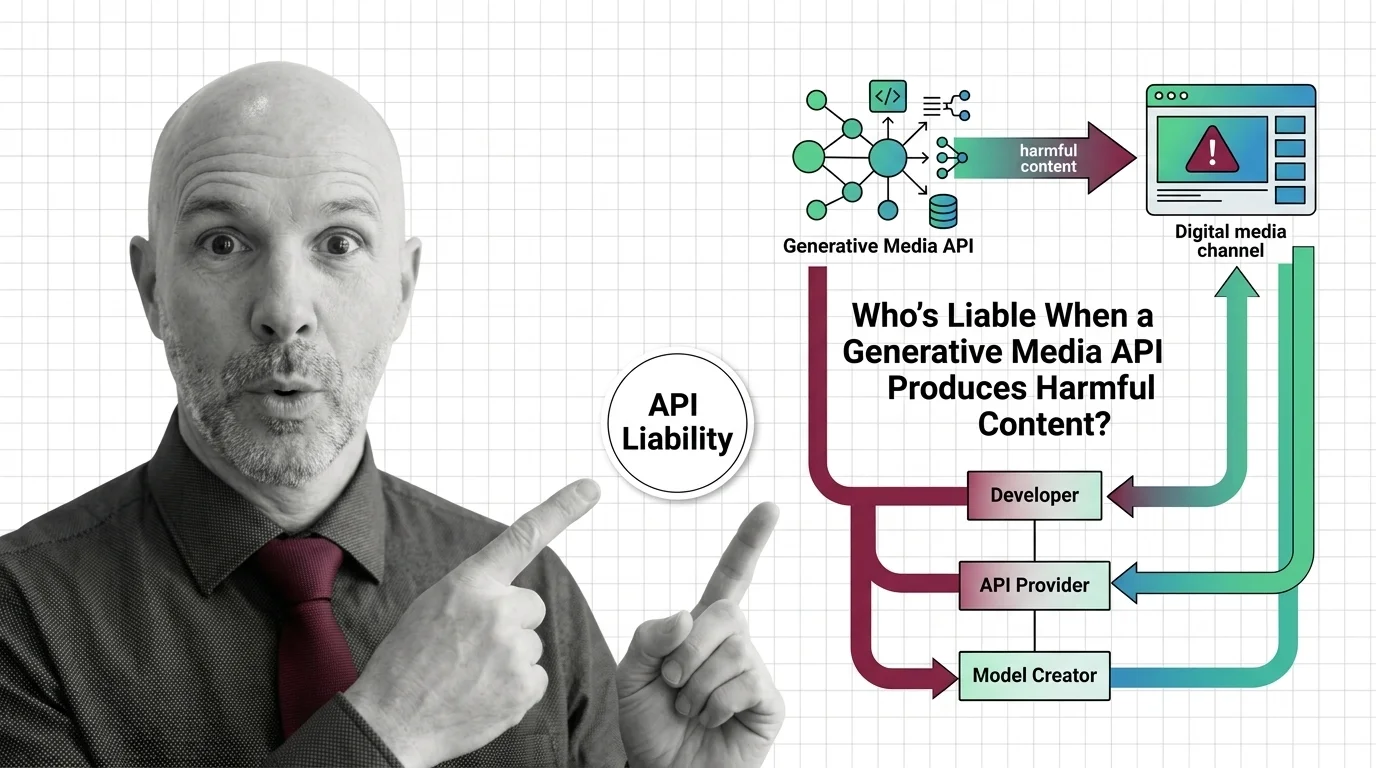
The Hard Truth
Stability AI’s terms of service cap its total liability at $100 — or whatever you paid in the past six months, whichever is greater — no matter what its API generates. That number isn’t a drafting oversight. It is, in practice, the entire liability architecture of an industry now generating a meaningful share of the images and video moving across the internet.
Somewhere between a developer’s prompt and the image that lands on a stranger’s screen, a chain of contracts quietly decides who answers for what happens next. Almost none of those contracts mention the stranger. There is a word for agreements that bind everyone involved except the people most affected: an externality, before software made it sound like an integration detail.
The Hundred-Dollar Ceiling
Stability API caps its total liability at $100, or whatever a customer paid across the prior six months — whichever is larger. Not an oversight in someone’s legal department. It is the default position of an entire category of infrastructure: cap the downside in writing, and let the rest sort itself out in indemnification clauses nobody reads until something goes wrong.
A handful of platforms sit at the center of this question, because a handful of platforms run most of it. Fal AI reports hosting more than 600 models and claims roughly half of all image-API inference, and close to that share of video, according to fal’s own State of Generative Media report — a figure no independent auditor has confirmed, so treat the scale as directional. Replicate and Stability AI fill out most of the field that matters. Those platforms host models trained by separate companies and research labs whose training data and licensing terms rarely surface in product documentation, so the developer, the platform, and the model’s original creator can each point at the other two. Most developers building on Generative Media APIs never read past the pricing page to the clause deciding what happens when the model gets it wrong. The clause is short. It says, in effect: not much, and not us.
A Bargain, Seen Two Ways
Read generously, a cap like this is what makes affordable, high-volume generative infrastructure possible at all. Open-ended legal exposure on every API call would mean only self-insured companies could afford to run one — consolidation that would make today’s market concentration look modest. Liability caps, in this reading, are the price of letting a solo developer build on the same rails as a platform with its own legal department. Not a loophole — what keeps the field open to more than a handful of incumbents.
Read critically, the same clause moves the cost of failure off the platform’s books and onto whoever is least equipped to absorb it. Stability’s terms require the customer to indemnify the company for claims arising from inputs and outputs; fal.ai states plainly it does not warrant its output is original or non-infringing, and use is at the customer’s own risk. Both readings can be true of the same sentence. The cap does not resolve who pays for harm — it only decides who the platform will never have to be.
What Both Readings Take for Granted
Both readings share an assumption rarely said out loud: that liability is something settled between two parties who signed something. The optimist sees a fair trade between platform and developer; the pessimist sees an unfair one. Both are arguing about the same two-party relationship — liability ends where the signatures do.
That assumption is comfortable because contract law is comfortable: it has rules, precedent, a forum where disputes get heard. But what happens to the people never offered a seat at that table?
The Party That Never Signed Anything
A generated image rarely stays inside the relationship that created it. Most of this infrastructure works asynchronously: a developer submits a job, walks away, and a Webhook fires when the file is ready, often with no human reviewing it before an application publishes it automatically. The request may have routed through a Multi Provider Abstraction layer that picked whichever backend was cheapest that day, so even the developer cannot say which company’s model produced the file. Harm doesn’t need a contract to travel — it just needs an output, and an audience.
And then it reaches someone who was never a party to any of this: a person depicted without consent, defamed, or otherwise harmed by an output they had no chance to refuse, holding no indemnification clause and bound by no arbitration agreement. A March 2026 class action against xAI in the Northern District of California alleged Grok had generated child sexual abuse material from real photographs, and that the company had licensed model access to apps that profited from it, according to techxplore.com — harm reaching people who never touched the platform. A 2026 ruling in Bouck v. Meta found Section 230 does not shield a platform when its generative AI materially contributes to content, per Eric Goldman’s law blog — though that case concerned a company’s own in-house feature, not a hosted API passed through someone else’s product, so it settles less than headlines suggested.
The Wager Hiding Inside Every Terms of Service
Thesis: A generative media API’s liability cap is not a resolution of who answers for harmful content — it is a bet that the people actually harmed by it will rarely have a contract, a forum, or the standing to test the clause at all.
That bet has held mostly because no one harmed this way has been positioned to challenge it, not because anyone decided it was fair. Indemnification clauses funnel disputes toward the developer who signed them, away from the platform that wrote them; arbitration agreements with no class mechanism mean even developers rarely test these clauses together. The first real crack is regulatory, not contractual: the European Council’s agreement to ban AI systems generating child sexual abuse material or non-consensual intimate content assigns liability at both the provider and the deployer level, ignoring the contract entirely. Politically agreed in May 2026, endorsed by Parliament the following month, not yet published in the Official Journal, with compliance required by December 2026. For one narrow category of harm, a regulator has decided the wager isn’t theirs to honor.
What a Hundred Dollars Doesn’t Count
A liability cap measures one thing: the maximum a company has decided it is willing to lose. It says nothing about what the rest of us absorb instead — the cost to someone whose likeness was used without consent, or the chilling effect of harm with no clear author and no clear remedy. In a market this concentrated, a handful of clauses written by a handful of legal departments start functioning as private law for an entire category of content, not an ordinary commercial term.
What if the number that should matter here was never the size of the cap, but the size of the population it was written to exclude?
Where This Reasoning Could Fail
This argument assumes courts will keep treating third-party harm as a gap the contract doesn’t reach. If judges instead enforce these clauses against anyone who tries to route around them — and so far, no case law has directly tested a hosted-API provider’s liability this way — “wager” overstates the uncertainty; it would just be a stable risk allocation nobody has successfully challenged. Statutory rules like the EU’s could also spread faster than litigation, closing the gap through regulation before a court rules on it.
The Question That Remains
The hundred-dollar clause will probably never be tested the way this essay imagines — not because it is fair, but because the people who would need to test it were never given a way in. The real question was never whether a hundred dollars is enough. Who gets to decide, in a contract between two parties, what a third party’s harm is worth?
AI-assisted content, human-reviewed. Images AI-generated. Editorial Standards · Our Editors