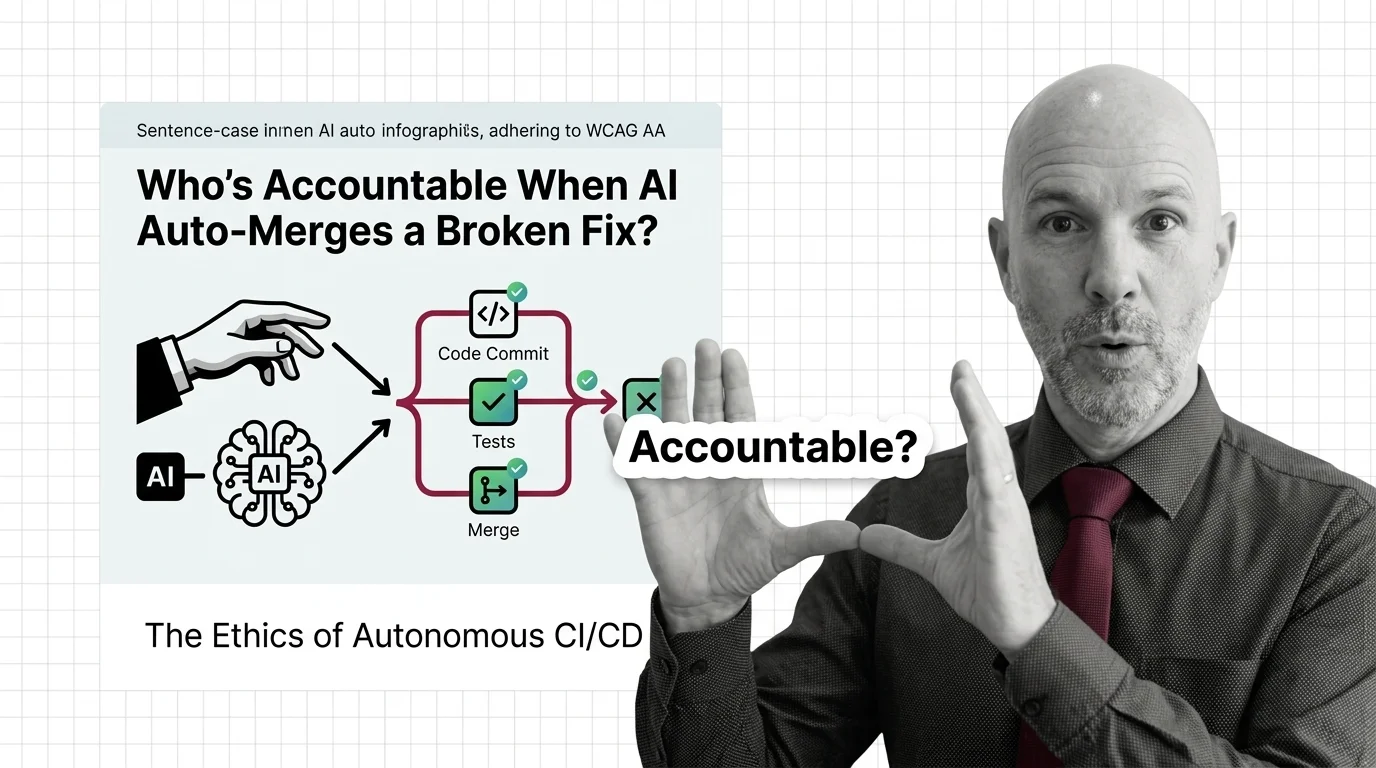
Who's Accountable When AI Auto-Merges a Broken Fix? The Ethics of Autonomous CI/CD
The Hard Truth
A test suite goes green at three in the morning. An agent that diagnosed the failure, wrote the patch, and watched every check pass is now one configuration flag away from merging it — with no human awake to notice. We built that approval gate to protect us. So why do we keep talking about removing it?
For most of software’s history, a broken release had an author. Someone wrote the code, someone approved it, and someone could be found in the commit log when it all went wrong. Autonomous AI in CI/CD Pipelines does not abolish that chain of responsibility so much as blur it — quietly, one merge at a time. The interesting question was never whether the machine can fix the build. It is who we will point to when it fixes the wrong thing.
The Gate We Are Quietly Negotiating Away
Today, the autonomous pipeline still asks permission. GitLab Duo’s Agent Platform, generally available since GitLab 18.8 in January 2026, runs a “Fix CI/CD pipeline” flow that analyzes a failure and prepares a merge request — but a human still approves the merge itself (GitLab Docs). GitHub Copilot’s coding agent opens a draft pull request on a constrained branch and cannot touch protected branches at all (GitHub Docs). No major vendor enables unsupervised auto-merge to production by default.
So the scenario in this article’s title is not a news report. It is a projection — the configurable edge case toward which convenience keeps nudging us. The question developers actually type into search engines is blunt: should AI be trusted to merge its own fixes without human review? Right now, the tools answer no on our behalf. The uncomfortable part is how easily that “no” becomes a setting.
The Case for Letting the Machine Merge
The argument for closing the loop is not reckless. It is humane. Anyone who has carried a pager knows the texture of Continuous Integration at its worst: the three-a.m. page, the Flaky Test Detection that never quite catches the right flake, the engineer who approves a merge on faith because the queue is backing up and the release window is closing. Fatigue makes worse decisions than any model does.
Modern pipelines now fold Deployment Risk Assessment, Test Prioritization, and Self Healing Pipelines into a single autonomous loop, all expressed as Pipeline As Code that a team can audit like any other artifact. The pattern thoughtful teams adopt even has a name — “autonomous investigation but governed remediation,” where pull request is the safety gate (Stochastic Coder). The machine does the tireless diagnosis; the human keeps the final say. And if the agent is right far more often than the exhausted human at three a.m., isn’t insisting on manual review just sentimentality dressed up as caution?
The Assumption Hidden Inside “It Passed CI”
Every argument for auto-merge rests on one load-bearing assumption: that a green pipeline means the change is correct. Pull on that thread and it frays. Tests encode what we already thought to check. They say nothing about the failure mode no one imagined, the integration that lives outside the suite, the Continuous Deployment step that behaves differently under real traffic. A passing suite is evidence, not proof.
When a human merges a green build, they are not only trusting the tests. They are lending their judgment to a decision the tests cannot fully make — and, in doing so, accepting that their name now sits beside it. Remove that human and you remove more than a few minutes of latency. You remove the last point in the system where a person’s judgment, and a person’s accountability, attaches to the act of saying yes.
What Accountability Meant Before the Pipeline Could Think
There is an older version of this problem, and it has nothing to do with software. Hannah Arendt described bureaucracy as “rule by Nobody” — a structure where responsibility is distributed so thoroughly across the machinery that no single person can ever be held to account, even as harm accumulates. The autonomous pipeline is a small bureaucracy of one: a procedure that acts, produces consequences, and offers no one to answer for them.
The vendors sense this, and the contracts show it. A research analysis of the terms of service behind AI coding assistants found a consistent tendency to shift responsibility for correctness, safety, and legal compliance onto the user (Treude 2026, a preprint not yet peer-reviewed). The traceability that might anchor responsibility is itself uneven — some agents sign their commits with clear authorship metadata, while others leave nothing at all (Treude 2026). When the audit trail itself is optional, “rule by Nobody” stops being a metaphor and becomes a configuration default.
Accountability Cannot Be Merged Away
Thesis: Autonomous CI/CD can distribute the labor of fixing software, but it cannot distribute responsibility for the result — and pretending it can is the real risk, not the broken build.
Regulators are circling the same intuition from the outside. NIST’s AI Risk Management Framework requires that AI outcomes remain traceable to human decision-makers, and notably does not relax that demand as systems grow more autonomous (NIST AI RMF, via Palo Alto Networks). The EU AI Act’s high-risk obligations — including mandatory human oversight — take effect on August 2, 2026 (EU AI Act). These regulations indicate the direction society is leaning: as the machinery gets more capable, the demand for a nameable human grows louder, not quieter. That is not bureaucratic friction. It is the institutional memory of every system that learned, too late, what “Nobody” costs.
The Questions We Owe the Next Engineer on Call
None of this argues for unplugging the agents. The autonomous CI/CD pipeline is genuinely good at the work humans are worst at, and refusing it on principle would trade real safety for the comfort of ritual. The honest response is not a policy to copy-paste but a short list of questions a team should never have to answer with a shrug.
Who reviews the agent’s merges once everyone trusts them enough to stop looking? Whose name is in the commit log when the trail goes cold? And who bears responsibility when the fix is plausible, passes every check, and is still wrong — the engineer who configured the agent, the vendor who trained it, or the team that quietly decided review was a formality? The danger is not the day we turn auto-merge on. It is the slower day, months later, when no one remembers it is on.
Where This Argument Could Be Wrong
I may be defending a gate whose value is mostly nostalgic. If autonomous agents prove, across years of audited production data, that their merges fail less often and less catastrophically than human-approved ones, then clinging to manual review would itself become the irresponsible choice — optimizing for a comforting name in the log over the actual safety of the people the software serves. This argument holds only as long as human judgment adds more than it costs. The moment that stops being true, the ethics flip, and the burden of proof lands on the people who insisted on staying in the loop.
The Question That Remains
We are not only automating the writing of code. We are automating the answer to “who is responsible,” and we are doing it without quite deciding to. The pipeline will keep getting better at fixing itself. The question we have to keep asking — long after it stops feeling urgent — is whether “the system did it” is an answer any of us can live with.
AI-assisted content, human-reviewed. Images AI-generated. Editorial Standards · Our Editors