Who Owns the 3D Model? IP Rights, Artist Displacement, and the Ethics of AI-Generated 3D Content
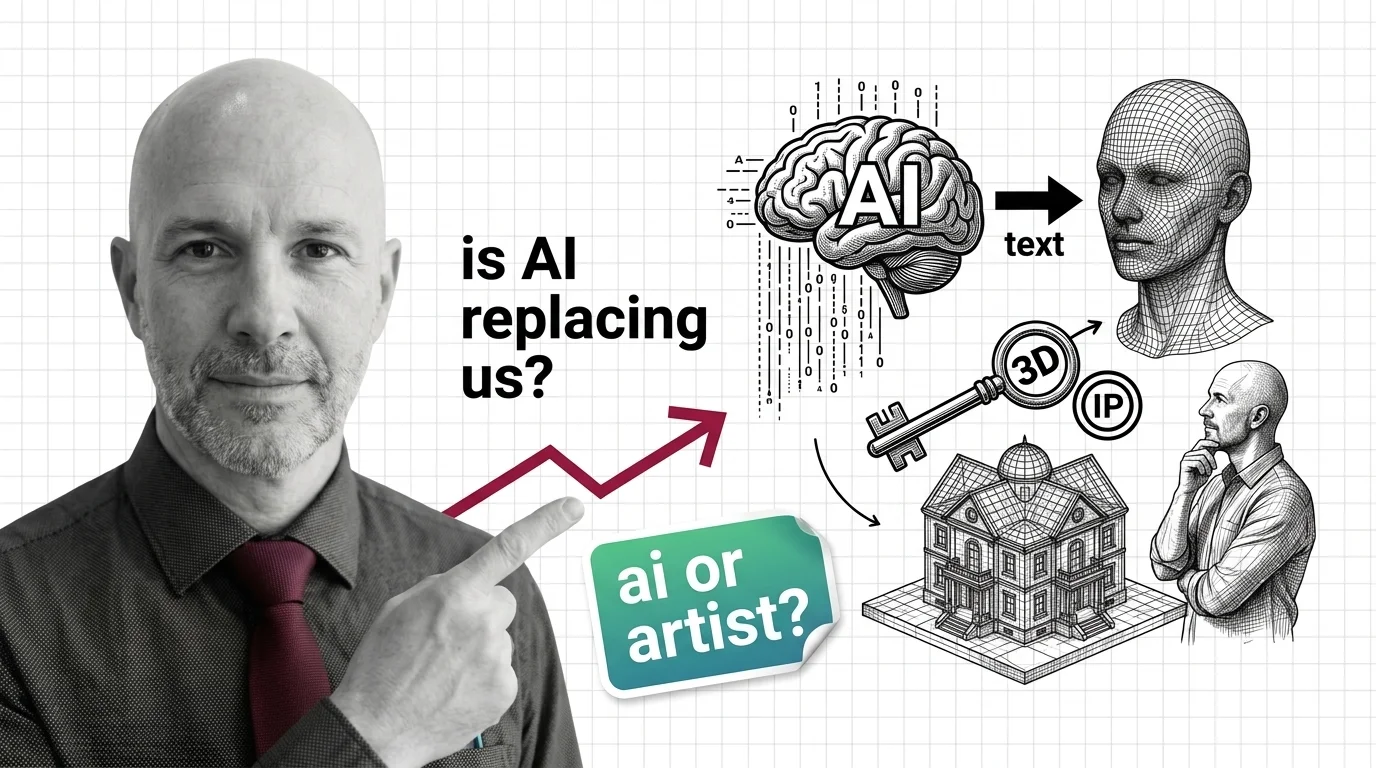
The Hard Truth
The pipeline ingests eight hundred thousand 3D models made by human hands, trains itself on the accumulated craft of thousands of artists, and then sells the product back to the same industry that employed those artists. The Copyright Office has confirmed the output is not copyrightable. So who owns the labor that made the machine possible?
Copyright law, it turns out, was never really about fairness. It was about incentives — a bargain the state made with creators to produce enough content that society could eventually inherit it. What happens when the thing that produces content at scale was never a party to that bargain?
The Question Nobody Wants to Ask
The argument that Text-to-3D represents creative progress rests on a particular reading of what a tool is. A chisel does not know the sculptor’s intent. Neither does Photoshop. The claim — stated or implied in almost every industry announcement — is that generative AI is simply a more sophisticated instrument, and that the creative intention that matters belongs to whoever types the prompt.
The question this framing avoids is not whether the technology works. It is what it was built from, and whether the people it was built from have any claim on what it produces.
What the Industry Believes, and Why
The conventional reading is coherent, and it deserves to be understood at its strongest rather than dismissed. Thoughtful people in the creative technology sector argue that AI-generated 3D content is a genuinely democratizing development — that indie developers, architects, educators, and small game studios who could never staff a 3D art team now have access to production-quality geometry in seconds. The barrier to entry for visualizing ideas in three dimensions has dropped from thousands of dollars and months of training to a single prompt.
There is also a precedent argument. Photography displaced portrait painters. Digital audio workstations displaced session musicians for certain kinds of work. 3D modeling software displaced illustrators who previously built physical maquettes. Each disruption was painful for the people displaced, and each ultimately expanded the total creative economy by lowering the cost of the medium. The assumption embedded here is that this transition follows the same curve — that the artists who master AI-assisted workflows will command more, not less, than before.
The indie developer typing “low-poly medieval castle, weathered stone, PBR Materials” into a text-to-3D tool is, in this reading, the author — just as a photographer is the author of an image even though the camera manufacturer built the mechanism that recorded light. The tool is the tool. The creative decision is what matters.
The Craft That Became Training Data
The discomfort begins when you look at where these models learned.
Objaverse, one of the most widely used 3D training datasets, contains over 800,000 models scraped from Sketchfab before the platform introduced a NoAI tag in February 2023, according to The Decoder. The artists who uploaded those models were not informed. Some of those models carry explicit NoAI flags. Some were copyrighted uploads. Training happened before consent was possible.
The conventional wisdom will point out that scraped data for machine learning has legal precedent behind it in the United States — the fair use doctrine has been tested in image generation cases, and the Copyright Office Part 3 analysis on training data and fair use, pre-released in May 2025, does not yet settle this definitively (Copyright Office). So the argument goes: the use was lawful, or at least not clearly unlawful, and legal use cannot be morally suspect by definition.
That argument mistakes legal permission for moral permission. We have been down this road before. Legal structures routinely lag behind the economic reality they are supposed to govern — and the gap between “not yet illegal” and “acceptable” is exactly where the ethical work lives.
The geometry of a detailed organic mesh — the Mesh Topology decisions that make a character deformable, the UV Mapping that lets a texture land without distortion — these are not raw materials extracted from nature. They are accumulated judgment. When that judgment is extracted, averaged, and sold back as automation, the people whose work fed the system do not share in the return.
The Hidden Assumption Inside the “Tool” Argument
Here is what the tool argument quietly assumes: that there is no meaningful difference between instrumentalizing an inanimate process and instrumentalizing the accumulated output of other people’s creative labor.
A camera records light. A text-to-3D system records — and compresses — decades of human decisions about how geometry should look, how PBR materials should behave, how Multiview Diffusion across viewpoints should reconcile into a coherent object. The “tool” is not neutral in the way a hammer is neutral. It is the distillation of a workforce, trained on that workforce’s output, and now positioned to replace a portion of it.
The Copyright Office recognized this asymmetry, if not in those terms. Its Part 2 report, published January 29, 2025, found that wholly AI-generated 3D models are not copyrightable — prompts alone are insufficient for human authorship (Copyright Office Part 2 Report). This is almost certainly correct as a legal matter. But notice what it leaves unresolved: the question of who bears the cost of a system that produces un-ownable outputs built on ownable inputs.
What the Statistics Cannot Tell You
Ask about displacement and you are quickly handed numbers. Surveys of entertainment studios suggest a significant majority have reduced or eliminated roles after introducing AI tools (Bolt Renders). Surveys of artists suggest the great majority feel they have lost commissions or career opportunities to AI tools — though these figures come from general AI art surveys, not 3D-specific peer-reviewed research, and should be read with that qualification in mind (Blood in the Machine). Research from Anthropic on labor market impacts found the job-finding rate for workers aged 22 to 25 in AI-exposed occupations fell roughly fourteen percent following the introduction of large language models, though that figure covers many professions, not 3D artists specifically (Anthropic Research).
What the statistics cannot tell you is whether this is displacement or transition. Every major automation event in industrial history came with exactly this ambiguity — textile workers displaced by looms were told they would find better work, and some did, eventually, in different industries and in different lifetimes. The statistics measuring “how many got better jobs” and “how many were just left behind” tend to be collected decades later, when the people most affected are no longer in a position to make noise.
There is also something specific to creative work that aggregate labor statistics miss. The entry-level 3D roles most at risk from AI — background props, simple hard-surface objects, stock asset libraries — are the same roles that trained the artists who now do higher-complexity work. Eliminating the bottom rung does not just reduce headcount; it closes the pathway.
A junior artist building game-ready background foliage is not just filling an economic niche. They are acquiring the tacit knowledge about UV mapping efficiency, about what fails in a game engine, about the way mesh topology has to be planned before sculpting begins — that cannot be taught in a classroom and cannot be learned by typing prompts. If those roles disappear, what they produce is recoverable by AI. What they teach is not.
Seeing the Problem Through a Different Frame
Intellectual property law was designed to balance private incentive against public benefit. It gives creators a temporary monopoly so they will create, then returns the work to the commons so society can build on it. The calculation always involves two parties: the creator and the eventual public.
Text-to-3D systems insert a third party: the platform that harvests the creators’ output before the public ever inherits it, commodifies it at speed, and captures the economic surplus before the original creators see any of it.
This is not new. We have seen a version of this with music streaming — where the nominal “democratization of distribution” compressed per-stream payments to fractions of a cent while catalog owners and platform investors captured the value. The difference with generative 3D is that the compression does not just affect distribution. It affects production itself: the AI system that trained on artists’ work can now produce a reasonable substitute for certain categories of that work, at a cost approaching zero, without any ongoing relationship with those artists.
The legal question of whether NeRF-based or Gaussian Splatting-derived outputs constitute infringement on source models remains genuinely unresolved. Adjacent litigation in AI music copyright — the Suno case has a summary judgment hearing scheduled for July 2026 — may eventually provide precedent, but the 3D domain has its own technical complexities: Score Distillation Sampling and multiview diffusion operate at a different remove from source material than pixel-level image diffusion (VLP Law Group). The Image-to-3D reconstruction pathway is closer to the source than text-to-3D, but both raise questions the courts have not yet answered.
The ethics of AI-generated 3D content cannot be resolved by copyright law alone, because the deepest harm is not infringement — it is the uncompensated extraction of accumulated craft from people who had no mechanism to refuse.
The argument here is not that AI-generated 3D content is inherently harmful, or that the tools should not exist. 3D reconstruction capabilities that once required expensive photogrammetry rigs can now run on a phone. Indie developers who could never afford a dedicated asset team now have access to production-quality geometry. These are real gains. The question is not whether the gains exist but who pays for them, and whether “the market settled it” is an adequate answer to that question.
Questions Worth Sitting With
If the harm here is real — if the extraction of accumulated craft without consent or compensation is an ethical problem and not merely a legal one — then the question that follows is who should do something about it. The artist who posted their model to Sketchfab in 2021 has no practical recourse now that the dataset exists. The platform that hosted the models settled no obligations with contributors when it allowed scraping. The companies that built models on Objaverse face no established mechanism for retroactive licensing at scale.
Collective licensing schemes exist in other creative industries — the performing rights organizations that collect royalties for music, the resale royalty rights that give visual artists a share of secondary market gains in some jurisdictions. These mechanisms are imperfect and often underpay. But they exist because at some point, the argument that “creators should be compensated for derivative use” became sufficiently mainstream that legislators or industry coalitions moved to encode it. No equivalent mechanism yet exists for 3D training data, and it is not clear whether one can be designed at the scale these datasets operate.
What would it mean for a text-to-3D company to have an ethical relationship with the people whose work trained its model? Is it enough to pay into a general artist support fund? Is per-model attribution feasible at 800,000 models? Is there a minimum threshold of modification at which the model’s 3D reconstruction process becomes sufficiently removed from source that no obligation persists? These are not rhetorical questions. They are engineering and policy problems that nobody has been asked to solve, because the framing that prevails treats them as already settled.
Where This Argument Is Weakest
I should be honest about where this position bends under pressure.
The “extraction without consent” argument is strongest when applied to clearly identifiable creative work — a character sculpt, a distinctive prop design, a recognizable style. It weakens significantly when applied to the general spatial intuitions baked into a large 3D model dataset: the physics of how metal reflects light, the standard topology conventions for facial animation, the geometry of a door hinge. At some point the “learned knowledge” in a model is indistinguishable from what any trained 3D artist absorbs by working in the field. If a human artist can learn from studying others’ models and then make their own, the ethical line between human learning and machine learning becomes genuinely hard to locate.
There is also a version of this future that is not zero-sum. If markets for high-skill creative work grow as access to basic 3D assets becomes cheaper — if the democratization of asset creation genuinely expands what gets built, rather than simply cutting labor costs for incumbent studios — then some of the displacement at the entry level is offset by growth at the creative frontier. That has happened before, and it might happen again. I am skeptical that it happens automatically, or equitably, or quickly enough to matter for the people currently losing commissions. But it would make me wrong to pretend the evidence is fully settled.
The Question That Remains
The question is not whether a machine can make a 3D model. We have settled that. The question is whether the people whose work taught the machine to make it have any legitimate claim on what it produces — and if not, whether the ethical framework we use to answer that question is adequate to the world it is now governing.
The Copyright Office drew a boundary at human authorship. The labor economists are drawing one at market outcomes. Neither answer tells us anything about accountability. And accountability is the question that gets harder, not easier, the longer we avoid it.
AI-assisted content, human-reviewed. Images AI-generated. Editorial Standards · Our Editors