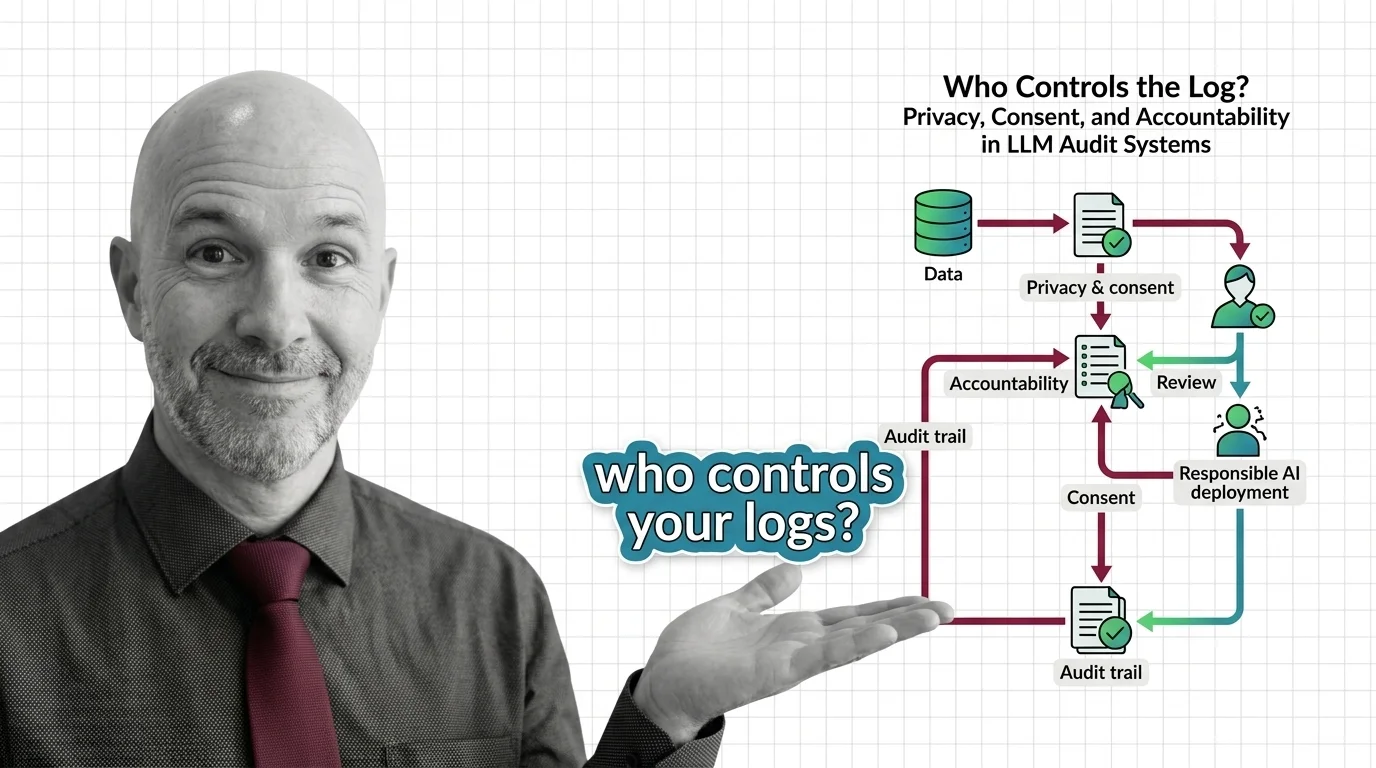
Who Controls the Log? Privacy, Consent, and Accountability in LLM Audit Systems
The Hard Truth
Every production LLM deployment ships with a logging layer. The documentation calls it observability. The compliance teams call it auditability. Nobody calls it what it also is: a record of every question your employees were afraid to ask their manager.
The debate about LLM Logging And Auditing usually concerns what to capture — token counts, latency, model versions, system prompt hashes. Rarely does anyone ask the second question: once captured, whose interests does that log serve? The person who typed the query, or the organization that processes it?
The Architecture of Observation
The logging question in enterprise AI deployments gets answered technically before it is asked ethically. Organizations build logging infrastructure to satisfy their observability platforms, their cost monitoring dashboards, and their Audit Trail requirements. These are legitimate purposes. But embedded in the technical decision is a social decision nobody announced: from this point forward, we will record what each person asks the AI.
That choice has a name in other contexts. In healthcare, it’s a medical record — governed by strict access controls, retention limits, and patient rights. In the workplace, it falls under the evolving and contested terrain of employee monitoring law. What makes the LLM audit log interesting — and uncomfortable — is that it arrives not as a surveillance system but as infrastructure, which is perhaps the most effective way to make a contested decision invisible.
What are the ethical risks of logging user prompts in production LLM applications? The surface-level answer points to PII Redaction failures, credential leaks, and data exposure. The OWASP Top 10 for LLM Applications 2025 identifies Sensitive Information Disclosure — LLMs exposing PII, financial records, health data, and credentials through logs and outputs — as a recognized production risk (OWASP). That answer is accurate. But the deeper concern is not that sensitive data leaks outward. It’s that the log itself — the complete behavioral record of how each person interacts with AI — becomes an instrument of a different kind of oversight than the one originally justified.
The Accountability Imperative
The case for Structured Logging in LLM deployments is genuine, and it deserves to be made honestly before it is challenged.
NIST’s AI Risk Management Framework 1.0 identifies traceability as a core characteristic of trustworthy AI: records must support oversight and investigation throughout the AI lifecycle. The EU AI Act’s Article 12 requires providers of high-risk AI systems to build in automatic logging covering events relevant to risk identification and operational oversight; Article 26 extends the obligation to deployers, requiring log retention for at least six months (EU AI Act Art. 12). Without LLM Observability, the promises of responsible AI remain unverifiable. When something goes wrong — and in systems operating at scale, something always does — the audit trail is the mechanism through which accountability becomes possible.
Invisible systems are unaccountable ones. If a logging infrastructure reveals that a model consistently produces lower-quality responses for certain categories of queries or users, that finding serves the people the AI is supposed to serve — not only the people running it. The conventional wisdom, at its strongest, holds that comprehensive logging is not surveillance. It is the minimum condition for trustworthiness.
The Alignment Nobody Tested
The steelman is correct. And it carries an assumption so embedded in its framing that it is nearly invisible: that the interests of the organization running the audit trail and the interests of the person whose queries are captured naturally align.
They do not.
Research examining audit trails in large language model deployments finds a structural tension at the core of the practice. Comprehensive documentation serves accountability. Comprehensive documentation also creates exposure — for the person being documented (Ojewale et al. 2026). These two things are in genuine competition, and the conventional wisdom rarely surfaces which side of that competition gets prioritized first.
When an employee uses an enterprise LLM to explore something they are uncertain about — a question about their job security, a health concern they haven’t disclosed elsewhere, a management decision they are quietly weighing — they may approach the exchange the way they’d approach a private browser search, assuming an ephemerality that does not exist. The log persists. It knows what was asked, when, and if the LLM Cost Management infrastructure captures session metadata, how many times the same topic was revisited. That behavioral pattern is a signal of a different character than a simple query — it is a cognitive fingerprint of professional and personal state.
The question nobody asks when architecting the logging layer is this: have we told people clearly what is being captured, and have we genuinely considered what the aggregate of that capture reveals about the people generating it?
What Labor Law Already Learned
German employment law offers an instructive parallel. The Betriebsverfassungsgesetz — the works council framework — requires the Betriebsrat’s approval before any employee monitoring system is put into use; the works council holds effective blocking power over implementations (eMonitor). This is not administrative formality. It is a legal recognition that the power asymmetry between employer and employee makes certain monitoring arrangements structurally coercive, and that worker representation must function as a counterweight to unilateral implementation.
The GDPR reaches a similar conclusion about consent in employment contexts. The European Data Protection Board’s position is that employee consent is not freely given — and therefore not a valid legal basis for workplace monitoring — because the power imbalance makes genuinely voluntary agreement structurally impossible (IAPP). This is not a technicality. It reflects a substantive ethical claim: that consent cannot be the mechanism that legitimizes the collection of detailed behavioral data from people who cannot realistically refuse.
Does storing employee LLM conversation logs comply with GDPR and the EU AI Act? The answer is conditional on classification, design, and process — not on deployment alone. Internal enterprise LLM tools may or may not qualify as high-risk under the EU AI Act’s Annex III, which determines whether Article 12’s automatic logging obligations apply. Where systematic individual tracking occurs, a Data Protection Impact Assessment under GDPR Article 35 is the starting point, not the finishing line. And the interaction between the right to erasure under Article 17 and mandatory audit retention obligations remains an area where no data protection authority has yet issued definitive guidance (GDPR Text). The regulations are moving — the EU AI Act’s full enforcement date for high-risk AI obligations is August 2, 2026 — and organizations implementing logging architectures now are doing so in advance of the final regulatory picture.
The Log Serves Someone
Thesis: The ethical question of LLM audit logging is not whether to log — it is whose interests the logging architecture is designed to serve, and that design choice is almost never made explicit.
Logging infrastructure is not neutral. Every decision — what to capture, how long to retain it, who can query it, what access controls govern retrieval — is a decision about power. Most enterprise implementations make those decisions by convention: copying vendor configurations, satisfying the minimum requirements of applicable regulation, and treating the result as a solved problem. The philosophical question — who is this log for? — goes unasked.
A log designed primarily to serve the people being monitored looks different from a log designed primarily to serve the organization monitoring them. Privacy by design applied to LLM audit logging would produce architectures with genuine purpose limitation, meaningful data minimization, clear retention schedules with enforced deletion, and mechanisms that reveal what the log has been accessed for — not only what it contains. The distance between that architecture and a default-everything logging configuration is not a technical gap. It is a values gap, and it is being decided, implicitly, every time an organization chooses a vendor’s default settings and moves on.
Living Inside the Observation
There is a specific form of epistemic unfairness in asymmetric observation. The person being logged does not know what signals the aggregate encodes about them. The person with access can draw inferences the logged person would never anticipate — behavioral analytics applied to query logs can reveal how individuals use AI systems, what they are uncertain about, where they return repeatedly, which topics they approach obliquely rather than directly. These are cognitive and professional fingerprints. They are invisible to the person generating them.
The infrastructure making this kind of analysis possible is itself in flux. The market for LLM observability platforms has been consolidating — through acquisitions in early 2026 that affect questions of data residency, vendor access, and contractual controls over retention. Organizations building on third-party logging platforms carry a dependency that most procurement processes have not mapped: the entity holding your employees’ behavioral data may look quite different eighteen months from now than it does today.
Who bears responsibility when the log is accessed for purposes beyond those that originally justified its collection — the engineer who built the pipeline, the manager who approved the vendor, or the compliance team that confirmed the legal basis and moved on?
Where Comprehensive Logging Becomes the Right Answer
The argument above, taken to its extreme, would produce logging systems too minimal to serve legitimate accountability functions. A system that captures nothing cannot demonstrate fair operation, cannot support post-incident investigation, and cannot fulfill the genuine obligations that regulation places on organizations running AI in high-stakes contexts. The tension between accountability and privacy is real, and privacy concerns, if they prevail absolutely, produce their own form of harm: systems that cannot be scrutinized when they fail.
The argument is also conditioned on a gap that may not be permanent. If organizations were routinely consulting affected employees before implementing monitoring infrastructure, building logging architectures with genuine data minimization, and establishing access controls that prevent query logs from being repurposed beyond their original justification — the ethical concern would shift. Evidence of that practice does not currently characterize the field. If it did, this argument would need to change.
The Question That Remains
The architecture of observation gets decided before anyone asks whether it was the right architecture. The log exists before anyone examines whose interests shaped it. And the person whose thinking it captures — question by question, uncertainty by uncertainty — is almost always the last to know what the log says about them.
Who controls the log? Right now, mostly the person who built the system. That may be adequate. But it is not yet a deliberate choice. It is a default. And defaults, left unexamined, become the world the people inside them are expected to accept.
AI-assisted content, human-reviewed. Images AI-generated. Editorial Standards · Our Editors