When Orchestration Hides the Failure: Accountability Gaps in Automated AI Workflows
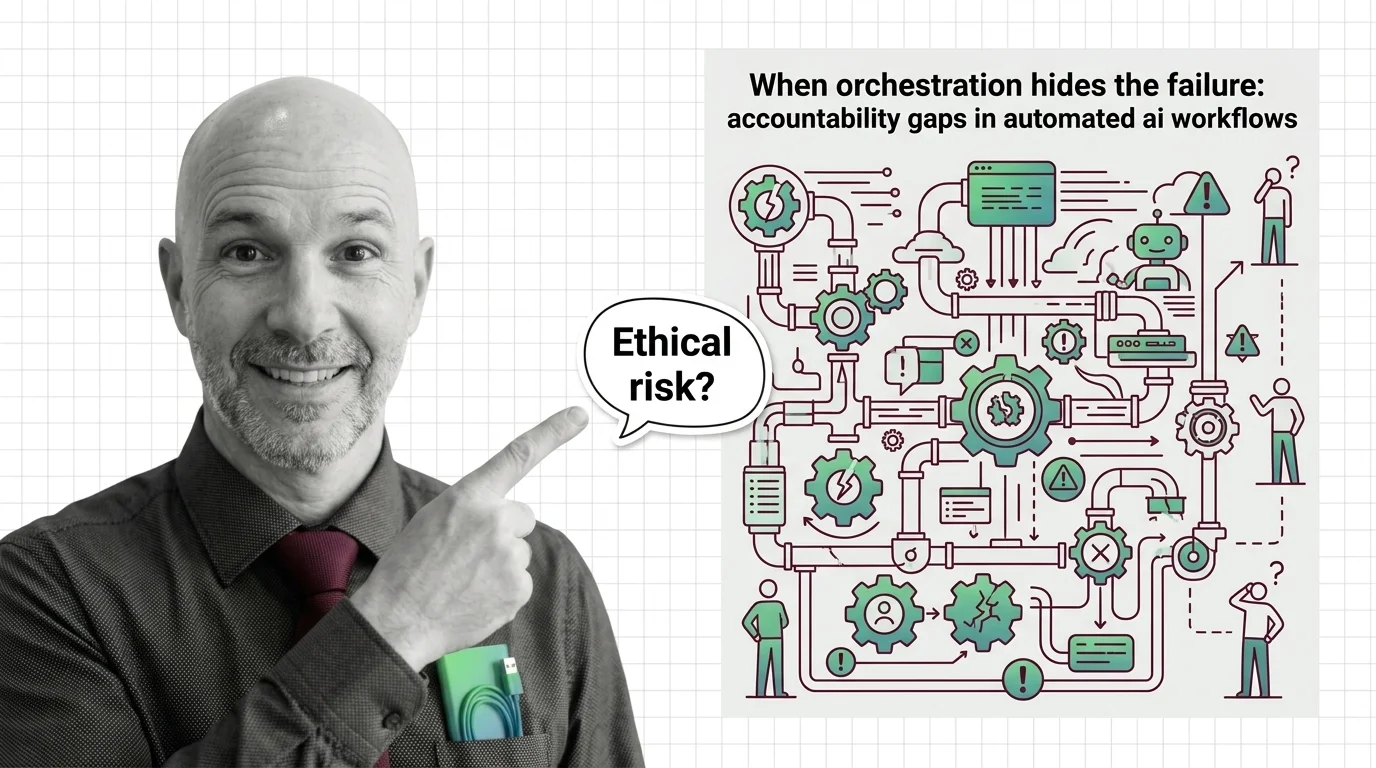
The Hard Truth
A workflow returns HTTP 200. The dashboard is green. Latency is within range. And somewhere inside that smooth signal, an autonomous agent has been looping on the same step for forty minutes, generating contaminated outputs that look exactly like good ones. Who is accountable when the system never admits it failed?
When industrial automation broke in the twentieth century, sirens went off. Pipes burst. Production lines stopped. The failure announced itself. Workflow Orchestration For AI has inherited the language of pipelines and DAGs but not their honesty — modern AI orchestrators can fail silently, at full throughput, with every health check still glowing green. That is a new category of failure, and the institutions we have built to assign responsibility were not designed to see it.
The Failures That Never Trip an Alarm
The conventional story about AI risk centers on dramatic moments — the model says something racist, the agent makes a wild purchase, the chatbot promises a refund it cannot deliver. Those stories matter. But they distract from a quieter failure mode that is harder to name and far harder to govern: workflows that perform exactly as engineered, return exactly the response shapes their consumers expect, and silently distort reality at scale.
In January 2026, a power outage in San Francisco stranded Waymo robotaxis at intersections, blocking emergency vehicles. The vehicles did not malfunction in any classical sense — they followed their orchestration logic to its conclusion. The failure was governance: nobody had specified what the fleet should do when the city itself went dark (CloudEagle). The same month, Amazon’s Alexa+ agentic mode began executing unintended purchases and device activations triggered by ambient audio. The agent worked. The orchestration worked. The accountability layer did not.
So the question we are not asking is not whether AI fails — it does, and it will keep doing so. The question is: when an orchestrated workflow fails without breaking, who is responsible for noticing?
The Steelman for Trusting the Stack
Let me give the conventional defense its strongest form before disagreeing with it. The argument for trusting modern orchestration goes something like this: we have decades of inheritance from Airflow, Temporal, and Prefect, and we have learned how to make distributed systems observable. We have APM tools, structured logs, distributed tracing. We have SRE practice, runbooks, postmortems. And in 2026, mature LLM-aware orchestration like LangGraph 1.x offers deterministic control flow with persistent checkpointing — the audit trail that earlier agent frameworks never had (Redwerk).
This is a serious position, and it is not wrong. The tooling has improved. Governance bodies have caught up — at least on paper. The EU AI Act’s Article 14 sets a compliance deadline of August 2, 2026 for human oversight in high-risk systems, and recognizes three legitimate modes: human-in-the-loop, human-on-the-loop, and human-in-command (EU AI Act). OWASP’s 2026 Top 10 for Agentic Applications names logging, non-repudiation, and decision-path observability as required controls (OWASP Gen AI). The scaffolding for responsible orchestration exists.
But scaffolding is not a building. And the conventional optimism elides the part that matters most.
The Assumption That Errors Announce Themselves
The hidden assumption inside the engineering defense is that failures, when they occur, will produce signals — a stack trace, a 500 status, a timeout, a circuit breaker tripping. That assumption is structural to how we built modern observability. Application Performance Monitoring evolved to catch failures that look like failures. It was never designed to catch a healthy-looking system that is quietly wrong.
A poorly defined agent task can produce an agent that loops on the same step without progress, returning to its orchestrator at the expected cadence with answers that satisfy the response schema. Looping or hallucinating agents still return HTTP 200 within normal latency, so traditional APM reports a healthy system while output quality silently degrades (Braintrust). The metrics we trust were calibrated for a different category of failure. They cannot see this one.
That blindness compounds when agents call other agents. A failure at any step propagates through the chain before human operators detect it, and cascades move faster than traditional incident response (Baker Botts). By the time someone notices, the contaminated output has already crossed three system boundaries and reached a customer who had no idea any of this was happening.
From Mechanical Accidents to Bureaucratic Errors
The closest historical parallel to this kind of failure is not the industrial accident — the bursting boiler, the snapped cable. It is the bureaucratic error. A bureaucracy can process millions of cases correctly and a hundred cases wrongly, and the failure mode is not that the institution stops working. The institution keeps working. It just produces consistently wrong outputs for the people unlucky enough to fall into the misclassified bucket.
For most of the twentieth century, we built mechanisms — administrative law, ombudspersons, appeal boards, freedom-of-information acts — that gave wronged individuals a way to surface decisions that looked routine from the inside but were destructive from the outside. The lesson encoded in those institutions is uncomfortable: when failure is invisible to the operator, accountability cannot live with the operator alone. It has to live with someone outside the loop, with the standing to ask questions the operator cannot answer.
That is the layer modern orchestration has not yet built. We have the operational tooling — checkpointing, replay, audit logs. We do not yet have the institutional capacity to act on what those tools surface.
Why Silent Failures Cannot Be Engineered Away
Thesis: Workflow orchestration creates an accountability gap that no internal engineering practice, however disciplined, can close on its own — because the failures it produces are invisible by design, and the people best positioned to notice them are the people the system has chosen not to consult.
The framing that orchestration is a technical problem with a technical solution rests on a category error. The deterministic control flow in LangGraph, the durable execution in Temporal, the audit trails layered on top of both — these are genuinely valuable. They make some failures recoverable that were previously catastrophic. But they do not, and cannot, identify which outputs are quietly wrong. That requires a judgment external to the system. It requires someone with the standing to say: “This answer looks fine to your validator, but it is wrong to the person who received it.”
A January 2026 industry survey found that 41% of organizations have agentic AI in operations while only 27% report mature governance (Squirro). Gartner projects that more than 40% of agentic AI projects will be scrapped by 2027 due to control and compliance failures — a forecast, not a measurement (CloudEagle). Industry estimates suggest each uncontrolled automation failure in regulated systems costs more than $4 million per incident (Analytics Insight), though the methodology behind that figure is opaque. The numbers move; the direction is consistent. Adoption is outpacing accountability faster than the governance layer is being built to catch it.
What We Owe the People in the Wrong Bucket
So what do we do — not as engineers patching a system, but as a society negotiating what we are willing to delegate?
The most useful work emerging this year does not try to make AI workflows fail loudly. It tries to make them answerable. Article 14’s two-natural-persons rule for biometric identification systems is one such mechanism — an admission that some decisions are too consequential for any single human reviewer, let alone any single agent (EU AI Act). The OWASP 2026 controls for tool-invocation auditing are another — they presume that someone outside the orchestration loop will eventually need to reconstruct what the system did, and why (OWASP Gen AI).
These are partial moves. They do not solve the silent-failure problem. They do something more modest and more honest: they create a record that an outside party can later interrogate. Whether that outside party exists, with the mandate and the technical capacity to act on the record, is not an engineering question. It is a political one.
Where This Argument Bends
The argument here is weakest at the boundary where governance and engineering meet honestly. If deterministic checkpointing, paired with durable execution and rigorous external red-teaming, becomes the default for high-stakes orchestration, the silent-failure category will shrink. Not vanish — shrink. Some of what I have described as a structural accountability gap is, in 2026, a maturity gap that the better tooling is actively closing. If the trajectory I am betting against turns out to be the trajectory we are on, the argument here will look overstated in five years.
The Question That Remains
The orchestration layer is becoming the place where consequential decisions happen most quietly. When the workflow stays green and the customer is harmed anyway, who has the standing to ask why — and who is obligated to answer?
AI-assisted content, human-reviewed. Images AI-generated. Editorial Standards · Our Editors