When AI Docs Lie: Hallucinated APIs, Stale Examples, and the Accountability Gap
The Hard Truth
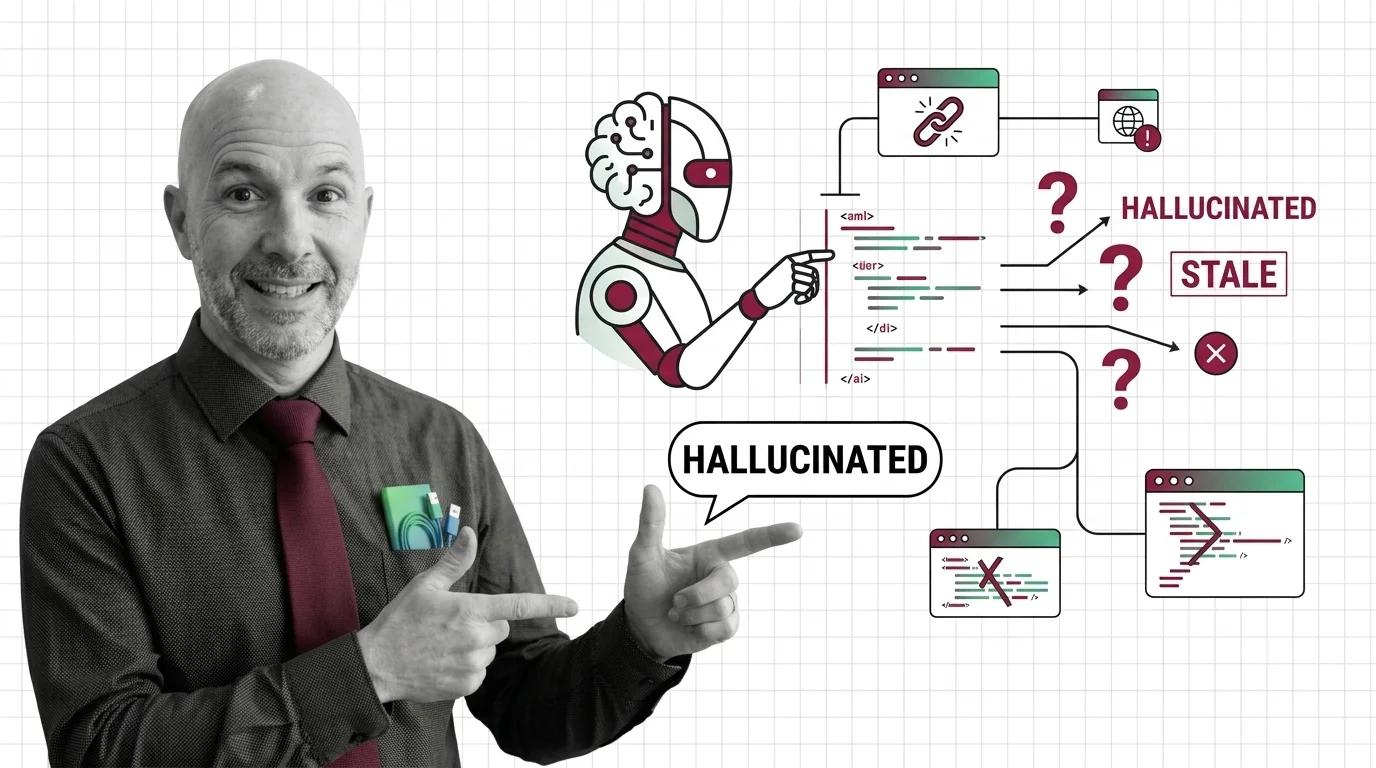
When a generated README confidently invents a function that does not exist, a maintainer who never wrote it is now blamed for misleading users. Who, exactly, owes the reader the truth — the model, the team that shipped the docs, or the company that monetized the speed?
For most of computing history, documentation was a slow human craft — written by the engineer closest to the code, reviewed by peers, signed in plain sight. That contract is quietly dissolving. The newest layer of AI Documentation Generation tooling drafts entire reference pages from source trees, opens pull requests against repositories overnight, and ships answers to questions developers never explicitly asked. The speed is real. The accountability is not.
The Question Nobody In Engineering Wants To Answer
When generated documentation describes an endpoint that does not exist, a parameter that was renamed two releases ago, or an install command for a package that was never published — who carries that mistake? The model vendor disclaims it in the terms of service. The maintainer who clicked “merge” did not write the prose. The reader who trusted the page has no relationship with either party. The mistake is real, the harm is real, and yet the responsibility floats in a kind of institutional vacuum.
This is not an abstract worry. The Spracklen et al. analysis, published at USENIX Security 2025, found that roughly one in five packages recommended in LLM code suggestions does not exist — and that nearly half of those hallucinations recur on every re-run of the same prompt. The fabrication is not random noise. It is a stable, repeatable signal that the model treats as truth. When that signal is then poured into auto-generated docs, the lie acquires the authority of a published reference.
What The Conventional Wisdom Gets Right
The case for AI-generated documentation is genuinely strong, and any honest critique has to acknowledge it. Documentation has always lagged code. A 2025 study from GetDX reports that engineering teams spend three to ten hours per week searching for answers that should already be documented, and that new hires take two to three months longer to ramp on systems with stale internal docs. Engineers do not avoid writing documentation because they are lazy. They avoid it because the incentive structure punishes it. Performance reviews reward shipped features. They rarely reward the patient prose that lets a stranger understand the system three years later.
Into that vacuum, tools like Mintlify, Swimm, and the documentation features inside AI Code Completion suites offer something genuinely useful: continuous, code-coupled prose that updates as the source changes. Swimm couples documentation snippets to specific code regions and flags them when the underlying code moves. Mintlify parses ASTs and writes reference pages that mirror the actual function signatures. The intent is honorable. The execution sometimes is too.
But honorable intent and honest output are not the same thing.
The Hidden Assumption Inside Every Generated Page
The conventional defense of these tools rests on a quiet assumption: that the human reviewer in the loop will catch errors before publication. This assumption is the load-bearing wall of the entire arrangement, and it is structurally weak. Reviewing generated prose for factual accuracy is fundamentally harder than writing the prose from scratch. The reviewer must mentally reconstruct what the function actually does, then compare it against fluent text that already sounds correct. The mind resists this. Plausible prose suppresses doubt. A subtly wrong example feels true because it parses.
The Help Net Security report on slopsquatting — a term coined in April 2025 by the Python Software Foundation’s Seth Larson — documented a real-world case where Lasso Security registered a hallucinated huggingface-cli package on PyPI. Within three months, it had been downloaded more than thirty thousand times. Nobody intervened. The hallucination became infrastructure, and readers absorb the silent cost.
This is the structural failure mode. Generated documentation does not fail loudly. It fails quietly, plausibly, and at the scale of distribution.
A Different History Tells A Different Story
There is a useful parallel from another domain. In medicine, when clinical documentation systems began auto-populating patient notes, the profession did not pretend the technology was neutral. Liability frameworks were extended — the Shared Accountability Addendum, professional indemnity carriers, clear chains of responsibility. The physician who signed the note remained the one accountable for what it said, regardless of who or what drafted it. The signature carried weight because the law required it to.
Software engineering has no equivalent. There is no signed attestation on a generated README. There is no professional body that revokes a license when fabricated APIs ship under your name. The EU AI Act, as analyzed in the Secure Privacy 2026 governance overview, imposes documentation and transparency obligations on high-risk systems — but most developer documentation is not classified high-risk, and the obligations stop at the system boundary. The reader of a generated page is outside that boundary. They are, in the eyes of every existing framework, on their own.
This article presents an ethical and social perspective on the issue, not legal analysis. Contact a qualified lawyer for legal advice.
The Thesis This Argument Builds Toward
Thesis: The ethical risk of AI-generated documentation is not that it sometimes hallucinates — it is that the speed of generation has outrun the institutional mechanisms that traditionally bound a written claim to a human who could be held to it.
Every previous wave of automated content — autocomplete, suggestion engines, even early AI Code Review systems — sat inside a human review loop that the technology could not outpace. The reviewer was the bottleneck, but the bottleneck was also the accountability layer. The current generation of doc tools removes that layer not by malice but by velocity. A team that ships fifty pages of generated reference per week cannot review them the way they reviewed two pages per week. The math does not work. The accountability layer was load-bearing, and it has been removed in the name of productivity.
OWASP recognized this shift formally in 2025, renaming what had been “Overreliance” in its LLM Top 10 to “Misinformation” (LLM09:2025) and reclassifying hallucination as a security risk rather than a quality issue. The framing matters. Quality is something a team improves over time. A security risk demands a control. The vocabulary has caught up; the institutional practice has not.
The Questions We Owe Ourselves Before The Next Release
What would it mean to treat a generated documentation page as a published claim with an accountable signer? Would teams still publish at the current velocity? Probably not. Would they catch more errors? Almost certainly. The question is whether we believe accuracy is worth the slowdown — and whether the absence of a clear signer is a feature of the new workflow or a failure of imagination.
There is also a quieter question. When generated docs become the primary surface through which developers learn an API — through AI Test Generation examples, through AI-Assisted Debugging suggestions that quote the docs back, through AI-Assisted Refactoring that treats the prose as ground truth — the documentation stops being a description of the system. It becomes the system, in the only form most users ever touch. A fabrication in that surface is not a typo. It is a small distortion of reality, distributed at the speed of CI.
Where This Argument Is Weakest
The strongest counter to this position is empirical. The Digital Applied 2026 benchmark study reports frontier-model hallucination rates ranging from roughly three to nineteen percent depending on the model and task, and the trajectory is downward. If hallucination becomes vanishingly rare, the accountability question becomes less urgent — not because it is resolved, but because the failure mode becomes statistically negligible. A second counter: human-written docs are not error-free either. Stack Overflow is a museum of wrong answers that worked anyway. If generated docs are merely worse than perfect rather than worse than human, the case for slowing them down weakens.
I do not find these counters fully persuasive, but they are honest, and a thoughtful reader should weigh them.
The Question That Remains
The accountability gap in auto-generated documentation is not a technical bug — it is a missing institution. The tools are not going away. The question is whether the profession will build a culture of signed authorship for generated prose before a class of harm makes regulators do it instead.
AI-assisted content, human-reviewed. Images AI-generated. Editorial Standards · Our Editors