What Is Voice Cloning and How Zero-Shot Models Reproduce a Speaker's Voice from Audio
ELI5
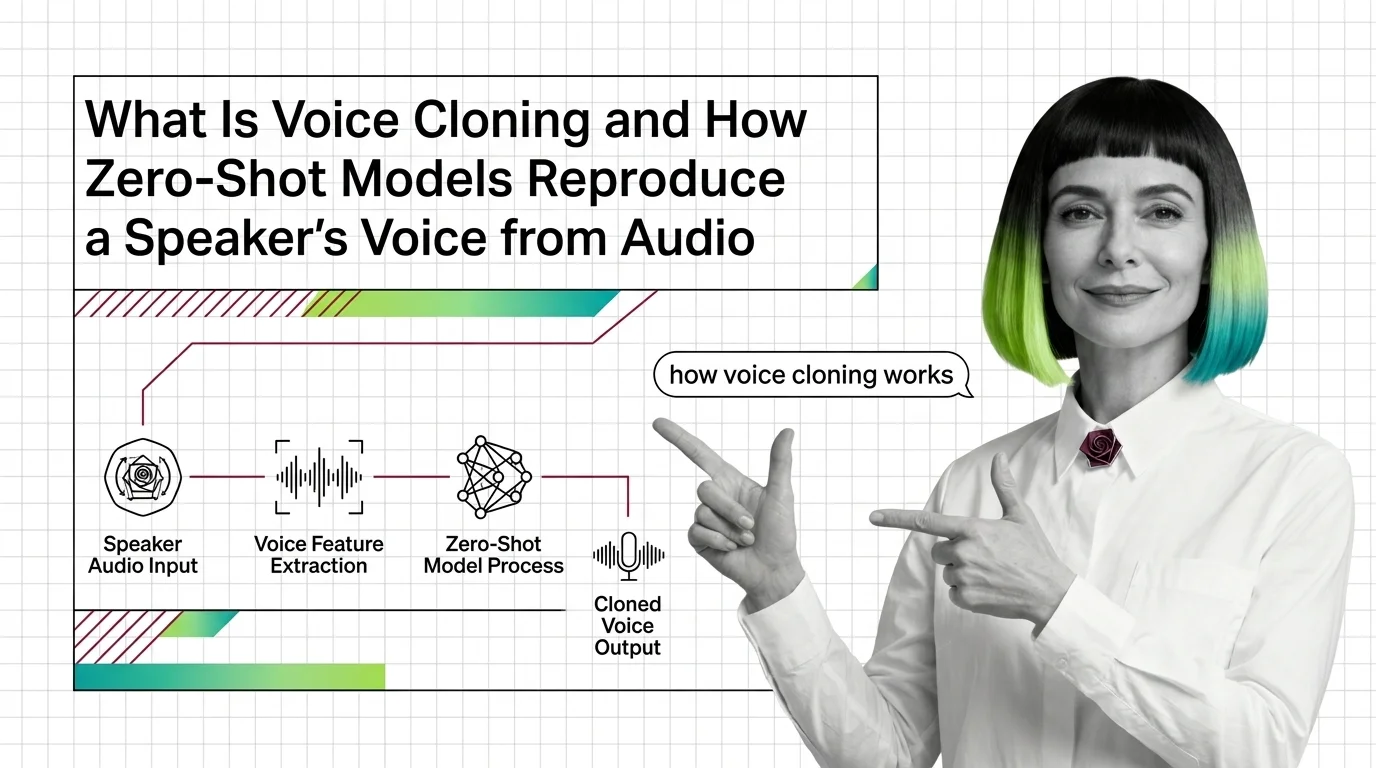
Voice cloning takes a short recording of someone speaking and uses it to make an AI speak in that same voice — without retraining the model. Newer systems need as little as six seconds of audio to do this.
The strange thing about voice cloning is not that it works. It’s that it works with so little input. Six seconds. Ten seconds. A clip recorded on a phone in a noisy kitchen. From that, a model produces speech that sounds like the person who recorded it — the same Prosody, the same resonance, the same hesitation patterns. No fine-tuning. No weight updates. The model was already trained; you’re just pointing it at a new speaker.
The mechanism behind this is not magic and not memorization. It’s geometry — a learned representation of what makes one voice different from another, compressed into a speaker embedding vector that can be handed to a synthesis network at inference time.
The Speaker Representation Problem
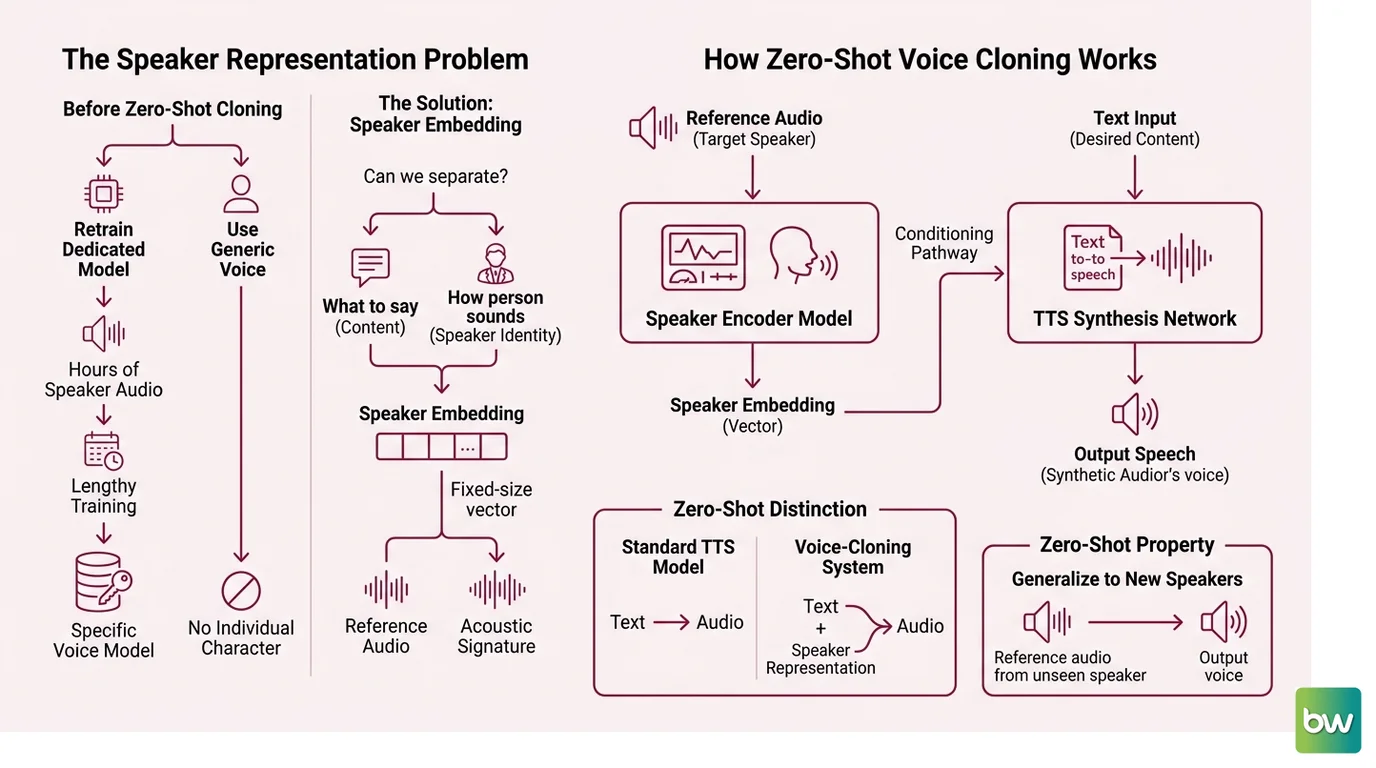
Before zero-shot cloning existed, making a model speak in a new voice required either recording hours of audio from that speaker and retraining a dedicated model, or accepting a generic synthetic voice with no individual character. The architecture question that changed everything was deceptively simple: can we separate what to say from how this particular person sounds?
The answer required building a representation that captures speaker identity independently of the content being spoken. That representation is called a speaker embedding — a fixed-size vector extracted from reference audio that encodes the acoustic signature of a specific voice.
What is voice cloning?
Voice Cloning is the process of generating speech in a target speaker’s voice using a short sample of that speaker’s audio, without updating any model weights. The system extracts a speaker embedding from the reference clip, then conditions a Text-to-Speech synthesis network on that embedding during inference. The synthesis network learns to disentangle speaker identity from linguistic content during training, which is why it can generalize to speakers it has never seen.
The key distinction from ordinary TTS is the conditioning pathway. A standard TTS model maps text to audio. A voice-cloning system maps text plus a speaker representation to audio. The speaker representation is not baked into the model during training for a fixed set of voices — it’s computed fresh from whatever reference audio you provide.
This is why the technique is called “zero-shot”: the speaker is not in the training set, yet the model reproduces their voice by conditioning on a vector that captures what their voice sounds like.
How does voice cloning work?
The pipeline has two separable components that interact at inference time.
The first is a speaker encoder — a model trained to produce consistent embeddings for the same speaker regardless of what they’re saying, while pushing apart embeddings for different speakers. Google’s Generalized End-to-End (GE2E) loss, introduced by Wan et al. in 2017 (GE2E paper, arXiv), trained on tens of thousands of speakers and achieved a speaker verification error rate reduction of roughly 10% over its predecessor, with training time cut by about 60%. The resulting d-vectors — dense floating-point representations of speaker identity — became the standard conditioning signal for zero-shot cloning systems.
The second component is the synthesis backbone. This has changed substantially across generations.
Tacotron 2 (Shen et al., 2018) established the seq2seq blueprint: a text encoder feeds an attention mechanism, which attends over encoded text while generating a Mel Spectrogram frame by frame. A separate Vocoder (WaveNet in the original system) then converts that spectrogram into waveform audio. Tacotron 2 achieved a mean opinion score of 4.53 against 4.58 for human speech (Tacotron 2 paper, arXiv) — close enough to human quality to define the benchmark. The two-stage design was the limitation: errors in the spectrogram propagated into the vocoder.
VITS (Kim et al., ICML 2021) collapsed that pipeline. A variational autoencoder with normalizing flows and adversarial training generates waveform audio end-to-end — no separate vocoder stage (VITS paper, arXiv). The stochastic duration predictor gives the model a natural distribution over timing rather than a single predicted duration per Phoneme. End-to-end training means the model can optimize audio quality directly, not through the intermediate spectrogram representation.
YourTTS (published December 2021, ICML 2022) extended VITS with multi-speaker and cross-lingual conditioning. With fewer than one minute of speech from a new speaker, it achieves state-of-the-art speaker similarity scores — the paper demonstrated zero-shot cloning with under a minute of reference audio at a quality that competitive systems at the time required much more data to match (YourTTS paper, arXiv).
The current open-research leader is F5-TTS (Chen et al., October 2024), which replaces the autoregressive generation of earlier systems with flow matching over a Diffusion Transformer backbone. There’s no phoneme alignment stage — the model learns to match text and audio without explicit forced alignment. At inference, it runs at a real-time factor of 0.15, meaning it generates audio faster than realtime (F5-TTS paper, arXiv). The training set spans 100,000 hours of multilingual audio.
What Zero-Shot Actually Means in Practice
Zero-shot conditioning works because speaker identity and linguistic content occupy different subspaces in a well-trained model. The speaker encoder is trained contrastively: utterances from the same speaker should map to nearby points, utterances from different speakers should map far apart. When the synthesis network is conditioned on this vector, the speaker characteristics modulate the acoustic output without interfering with the phonetic content.
Not speaker mimicry. Speaker disentanglement.
The model does not try to predict what a specific person’s voice sounds like from some database of voices. It learns a general decomposition during training — a factorization where speaker identity is one axis and linguistic content is another. At inference, the reference audio provides the speaker coordinate, and the text provides the content. The synthesis network fills in the joint distribution.
This architecture predicts some observable behaviors. If the reference audio is noisy, the embedding will capture the noise characteristics along with the speaker identity, and the output will tend to reflect that ambient quality. If the reference audio is very short and the speaker is unusual in some acoustic dimension the training distribution didn’t cover well, the embedding will be a poor approximation — the model will produce speech that’s recognizably in the right direction but missing fine-grained characteristics. The geometry does not guarantee perfect reproduction; it guarantees interpolation within the learned speaker space.
The Current System Landscape
Understanding the architecture is useful. Understanding the actual production options is necessary.
XTTS (INTERSPEECH 2024), maintained as coqui-tts on PyPI, requires a minimum of 6 seconds of reference audio and supports 17 languages (Coqui Docs). The model license is CPML — non-commercial only — and Coqui AI shut down in January 2024, meaning no new commercial licenses will be issued. The original pip install TTS package fails on Python 3.12+; the active community fork is pip install coqui-tts via the idiap/coqui-ai-TTS repository, with streaming latency under 200ms (idiap/coqui-ai-TTS GitHub).
Security & compatibility notes:
- XTTS-v2 (
TTSpackage, BREAKING): The originalcoqui-ai/TTSpackage is abandoned and fails on Python 3.12+. Usepip install coqui-tts(idiap fork) instead.- XTTS-v2 license (WARNING): CPML is non-commercial only. Coqui AI shut down January 2024 — no new commercial licenses available.
Chatterbox (Resemble AI), released under the MIT license, is the leading commercial open-source option. It accepts 5–20 seconds of reference audio and supports 23+ languages in the Chatterbox Multilingual V3 version. In a blind evaluation against a major commercial API using 7–20 second clips, 63.75% of evaluators preferred Chatterbox output (Resemble AI). Every generation carries PerTh watermarking — an acoustic signal that persists through common audio processing.
Cartesia Sonic runs a different architecture than the transformer-based systems described above: a State Space Model (SSM) that processes audio sequences without the quadratic attention cost. The current production model is Sonic 3.5 (GA). Time-to-first-audio is as low as 40ms (Cartesia), which matters for real-time applications like voice agents where latency is the binding constraint. The clone endpoint (POST /voices) accepts 10 seconds of reference audio and accepts flac, mp3, mpeg, mpga, oga, ogg, wav, and webm formats (Cartesia Docs).
ElevenLabs distinguishes between two cloning modes that correspond to the two ends of the quality-speed tradeoff. Instant Voice Cloning (IVC) operates entirely at inference time — the reference audio conditions the synthesis network with no weight updates, and less than 2 minutes of audio is sufficient, with 1–5 minutes recommended for consistency (ElevenLabs Docs). Professional Voice Cloning (PVC) fine-tunes model weights on the speaker’s audio, with around 30 minutes of high-quality recordings recommended for best results (ElevenLabs Docs). IVC is zero-shot in the strict sense; PVC is not.
What the Architecture Predicts — and Where It Fails
The speaker disentanglement model generates several testable predictions.
If the linguistic content in the reference audio systematically biases the acoustic signal — a speaker who only ever whispers in the sample, a recording of a formal speech by someone who normally speaks casually — the embedding will encode that context, not the speaker’s full voice. The output will sound like the speaker in that specific register, not their voice generally. This is not a bug in the geometry; it’s a fidelity cost of using a short, non-representative sample.
If two speakers occupy nearby regions of the learned speaker space — similar accent, similar timbre, similar pitch range — the cloned output for one may drift toward the other when the reference audio is short. The model is interpolating within its learned manifold; with few data points to constrain the estimate, the embedding lands somewhere close to the target but not precisely there.
The implications for inference-time use are specific:
- Provide reference audio that covers the speaker’s typical dynamic range — not just one emotional register.
- Avoid recordings with significant background noise unless the target application also has background noise; the embedding will encode the noise floor as a speaker characteristic.
- The minimum audio durations listed in documentation (6 seconds for XTTS-v2, 10 seconds for Cartesia, 1–5 minutes for ElevenLabs IVC) are engineering thresholds, not quality guarantees. More clean audio consistently produces more accurate embeddings.
Rule of thumb: quality of the speaker embedding scales with quality and diversity of the reference audio, not just duration.
When it breaks: zero-shot cloning degrades when the reference audio doesn’t represent the speaker’s typical voice — a recording of them sick, whispering, or in an unusual acoustic environment produces an embedding that reflects those conditions, not their normal voice. No amount of inference-time processing compensates for a systematically unrepresentative reference sample.
The Data Says
Voice cloning crossed a practical threshold when the zero-shot paradigm replaced speaker-specific fine-tuning: the same model generalizes to any speaker at inference time, requiring only seconds of reference audio. The architecture is a learned factorization of speaker identity from linguistic content, with speaker encoders trained on thousands of speakers to produce embeddings that generalize to new voices. The distance between Tacotron 2's 2018 two-stage pipeline and F5-TTS’s 2024 flow-matching architecture reflects six years of removing intermediate representations — each generation eliminating one more stage where errors could accumulate.
AI-assisted content, human-reviewed. Images AI-generated. Editorial Standards · Our Editors