What Is Role Prompting and How Assigning an Expert Persona Changes LLM Behavior
ELI5
Role prompting assigns an expert persona to an LLM inside the system prompt. It doesn’t inject new knowledge — it shifts which patterns the model weights most heavily when sampling its next token.
Ask an LLM “What are the early signs of cardiac arrest?” without any setup, and you get a general-purpose explanation suited to a consumer health article. Prefix the same question with “You are a senior emergency cardiologist” and the response changes: clinical vocabulary tightens, hedging reduces, framing shifts toward differential diagnosis rather than public health literacy. Same model. Same parameters. Same training corpus. The model learned nothing about cardiology between those two prompts.
So what, exactly, happened?
This is the anomaly at the center of role prompting: the persona declaration appears to grant expertise the model already possesses. Understanding what it actually grants — and when that grant turns counterproductive — requires looking at what changes in the probability distribution, not in the knowledge base.
The Token Geometry Under Every Role Assignment
Role prompting sits inside Prompt Engineering as one of its oldest and most studied techniques; its mechanism runs deeper than its surface simplicity suggests. The declaration occupies the System Prompts — the layer that precedes the user’s query and establishes the model’s operating context. According to Anthropic’s documentation, even a single sentence here makes a measurable difference. What makes it make a difference is the question worth answering.
what is role prompting in prompt engineering
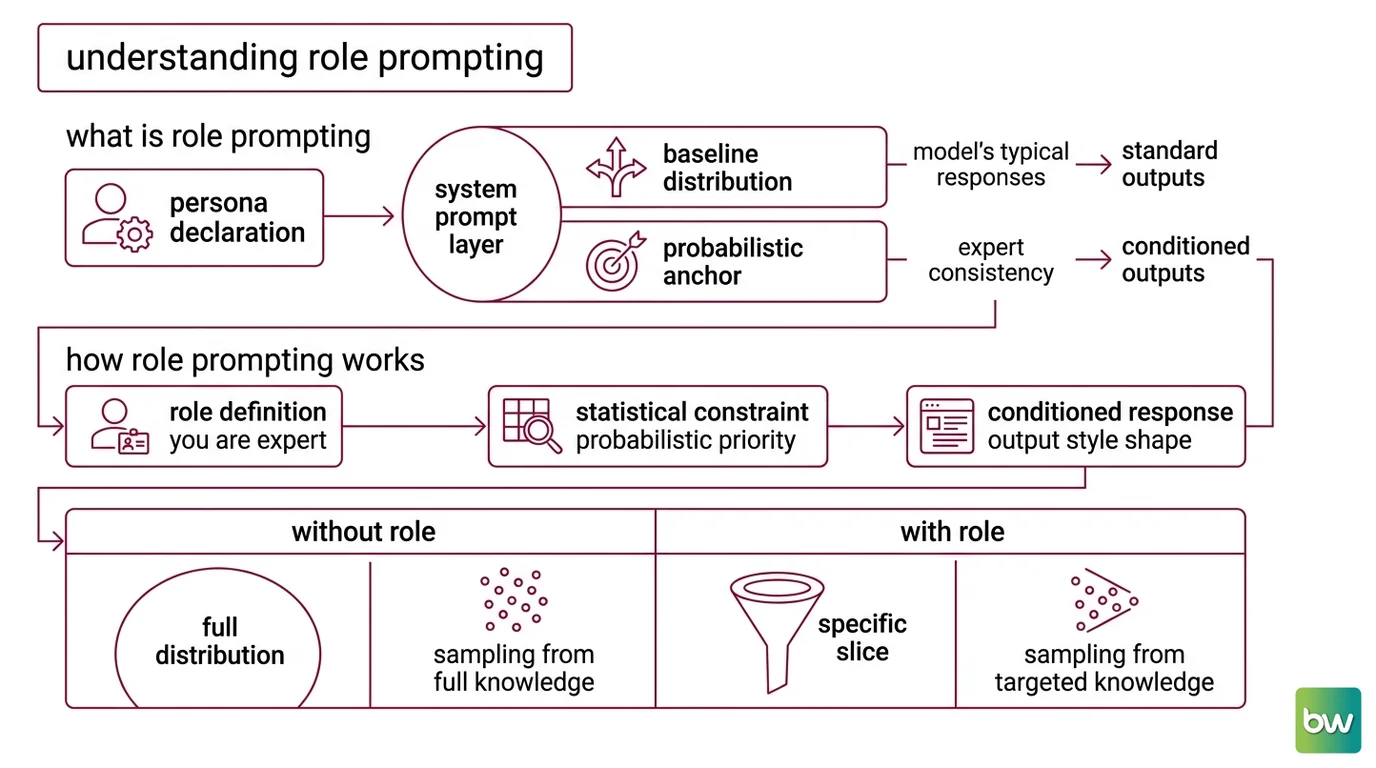
Role prompting is the practice of assigning an expert identity to an LLM via a persona declaration in its system prompt. Rather than relying on the model’s baseline distribution — whatever training data considers a “typical” helpful response — you give the model a probabilistic anchor: outputs should look like they came from someone with specific expertise, background, or perspective.
The simplest form: “You are a helpful coding assistant specializing in Python.” In the API, this occupies the system parameter (Anthropic Docs). A short sentence. A large effect.
Not new knowledge. A new prior.
The model already contains everything it knows about Python engineering. The role declaration shifts which slice of that knowledge gets statistical priority. Without a role, the model samples from the full distribution of helpful-assistant behavior. With a role, it conditions on an additional constraint: outputs should be consistent with what a Python specialist would plausibly produce.
In Zero Shot Prompting contexts — where no in-context examples guide the response — the role becomes one of the strongest available signals for shaping output style without adding examples or retraining.
how does assigning a role to an LLM change its responses
Every token an LLM produces is sampled from a probability distribution over its vocabulary. That distribution is shaped by the full content of the Context Window — the system prompt, conversation history, user query, and every prior generated token. The role declaration is part of this conditioning input; it participates in the attention computation alongside everything else.
When the model processes “You are a senior Python engineer,” the attention mechanism computes relationships between that declaration and every subsequent generation decision. Tokens consistent with “senior Python engineer” patterns — precise variable naming, awareness of edge cases, idiomatic use of context managers — become statistically more likely. Generic filler becomes statistically less likely.
Xiao et al. (2026) described this precisely: role prompting “primarily reshapes response characteristics rather than broadly improving capability.” The persona doesn’t inject facts. It reshapes which facts get surfaced, in what register, at what confidence level. Priority shifts; capability stays fixed. A better analogy than expertise transplant: frequency tuning. The signal was always there; the role instruction tunes which channel the model samples from at each generation step.
Instruction Following is the mechanism that makes this work in post-trained LLMs — models fine-tuned on instruction-following objectives have learned to condition their generation strongly on system-level directives. The role declaration is processed as a high-priority instruction, not as narrative color to be weighed against competing information. That’s why short, direct declarations have outsized effect relative to their token count.
Three Properties That Define an Effective Role Prompt
Not all role declarations produce the same shift. Kim et al. (2024) found a revealing asymmetry: LLM-generated personas produce more stable results than handcrafted ones. This tells you something about what effective role prompts contain — specificity, internal consistency, and task-type alignment — properties that human authors frequently underweight and that language models automatically include when asked to generate persona descriptions. Understanding those properties lets you write them deliberately.
what elements make a role prompt effective
Three structural elements appear consistently in higher-performing role prompts.
Specific expertise scope. “You are a Python engineer who reviews production async I/O code for performance bottlenecks” outperforms “You are a programming expert.” The specificity gives the attention mechanism more signal to condition on — not because it adds facts, but because it narrows the probability space more precisely toward the target domain.
Domain alignment with task type matters as much as specificity. Research by Xiao et al. (2026), evaluating 38 expert roles across 6 domains and 1,140 open-ended questions, found that role prompting helps when the task is advisory or interpretive — medicine, psychology, subjective assessment — and hurts when the task requires factual precision, as in finance, legal, and science domains. The role conditions the model to produce outputs consistent with expert behavior; that conditioning improves advisory tasks and corrupts factual ones.
Explicit output constraints separate persona from form. For tasks requiring Structured Output, the role declaration shapes tone but doesn’t specify format. Combining “You are a clinical pharmacist” with “Always respond in bullet format with dosage range, contraindications, and monitoring parameters” decouples what the model sounds like from what shape the output takes.
Two-stage prompting can improve stability. This is one application of Meta Prompting: establish the persona in one turn, issue the task in the next. Separating persona establishment from the actual instruction reduces ambiguity about which tokens are context versus directives, producing more consistent adherence to the declared role.
There is also a Context Engineering consideration at the system level. In long agentic workflows, the role declaration’s influence can weaken as conversation history grows — longer contexts dilute the attention weight on the initial system prompt. Periodic re-injection of the role in system-level messages compensates for this drift. Understanding where and why the role’s influence attenuates is as important as knowing how to write it.
What Task Type Predicts About Role Prompting Performance
The research on role prompting is fragmented — worth acknowledging directly. The learnprompting.org documentation notes that “this area has not been studied enough” to produce firm universal recommendations. The most rigorous recent evaluations (Xiao et al. 2026, Kim et al. 2024, Hu et al. 2026) are preprints. But the available evidence converges on a pattern that is mechanistically coherent, not just empirically observed.
Role prompting helps when the task is advisory, interpretive, or style-dependent. It fails — and actively degrades performance — when the task requires factual precision.
The mechanism for the failure case is significant. Expert personas improve human-preference alignment: responses feel more authoritative, more relevant, more confident (Hu et al. 2026). Confidence rises; accuracy falls. The model sounds more certain. It isn’t more accurate. The same conditioning that makes the expert persona sound authoritative suppresses the hedging that factual uncertainty requires. On questions where the correct answer requires acknowledging limits of knowledge — a stock’s performance next quarter, an obscure legal precedent, a medication’s off-label interactions — the expert persona works directly against the output.
Concrete predictions from this mechanism:
- If the task is “explain this diagnosis to a non-specialist patient,” a medical expert role helps — the model shifts toward accessible framing without abandoning clinical structure.
- If the task is “list the contraindications for this drug interaction,” an expert role may corrupt the output — persona confidence reduces appropriate uncertainty expressions at exactly the point they matter most.
- On reasoning-intensive tasks in zero-shot conditions, the effect is model-dependent. Kong et al. (NAACL 2024) documented task-specific gains for role-play prompting on math reasoning with ChatGPT — for AQuA, accuracy rose from 53.5% to 63.8%, outperforming standard chain-of-thought prompting. Kim et al. (2024) found persona prompts degraded reasoning in 7 out of 12 datasets tested on Llama 3. The divergence suggests the gain is not universal; it depends on the model’s scale, the task structure, and the specificity of the role formulation.
Before applying role prompting to a new task, run it against a no-role baseline. The technique is conditionally beneficial, not universally so.
In agentic systems, there is a security dimension to understand. Role-based instructions embedded in prompts can be overridden by prompt injection attacks — an adversary who can insert text into the model’s context can reassign the persona or neutralize its constraints. Prompt Leakage presents a related exposure: system-level role instructions intended as invisible context can be surfaced and extracted through adversarial user queries. Prompt injection attacks have been documented as a primary failure mode for role-based controls in AI-integrated workflows, per the OWASP 2026 LLM Security Report (Help Net Security).
Security note:
- Role-based prompt injection (OWASP 2026): Prompt injection bypassed role-based controls in 42% of AI-integrated workflows studied, per the OWASP 2026 LLM Security Report (Help Net Security). Attacks increased 340% year-over-year. Role declarations are guidance, not enforcement boundaries — do not rely on them as security controls in agentic systems.
When it breaks: Role prompting degrades factual accuracy when expert persona confidence conflicts with the model’s actual uncertainty — the persona suppresses appropriate hedging precisely when hedging is correct. On finance, legal, and technical domains, the output becomes more authoritative-sounding and less reliable simultaneously. This failure is structural, not incidental.
The Data Says
Role prompting shifts which knowledge gets statistical priority at inference time — it doesn’t add knowledge. The technique has measurable benefits on advisory and style-dependent tasks, and measurable costs on factual precision. That tradeoff isn’t a limitation to engineer around; it is the mechanism itself. Match role prompts to task type, pair persona with explicit output constraints, and treat role declarations as probabilistic guidance rather than enforcement in any system where adversarial input is possible.
AI-assisted content, human-reviewed. Images AI-generated. Editorial Standards · Our Editors