What Is Real-Time AI Generation and How Distilled Diffusion Models Hit Sub-Second Output
ELI5
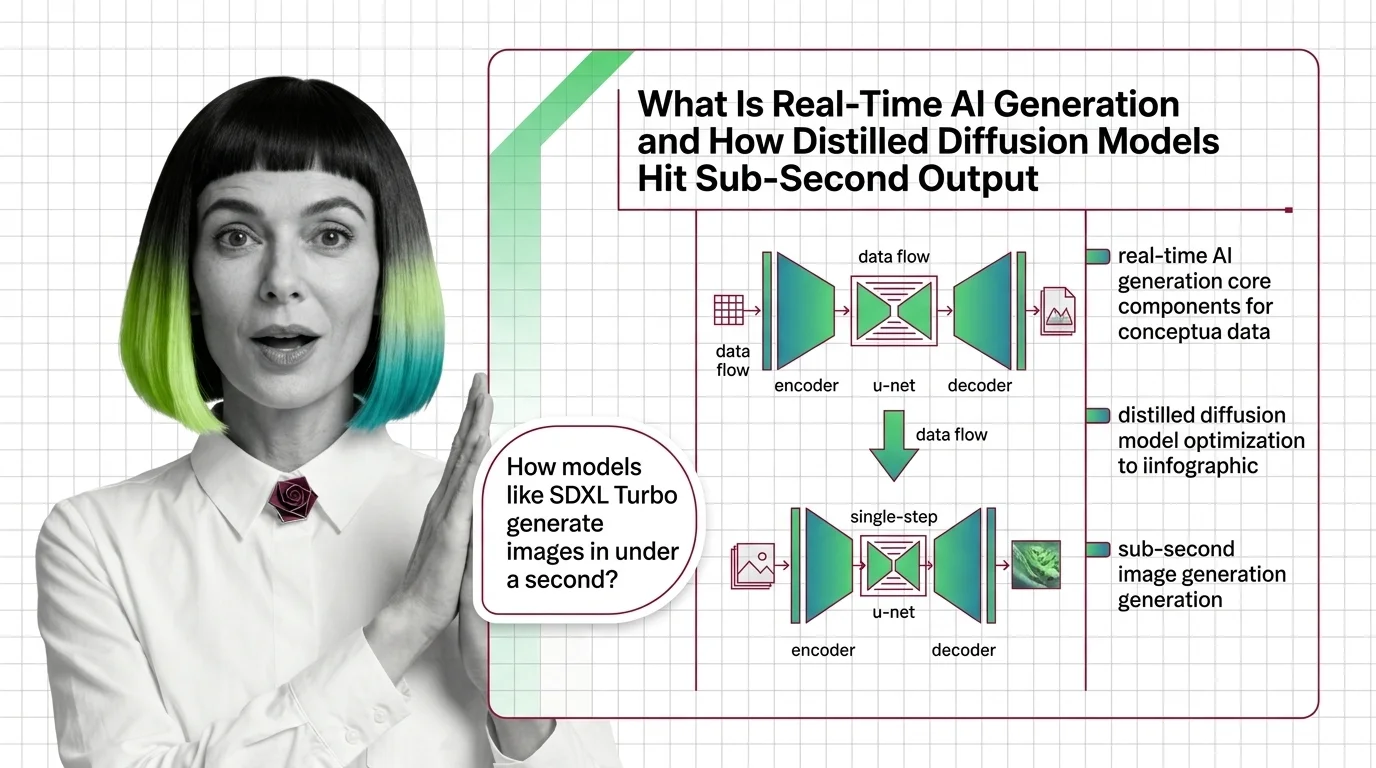
Real-time AI generation produces usable image, video, or audio output in under a second — fast enough to feel instant. Distilled diffusion models compress dozens of denoising steps into one or two, trading some quality for speed.
Run a diffusion model for a single step and theory says you should get noise — a half-finished sketch frozen mid-refinement, not a coherent photograph. Yet open a real-time image tool today and a recognizable face renders before you finish reading this sentence. The image arrives whole, not half-baked. Something about the training process changed what “one step” means.
The Architecture of Compressed Time
“Real-time” sounds like a marketing word, but in generation pipelines it has a specific engineering meaning: output fast enough that the person on the other end doesn’t perceive a wait. That threshold differs by modality — a streamed audio reply has to start before the listener’s attention drifts, while a static image preview can tolerate a slightly longer beat. Both share the same constraint: generation has to finish inside a latency budget measured in milliseconds, not seconds.
What Is Real-Time AI Generation?
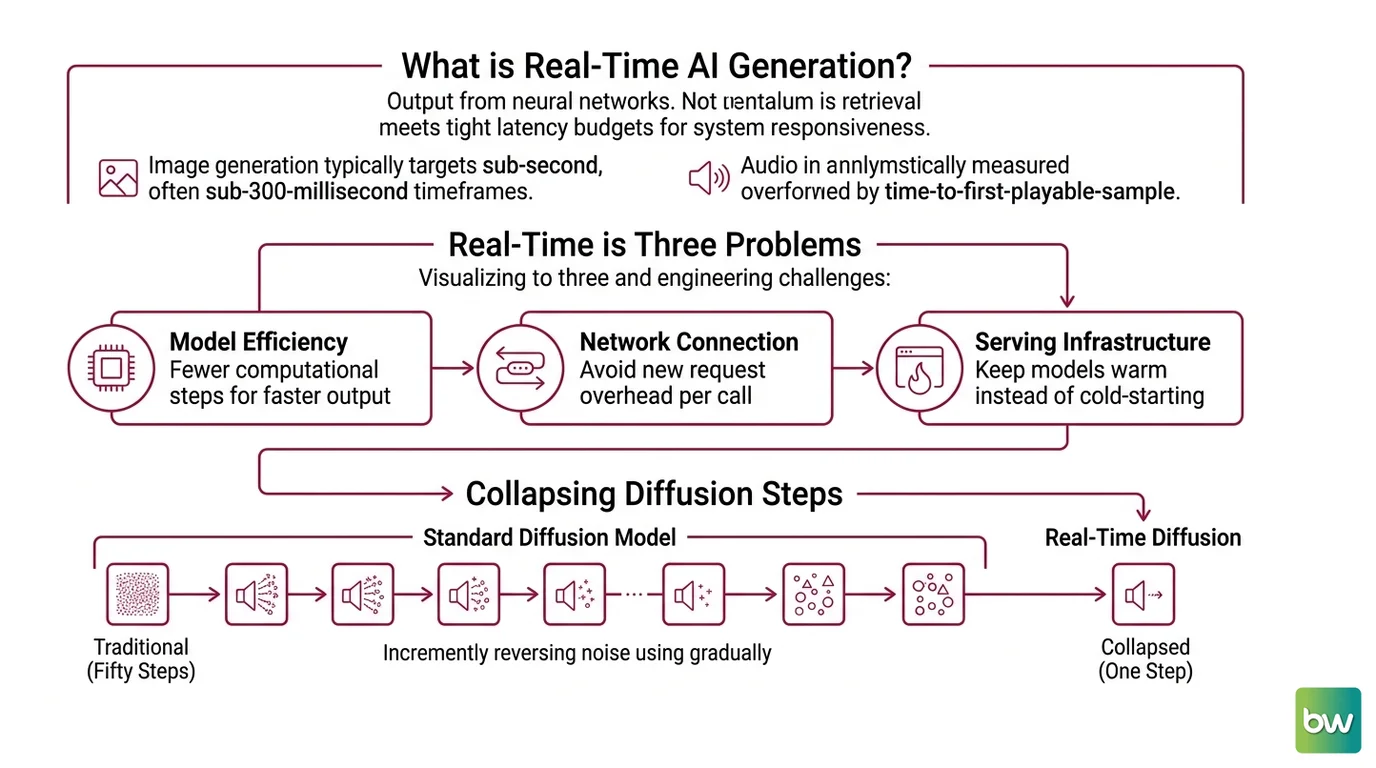
Real-time AI generation is the production of usable image, audio, or video output — generated by a neural network rather than retrieved from storage — within a latency budget short enough that the system feels responsive rather than computed. For image generation that typically means sub-second, often sub-300-millisecond, turnaround from prompt to pixel. Audio is measured differently: not by when the full clip finishes, but by when the first playable sample arrives.
That distinction matters because real-time generation isn’t one technique — it’s a constraint that forces three engineering problems to be solved together. The model has to produce a usable output in far fewer computational steps than it was designed for. The connection between client and server has to avoid the overhead of a new request each time. And the serving infrastructure has to keep the model warm rather than starting it cold per call. Real-time is three problems, not one — solve only the model and the system still feels slow.
Collapsing Fifty Steps Into One
Standard Diffusion Models generate by reversing noise gradually — typically near fifty discrete denoising steps, each one nudging a field of random pixels closer to a coherent image. That process is why the earliest text-to-image tools took ten or twenty seconds per request: every step is a full forward pass through a large neural network, and fifty of them add up. Reaching sub-second speed meant attacking the step count directly, not just making each individual step faster.
How Do Models Like SDXL Turbo and LCM Generate Images in Under a Second?
A standard diffusion model removes noise the way a hiker descends a mountain on a switchback trail — dozens of short, deliberate legs, each one correcting for the drift the last step introduced, slowly converging on the valley floor. A distilled model is trained to predict where the trail ends from anywhere on the mountain, and jump there directly.
Not a faster walk down the same path. A trained guess at where the path ends.
Stability AI’s Adversarial Diffusion Distillation (ADD) builds that guess by combining two training signals. Score distillation pushes the student’s single-step output to match what a full multi-step teacher model would have produced — the destination, not the route. An adversarial loss, borrowed from GAN training, adds a critic that judges whether the output looks real or like a flattened sketch, sharpening detail that score distillation alone tends to blur. Together the two signals let the model sample in one to four steps instead of the roughly fifty a standard run requires (Stability AI Research). SDXL Turbo, built on this method, generates a 512x512 image in 207 milliseconds on an A100 GPU — 67 of those milliseconds the network forward pass — per Stability AI’s blog post introducing the model.
Latent Consistency Models take a related but distinct route: rather than distilling a single forward step, LCM trains the network to map any point along the diffusion trajectory directly to the solution of the probability flow ODE — the curve the denoising process traces from noise to image — typically in two to four steps. The distillation itself is comparatively cheap: roughly 32 A100 GPU-hours and 4,000 training steps to compress an existing latent diffusion model down to few-step inference, per the LCM project page.
Neither paper offers a head-to-head benchmark of the two methods on identical hardware — they were measured separately, on separate infrastructure — so treat any claim that one beats the other as unverified. The speed comes from training, not inference cleverness. Both methods bake the multi-step trajectory into the weights ahead of time, so the model never has to walk it at generation time.
By mid-2026, faster successors exist — Black Forest Labs’ FLUX.1 schnell and Alibaba’s Z-Image-Turbo among them — and SDXL Turbo and LCM are no longer the fastest distillation techniques available. But they’re the ones that proved single-step diffusion could produce a coherent image at all, worth understanding on its own terms. SDXL Turbo carries a caveat worth knowing before building on it, too: it ships under a non-commercial research license, with commercial use requiring a separate agreement with Stability AI and exact terms left unpublished, per the company’s Hugging Face model card.
What Has to Happen Between Click and Pixel
A fast model alone doesn’t make a real-time system. Every request that opens a new connection, waits in a queue, and cold-starts a model from disk adds latency that distilled weights can’t claw back — which is why real-time generation is as much a Generative Media Pipelines problem as a modeling one.
What Are the Core Components of a Real-Time AI Generation Pipeline?
Fal AI’s real-time inference architecture illustrates the pattern other Generative Media APIs have converged on. Instead of a standard request-response call, the client opens a persistent Websocket connection to a dedicated endpoint, serializes each frame in a compact binary format (msgpack by default) instead of JSON, and keeps the connection open across many generations. Two things follow: the request bypasses the normal job queue entirely, and the model runner stays warm between calls instead of reloading weights fresh each time, according to fal.ai’s documentation. Generation reportedly completes in under 100 milliseconds for supported models — though the company’s separately published frame-rate figures (2-3 fps over REST, 3-5 over WebSocket) come from a different source and aren’t reconciled with that number, so read the headline figure as a target, not a guaranteed service level. Only two models currently support the real-time client — fast-lcm-diffusion and a tuned SDXL Turbo variant — and 512x512 is the resolution at which it runs fastest, per the same documentation.
Audio generation runs the same Streaming Inference pattern but measures success differently. A text response is complete when the last token arrives; an audio response has to be judged by when the listener can start hearing it, because naive “time to first byte” overstates responsiveness — a WAV or Ogg container’s header bytes arrive before any audible sound does. That’s the reasoning behind Time To First Audio (TTFA) as its own metric: the clock starts at first sound, not last. Gradium, a Paris voice-AI startup, published a 2026 benchmark putting its median TTFA at 258ms, ahead of ElevenLabs Turbo (304ms), OpenAI’s GPT-4o mini TTS (420ms), and OpenAI’s TTS-1 (969ms) — a self-published comparison, but the methodology is documented on its engineering blog. The benchmark frames its result against a specific target: human conversational turn-gaps run close to 200 milliseconds, so the latency budget for a voice agent isn’t competing against network speed anymore. It’s competing against how fast people actually take turns talking.
If You Cut the Steps, What You Lose
Collapsing fifty steps into one is not a free lunch, and the math predicts specific places where the trade shows up.
Push a distilled model below the step count it was trained for and the output loses fine compositional detail first: overlapping objects, legible text, and correctly-rendered hands are usually the earliest casualties, because those need the mid-generation correction multi-step diffusion has room for and single-step distillation does not.
If the application needs frame-to-frame consistency rather than a single still — a live avatar, a streamed video preview — expect flicker unless the pipeline adds explicit consistency conditioning between frames. Distillation optimizes for a single output’s fidelity to the teacher’s distribution; it says nothing about how that output relates to the frame generated a tenth of a second earlier.
If the target is a commercial product rather than a research demo, expect to need a different model license than the one most research checkpoints ship with — SDXL Turbo’s non-commercial terms are a preview of a pattern likely to repeat.
Rule of thumb: if a real-time demo doesn’t disclose its step count, assume the model traded output diversity for speed — adversarial distillation narrows the range of images a prompt can produce toward the modes the discriminator rewarded, not the full spread a fifty-step run would explore.
When it breaks: push a distilled model past the step count it was trained for, or hand it a prompt demanding precise multi-object composition, and the speed gain reverses — the model has no spare denoising passes left to correct an early mistake, so errors a slower model would smooth out compound instead.
The Provenance Problem Speed Creates
There’s a second-order consequence that doesn’t show up in any latency benchmark. The same compression that makes a face render before a sentence finishes also makes it harder to tell, after the fact, whether that face was ever real. A fifty-step diffusion process was already slow enough to make live synthetic video calls impractical; a one-step distilled model removes that barrier. What’s left to distinguish synthetic media from captured media is no longer generation speed — it’s AI Watermarking And Content Provenance: cryptographic signing, content credentials, or detection models trained to spot the statistical fingerprints distillation leaves behind.
Whether that fingerprint is even reliably detectable is an open engineering question, not a settled one. Adversarial training optimizes the student’s output to be indistinguishable from a real image to a discriminator — precisely the property that makes provenance detection difficult. The faster generation gets, the more the burden shifts from “can we make this,” increasingly solved, to “can we prove this wasn’t,” which is not.
The Data Says
Real-time AI generation isn’t one breakthrough — it’s three: distillation methods like ADD and LCM that compress roughly fifty denoising steps into one to four, persistent connections that remove per-request overhead, and warm infrastructure that skips the cold-start tax. SDXL Turbo’s 207-millisecond image and Gradium’s 258-millisecond audio response both prove the same point: sub-second generation is now an engineering target, not a research curiosity. The open question is no longer whether models can generate this fast — it’s what gets lost in exchange, and who can tell the difference once it’s running live.
AI-assisted content, human-reviewed. Images AI-generated. Editorial Standards · Our Editors