What Is Prompt Versioning and How Version Control for LLM Prompts Actually Works
ELI5
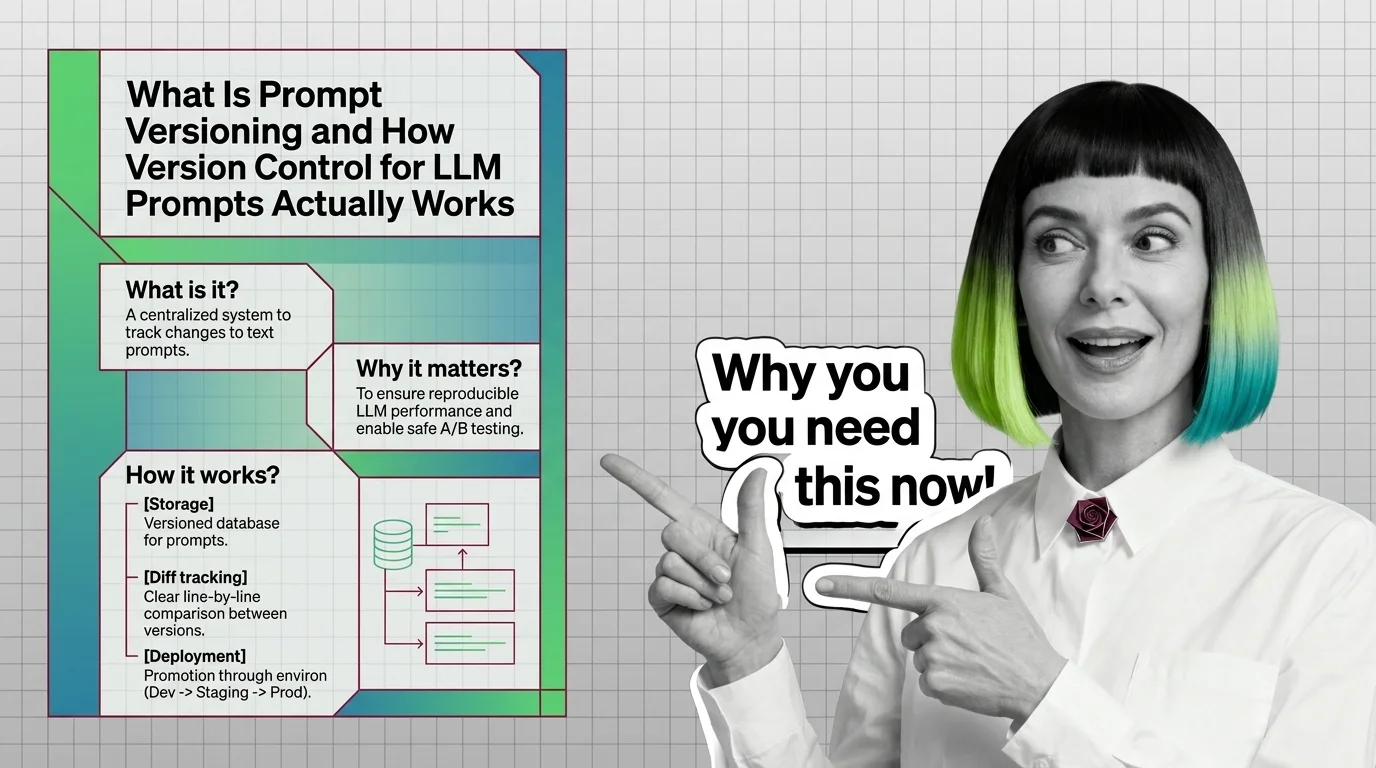
Prompt versioning tracks every change to your LLM prompt as an immutable, numbered snapshot. Teams use it to compare outputs across versions, attribute quality regressions to specific edits, and roll back to a known-good state without touching application code.
The symptom arrives without a code diff. Output quality degraded — the model is hedging where it used to be direct, returning malformed entities it once handled cleanly. Engineers check deployment history, model changelogs, input distributions. Nothing changed. Then someone opens the prompt storage directly: a field labeled “production_prompt,” last modified forty minutes ago, no change history, no attribution. Someone edited the live prompt by hand. There is no record of what it said before.
That is the failure mode prompt versioning is designed to prevent — and understanding why it works requires looking at what an LLM prompt actually is in a production system.
The Invisible Variable: What Prompt Versioning Solves
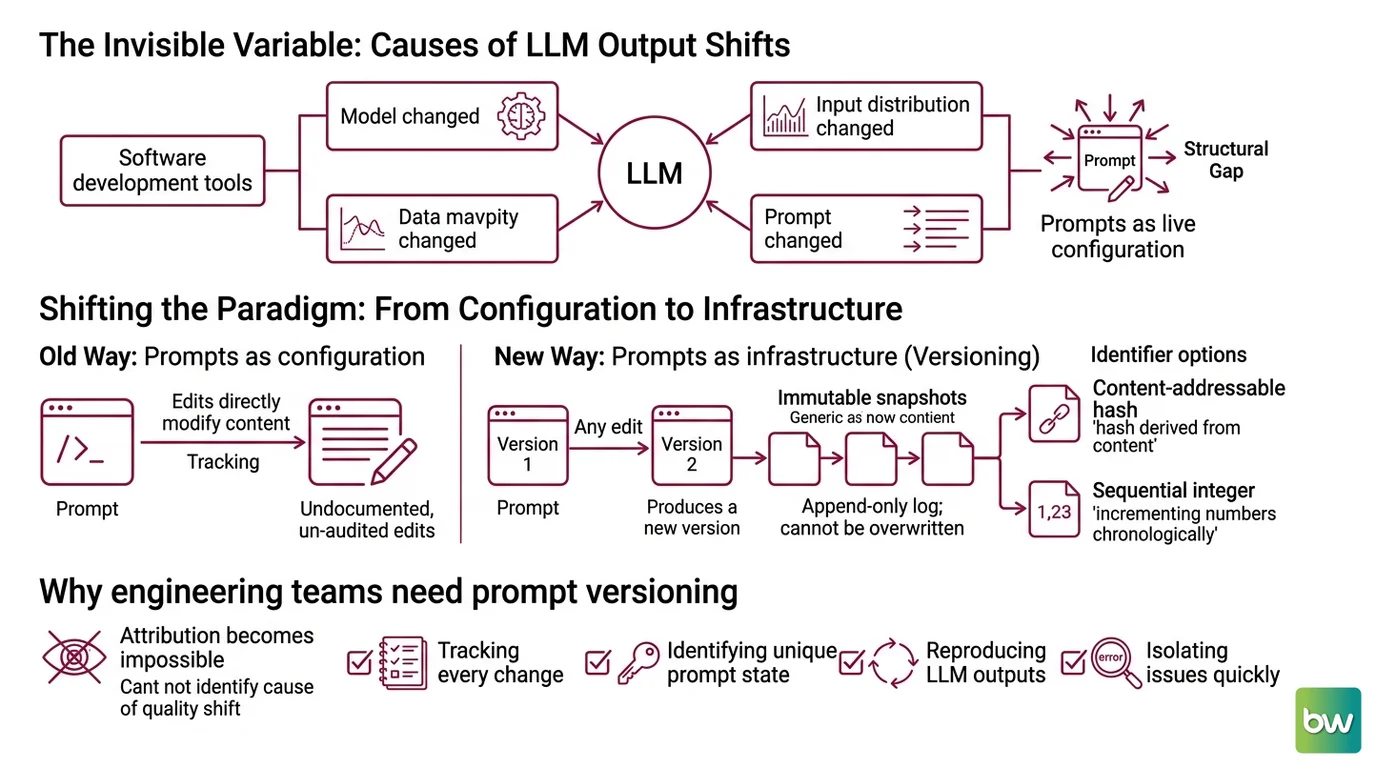
LLM output is non-deterministic. When output quality shifts, the cause is one of three variables: the model changed, the input distribution changed, or the prompt changed. Software teams have well-established tools for isolating the first two. The third variable — the prompt — often lives outside version control entirely, in a database field, an environment variable, or a configuration store where it can be edited by anyone with credentials and without audit trail.
That structural gap is why prompt versioning exists as a discipline.
Most teams treat prompts as live configuration — values editable by whoever has credentials, managed the same way they’d manage an environment variable.
Not configuration. Infrastructure.
What is prompt versioning and why do LLM engineering teams need it?
Prompt versioning is the practice of tracking every change to a prompt — its text, variable definitions, model parameters — as an immutable, uniquely identified snapshot (Braintrust). Once a version is created, it cannot be modified. Any edit produces a new version. The relationship between versions forms an append-only log; history cannot be overwritten.
The version identifier can take two forms in practice. A content-addressable hash derives the ID from the prompt content itself: change a single character and the ID changes. A sequential integer assigns incrementing numbers chronologically: version 12 is always newer than version 3. The first scheme is self-validating — if the hash matches, the content matches. The second is chronologically intuitive. Both appear in production systems; the choice reflects architectural preference rather than correctness (Braintrust).
Why do engineering teams need this? Because without immutable versions, three capabilities break simultaneously.
Attribution becomes impossible. You cannot determine which prompt state caused a quality shift if the prompt has been edited in place. The version history is the only record that maps outputs to the exact prompt that produced them.
Controlled experimentation collapses. Prompt Optimization across a team requires a shared record of what was tried and what the results were. Without versioning, two engineers may unknowingly test the same variation on different prompt states, producing results that cannot be compared.
Recovery slows to a crawl. When a bad prompt reaches production, rollback without versioning means reconstructing the old prompt from memory or database backups. With versioning, recovery is a label reassignment — a seconds-long operation.
There is a further dimension that documentation frequently understates: modern production prompts are not simple strings. A prompt is a structured artifact — text with variable placeholders, model parameters, and increasingly, schemas for Tool Use in Prompts and structured output contracts. Prompts that use JSON Schema definitions for output validation — enforced via libraries like Instructor or domain-specific languages like BAML — incorporate the output schema as part of the prompt itself. Some configurations include Constrained Decoding settings that govern how the model samples its output format. Prompts built around Structured Output Prompting are particularly sensitive to version drift: a schema change is a breaking change even when the natural language instruction appears identical.
The version must capture all of these components together as a single atomic unit. That is the storage contract.
Version Identity and Deployment Labels: The Mechanics
The most consequential distinction in prompt version control is one that most documentation buries: the version and the deployment label are not the same thing. Version identity is immutable; labels are not. The version is a permanent snapshot. The label is a mutable pointer. Understanding this separation is what distinguishes teams that can roll back in under a minute from teams that need a hotfix deployment cycle.
How does prompt version control work: storage, diff tracking, and environment-based deployment?
Three storage patterns cover most production systems.
Content-addressable identifiers. The version ID is derived from a cryptographic hash of the prompt content, as in Braintrust’s model. Change a single character: different hash, different version. The property is architecturally elegant because IDs become self-verifying — if two systems independently compute the same ID for a prompt, they hold identical content. Diff tracking is implicit: any two versions with different IDs contain different content, by construction.
Sequential integer versioning. Systems like Langfuse assign auto-incrementing integers (1, 2, 3…) as version IDs. The version number carries chronological information but not content identity. The operationally critical element is the label: when “production” is assigned to version 12, all SDKs and API calls return version 12 by default — with no code change required in the calling application (Langfuse Docs). Rollback is label reassignment: point “production” at version 9, and all downstream calls immediately receive the prior prompt. Langfuse V4, launched March 2026 on Langfuse Cloud (Langfuse Changelog), introduced architectural changes to scale; self-hosted users on V3 should review the migration path before adopting new prompt management features.
Commit hash plus tag model. LangSmith uses commit hashes as version identity, with separately assignable tags such as “v2,” “staging,” and “prod” (LangSmith Docs). Tags behave as named pointers — stable references that can be reassigned without changing the underlying commit. A single commit can exist simultaneously in both Staging and Production environments. Webhook triggers fire when tags are reassigned, enabling integration with CI/CD systems without a dedicated synchronization mechanism.
Environment promotion follows a consistent pattern across all three models: dev → staging → production (Braintrust). Promotion does not move the prompt; it moves the pointer. The artifact stays in the Prompt Registry — the central store for all versioned prompt artifacts, analogous to a package registry for code. Only the label changes, and the calling application needs no update.
The caching behavior in these systems reveals the underlying architecture with unusual clarity. In MLflow 3.14.0 (MLflow Releases, released June 17, 2026), version-specific lookups — references like prompts:/prompt-name/2 — are cached indefinitely (MLflow Docs). The version is immutable; there is nothing to invalidate. Alias-based lookups — references like prompts:/prompt-name@production — carry a 60-second default TTL (MLflow Docs). The alias can be reassigned at any time, so the cache must eventually expire. The TTL is not arbitrary: it is a direct mechanical consequence of the label-versus-version distinction, encoded in the caching layer.
Diff tracking across versions follows directly from the storage model. A diff between version 3 and version 7 compares their respective immutable snapshots — the same logical operation as a git diff between two commits. The diff is deterministic because neither snapshot can change after creation. This is what makes the prompt registry a trustworthy forensic record rather than a mutable configuration store.
What the Version History Predicts
The mechanics of prompt versioning translate directly into observable engineering properties. If you understand the mechanism, the failure modes become predictable — and so do the conditions that prevent them.
If you reference prompts by alias — @production, @staging — rollback is a UI operation: reassign the label, and all downstream calls immediately receive the prior prompt. No code change. No deployment cycle. Incident response time is bounded by the round-trip latency of the registry API.
If you hardcode a specific version identifier into your application code, rollback requires a code change and a full deployment. The safety of this approach — knowing precisely which prompt is running — comes at the cost of operational flexibility. Many teams use version pinning in development and alias-based references in production for exactly this reason.
If you pair version tracking with Prompt Testing And Evaluation, the version history becomes an experimental ledger: each evaluation run is stamped with the version ID of the prompt under test, so quality metrics are attributable to specific prompt states rather than floating as undifferentiated aggregates. This is the foundation of controlled prompt experiments, where the prompt is treated as the independent variable and output quality is the dependent one.
If your team stores prompts outside the registry — in environment variables, hardcoded strings, or undocumented configuration fields — you lose the audit trail. This matters beyond debugging: when a Prompt Injection incident occurs, the forensic question is “which prompt was active when the injection succeeded?” Without version history, that question has no reliable answer.
Rule of thumb: Treat the deployment label as the operational control surface, and the version ID as the forensic record. Operators should reason about labels. Engineers investigating incidents should reason about version IDs.
When it breaks: Prompt versioning isolates prompt changes as a variable, but cannot isolate model behavior changes — providers update model weights on schedules that may not be communicated with changelogs. A version-tracked prompt cannot guarantee reproducible outputs if the underlying model has changed between evaluation runs; it records what you controlled, not what you didn’t. Combining prompt versioning with model version pinning and prompt testing and evaluation over time is the more complete control structure for production LLMOps — versioning alone closes one variable, not all of them.
The Data Says
Prompt versioning is not a convenience feature — it is the infrastructure prerequisite for controlled experimentation on LLM systems. The core insight is architectural: version identity and deployment labels are independent concepts, and conflating them is what makes rollbacks slow and attribution impossible. Systems like MLflow, Langfuse, and LangSmith implement the same separation with different identifier schemes; the underlying mechanism is identical. A prompt that cannot be versioned cannot be debugged systematically.
AI-assisted content, human-reviewed. Images AI-generated. Editorial Standards · Our Editors