What Is Prompt Testing and Evaluation and How Automated Metrics Replace Manual Spot-Checks
ELI5
Prompt testing and evaluation is the process of measuring how well an LLM or LLM-powered application performs against defined quality criteria — using automated scorers instead of human reviewers reading every output.
The problem is not that LLM outputs are sometimes wrong. The problem is that they fail silently, inconsistently, and in ways that are invisible to the person who wrote the prompt. You change a model version. You adjust a sentence in the system prompt. You add a new document to the retrieval context. Then, three days later, a user reports something strange — and you have no idea when the drift started.
Manual spot-checking is how most teams respond to this. A developer reads twenty outputs, pronounces them “good enough,” and ships. It is the AI equivalent of testing software by clicking around the UI before a release. It catches the obvious failures. It misses the systematic ones.
The Anatomy of an Evaluation Pipeline
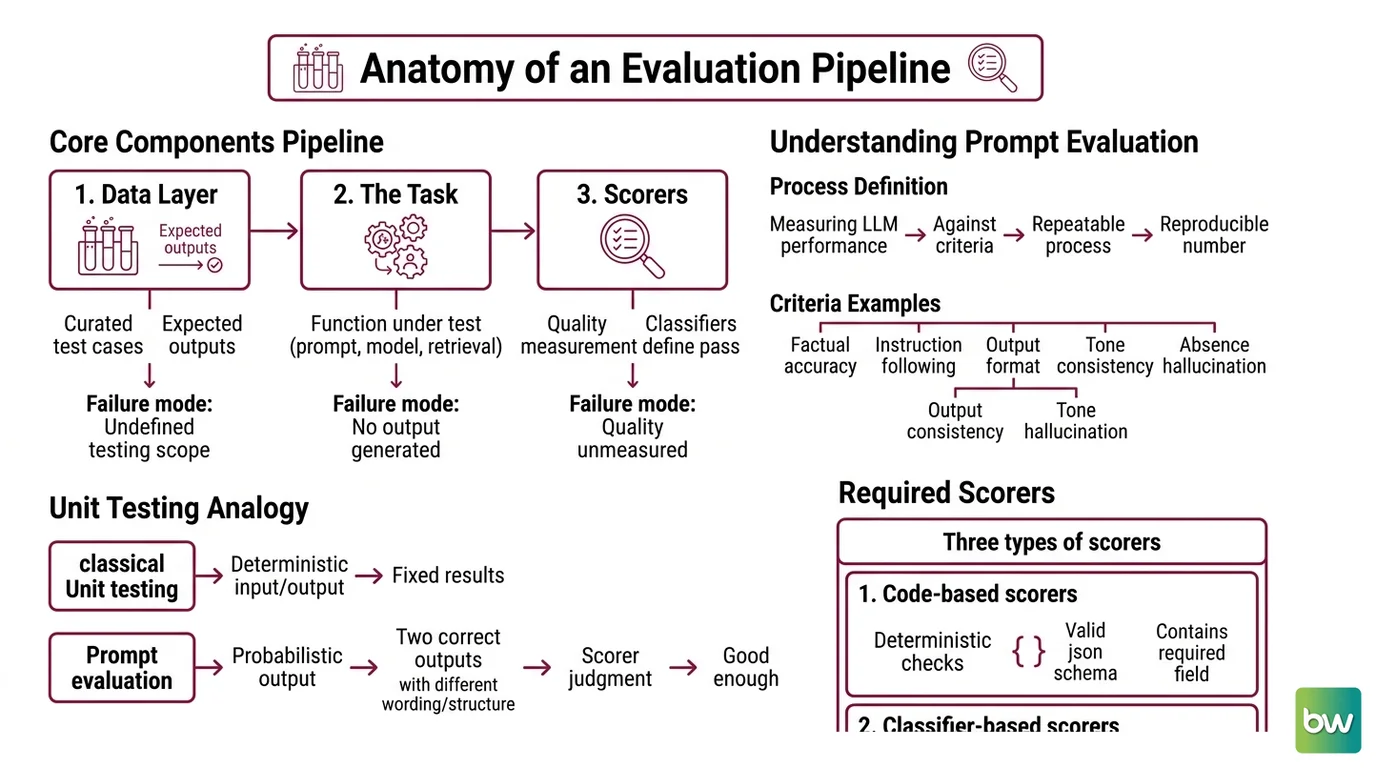
Prompt evaluation is not a single check — it is a structured pipeline with three distinct components working in sequence. Think of it the same way you think about a test suite: data defines what to test, the task defines what runs, and scorers define what passes.
The data layer is a curated set of test cases with expected outputs. The task is the function under test — the prompt, the model call, the retrieval step, whatever produces the output. The scorers are classifiers that measure quality. Each component has a different job, and the failure mode of skipping any one of them is distinct and predictable.
What is prompt testing and evaluation?
Prompt testing and evaluation is the process of measuring how well an LLM or LLM-powered application performs against defined quality criteria (Braintrust Blog). The definition is deliberately broad, because the quality criteria vary: factual accuracy, instruction-following, output format, tone, absence of hallucination, absence of injected content. What all these share is that they require a measurement protocol — not a human eyeballing results, but a repeatable process that produces a comparable, reproducible number.
The closest analogy to classical software engineering is unit testing — but with a critical asymmetry. In unit testing, the expected output is deterministic: given input X, the function must return Y. In prompt evaluation, the expected output is probabilistic. Two outputs can both be correct, with different wording, different structure, different level of detail. The scorer has to decide whether “good enough” is close enough to the reference output — and that decision is itself a form of judgment.
This is why Prompt Testing And Evaluation requires three types of scorers rather than one. Code-based scorers handle deterministic checks: does the output parse as valid JSON Schema? Does it contain a required field? Does the length fall within bounds? These run in microseconds and never disagree with themselves. LLM as a Judge scorers handle nuanced quality dimensions: does the response address the question? Is the reasoning coherent? Is the tone appropriate? Human scorers establish ground truth calibration — the baseline against which the LLM judges are themselves evaluated (Braintrust Docs).
The three scorer types are not substitutes for each other. They measure different things, at different costs, at different speeds. The architecture of a real evaluation pipeline assigns each check to the scorer type that can answer it — and only that type.
How does a prompt evaluation pipeline work?
A prompt evaluation pipeline operates in two modes: offline and online, and the distinction matters for how you interpret results.
Offline evaluation runs during development, against a curated dataset, before anything reaches production. It is the equivalent of a CI test run: deterministic, comparable across runs, designed to catch regressions before they ship. You run the prompt against a fixed set of inputs; scorers produce scores; the scores are compared against a release threshold. If the aggregate score drops below the minimum, the change does not ship (Braintrust Blog).
Online evaluation monitors live traffic in production, running asynchronously so it adds no latency to the user-facing response. It is the equivalent of application performance monitoring — except instead of measuring response time, it measures output quality. Online evaluation catches the regressions that offline missed: distribution shift in user inputs, model provider updates that weren’t announced, subtle changes in retrieval behavior that only manifest at scale.
The regression testing layer connects the two modes. It requires three things: a golden dataset that represents known-good behavior, a drift detection mechanism that flags when score distributions shift, and a set of release criteria — minimum acceptable scores below which deployment is blocked. Without the release criteria, the golden dataset is just data. Without the golden dataset, drift detection has no reference point. Without drift detection, the release criteria are checked only at deploy time, not continuously (Braintrust Blog).
Promptfoo implements this architecture as an open-source CLI. It covers 50+ vulnerability types — Prompt Injection, PII leaks, jailbreaks, tool misuse — and is currently used by 350,000+ developers, with more than a quarter of Fortune 500 companies in that count (Promptfoo Docs). Multiple sources report that Promptfoo was acquired by OpenAI, though no official announcement page has been published at the time of writing. Deepeval provides a Python framework with 50+ metrics including RAG evaluation, agentic evaluation, and conversational evaluation, with direct Pytest integration for teams that want evaluation inside their existing test infrastructure (DeepEval Docs). Braintrust covers the full lifecycle from playground experiment to CI integration to production monitoring, with a free tier at 10,000 scores per month and a Pro tier at $249/month for 50,000 scores (Braintrust Pricing).
The LLM-as-Judge Problem
The most interesting scorer type — and the one that generates the most skepticism — is LLM as a Judge. The idea is that you use a language model to evaluate the outputs of another language model. This sounds circular. It is not, but it does come with specific failure modes that the design of an evaluation pipeline has to account for.
The mechanism works because the evaluator and the generator are operating on different tasks. The generator produces an answer. The evaluator assesses the answer against a rubric. These are different cognitive operations, and there is no formal reason why the evaluator must be wrong just because it is also a language model. The evidence supports this: in well-calibrated setups, LLM judges reach roughly 80–88% agreement with human evaluators (PMC). The qualification matters — “well-calibrated” requires careful rubric design, a good choice of judge model, and calibration against human labels for the specific domain.
Where this breaks down is in expert domains. For dietetics and mental health evaluation tasks, LLM-judge agreement with human experts dropped to the 60–68% range (PMC). The failure is not random; it is concentrated in exactly the cases where domain expertise matters most and where errors are most consequential. Calibrating LLM judges against expert human labels is not optional for high-stakes domains — it is the validity test.
The cost structure is what makes LLM-as-judge worth the calibration effort. Estimates suggest it runs somewhere between 500 and 5,000 times cheaper than equivalent human evaluation at comparable accuracy levels (Braintrust Blog). At those ratios, you can afford to run the evaluator on every output, not just a sample — which changes the statistical properties of what you can detect.
Indirect Prompt Injection is a specific evaluation target that deserves its own mention. When a model processes retrieved documents, emails, or tool outputs, malicious content in those sources can hijack the model’s behavior without the user’s knowledge. Evaluating for this requires red-team style testing — generating adversarial inputs and checking whether the model’s Trust Boundary holds. Promptfoo includes this category in its red-team suite.
What Systematic Evaluation Changes
The gap between manual spot-checks and a proper evaluation pipeline is not primarily about coverage — it is about what you can measure, compare, and act on.
Manual spot-checks produce qualitative impressions. A developer reads twenty outputs and concludes “these look better than before.” But “better” is not comparable across time, across model versions, or across reviewers. If you can’t quantify the change, you can’t detect the regression. If you can’t detect the regression, you discover it from user reports.
Systematic evaluation produces a number — and numbers have a different set of properties. They can be compared to a baseline. They can trigger an alert. They can block a deployment. The Notion case study illustrates this: after adopting systematic evaluation, the team increased their issue-resolution rate from 3 to 30 fixes per day (Braintrust Blog). The mechanism is not that evaluation makes the fixes easier — it is that evaluation makes the problems visible, and visible problems get fixed.
The offline/online split maps naturally to Structured Output Prompting workflows. Offline evaluation tests whether the prompt reliably produces valid Structured Output — parseable, schema-conformant, within required bounds. Libraries like Instructor, BAML, and Outlines use Constrained Decoding or retry logic to enforce structure at generation time, but enforcement at generation time does not replace evaluation: it tells you the output is structurally valid, not semantically correct. XGrammar implements grammar-constrained decoding at the token level, guaranteeing format compliance — but a grammatically valid response can still be factually wrong, off-topic, or hallucinated.
The distinction matters because teams often treat structured output as a proxy for quality. It is not. It is a necessary condition, not a sufficient one.
If you increase the temperature parameter, expect more variance in outputs — and that variance will be distributed across your scorer dimensions in ways that are not predictable from reading a few examples. If you change the model provider, expect the score distribution to shift even if the average appears stable; the tails behave differently across models. If you add a document to the retrieval context, expect Indirect Prompt Injection surface area to increase — an evaluation run that targets injection should accompany any retrieval corpus change.
Rule of thumb: treat prompt changes as code changes — with the same expectation of regression risk and the same requirement for a test suite before deploy.
When it breaks: LLM-as-judge evaluation degrades in expert domains and for tasks where the evaluator model lacks the domain knowledge to distinguish a correct answer from a plausible-sounding one; calibration against human labels is the only reliable fix, and it requires a labeled dataset that most teams don’t have when they start.
The OpenAI Evals Deprecation
One development worth flagging explicitly: the OpenAI Evals Platform is shutting down November 30, 2026, with Promptfoo listed as the official migration path (OpenAI API Docs). The OpenAI Reusable Prompts API (v1/prompts) shuts down on the same date.
Deprecation notes:
- OpenAI Evals Platform: Shutting down November 30, 2026. Official migration target: Promptfoo. Begin migration before Q4 2026.
- OpenAI Reusable Prompts API (
v1/prompts): Shutting down November 30, 2026. Move prompt content into application code.- OpenAI Assistants API: Deprecated August 26, 2025; scheduled removal August 26, 2026. Migrate to the Responses API.
For teams currently using the OpenAI Evals Platform, the migration is not optional — it is time-bounded. The architecture of Promptfoo is close enough to the OpenAI Evals model that migration should be tractable, but the evaluation datasets and scoring rubrics will need to be ported and re-validated. Rubrics that worked for one platform do not transfer transparently to another.
The Data Says
Prompt evaluation is not a quality-of-life improvement — it is the mechanism by which teams move from discovering problems in production to detecting them in development. The three-scorer architecture (code-based, LLM-as-judge, human calibration) exists because no single scorer can measure every quality dimension at an acceptable cost-accuracy tradeoff. The LLM-as-judge component reaches 80–88% agreement with humans in well-calibrated setups; in expert domains, it requires human calibration data that most teams are not collecting systematically. The Notion benchmark — 3 to 30 issue fixes per day after adopting evaluation — is the cleaner signal: visibility precedes resolution.
AI-assisted content, human-reviewed. Images AI-generated. Editorial Standards · Our Editors