What Is Prompt Optimization and How Manual Refinement, DSPy, and Compression Techniques Work
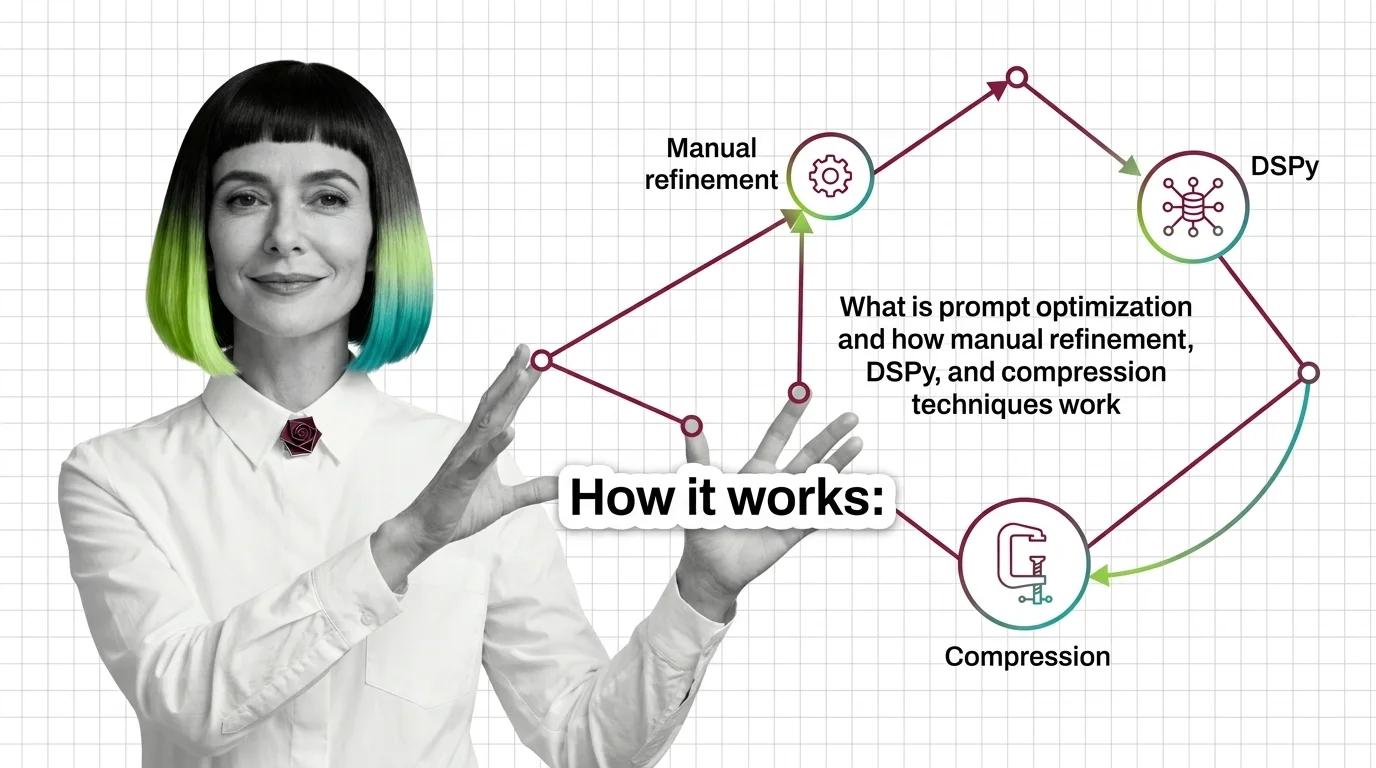
ELI5
Prompt optimization is the systematic process of improving the instructions sent to an LLM — through human iteration, automated frameworks like DSPy, or compression tools that trim redundant tokens while preserving meaning.
There is a phenomenon engineers rarely name out loud: the prompt that works well enough to move into production, then stays frozen forever. Output quality settles into an acceptable range; nobody schedules time to push it higher.
Not broken. Unoptimized.
The gap between what existing instructions produce and what better instructions would produce is never measured — so it is never closed.
The Difference Between a Working Prompt and an Optimal One
The common assumption is that a prompt either works or it doesn’t — either the model follows instructions or it doesn’t. This binary view misses what is actually continuous about prompt quality: there is a spectrum between “produces correct output sometimes” and “produces correct output reliably, efficiently, and with minimal token expenditure.” Most deployed prompts sit somewhere in the lower half of that spectrum without anyone noticing.
What is prompt optimization?
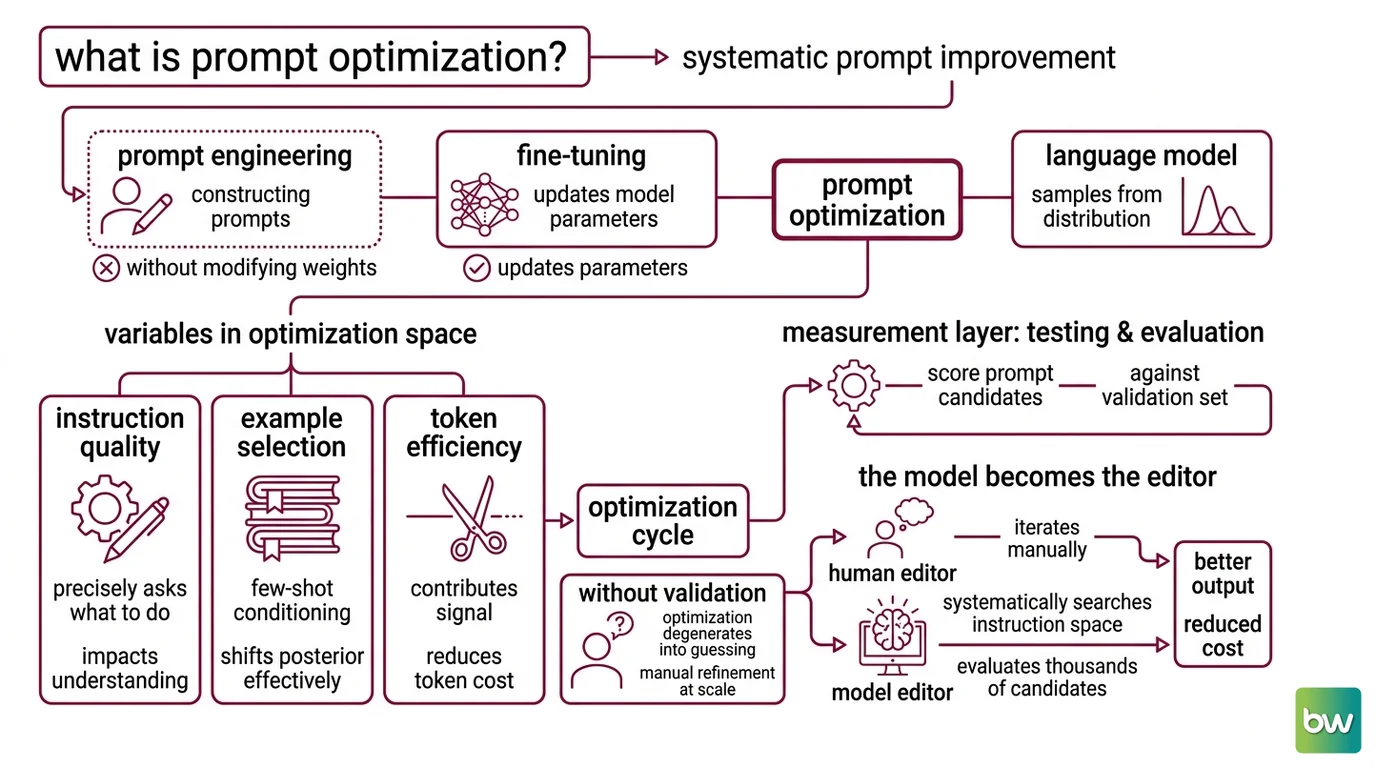
Prompt optimization is the process of systematically improving the instructions sent to a language model to increase output quality, reduce token cost, or both — without modifying the model’s weights. This distinguishes it from Prompt Engineering (the craft of constructing individual prompts) and from fine-tuning (which actually updates model parameters). The target is the probability distribution the model samples from during inference.
A prompt acts as a runtime constraint on that distribution. Optimizing a prompt resembles adjusting a prior in Bayesian inference: you are not changing the model’s learned knowledge, you are changing the conditions under which that knowledge expresses itself in this particular inference pass. A better prior surfaces better posteriors — without touching the parameters that encode the model’s world model.
Three variables define the optimization space. Instruction quality determines what the LLM is asked to do and how precisely. Example selection, when using few-shot conditioning, determines which demonstrations shift the model’s posterior most effectively toward the desired output distribution. Token efficiency — what you include versus what you cut — determines whether each token contributes signal or noise to the sampling process.
Prompt Testing And Evaluation is the measurement layer that feeds every optimization cycle. Without a way to score prompt candidates against a validation set, optimization degenerates into guessing — and guessing at scale is just manual refinement dressed in optimism.
When the Model Becomes the Editor
The interesting architectural inversion isn’t whether humans can improve prompts through iteration. They can. The question is what happens when you replace the human editor with a model that can search the instruction space systematically — evaluating thousands of candidates against a validation set in the time it takes a practitioner to test three.
How does automated prompt optimization work?
The method formalized in the OPRO paper (Yang et al., ICLR 2024) is conceptually direct: use a language model as the optimizer. Provide the current prompt, its measured performance on a validation set, and the task objective. Ask the model to propose a better prompt. Evaluate the candidate. Keep the improvement, discard the regression. Repeat until marginal gains fall below threshold.
OPRO demonstrated up to 8% improvement on the GSM8K benchmark and up to 50% improvement on Big-Bench Hard tasks compared to human-designed prompts (OPRO paper). The effect is real. The standalone google-deepmind/opro reference repository, however, has accumulated only ~12 total commits and targets PaLM APIs that are now deprecated by Google — making the standalone code non-functional for its original targets (Google DeepMind GitHub). The method is well-specified; the reference implementation is not the right access point.
DSPy (v3.2.1, May 2026) operationalizes this approach at production scale. Rather than treating prompts as flat text strings, DSPy treats them as program modules with two learnable parameters: the instruction text and the few-shot examples. Its MIPROv2 optimizer applies Bayesian search jointly over instruction candidates and example selections — finding combinations that outperform what either variable could produce independently. DSPy reports 10–40% quality improvement over manually written prompts on internal benchmarks (DSPy Docs); these figures come from framework documentation rather than independent peer review, so treat them as directional. The production record is less ambiguous: Shopify reported approximately 550× cost reduction after DSPy adoption, and Dropbox, AWS, JetBlue, Databricks, and Replit have adopted it for production use (DSPy Docs).
The optimizer doesn’t write better instructions by understanding the task. It searches the instruction space more exhaustively than any human would bother to.
TextGrad takes a different path. Where DSPy treats optimization as search, TextGrad treats it as differentiation — borrowing the backpropagation metaphor from PyTorch. The framework defines a loss over the model’s output, computes a “textual gradient” (natural language feedback from a judge model), and propagates that gradient back to the prompt. Published in Nature in March 2025 and available as v0.1.6 on GitHub (TextGrad GitHub), it remains research-oriented. One practical caveat: the original LLM engine APIs are deprecated in favor of new LiteLLM-based engines, which are currently experimental — code using the old initialization pattern will need updating before deploying.
The shift from search to differentiation opens different trade-offs. DSPy requires a labeled validation set; TextGrad can accept any differentiable loss, including subjective feedback from a judge model. Which matters more depends on what you can actually measure about your task.
Three Schools of Thought on Prompt Improvement
Not every optimization problem calls for an automated optimizer. The right approach depends on what is actually wrong with the current prompt — and whether that problem is most efficiently attacked through clearer instructions, better examples, or fewer tokens.
What are the main techniques used in prompt optimization?
Manual iterative refinement is the oldest method and the most common by a wide margin. A practitioner edits the prompt, evaluates outputs against some criterion, and revises. Secondary sources suggest iterative refinement yields roughly 10–15% accuracy improvement over initial prompts — though this figure lacks a single controlled benchmark to anchor it; treat it as a rough order of magnitude. The advantage of manual refinement is interpretability: each edit is legible, and the reasoning chain behind it survives for future engineers to understand. The disadvantage is that manual search doesn’t explore the instruction space systematically and saturates quickly as the task grows more complex. Prompt Versioning becomes essential the moment you’re managing more than a handful of candidate prompts — without version control, iterative refinement produces drift without a record of what changed or why.
Automated instruction optimization reframes prompt improvement as a search problem with an objective function. DSPy ships seven optimizers — MIPROv2, BootstrapFewShot, COPRO, BetterTogether, GEPA, SIMBA, and InferRules — each targeting a different region of the cost-quality trade-off (DSPy Docs). MIPROv2 is the most computationally intensive and the most effective: it jointly optimizes instructions and few-shot examples via Bayesian search. Opro is also available inside DSPy as a built-in optimizer module — the better access point than the low-maintenance standalone repository. For tasks where a validation set exists and manual refinement has hit its ceiling, automated optimization tends to find improvements that are invisible to human editors because they involve interaction effects between instruction phrasing and example selection.
Each approach attacks a different failure mode of the same static prompt. Prompt compression targets token efficiency, not instruction quality. Prompt Compression approaches treat the existing prompt text as an information source with uneven density — some tokens carry decision-relevant signal, others are scaffolding that survives drafts because nobody removed it. LLMLingua (EMNLP 2023) uses a small language model (GPT-2-small or LLaMA-7B) to score token salience and drop low-information tokens, achieving up to 20× compression with less than 1.5 points of performance loss (Microsoft Research). Its successor, LLMLingua-2 (ACL 2024), is task-agnostic: GPT-4 distillation trains a BERT-level encoder for token classification, achieving 80% token reduction at 3–6× the inference speed of its predecessor (Microsoft Research). For long-context prompts where latency and cost are constraints, compression offers meaningful gains without touching instruction logic.
These approaches compose. Structured Output Prompting pairs naturally with optimization — more precise instructions specify output structure more clearly, and tools like Instructor and BAML enforce JSON Schema compliance at the output layer, turning ambiguous instructions into validated structured data. Constrained Decoding tightens this further by restricting the model’s token choices at generation time, encoding format constraints into the sampling process rather than relying on instructions alone. An optimized prompt combined with constrained decoding and Prompt Injection-resistant instruction design is structurally harder to subvert than a sprawling prompt assembled without any of these layers.
Security & compatibility notes:
- TextGrad engine migration (WARNING): Original LLM engine APIs deprecated; new LiteLLM-based engines are required and remain experimental. Code using direct
get_engine("gpt-4o")initialization will break — see TextGrad GitHub for the migration path.- OPRO standalone repo (WARNING): Reference implementation at google-deepmind/opro has ~12 commits total; PaLM/text-bison API targets are deprecated by Google, making the standalone code non-functional for those targets. Access OPRO logic via DSPy’s built-in OPRO optimizer module.
- LLMLingua v1: Superseded by LLMLingua-2 for new implementations — 3–6× faster and more accurate out-of-domain (Microsoft Research).
The three approaches are not mutually exclusive — but where you start depends on what your measurement infrastructure can already support.
What Optimization Reveals About Prompt Geometry
Automated optimization doesn’t only produce better prompts. It produces evidence about why the original prompts were underperforming — and the pattern that evidence reveals is consistent enough to be informative.
When an optimizer consistently outperforms a human-written prompt on a validation set, the gap usually traces back to one of three root causes. The instruction was ambiguous in a way that only becomes visible at scale — across edge cases the engineer didn’t test during manual refinement. The few-shot examples contained a distributional bias that steered the model toward outputs that looked correct on the majority case but failed on the tail. Or the prompt contained informative-seeming text that was actually zero-gradient: present in every candidate, never predictive of output quality, and therefore never discovered through human editing because nothing changed when it was there.
If your task is adversarially contested — where users might deliberately push the model toward unintended outputs — a tighter, optimized prompt is structurally more resistant than a sprawling one. Optimization removes the slack that injection attacks exploit.
The optimizer has no way to distinguish between “this instruction is accurate” and “this instruction scores well on the metric” — those two things are only the same when the validation set is a precise specification of the actual goal.
When it breaks: Automated optimizers require a reliable validation set to evaluate candidates — when ground truth is expensive, ambiguous, or poorly specified, the optimizer converges on prompts that score well on the metric while failing the actual intent. This is Goodhart’s law applied to instruction search: the measure becomes the target. Prompt compression can catastrophically degrade performance on tasks where a clause that appears semantically redundant carries critical constraint information — the small language model scoring token salience has no access to the downstream task’s semantics. And the DSPy benchmark figures should be treated as directional: 10–40% improvement on internal benchmarks does not guarantee the same range on a novel task with different output structure and different failure modes.
The Data Says
DSPy v3.2.1 ships with seven optimizers and a documented production record across multiple large organizations — directional evidence that automated prompt search finds improvements manual iteration misses. LLMLingua-2 achieves 80% token reduction at 3–6× the inference speed of its predecessor (Microsoft Research), suggesting most production prompts contain more redundant text than their authors recognize. The NAACL 2025 survey on prompt compression was selected as an oral presentation — a signal that compression has matured from an engineering trick into a studied discipline with its own benchmark methodology.
AI-assisted content, human-reviewed. Images AI-generated. Editorial Standards · Our Editors