What Is Prompt Chaining and How Sequential LLM Calls Enable Complex AI Reasoning
ELI5
Prompt chaining connects multiple LLM calls in sequence — each call’s output becomes the next call’s input. Instead of one prompt handling everything, you build a pipeline where each step handles exactly one focused part of the problem.
Here is a common engineering assumption that leads to predictable failure: if a complex AI task produces poor results, the prompt needs improvement. Spend another hour refining it. Add more context. Be clearer about the output format.
The assumption is wrong.
Not the prompt. The architecture.
A single LLM call processes one input, generates one output, and retains no memory of what came before — unless you embed that memory explicitly. When you load a single call with three competing objectives, attention distributes across all of them rather than focusing on any one. The model satisfies all constraints in aggregate, approximately. It will not fail loudly; it will produce output that looks plausible but misses each objective by a margin.
Prompt Chaining addresses this not by improving the prompt, but by changing the architecture. Each subtask becomes its own Inference call, focused on one transformation. The outputs connect in sequence. The mechanism is structural, not linguistic.
The Arithmetic of Sequential Inference
Each LLM call is stateless. It processes its input, generates its output, and retains nothing. The next call starts from scratch — with exactly the context you provide and nothing more. Prompt chaining turns this constraint into a design principle: one call, one responsibility; explicit state passed between each.
What is prompt chaining in AI?
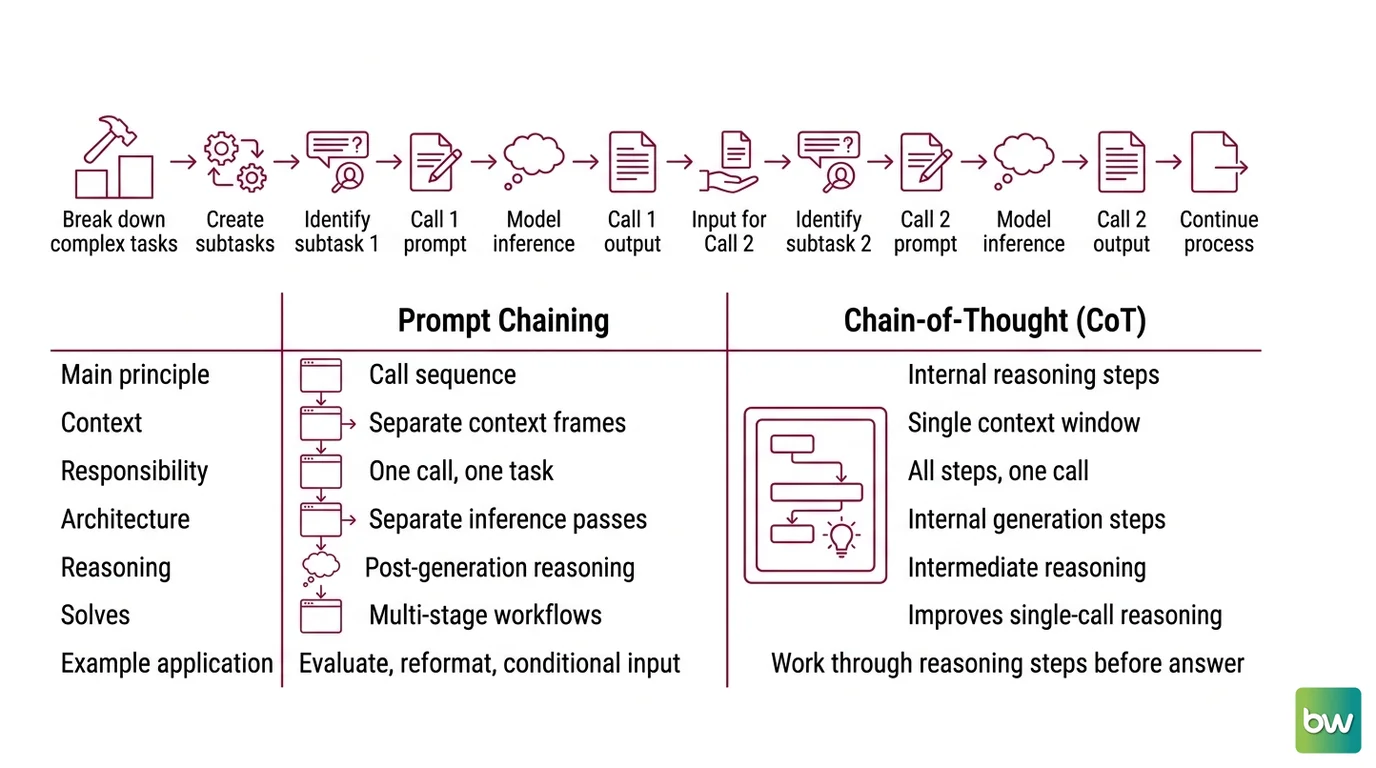
Prompt chaining decomposes a complex task into subtasks. Each subtask is sent to the model as a separate API call, with a focused prompt written for exactly that step. The output of each call becomes the input for the next — the mechanism is compositional in the same way function composition works in code, except the functions are LLM calls and the return values are natural language or structured data (Prompting Guide).
This is distinct from Chain-of-Thought prompting in a way that matters architecturally. Chain-of-thought, formalized by Wei et al. in 2022, asks the model to work through intermediate reasoning steps within a single prompt — one call, one Context Window, one probability distribution. The intermediate steps happen inside the generation. Prompt chaining issues separate calls for separate stages; each step receives its own inference pass, its own context frame, and produces its own output before the next step runs (AirOps Blog).
They solve different problems. Chain-of-thought improves reasoning quality within a single call by nudging the model to articulate intermediate steps before committing to an answer. Prompt chaining enables multi-stage workflows where the output of one operation must be evaluated, reformatted, or used as the conditional input for an entirely different operation.
Consider extracting payment terms from a contract, translating each term into German, then checking each translated term against EU consumer protection rules. Three tasks, three different attention requirements. One prompt attempting all three will produce approximate results at each stage. Three calls — one per task, each with a focused instruction set — produce inspectable output at every step.
How does prompt chaining work step by step?
The operational pattern is consistent regardless of the framework. A first prompt runs; the response is captured as a variable. That variable is embedded into the second prompt — substituted into a template or appended as context. The second model call runs. Its output becomes the input for the third. The sequence continues until the final call produces the target artifact.
In practice, a three-stage chain distributes work like this:
- Extraction stage — The prompt instructs the model to parse the source document and return a defined JSON structure. No analysis is requested; only extraction. The output is a typed data object.
- Transformation stage — The JSON from stage one is embedded into a prompt that asks for translation or reclassification. The model receives clean structured input and one clear instruction. Nothing from the original document is in this context unless stage one’s output included it.
- Validation stage — The transformed output is submitted to a prompt that checks for consistency, completeness, or policy compliance. The model returns a verdict — a boolean and a rationale — which the orchestrating code uses to decide whether to continue or halt.
Each stage issues a separate API call. The logic connecting them — what gets passed, how it is formatted, what happens on failure — lives in your application code, not in any model. The context window at each step contains only what that step needs, which reduces token consumption and limits the probability that irrelevant earlier content pulls the generation off course.
The Anatomy of a Functional Chain
Stringing API calls together is not a prompt chain — it is a sequence of calls. A functional chain is a data pipeline with defined contracts at every boundary: what each stage accepts, what it produces, and what should happen when a stage delivers output outside those contracts. The same engineering discipline that governs any pipeline applies here, and every stage boundary is a contract.
What are the building blocks of a prompt chain?
Every functional prompt chain has four components.
Stages are individual LLM calls, each with a single well-defined objective. A stage prompt requests exactly one transformation: extract, classify, translate, summarize, validate. When a stage’s prompt includes multiple objectives, the model averages across them rather than satisfying each in turn, and precision degrades at every conflated step.
State is the data structure that flows between stages. It might be a plain string; in more complex pipelines, it is a typed object carrying the original input, the outputs of all prior stages, and metadata — which model ran each step, latency measurements, flags from validation stages. Explicit, typed state management is what distinguishes a chain from a sequence of loosely coupled calls.
Gates are conditional checks that run between stages. A gate inspects the prior stage’s output before allowing the chain to proceed. If the extraction stage returns an empty object, the gate halts the chain rather than passing empty input to the transformation stage — where the model would produce confident-sounding prose about nothing. Gates can be deterministic (JSON schema validation, regex checks) or can themselves be model calls that score output quality before the next stage runs.
Branches handle cases where the next stage depends on the semantic content of the prior output. A classification stage might route to a German translation path or a legal review path depending on the document type detected. Branches increase orchestration complexity but allow the chain to adapt to the content of its own outputs, which a linear sequence cannot.
Modern frameworks express this structure through composable primitives.
LangChain’s Expression Language (LCEL) uses a pipe operator — prompt | llm | parser — to define chains declaratively (LangChain Docs). Note that LLMChain and SequentialChain, the older LangChain APIs, were removed in version 1.0 in September 2025; current chain definitions use RunnableSequence via the | pipe syntax.
Pydantic AI 2.0.0, released June 23, 2026, takes a capabilities-first approach: composable primitives called Capabilities bundle tools, hooks, instructions, and model settings into reusable units across multiple agents or chain stages (pydantic-ai changelog).
What do you need to understand before building prompt chains?
Three concepts determine whether a chain behaves predictably in production.
Context window economics. Every stage consumes tokens: the prompt, any prior output embedded in it, and the model’s response. In a multi-stage chain where each stage passes its output downstream, cumulative token consumption grows with each step. A verbose extraction stage that returns extensive prose to the transformation stage is passing context the transformation stage does not need — and that context competes with the transformation instructions for attention. Summarize or trim intermediate outputs to carry only what the downstream stage actually requires.
Error propagation geometry. A chain has no intrinsic error correction. If a gate is absent between stages two and three, and stage two produces malformed output, stage three receives that malformed output as its input. The error compounds; by the final stage, the output is wrong in ways that trace back to a parsing failure several steps earlier. The model at the final stage has no access to the original data, no ability to detect the upstream error, and no signal that something broke. This is not a model limitation. It is a pipeline design property, directly addressable with gates.
Output contracts. Each stage must produce output in a format the next stage expects. If a prompt asks for JSON and the model returns prose with JSON embedded in a markdown block, downstream parsing breaks. Structured Output modes — available across major providers — enforce the schema at the API layer, significantly reducing parsing failures. A dedicated normalization stage can also clean inconsistent output before it propagates. Either approach works; the constraint is that downstream stages receive what they expect, not what the model found convenient to produce.
Where Chains Break, and Why the Failures Are Predictable
Understanding the mechanism makes the failure modes specific enough to anticipate.
If you increase the number of stages without adding gates, error compounding is the expected outcome. Each stage introduces some probability of producing malformed or off-target output. Without checkpoints, that probability accumulates. The failure mode is characteristically a coherent but incorrect final output: the chain completed without raising an exception, the model never signaled a problem, and the answer is wrong for reasons traceable to a single corrupted intermediate result.
If you reduce the scope of each stage to one focused objective, output precision improves. The model at each stage attends to one instruction set, not several. This is the same principle that makes function composition reliable in code: a function that does one thing can be verified and reused. A function that does three things cannot be cleanly verified at any one of them.
If you add schema-enforced output contracts at every stage boundary, you should observe earlier and more legible failures — not a wrong final answer at the end of a long chain, but an error at the exact stage where the data broke, with the malformed value available for inspection.
Rule of thumb: If you cannot describe a task as a sequence of single, named transformations — each with a defined input type and a defined output type — it is not a candidate for a linear chain. Use branching logic, parallel chains, or reconsider whether the task is correctly decomposed.
When it breaks: Prompt chains fail most often when state is passed as unstructured prose between stages. The downstream stage receives text that is ambiguous in format, length, and completeness, then interprets it according to whatever the model’s prior distribution assigns highest probability. The fix is almost never rewriting the upstream prompt — it is enforcing a typed output contract at the stage boundary.
Security & compatibility notes:
- LangChain API (BREAKING):
LLMChainandSequentialChainwere removed in LangChain v1.0 (September 2025). Build prompt chains usingRunnableSequencevia the LCEL|pipe operator. Code from pre-1.0 tutorials will not run on current versions.- pydantic-ai (CVE-2026-25580 / CVE-2026-46678): Two SSRF vulnerabilities affected earlier pydantic-ai versions. Both are fully remediated in v2.0.0 (current as of June 2026). Pin to v2.0.0+ or verify your installed version before use.
The Data Says
A prompt chain does not make the model smarter — it makes the problem smaller at each step. The model at any given stage does not know it is part of a chain; it processes its input and generates its output, stateless. What changes is how information is structured and verified between calls. The technique’s reliability comes not from the model’s capabilities at each stage, but from the contracts enforced between stages. Chains with explicit gates and typed output formats fail loudly and early; chains without them fail quietly and late.
AI-assisted content, human-reviewed. Images AI-generated. Editorial Standards · Our Editors