What Is Multimodal Prompting and How Vision-Language Models Process Images, Audio, and Text Together
ELI5
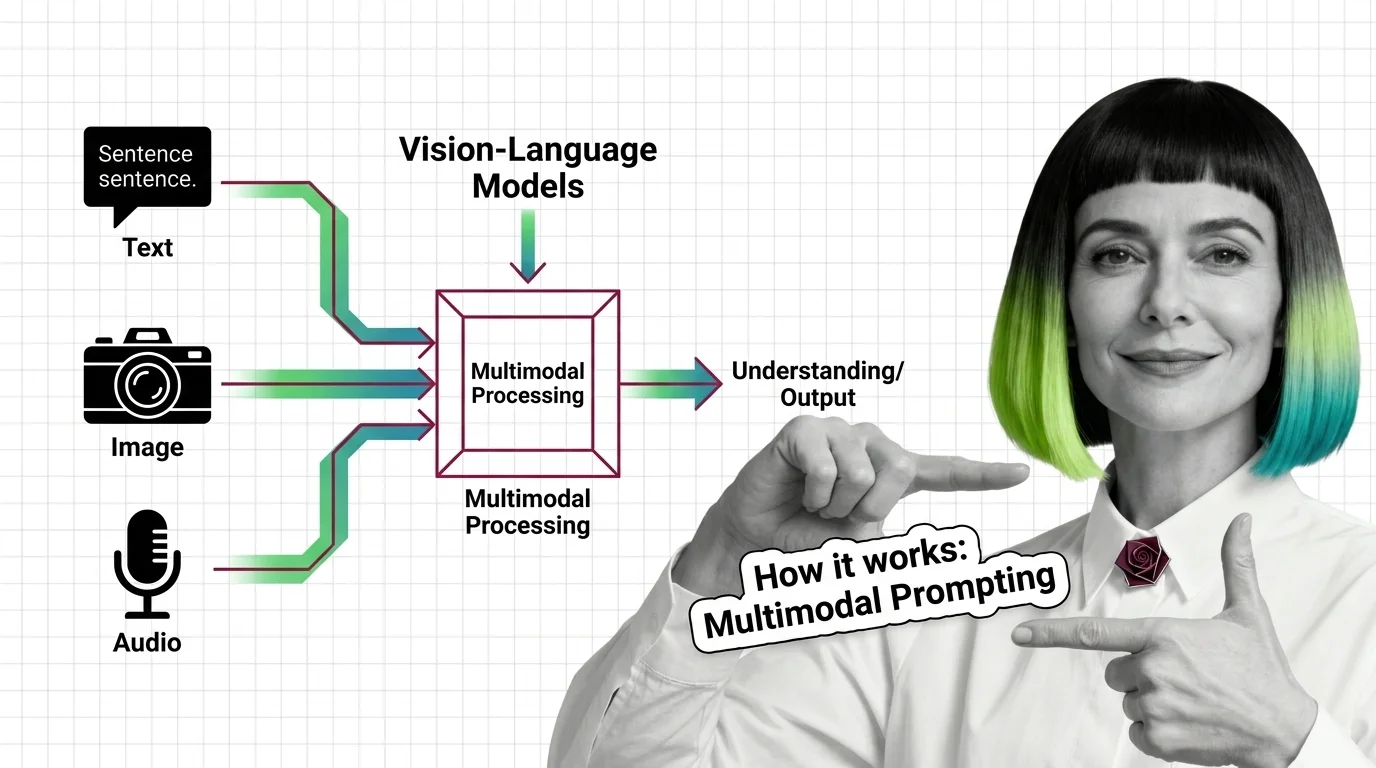
Multimodal prompting sends images, audio, or video alongside text in one query. A vision encoder converts each image into token-like numbers; the LLM then reasons across both image and text in a single attention pass.
Something counterintuitive happens when you send a photo of a hand-written invoice to a vision-language model and ask it to extract line items as JSON. The model returns a structured table — but it never “looked at” the image the way you imagined. Not a pixel scan. A sequence of numbers derived from fixed-size patches, projected into the same vector space as the words in your prompt. The image arrived as tokens. The LLM attended to them the way it attends to everything else: statistically, in sequence, conditional on what came before.
What the Model Actually Receives When You Send a Photo
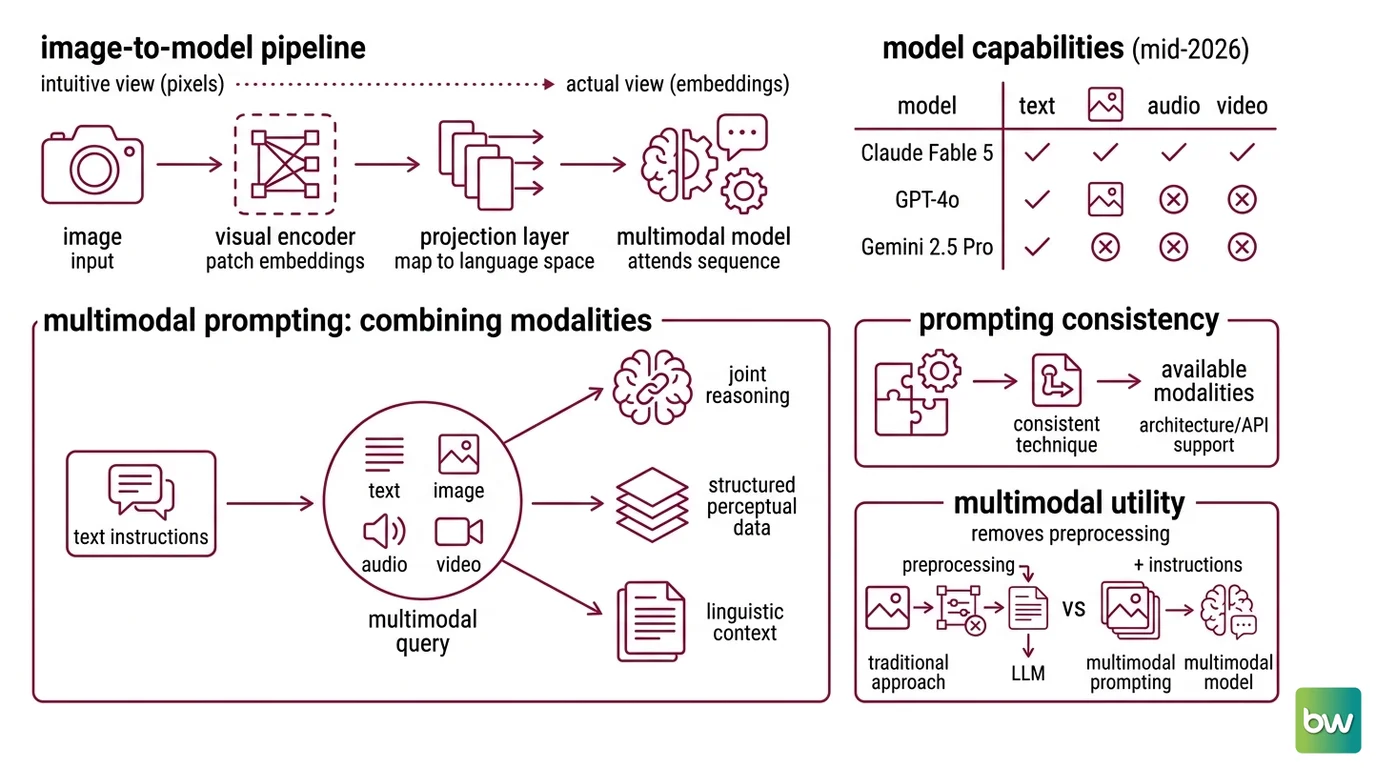
The intuition most developers carry into their first multimodal integration is wrong in an interesting way. We imagine the model “looking at” an image — some spatial, pixel-level scan followed by semantic interpretation. The reality is a three-stage pipeline: a visual encoder converts the image into patch embeddings, a projection layer maps those embeddings into the LLM’s token space, and the language model attends to the resulting sequence the same way it attends to text tokens. The image never exists as an image inside the model.
Not an image. A vector sequence — patch embeddings projected into language space.
What is multimodal prompting
Multimodal Prompting is the practice of combining text with one or more additional modalities — image, audio, or video — in a single model query, so the model can reason across all inputs simultaneously. It extends Prompt Engineering into the spatial and temporal domains: instead of sculpting a purely linguistic input, the prompt now contains structured perceptual data alongside natural language instructions.
The “multimodal” qualifier carries an important asterisk, because not all models support all modalities. As of mid-2026, Claude Fable 5, Mythos 5, Opus 4.8, Sonnet 4.6, and Haiku 4.5 all accept images alongside text but do not process audio (Anthropic Docs). GPT-4o accepts text, audio, image, and video in a single query and generates responses in multiple formats including audio — a genuinely end-to-end multimodal pipeline, with audio response latencies comparable to human conversation (OpenAI GPT-4o). Gemini 2.5 Pro supports audio natively as well. The prompting technique is consistent across these models; the available modalities are determined by architecture and API support.
The underlying utility of multimodal prompting is that it eliminates a preprocessing step. Instead of extracting text from an image before passing it to an LLM, you pass the image directly — and the model infers what matters from the combined context of your text instruction and the visual content. Instruction Following in this setting means the model must jointly interpret the language of your request and the visual structure of the input, without separating those concerns into distinct passes.
Difference between multimodal prompting and text-only prompting
In text-only prompting, the Context Window contains exactly one type of token: subword units from the model’s vocabulary. In multimodal prompting, the context window contains at least two types — text tokens and visual tokens — and the model’s attention mechanism must learn to relate these across modality boundaries.
The cost difference is material. A standard text query might consume a few hundred tokens. The same query with a 1000×1000-pixel image attached adds approximately 1,296 visual tokens derived from 28×28-pixel patches, as Anthropic documents for Claude. Larger images or multiple images multiply the token budget accordingly — a 1024×1024 image processed through a ViT-based encoder with 16×16 patches can produce roughly 4,096 visual tokens (Label Your Data). Token budget management — what practitioners call Context Engineering — becomes significantly more constrained once images enter the mix, because visual tokens and text tokens compete for the same fixed capacity.
The other structural difference is the source of variation. Text prompts produce output variation along linguistic dimensions; multimodal prompts introduce a second axis: the visual content itself. Two prompts with identical text but different images produce different outputs — not because the text changed, but because the visual token sequence shifted the conditional probability distribution the model samples from. This is not a failure mode. It is the mechanism working exactly as designed.
How the Vision Encoder Translates Pixels Into Token Space
The bridge between image and language is more mechanical than magical — and understanding it changes how you write prompts. Three components form the pipeline. First, a visual encoder, almost always a Vision Transformer variant, divides the image into fixed-size patches and converts each patch into a dense Embedding vector. Second, a projection layer — typically a multilayer perceptron — maps these vision embeddings into the LLM’s embedding space, creating visual tokens the language model can process directly. Third, the LLM decoder receives the concatenated sequence of visual tokens and text tokens and runs self-attention over the full joint sequence.
The encoder choices in current production models include CLIP, SigLIP, EVA-CLIP, and InternViT — all variants of the vision transformer architecture (HuggingFace VLM Design). The projection layer is what makes them interoperable with language models: without this alignment bridge, visual embeddings would occupy a different region of the vector space than word tokens, and the attention mechanism would treat them as unrelated noise. The CLIP Model family of vision encoders gained early adoption in part because CLIP pretraining aligns image representations to language descriptions during training — a head start for downstream fusion.
How do vision language models process image and text inputs at the same time
The process begins before the LLM sees anything. The image is passed to the visual encoder, which splits it into a grid of patches. In common implementations, each patch is 16×16 pixels; a typical 1024×1024 image produces around 4,096 patch tokens (Label Your Data). Each patch is projected to a fixed-length embedding vector. These vectors then pass through the projection layer, which maps them into the same dimensional space as the LLM’s text token embeddings.
At this point, the model receives what looks like a long token sequence — some tokens derived from image patches, others from the tokenized text of your prompt. The LLM’s self- Attention Mechanism operates over this full joint sequence: each text token can attend to each visual token, and vice versa. The model learns during pretraining to extract cross-modal relationships from these joint attention patterns. A patch embedding representing a sharp edge can activate alongside the text token for “boundary”; a patch embedding from a region containing dense text can align with tokens in the prompt that reference printed content.
Not all VLM architectures implement this fusion identically. Early models used cross-attention layers between visual and text streams, keeping the modalities more separated during processing. Current open-source models overwhelmingly use the interleaved-token approach — prepending visual tokens directly to the text sequence — because it integrates with standard decoder architectures without modification (HuggingFace VLM Design). The cross-attention fusion approach is largely deprecated in mainstream open-weight models.
Audio modalities follow an analogous pipeline: an audio encoder converts the waveform into spectral embeddings, a projection layer maps those into token space, and the LLM attends to the joint audio-text sequence. Once any perceptual signal is projected into the LLM’s embedding space, it is mechanically indistinguishable from text tokens — the attention mechanism applies the same operations regardless of modality origin. The Visual Question Answering task sits at this intersection: a model receives an image and a natural language question, then generates a correct natural language answer by attending to the joint token sequence and retrieving information from the visual tokens to satisfy a linguistic constraint (arXiv VQA Survey).
What the Architecture Predicts About Your Prompts
Once you understand that visual tokens and text tokens occupy the same attention space, the behavior of multimodal models becomes more predictable — and more controllable. The text portion of your prompt doesn’t just instruct the model; it shapes which visual features receive attention weight during inference.
If your text prompt focuses on one region of the image (“examine the upper-right corner”), the model shifts attention mass toward the tokens derived from that part of the image. If your System Prompts establish a specific analytical framework before the image is presented, that framework constrains how the model interprets ambiguous visual features. Role Prompting — assigning a domain-specific persona before the image arrives — changes which visual details surface in the response, because the persona shifts the probability distribution over descriptive vocabulary. A radiologist persona and a product designer persona, given the same image, will produce descriptions that diverge along the dimensions their respective priors emphasize.
For sequential visual analysis, Multi-Turn Prompt Design matters in a specific way: the model’s visual token sequence is fixed at the first turn (the image doesn’t change), but subsequent text turns can refocus attention on different visual regions by altering the linguistic context in which those tokens are interpreted. Structured extraction tasks — pulling line items from invoices, reading fields from forms, transcribing handwritten notes — benefit from Structured Output constraints that force the model to account for each visual region in a specified format, reducing the probability of omissions or hallucinated fields.
Meta Prompting strategies — prompting the model to generate its own analysis plan before executing it — can improve accuracy on complex visual reasoning tasks, but require careful token budgeting because the reasoning chain competes with visual tokens for context space. On longer documents with multiple images, the token budget can become the primary architectural constraint, not the model’s visual understanding.
On the security side, Prompt Leakage acquires a new vector in multimodal settings. Adversarial text embedded in images — white text on a white background, or text hidden in image metadata that some pipelines surface — can be processed by the visual encoder and potentially expose content from the system prompt in the model’s output. This attack surface is distinct from text-injection prompt injection and requires image-specific mitigations.
Rule of thumb: treat visual tokens the way you treat dense text passages — they consume context budget, respond to linguistic framing, and compete for the model’s attention. A precise text prompt doesn’t just help the model understand what you want; it configures the attention space the model uses to read your image.
When it breaks: multimodal models hallucinate visual details that aren’t present in the image, particularly when the text prompt creates strong linguistic expectations the visual tokens don’t fully satisfy. A 2025 study found that structured reasoning prompts — including Chain-of-Thought approaches — may increase hallucination rates in smaller multimodal models, where token budgets are tighter and visual representations are more aggressively compressed (arXiv Adaptive Prompting, April 2025). This finding comes from a single paper and should be treated as a hypothesis under investigation rather than established consensus — but it suggests that adaptive prompting strategies, rather than uniform reasoning chains, are worth exploring when working with smaller or quantized VLMs.
Security & compatibility notes:
- Chain-of-thought in small multimodal models: A 2025 study (arXiv:2504.10179) reports structured reasoning prompts may increase hallucination rates in small multimodal LLMs. Results are from a single paper; replicate cautiously before applying to production pipelines.
- Google Imagen API: Deprecated and shut down June 24, 2026. Image generation via Google APIs now routes through the Gemini Image model family (Gemini API changelog).
The Data Says
Visual tokens and text tokens compete in the same attention space — which means every multimodal prompt is simultaneously a resource allocation decision and an attention-configuration choice. The text you write doesn’t just instruct the model; it shapes which features of the image become statistically relevant during generation. Multimodal prompting is not a separate discipline added on top of language prompting. It is the same probabilistic mechanism, extended to perceptual inputs that arrive as structured number sequences rather than words.
AI-assisted content, human-reviewed. Images AI-generated. Editorial Standards · Our Editors