What Is Multi-Turn Prompt Design and How Context Accumulates Across LLM Turns
ELI5
Multi-turn prompt design structures LLM conversations across multiple exchanges by including the full message history in every API request. There is no server-side memory — the model reconstructs context from the token array it receives each time.
Every conversation you have with an LLM feels continuous. The model appears to remember the constraint you stated in the opening message, the example you offered three exchanges back, the correction you made when it went off course. The thread holds together.
The model does not remember any of this.
Not memory. Reconstruction.
What you experience as conversational continuity is the result of deliberate architectural plumbing: every time you send a message, the full conversation history is resubmitted as tokens, and the model generates its next response as though encountering the entire context for the first time. Understanding this mechanism — not just its surface behavior, but the underlying mechanics — is the difference between designing multi-turn sessions that stay coherent and ones that quietly drift into confident incoherence after a dozen exchanges.
The Stateless Machine Behind Every Conversation
An LLM inference pass is stateless: no memory persists between calls, and no hidden channel carries information forward. Each call is a fresh computation over the token sequence it receives as input — and that sequence must contain everything the model needs to know to produce a useful response.
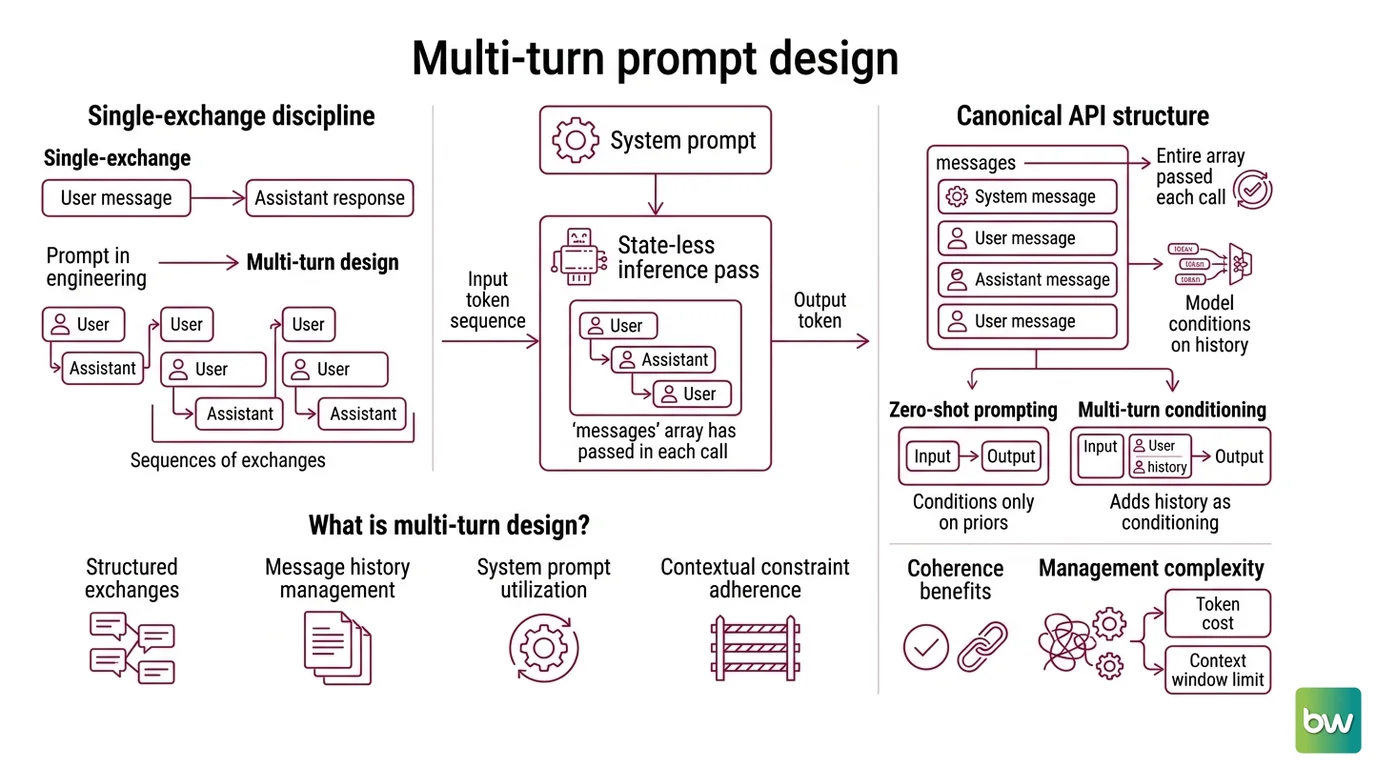
Prompt Engineering began as a single-exchange discipline: craft the input carefully and the model produces useful output. Multi-turn design extends this to sequences of exchanges, where what you establish in the first message shapes the conditional probability landscape for every message that follows. The design challenge is not primarily technical; it is compositional — deciding which information needs to persist across turns, in what form, and at what token cost.
What is multi-turn prompt design?
Multi-turn prompt design is the practice of structuring a sequence of LLM exchanges — through deliberate management of message history, System Prompts, and contextual constraints — so the model produces goal-directed, coherent responses across many turns rather than just one.
The canonical API structure is straightforward. Every call passes a messages array of alternating user and assistant entries, along with a system prompt that establishes the operating rules for the session. The model sees this entire array on each request; it does not receive a summarized history (OpenAI Docs). It does not perceive a “conversation.” It perceives a single continuous token sequence from which it infers the next plausible continuation.
This distinction matters mechanically. In Zero Shot Prompting, the model conditions only on its pre-trained priors — there is no history to attend to. Multi-turn design adds that history as additional conditioning, which creates coherence benefits (the model can reference prior context) and management complexity (that history costs tokens and eventually fills the window). The tradeoff is architectural, not incidental.
Role Prompting illustrates the dependence precisely. A persona established in the system prompt shapes every subsequent assistant response — but only if that system prompt is included in every API request. Remove it from a later call and the model’s next response has no role constraint to condition on. Only the system prompt survives every rebuild — and it survives because the developer includes it on each call, not because the model retains it between calls.
How does an LLM maintain conversation context across multiple turns?
The mechanism is literal concatenation. Each new user message appends to the messages array; the full array is transmitted with every API call; the model processes all preceding turns as input tokens before generating its response. There is no retrieval step. There is no database lookup. There is only the prompt, growing larger with each exchange.
Architecturally, attention is the instrument through which prior turns influence the next response. Every token in the current sequence attends to every previous token within the Context Window, weighted by learned attention scores. The model does not “recall” turn three; it attends to turn three’s tokens as part of the same sequence it is currently processing — with the same mechanism it uses for every other position in the input.
This has a precise implication: the effective influence of any given prior turn is bounded both by whether it fits inside the context window and by the attention weight it receives relative to everything else in the sequence. A constraint stated in turn one is available to the model in turn twenty — but it competes for attention with every token added since. Research on multi-turn interaction dynamics (arXiv 2510.07777) suggests that context drift — the gradual shift in the model’s apparent framing or goal-directedness — stabilizes at finite levels rather than growing without bound, and that lightweight goal reminders injected periodically can reduce it substantially.
Practically: if a constraint established early in a session is critical to the coherence of later turns, restating it in the system prompt of every request is not redundancy. It is Instruction Following hygiene — ensuring the constraint appears in every call at a fixed, predictable position in the token sequence, where it will receive consistent attention weight rather than drifting toward the periphery as the conversation grows.
For tasks requiring Structured Output formats across multiple turns, anchoring the format specification in the system prompt ensures it appears in every API call at a consistent position and token cost, rather than depending on each user turn to restate it correctly.
The OpenAI Responses API offers a previous_response_id parameter that handles history reconstruction automatically — the client links turns by ID rather than rebuilding the messages array manually, with history retained for 30 days by default per current documentation (OpenAI Docs). This is a convenience layer over the same mechanism: the underlying token concatenation still occurs on every request.
One technique borrowed from Meta Prompting — directing the model to summarize or reorganize prior context as part of a turn — can help manage long-session drift by compressing the informational content of older turns before their token cost compounds against the window limit. The model does not summarize its own memory; the developer prompts it to produce a compressed representation that replaces the verbatim history for subsequent calls.
The Geometry of a Filling Window
Every token in the messages array occupies capacity. The context window is finite, and multi-turn conversations consume it linearly with each exchange. The constraint is not abstract — it determines what the model can coherently consider when generating each response.
Current production models offer substantially larger windows than their predecessors. Claude Sonnet 4.6 supports a 1M-token context window, as does GPT-4.1 (Anthropic Docs; OpenAI Docs). GPT-4o operates at 128K tokens and remains the most widely deployed baseline for many production applications (OpenAI Docs). The window size sets the hard upper bound on how long a coherent session can run before something must give.
What happens when a context window fills up in a multi-turn LLM conversation?
When cumulative message history exceeds the available context window, one of three outcomes follows — and which one depends entirely on how the system was designed, not on any automatic model behavior.
Hard truncation drops the oldest messages from the array. The model loses access to early turns. Instructions established at session start, persona definitions that shaped the conversation, constraints the user specified in the opening message — all of it disappears from the computation. The model’s responses change not because it made an error, but because the information it was conditioning on no longer exists in the token sequence it receives. Hard truncation is simple to implement and dangerous to operate without explicit awareness that it is happening.
Rolling summarization replaces older turns with a compressed representation, preserving semantic content at reduced token cost. This is the foundation of what is now a dominant pattern in production agentic systems: a hierarchical structure with a hot layer of recent turns kept verbatim and a warm layer of older turns maintained as running summaries (AgentMarketCap). Sessions can extend past the raw context limit while key information remains accessible — and the summarized warm layer is often more useful than raw verbatim history, because it strips noise and preserves signal.
Active Context Engineering takes the most deliberate approach: the developer manages what enters the context on each turn, injecting only the information relevant to the current exchange. This requires the most upfront design work but produces the most controlled behavior in long-horizon tasks, where the distinction between “available context” and “useful context” matters most.
Context limits are architectural decisions, not error conditions. A system that reaches its window limit without a defined strategy does not fail gracefully — it fails silently, dropping information without notification, producing responses that appear confident and coherent but are conditioned on an incomplete version of the intended context. The model has no way to signal that it cannot attend to something it can no longer see.
Fragmentation is the failure mode on the opposite end. Splitting what could be a single well-specified request into multiple sequential turns introduces accumulation risk without the coherence benefits that genuinely multi-turn tasks provide. Illustrative comparisons from multi-turn evaluation research suggest a meaningful performance gap between cohesive single-turn prompts and fragmented multi-turn approaches (Confident AI), though that finding comes from a blog analysis rather than a peer-reviewed study and should be treated as directional rather than authoritative.
What the Token Accumulation Predicts
The mechanism generates testable predictions. Each follows directly from the architecture, not from heuristic observation.
If you embed a critical constraint in an early user turn without echoing it in the system prompt, expect that constraint to carry less effective weight as the conversation grows. Attention distributes across more tokens with each exchange; any given prior instruction receives a proportionally smaller share of the model’s attention.
If your session crosses from early to mid-length without a summarization or pruning strategy, expect the model’s apparent goal-directedness to shift gradually — and syntactically smoothly, which is what makes the drift easy to miss. The model continues producing fluent responses. They are conditioned on a different effective context than the one you intended.
If a user’s conversation wanders through multiple subtopics before arriving at the actual question, the model must attend to all accumulated context while generating its final response. The result often looks like topic contamination: the model draws on semantically proximate content from earlier in the session, even when the user intends a clean pivot.
Prompt Leakage — where sensitive or irrelevant context surfaces in responses — is partly a consequence of this same concatenation architecture. Everything in the messages array is attended to. If a prior turn contains information that should not influence the current response, the only reliable way to prevent that influence is to exclude that turn from the array before the request is sent.
Rule of thumb: treat every exchange as contributing permanent tokens to the current request. Front-load critical constraints in the system prompt. Restate key invariants at intervals proportional to the session’s expected length. Decide on a truncation or summarization strategy before the first turn is complete, not when the window starts filling.
A survey of multi-turn interaction failure patterns in production systems (arXiv 2504.04717) confirms that the failure modes most consistent with what the architecture predicts are also the hardest to catch — precisely because neither produces an error message.
When it breaks: Multi-turn design fails most visibly when accumulated context surfaces in responses where it should not appear — through prompt leakage or the model attending to turns the user assumed were no longer relevant. It fails more consequentially, and silently, when critical instructions drop out of the window and the model produces coherent responses conditioned on an incomplete version of the intended context.
The Data Says
A multi-turn conversation is not a dialogue stored on a server. It is a single, ever-growing token sequence, rebuilt from scratch on every API call, with the context window as the only form of memory available. Every token costs attention budget — and the model cannot give more weight to the important parts unless the architecture ensures they are distinguishable from the noise. Designing for multi-turn coherence means designing that sequence deliberately: deciding not just what to say next, but what to carry forward, what to compress, and what to let go before the window fills.
AI-assisted content, human-reviewed. Images AI-generated. Editorial Standards · Our Editors