What Is LLM Cost Management and How Token-Based Pricing Scales in Production
ELI5
LLM cost management is the discipline of measuring, predicting, and controlling how much you spend on token-based AI inference — before the bill arrives at production scale.
Something happens between a test environment and scale that most teams don’t model in advance. At a few thousand API calls per day, the cost feels like a known quantity: multiply average tokens per request by the per-token rate. At a hundred thousand calls per day, the invoice looks like a different function. Not because the pricing changed. Because the cost drivers interact in ways that aren’t visible at test volume.
The relationship isn’t linear. And the first large production invoice is usually when that becomes obvious.
The Ledger Behind Every API Call
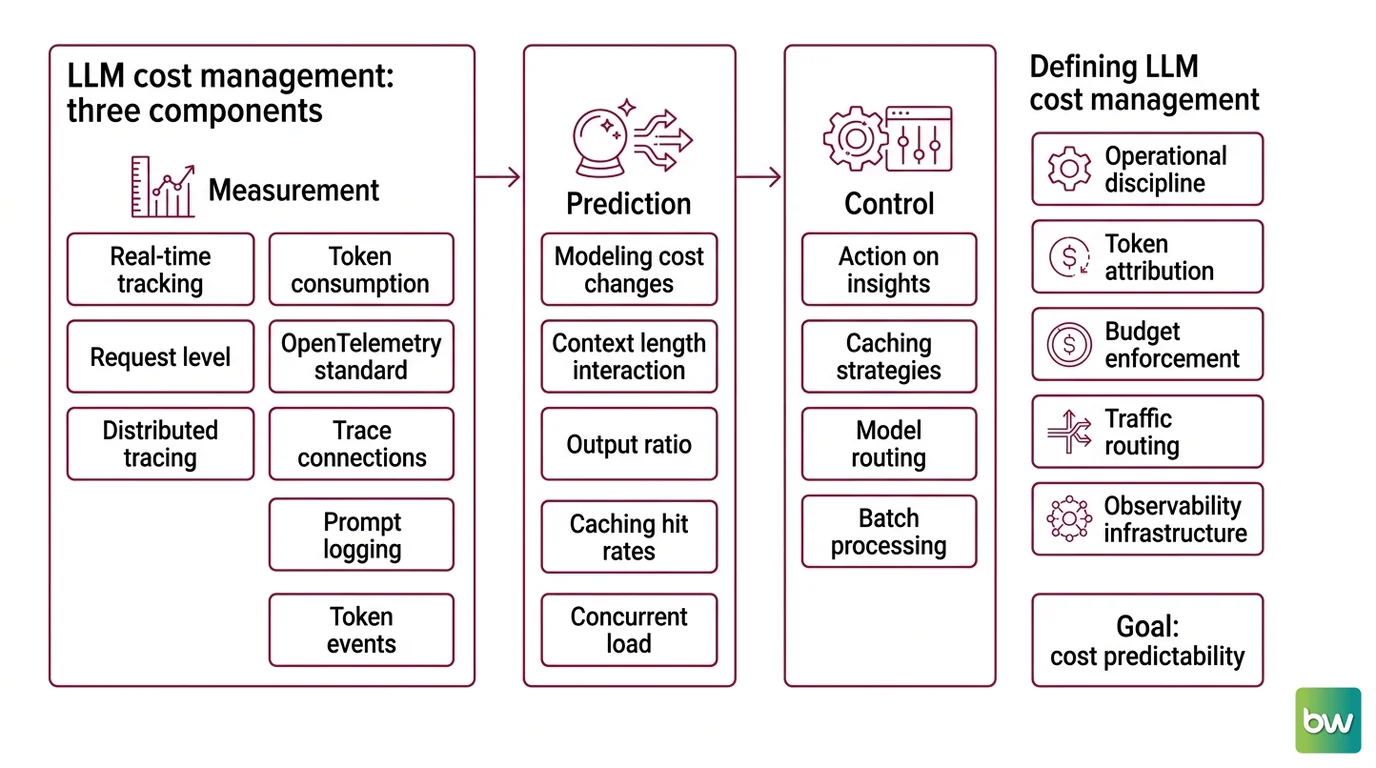
LLM cost management has three components, and the easiest one to skip is the first one.
Measurement requires attributing tokens to their source — not just knowing that your application spent X dollars last month, but knowing which features, which users, which prompt patterns drive which portions of that number. LLM Observability provides the foundation: real-time tracking of token consumption at the request level. OpenTelemetry is the standard instrumentation layer for capturing that data; Distributed Tracing connects individual API calls into the request flows they belong to, so a cost spike on one endpoint can be isolated without searching through aggregate dashboards. Prompt Logging captures the token-level events for individual calls — which prompts triggered which token counts — producing the raw data measurement depends on.
Prediction means modeling how costs will change before the bill confirms it. The inputs are not just unit prices; they’re the interaction between context length, output ratio, caching hit rates, and concurrent load — each of which behaves differently at scale than at test volume.
Control is the layer that acts on what measurement and prediction reveal: caching strategies, model routing, batch processing. The control mechanisms are well-documented. The problem is that teams often implement them without the first two layers in place, optimizing blindly against a cost they cannot fully attribute.
What is LLM cost management
LLM cost management is the operational discipline of measuring, predicting, and controlling compute costs generated by large language model API usage. It covers token attribution, budget enforcement, traffic routing, caching strategy, and the observability infrastructure those practices depend on. The goal is cost predictability, not just cost reduction — a system where the answer to “what will this cost at ten times current volume” exists before you find out.
The Quadratic Trap: Why Production Costs Don’t Scale Linearly
You pay for tokens. That’s the unit. But the number of tokens your application generates is not a fixed function of your input — it depends on model choice, context depth, output length, and, as of recent model generations, which tokenizer the provider uses.
Pricing across providers follows a consistent structure: separate per-million-token rates for input and output, with output priced significantly higher. Output tokens cost 2–6× more than input tokens across all major providers (CloudZero). That asymmetry matters because output length is the most variable cost driver — a summarization task and a multi-step reasoning chain can take similar input and produce output lengths that differ by an order of magnitude.
How does LLM API token pricing work and why do inference costs scale non-linearly at production volume
Current model pricing as of June 2026 spans roughly 600× from the cheapest available to the most capable when comparing output rates across providers (CloudZero):
| Model | Input ($/MTok) | Output ($/MTok) |
|---|---|---|
| Claude Fable 5 | $10.00 | $50.00 |
| Claude Opus 4.8 | $5.00 | $25.00 |
| Claude Sonnet 4.6 | $3.00 | $15.00 |
| Claude Haiku 4.5 | $1.00 | $5.00 |
| GPT-5.5 | $5.00 | $30.00 |
| GPT-5.4 | $2.50 | $15.00 |
| GPT-5.4-mini | $0.75 | $4.50 |
| GPT-5.4-nano | $0.20 | $1.25 |
| Gemini 3.5 Flash | $1.50 | $9.00 |
| Gemini 3.1 Flash-Lite | $0.25 | $1.50 |
(Anthropic Docs, OpenAI Docs, Google AI Docs — verified June 2026. Link to official pricing pages for current rates, which change frequently.)
The non-linearity problem lives in several places simultaneously.
First: context window attention scales quadratically. Double the context length and attention computation grows roughly fourfold — because attention operates over all token-pair interactions, scaling as O(n²) over sequence length. The KV cache grows linearly with context, but the attention operation itself does not.
Not overhead. A structural property of the attention mechanism.
Long-context use cases — document analysis, extended multi-turn conversations, retrieval-augmented generation over large corpora — carry a hidden cost multiplier that simple per-token estimates miss entirely.
Second: Inference contexts do not pool across users. Each concurrent user runs their own context; KV cache state is not shared between separate requests by default. At ten thousand concurrent users, you have ten thousand separate attention computations. The per-request cost is unchanged; the aggregate cost scales faster than volume because each new user adds a full context-length computation, not a fractional share of existing work.
Third: tokenizer changes between model generations can silently increase token counts. Anthropic’s tokenizer in Opus 4.7 and later models encodes the same text using up to 35% more tokens than older models (Anthropic Docs). Teams migrating from Claude 3.x may find their token volumes rise even when per-token rates drop — the net cost effect depends on the ratio, and most teams don’t audit the tokenizer before assuming a rate change is favorable.
Together, quadratic attention, non-pooled parallelism, and tokenizer drift explain why production costs often deviate from test estimates by more than the volume multiplier alone would suggest.
The Three Levers That Actually Move the Number
Cost reduction at scale comes from operating at multiple layers simultaneously. Each lever addresses a different portion of the cost structure; the compound effect of combining them is larger than any single lever alone.
What are the main strategies for controlling LLM operational costs
Prompt caching (server-side): Prompt Caching preserves repeated prompt prefixes — system instructions, few-shot examples, large documents — across API calls. On a cache hit, Anthropic charges 0.10× the base input price: a 90% discount. Cache writes cost 1.25× the base rate for a five-minute TTL, or 2× for one hour. The minimum cacheable prefix is 1,024 tokens for Opus 4.8 and 4,096 tokens for Haiku 4.5 (Anthropic Prompt Caching Docs).
The arithmetic favors applications with consistent system prompts. A production application sending an 8,000-token system prompt on every request converts that portion from the standard input rate to 10% of that rate on cache hits — a structural cost reduction on the most predictable part of every call.
Semantic caching (application-side): Semantic Caching intercepts queries before they reach the model, checks for semantically similar past queries using vector similarity, and returns the cached response when similarity exceeds a threshold — typically cosine similarity 0.7–0.95 in production deployments. On a cache hit, the model never runs.
Measured cost reductions range from 30–70%, with latency dropping dramatically on cache hits (Mavik Labs). Hit rates depend heavily on workload: FAQ and customer support applications see high cache utilization; diverse analytical queries see far lower rates. Semantic caching is a workload-specific optimization — its value scales with query repetition, and drops sharply when query diversity is high.
Batch API: The Batch API trades real-time response for a 50% discount on both input and output tokens. Anthropic, OpenAI, and Google all offer batch processing at this discount level; OpenAI guarantees 24-hour completion. For workloads that don’t require immediate responses — bulk classification, overnight document processing, report generation — the batch API is the simplest available cost reduction, requiring no architectural changes beyond async request handling.
The combined effect of these two layers compresses costs significantly. Running Sonnet 4.6 with prompt caching enabled, reading from cache via the batch API, produces an effective cost of approximately $0.15 per million tokens on the cached input portion — compared to $3.00 standard, a roughly 95% reduction on that segment (Anthropic Docs).
Model tiering and routing: Model Tiering routes requests to the cheapest model capable of handling the task. Simple classification, short-form extraction, or boilerplate generation can run on models at a fraction of the flagship cost; complex reasoning and high-quality generation require the upper tier. The spread between tiers is wide — the cheapest and most capable options differ by 50× on input price alone. The routing logic is where the risk lives: classification accuracy at the task level determines whether cheaper routing produces acceptable quality or expensive corrections.
LLM gateway infrastructure: LiteLLM provides a unified interface across 100+ provider APIs in OpenAI-compatible format, with built-in cost tracking and budget enforcement per key, user, or team. Per-entity spend tracking requires PostgreSQL or Redis as a backend. This is the layer that makes the other strategies operable at scale: without request-level cost attribution, you cannot identify where the reduction levers apply.
Security & compatibility notes:
- LiteLLM Supply Chain Attack (March 2026): Versions v1.82.7–v1.82.8 contained malicious code injected via stolen PyPI credentials; packages were live approximately 40 minutes before quarantine. Resolved in v1.83.0 with a new CI/CD pipeline. Docker image users with pinned dependencies were unaffected. Pin to v1.83.0 or later — current stable release is v1.89.4 (June 25, 2026). (LiteLLM Security Blog)
Combined, model routing and semantic caching have been measured producing 47–80% cost reduction on mixed production workloads without measurable UX degradation (Mavik Labs).
What the Cost Map Predicts
The mechanisms above make testable predictions.
If you double your average context length, expect attention compute to roughly quadruple on affected calls — not double. If you migrate from an older Claude model to Opus 4.8 or later, expect token counts to rise on the same inputs; the per-token rate may look more favorable while the token volume offsets the gain. Lower rates don’t guarantee lower costs. If you enable prompt caching on a workload where the system prompt exceeds the minimum token threshold and repeats across requests, the cached input portion becomes nearly free relative to the uncached baseline — making prompt length irrelevant on repeated calls.
If you implement semantic caching on a customer support product, expect hit rates high enough to meaningfully reduce load. If you apply the same caching to an analytical research tool where users phrase every question differently, expect much lower utilization — the similarity threshold that prevents false matches also filters the variation that makes diverse queries distinct.
The 50× gap between the cheapest and most capable models is a real lever. It becomes available only when the routing classifier can reliably distinguish task difficulty — and that reliability is hard to validate until the classifier encounters the long tail of production queries.
Rule of thumb: Measure token costs at the feature level, not the application level. Application-level averages hide which prompt pattern or user behavior is driving the bill.
When it breaks: Semantic caching fails when query diversity is high — embedding computation adds latency overhead without meaningful hit rates, making it a net cost contributor rather than a reducer. Model routing fails when task complexity is difficult to classify upfront; a router trained on clean training examples encounters the ambiguous edge cases in production that fall between tiers, generating quality regressions that take longer to diagnose than the cost savings justified.
The Data Says
Token pricing spans roughly 600× across providers and model tiers, but unit price is rarely the primary cost driver in production. The more consequential variables are context window depth — attention scales quadratically, not linearly — output-to-input ratio, and caching hit rates on the specific workload. Combine prompt caching with batch processing on a workload with consistent system prompts, and effective input costs for the cached segment drop by roughly 95%. The constraint is not the pricing page; it’s whether your observability stack has enough granularity to know which optimization applies where.
AI-assisted content, human-reviewed. Images AI-generated. Editorial Standards · Our Editors