What Is ELO Rating for LLMs and How Pairwise Human Votes Rank Language Models
ELI5
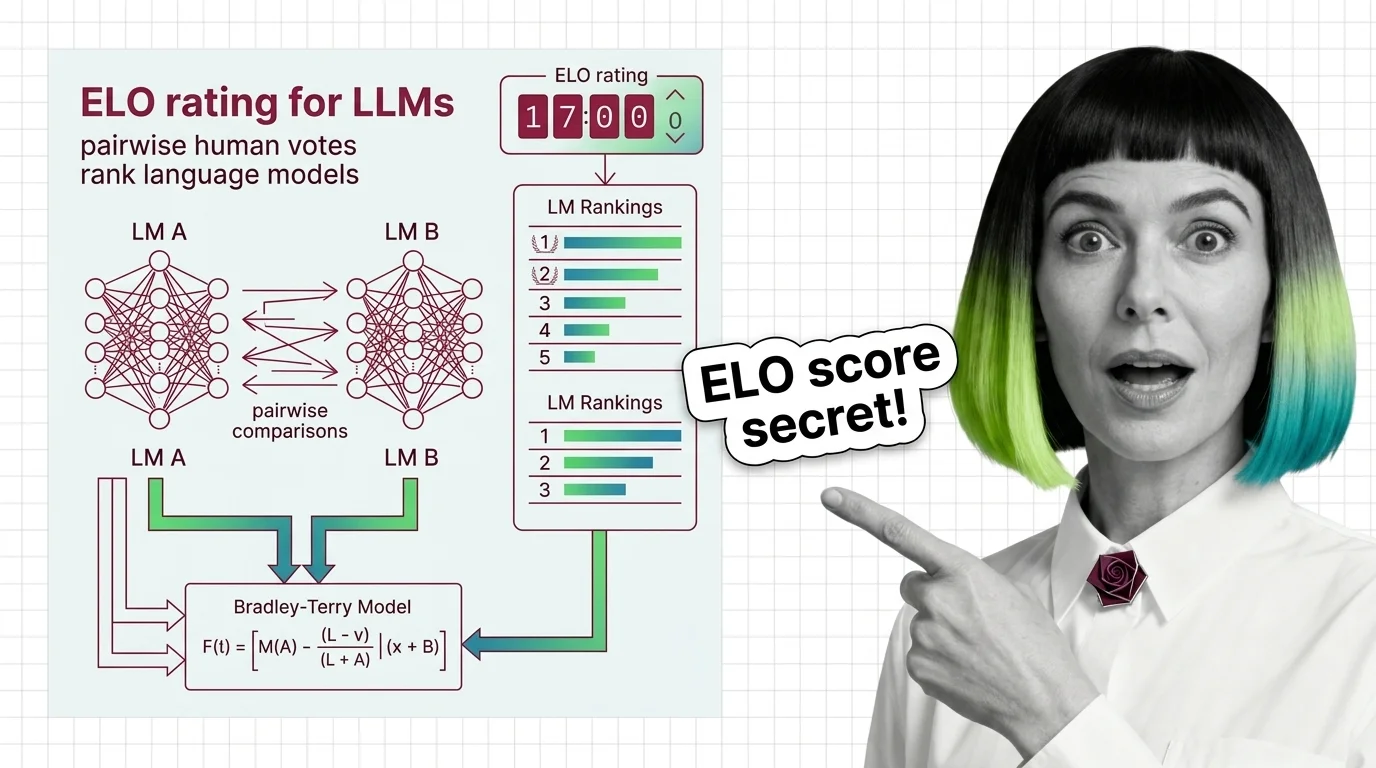
ELO rating for LLMs is a statistical ranking method where two models answer the same question anonymously, a human votes for the better response, and the Bradley-Terry algorithm converts thousands of such votes into a ranked leaderboard.
Scoring a model on a benchmark is arithmetic. Ranking models by human preference is geometry — the math is different, and so is what the result actually measures. Arena.ai built the largest public demonstration of this distinction: a leaderboard derived entirely from blind pairwise comparisons, with over 7 million votes cast across 368 tracked models as of June 2026 (Arena.ai). To most readers, the output looks like a chess leaderboard. The underlying math has not been classic Elo since December 2023.
The Sorting Problem That Standard Benchmarks Cannot Solve
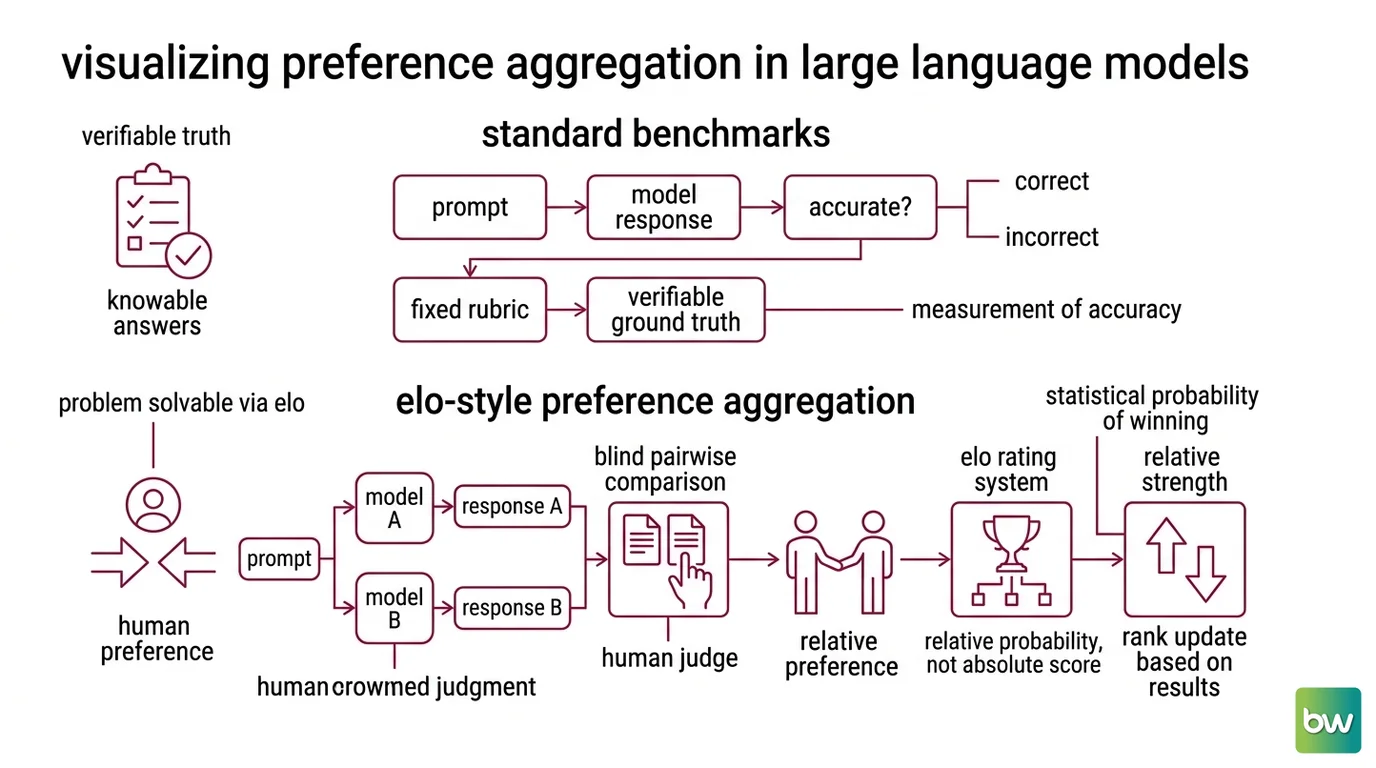
Benchmarks like MMLU or SWE Bench measure model performance against fixed, knowable answers. That works well for tasks with verifiable ground truth — code that either executes correctly or does not, factual recall where the record exists. It does not work for the question “which of these two explanations is clearer?” because the answer is not in any test set; it depends on the human reader.
This is the foundational insight behind Human Evaluation for AI: certain dimensions of quality cannot be operationalized as a rubric without losing what you were trying to measure in the first place. Open-ended generation, conversational fluency, stylistic coherence — these require a judgment call. The statistical question is how to aggregate thousands of those calls into something reliable enough to rank hundreds of models against each other.
Preference aggregation requires different math than accuracy measurement.
What is ELO rating for LLMs?
The ELO Rating system was invented by Arpad Elo, a Hungarian-American physics professor at Marquette University, to solve a specific problem in competitive chess: how do you rank players who have not all played each other? The answer is to treat each match outcome as evidence about relative strength and update scores accordingly — a system international chess organizations had fully adopted by 1970.
The adaptation for LLMs keeps this surface logic intact while replacing the mechanism underneath. In the LLM context, an ELO-style rating is a score derived from blind pairwise comparisons: two models respond to the same prompt, a human picks the winner, and the result contributes to both models’ relative position on the leaderboard. The approach does not require a rubric or a correct answer. You only need a human to judge which response they preferred.
Not a score. A relative probability.
The integer displayed on Arena.ai’s leaderboard looks like a chess Elo number — the top model currently scores 1508 as of June 2026 (Arena.ai) — but it is not computed by the classic Elo update formula. It represents a maximum likelihood estimate of each model’s latent strength parameter, expressed on a familiar numeric scale. The resemblance to chess Elo is intentional and communicatively useful. The math behind it changed fundamentally in December 2023.
Inside the Arena: From Blind Vote to Score
Chatbot Arena — launched May 3, 2023 by LMSYS / UC Berkeley (LMSYS Blog) and rebranded as Arena.ai in January 2026 — works as follows: a user submits a prompt to the platform, two model responses appear simultaneously with model identities hidden, and the user selects which response they prefer or declares a tie. That judgment is the atomic unit of data.
Anonymity is the control condition.
If users knew they were evaluating a response from a major commercial model, their ratings would partially reflect that knowledge rather than the response itself. Blind evaluation removes the halo effect and makes the vote informative about content rather than brand.
How does Chatbot Arena convert blind pairwise human votes into an ELO score?
The conversion from raw votes to ranked scores proceeds in several steps. First, each vote is categorized: a win for model A, a win for model B, or a tie. Ties occur in roughly one in five comparisons — approximately 20.4% of all votes (arXiv:2412.18407) — and each tie is split as a half-win for both models (LMSYS Blog).
The votes then feed into a statistical model. The original platform, from its May 2023 launch through late 2023, used online Elo — the same K-factor-based update mechanism chess organizations have used for decades. This was a reasonable first approximation, but it carried an assumption that does not hold for language models: that the thing being rated changes over time. A chess player’s skill evolves, so weighting recent games more heavily than older ones is justified. A language model has fixed weights after training. Overweighting its most recent comparisons is not a feature — it is a statistical artifact.
Arena.ai switched to the Bradley-Terry model in December 2023 (LMSYS Blog). The change addressed this bias by using the full accumulated vote history rather than a recency-weighted stream, and by replacing heuristic updates with principled statistical estimation. A second correction addressed vote imbalance: models that attract more total comparisons would otherwise dominate the leaderboard’s calibration. Arena.ai now weights each battle inversely proportional to the model’s total vote frequency (Arena Changelog), so sparse and dense models contribute comparably weighted evidence.
The Bradley-Terry Model: The Probability Behind the Integer
The platform displays Elo-style integers, but the computation is not Elo. Understanding why the switch happened requires understanding what the Bradley-Terry model actually does differently.
What is the Bradley-Terry model behind Chatbot Arena ELO rankings?
The Bradley-Terry model estimates each model’s latent strength from the full set of pairwise outcomes. The core formula is:
P(i beats j) = πᵢ / (πᵢ + πⱼ)
where πᵢ = eˣⁱ for each model’s strength parameter xᵢ. Given the observed win/loss/tie data across all comparisons, Maximum Likelihood Estimation finds the set of strength parameters that makes the observed outcomes most probable (LMSYS Blog). In practice: if model A consistently beats model B, MLE assigns A a higher strength parameter. If comparisons are close and votes are split, the parameters converge.
This is where the contrast with LLM as a Judge becomes analytically useful. An automated judge assigns scores by evaluating responses against criteria — either explicit instructions from Rubric Design or patterns learned implicitly from training data. A pairwise human vote aggregates preference without specifying why the preference exists. The two approaches measure related but non-identical quantities: rubric compliance versus holistic preference. For structured tasks with defined criteria, the rubric approach offers interpretability that preference voting cannot, and Cohen's Kappa can quantify the degree to which annotators actually agree on those criteria. For open-ended generation quality — the dimension Arena.ai targets — holistic preference captures something that rubrics tend to miss or distort by constraining the evaluation frame.
Overlapping confidence intervals mean the ordering between models is noise.
Confidence intervals close the statistical loop on each estimate. Since July 2025, Arena.ai calculates these using a closed-form equation based on the central limit theorem for M-estimators, replacing an earlier bootstrapping approach (Arena Changelog). These bands are not cosmetic. As of June 2026, the top eight models on the Arena.ai leaderboard sit within approximately 55 Elo points of each other — the tightest cluster on record (Arena.ai). Much of the current top-of-table ordering should be read as a statistical near-tie. The score differences are real; the implied ranking precision often is not.
What the Numbers Actually Mean — and When They Fail
Understanding the mechanism generates concrete, testable predictions.
If two models’ confidence intervals overlap substantially, swapping their leaderboard positions is statistically defensible — the vote data does not cleanly distinguish them. If a model accumulates most of its votes in one language or topic domain, its score reflects performance in that distribution, not general capability across all tasks. If the annotator pool shifts composition — Arena.ai’s users are self-selected, technically sophisticated, and concentrated in specific linguistic communities — the ranking shifts with it, without any change in model weights. The model did not improve; the voters changed.
For structured annotation workflows where interpretability matters more than coverage breadth, annotation tools like Label Studio provide explicit rubric scaffolding alongside inter-annotator agreement metrics. The preference-voting approach Arena.ai uses is powerful at scale and ecologically valid — real users bringing real tasks — but opaque at the level of individual votes. You learn that one response was preferred; you do not learn whether the preference reflects a generalizable quality dimension or an artifact of the particular prompt.
Rule of thumb: an Arena.ai score describes how the current self-selected voter population responded to a model’s outputs, on the prompts they happened to bring. That is meaningful and well-calibrated. It is not the same statement as “best model for your use case.”
When it breaks: the Bradley-Terry model assumes comparison outcomes are independent and that each model’s latent strength is stable across the measurement period. Both assumptions weaken when models are updated silently mid-period, when prompt topics shift systematically (a surge in coding queries temporarily weights coding performance), or when vote counts per model are too low for stable MLE estimation. Below a certain vote density, confidence intervals widen enough to make any ranking between individual models unreliable — the leaderboard position becomes an artifact of coverage, not capability.
The Dispute About What the Leaderboard Measures
A research paper published in April 2025 — The Leaderboard Illusion (arXiv:2504.20879, Cohere Labs / AI2 / Princeton) — raised a concern about the data collection process itself: that labs can test models privately on the platform before choosing whether to publish results, and that a substantial fraction of models that appeared publicly were later silently deprecated. The authors argued this creates systematic selection pressure — the leaderboard reflects which results labs chose to reveal, not raw capability.
Arena.ai published a methodological rebuttal (Arena.ai Blog) contesting the characterization. The debate is ongoing and unresolved. Worth separating clearly: even if the private testing concern is valid, it does not undermine the statistical soundness of the Bradley-Terry estimation given the votes that were actually collected. The concern is about whether the vote collection process is representative — a distinct and prior question from whether the math correctly extracts rankings from whatever votes exist.
A separate caveat: the major methodology overhaul of January 13, 2026 changed vote filtering criteria more consistently, reshuffling several top positions (Arena Changelog). Rankings from before and after that date are not directly comparable. Any analysis citing pre-2026 leaderboard positions should treat them as historical snapshots, not current standings.
The Data Says
The Bradley-Terry model is a principled answer to a genuine measurement problem: how to extract relative rankings from pairwise human judgments without fixed ground truth. The switch away from online Elo in December 2023 was statistically correct — models do not change over time the way chess players do, and the full-history MLE is more defensible than recency-weighted heuristics. The current leaderboard as of June 2026 tracks 368 models across more than 7 million votes, with the top cluster so tightly packed that confidence intervals render most top-of-table ordering uninformative at the individual model level. The score is real. The precision it implies is often not.
AI-assisted content, human-reviewed. Images AI-generated. Editorial Standards · Our Editors