What Is Domain-Specific Prompting and How Vocabulary, Role Injection, and Constraint Framing Shape LLM Output
ELI5
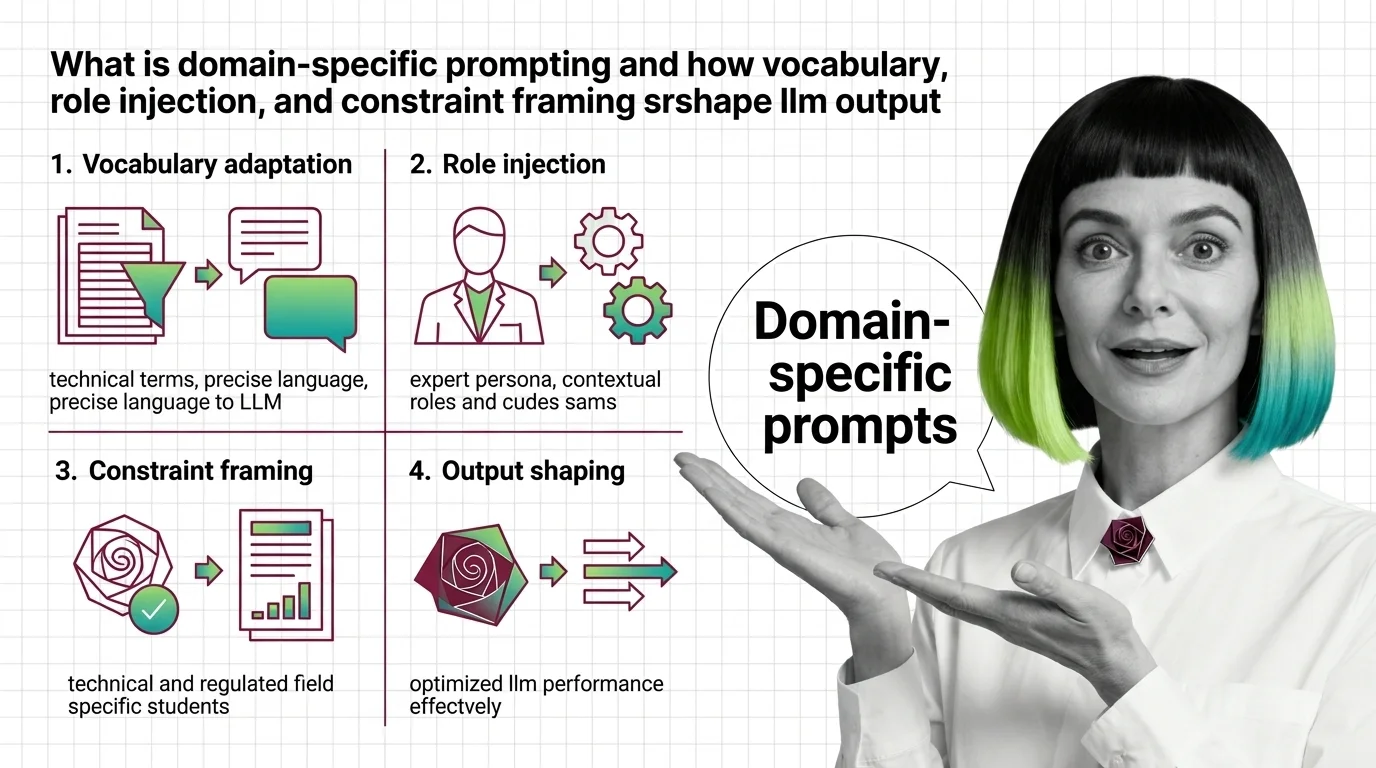
Domain-specific prompting tailors LLM behavior for a particular field — medicine, law, code — by loading domain vocabulary, assigning a specialist role, and constraining output format. No model retraining. The gap between generic and domain-tuned output is often larger than the gap between model sizes.
The word “prompt” implies something minimal — a nudge, a cue. But what happens when the domain is cardiovascular pharmacology, contract law, or the internal compliance rulebook of a regulated bank? A nudge isn’t enough. What you need is a full contextual frame: the right vocabulary loaded in, a credible role established, and the output bounded before the model generates its first token.
That’s not prompting. That’s prompt architecture, aimed at a specific domain.
The gap between generic LLM output and domain-tuned output is frequently misattributed to model capability. It isn’t. Rewording a prompt without changing the underlying model can close — or widen — a 30+ point accuracy gap on a classification task (DETAIL Matters). The model’s knowledge was already there. The prompt either activated it or didn’t.
What “Domain” Actually Does to a Probability Distribution
There are four recognized paradigms for injecting domain knowledge into an LLM: Prompt Engineering, fine-tuning, retrieval-augmented generation, and hybrid approaches. Domain-specific prompting sits in the first column — no weight updates, no external retrieval pipeline, no retraining budget. It works entirely within the inference pass, by crafting prompts that reach into the model’s existing knowledge and activate the relevant subset (Song et al. 2025).
That framing matters, because it changes what the technique can and cannot do. A well-constructed domain prompt does not add knowledge the model never had. It reduces the probability mass assigned to irrelevant responses while amplifying the probability of domain-coherent ones. Think of it as narrowing the sampling aperture.
The geometry of that aperture is determined by three interacting components: vocabulary, role, and constraint.
The Three Layers of a Domain-Specific Prompt
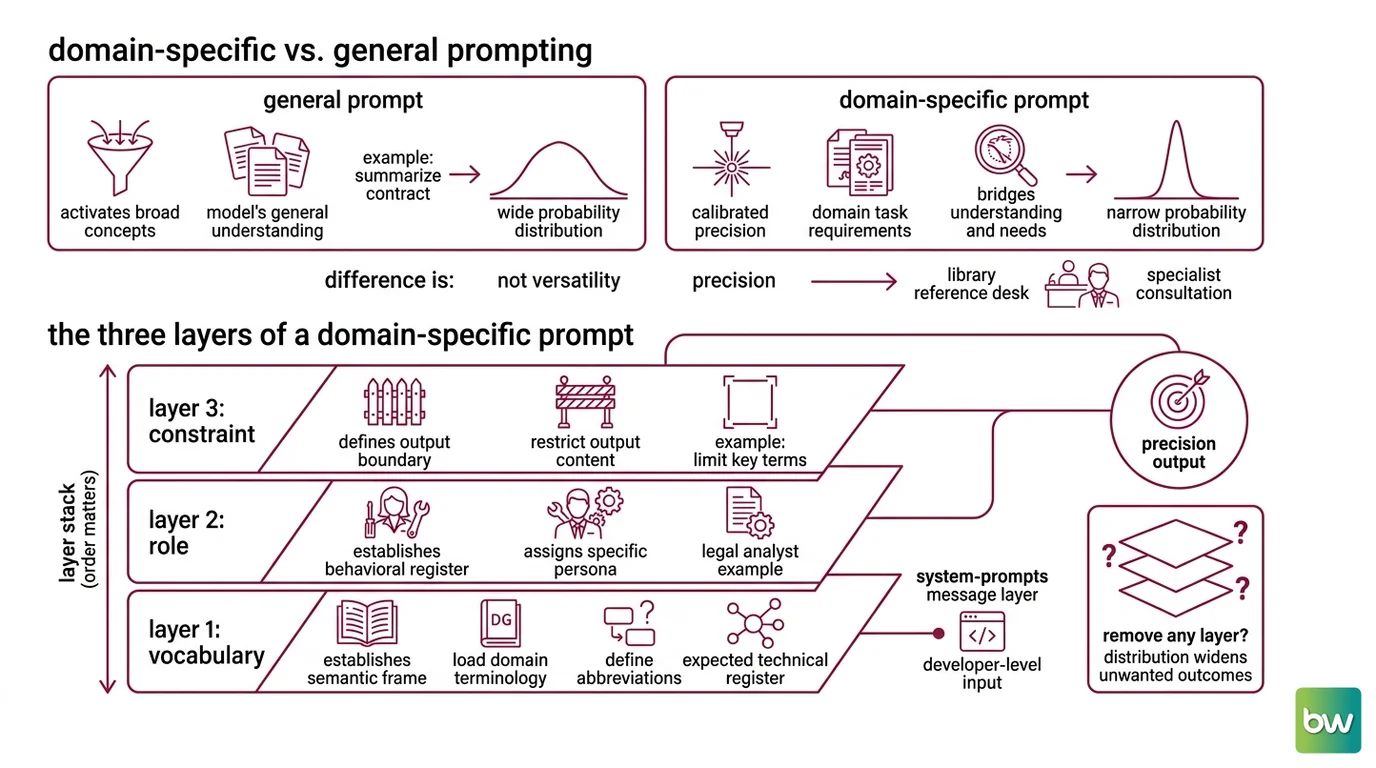
A domain-specific prompt is not one instruction — it’s a stack. Each layer does different work on the probability distribution, and the order matters. Vocabulary establishes the semantic frame. Role establishes the behavioral register. Constraint defines the output boundary. Remove any layer and the distribution widens in ways you don’t want.
What is domain-specific prompting and how does it differ from general LLM prompting?
General Prompt Engineering asks the model to produce “good” output without specifying what “good” means within a particular knowledge domain. Domain-specific prompting is a prompt optimization paradigm that bridges general-purpose LLM understanding and domain-specific task requirements — without model retraining (Song et al. 2025). The difference is not decorative; it is architectural.
A general prompt like “summarize this contract” activates the model’s broad concept of “summary” — which may produce a readable paragraph that entirely misses the operative clause. A domain-specific prompt that loads the model with contract-review vocabulary, assigns a legal analyst role, and constrains output to key terms and risk flags produces output calibrated to what a legal professional actually needs.
Not versatility. Precision.
The distinction between general and domain-specific prompting mirrors the distinction between a library reference desk and a specialist consultation. Both use language. Only one knows which questions matter in this particular field.
How does domain-specific prompting adapt LLM behavior using vocabulary, role injection, and constraint framing?
Vocabulary injection is not a separate API feature — it’s a component of the System Prompts, the developer-level message layer that sits above the user turn in the message hierarchy. You load domain terminology, define abbreviations, establish the expected register of technical language. The model has likely encountered most of these terms during pre-training, but without explicit framing, their weight in the output distribution competes with colloquial synonyms and general usage patterns.
There is a precision ceiling, however. Schreiter (2025) found an optimal vocabulary specificity range per model and domain: increasing lexical precision beyond that range does not improve performance and can degrade it. Tested across Llama-3.1-70B, Granite-13B, Flan-T5-XL, and Mistral-Large 2 on STEM, law, and medicine. The implication is that vocabulary injection is a calibration problem, not a “more is better” one.
Role injection — assigning a specialist persona in the System Prompts — focuses behavioral tone and the subset of knowledge the model draws on. Anthropic’s documentation is unusually direct on this: even a single sentence in the system parameter makes a measurable difference. Their canonical example, "You are a helpful coding assistant specializing in Python," is simple to the point of looking trivial, but the mechanism it activates is not.
Role Prompting shifts the prior distribution over the model’s internal representations toward patterns consistent with that role’s expertise and communication style.
Wang et al. (2024) extended this into multi-domain adaptation. Their REGA framework assigns a central prompt to the general domain and a unique role prompt per specialized domain, reducing inter-domain confusion and alleviating what would otherwise be Context Engineering interference between domain-specific patterns. The technique’s value for fine-tuning workflows aside, the finding that role specificity per domain reduces interference is directly applicable to prompt design.
Constraint framing is the output boundary layer. Specifying word limits, required sections, output format, prohibited language, or step count keeps the model focused by reducing the entropy of the output distribution before generation begins — constraints act as invisible scaffolding (OpenAI Docs). This is not the same as specifying what you want; it specifies what you will not accept. The distinction matters because LLMs sample from a distribution; constraint framing changes which parts of that distribution are even reachable.
The Architecture of the System Prompt in Practice
The three layers live primarily in the developer message — the highest-priority role in OpenAI’s three-role message architecture (developer → user → assistant), and the equivalent system parameter in Anthropic’s API (OpenAI Docs). This is where domain-specific prompting begins structurally.
What are the key components of an effective domain-specific prompt for technical and regulated fields?
For technical and regulated domains — healthcare, finance, security, legal — the stakes of output precision are higher, and the failure modes are more consequential. Several structural elements consistently improve output calibration:
Vocabulary and glossary block. A compact glossary of domain-critical terms, acronyms, and their preferred definitions. This isn’t documentation — it’s a probability anchor. It establishes which interpretations of ambiguous terms are correct in this domain context. Length matters: Schreiter (2025) found that vocabulary precision has a domain-specific ceiling, so the block should include the terms that resolve ambiguity, not every term in the field.
Role specification with scope boundary. A specific role description that includes not just the function (“senior risk analyst”) but the scope of authority (“provides technical analysis, does not give legal advice”). This matters for regulated fields because the model’s output carries implied authority, and scope-bounded role definitions reduce the probability of responses that overstep into territory requiring licensure or certification.
Explicit output schema. The expected format — sections, maximum length, required headers, output type (JSON, markdown, prose). The
Instruction Following capability of current frontier LLMs is high, but it degrades when output expectations are implicit. Anthropic recommends wrapping content in XML tags (<instructions>, <context>, <examples>) for complex multi-part prompts to reduce prompt misinterpretation (Anthropic Docs).
Few-shot domain examples. Three to five domain-specific examples of input-output pairs, recommended by Anthropic Docs, with the caveat that examples must be diverse to avoid unintended pattern pickup. The mathematical reality: few-shot examples shift the model’s posterior distribution by conditioning it on observed domain-coherent outputs. A single ambiguous example can create a local attractor that distorts the distribution in ways that don’t show up until an edge case.
Explicit exclusions for regulated contexts. Statements about what the model should not do — not provide tax advice, not recommend specific medications, not speculate on legal outcomes. These are constraint frames at the content level, distinct from format constraints. They narrow the distribution away from high-liability output patterns.
The full stack, assembled in the system prompt, does something the components cannot do individually: it creates a coherent frame within which the Context Window operates. The model’s attention is not infinite — it distributes across the entire context. A well-architected domain-specific prompt ensures that domain-relevant signals receive proportional weight throughout that distribution.
One structural note for Multi-Turn Prompt Design: domain framing established in the system prompt persists across turns, but it can erode if user messages introduce contradictory frames or if the conversation extends into territory the system prompt didn’t anticipate. Long technical conversations in regulated domains should periodically reassert the scope boundary, not assume the initial frame is stable.
What Breaks and What Doesn’t
The mechanism predicts specific failure modes, and those predictions are more useful than general cautions.
If vocabulary injection is too sparse, the model code-switches — it defaults to general-usage interpretations of ambiguous terms, which in a legal or medical context is precisely the failure you’re trying to prevent. If it’s too dense (past the calibrated ceiling for the model-domain pair), the additional specificity adds noise rather than precision.
If the role is too broad, behavioral focus is shallow — the model produces output that’s technically competent but tonally misaligned with domain norms. A “medical professional” role produces different output than a “board-certified emergency physician reviewing a triage protocol.” The more specific the role within the domain, the narrower the behavioral prior.
If constraint framing is absent, the model satisfies the prompt’s semantic content with whatever output format its prior distribution favors — which may be fluent, plausible, and structurally wrong for the use case.
Rule of thumb: build the domain-specific system prompt in layers, verify each layer’s effect independently before composing them, and test with edge cases that the domain encounters regularly, not the average case.
When it breaks: domain-specific prompting fails when the model genuinely lacks coverage of the domain in its training data — no amount of vocabulary injection activates knowledge that wasn’t encoded. For highly specialized subfields or recently evolving regulatory frameworks, the technique reaches its ceiling and retrieval-augmented generation becomes necessary.
A secondary failure mode concerns Prompt Leakage: in multi-turn or API-exposed contexts, domain-specific system prompts — which often contain proprietary vocabulary, confidential scope definitions, or internal compliance rules — can be elicited through adversarial user inputs. The more precisely you’ve architected the domain frame, the more valuable it is, and the more exposed it is if the architecture doesn’t account for extraction vectors.
One more consideration for teams using Meta Prompting to generate domain-specific prompts programmatically: the quality of the generated frame depends on the meta-prompt’s own domain accuracy. Automating domain-specific prompt generation without domain expert review introduces a second layer of vocabulary and scope errors that may not be visible until production.
The Data Says
Rewording a prompt — without touching the model — can close or open a 30+ point accuracy gap on a classification task (DETAIL Matters). Domain-specific prompting is the structured version of that observation: vocabulary, role, and constraint are the three levers that determine where in the model’s probability distribution your task lands. The technique works because the knowledge is already encoded; the architecture determines whether it surfaces.
AI-assisted content, human-reviewed. Images AI-generated. Editorial Standards · Our Editors