What Is Dataset Bias and How Skewed Training Data Shapes Model Predictions
ELI5
Dataset bias is a systematic skew between the data a model learns from and the real world it runs in. The model treats the skew as truth, then repeats it — and often amplifies it — in its predictions.
A face-recognition system can be 99% accurate and still be broken. Not broken at random — broken in a pattern. It reads some faces almost perfectly and stumbles, again and again, on others. The aggregate number looks healthy. The model is not. The mystery isn’t in the architecture; it’s in the data the model was fed, and in a quiet assumption almost everyone makes: that a large enough dataset is a neutral mirror of the world.
The Mirror That Reflects a Sample
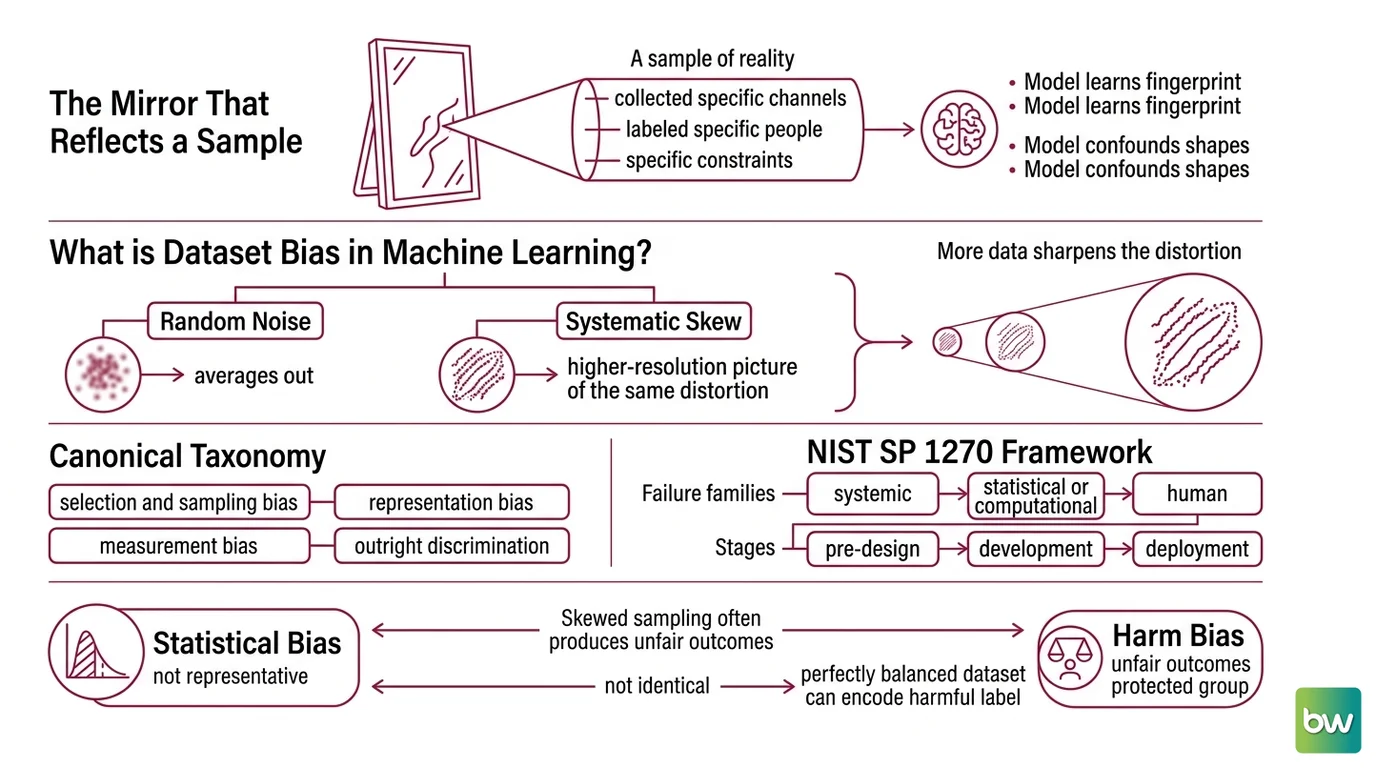
A training set is not a photograph of reality. It is a sample of reality, collected through specific channels, labeled by specific people, under specific constraints. Every one of those choices leaves a fingerprint on the data, and the model learns the fingerprint along with everything else. The trouble is that a sample has a shape, and the model cannot tell the shape of the world apart from the shape of how the world was sampled.
What is dataset bias in machine learning?
Dataset bias is a systematic skew between the distribution a model learns from and the distribution it will face in deployment. The word systematic is doing the heavy lifting. Random noise averages out as you collect more examples; bias does not. Collect ten times more data through the same skewed channel and you get a higher-resolution picture of the same distortion. More data sharpens the distortion, it does not dilute it.
The research literature splits the phenomenon into distinct sources rather than treating “bias” as one thing. One canonical taxonomy separates selection and sampling bias, representation bias, and measurement bias from outright discrimination, which is human prejudice acting on sensitive attributes (Mehrabi et al.). A parallel framework groups the failure into three families — systemic, statistical or computational, and human — and tracks them from pre-design through development to deployment (NIST SP 1270).
It helps to keep two senses of the word from fusing. There is statistical bias: the data is not representative of the target population. And there is harm bias: the model produces unfair outcomes for a protected group. The two are related, because skewed sampling often produces unfair outcomes. They are not identical, because a dataset can be statistically skewed in ways that harm no one, and a perfectly balanced dataset can still encode a harmful label. Keep them linked, but keep them separate.
How a Skew Becomes a Belief
Understanding why skew survives training means looking at what training actually optimizes. A model does not try to understand the world. It tries to minimize a loss function, and almost every standard loss rewards one thing above all: low average error across the dataset.
How does biased training data cause AI models to learn and amplify unfair patterns?
Average is the operative word. Suppose 95% of your examples come from one group and 5% from another — a Class Imbalance the collection process baked in without anyone deciding it on purpose. The optimizer can drive total error down fastest by getting the majority right, because the majority is where the error mass lives. The minority contributes so little to the average that the gradient barely flinches when the model fails on it. Capacity flows to the majority not out of malice but out of arithmetic: that is where the loss told the model to spend itself.
Amplification is the second turn of the screw. A model trained on a lopsided split will frequently predict the majority class even more often than its share of the data, because betting on the majority is a sound statistical strategy when you are scored on average accuracy. Then the model’s outputs re-enter the world — ranked results, surfaced candidates, flagged transactions — and those outputs become a source of tomorrow’s training data. The skew feeds itself.
The amplification effect is well documented across model families; the precise degree is not fixed. It depends on the loss, the model class, and how strongly outputs loop back into the data. The direction is consistent. The magnitude is situational.
Where the Bias Actually Enters
Skew is not a single leak. It enters at three different points in the pipeline, and each one needs a different fix, which is why “just get more data” is rarely the answer.
The first point is selection: how examples are gathered. Selection Bias arises when the sampling channel quietly excludes part of the population — scraping one platform, surveying one region, logging only users who already converted. The second is representation: even with a fair channel, some subgroups are under-sampled relative to their real frequency or relative to the standard you need ( Representation Bias). The third is measurement: the features and labels are proxies, and the proxy can be distorted even when the rows are balanced ( Measurement Bias). Arrests stand in for crime; clicks stand in for relevance; a diagnosis code stands in for a disease. The proxy is never the thing itself.
The face-recognition case shows representation bias with uncomfortable clarity. In a 2018 audit, commercial gender classifiers misread darker-skinned women up to 34.7% of the time against 0.8% for lighter-skinned men — a roughly 43-fold gap (Gender Shades). Vendors have narrowed that gap since, so the figure is a documented historical illustration, not a scoreboard for today’s systems. Its value is what it reveals about the cause: the benchmark face sets behind many of these systems were overwhelmingly lighter-skinned, 79.6% in IJB-A and 86.2% in Adience (MIT Media Lab). The model performed worst exactly where the data was thinnest. The failure was not geometric chance. It was a faithful report of who the dataset had seen.
What the Skew Predicts
Once you see bias as a property of the sample rather than a defect of the algorithm, the model’s behavior becomes predictable. The mechanism turns into a set of if/then expectations you can check before a system reaches users.
- If overall accuracy is high but you have never measured error per subgroup, expect the gap to be hiding inside the average.
- If you collect more data through the same pipeline, expect the skew to sharpen rather than dissolve.
- If you rebalance the rows but never question the labels, expect measurement bias to survive the cleanup untouched.
Some of these problems are structural and detectable by machine. Data Leakage — where information from outside the training fold bleeds in and inflates scores — has mechanical signatures, including Target Leakage (a feature that secretly encodes the label) and Temporal Leakage (using future information to predict the past). A disciplined Cross Validation split and a validation tool such as Deepchecks (v0.19.1, AGPL-3.0) will catch this class of contamination. One caveat: that project has shipped no release since December 2024, so confirm it still fits your stack before depending on it (Deepchecks GitHub). And it only finds structural leakage — it does not detect representation or measurement bias, which leave no broken boundary to flag.
For the harder, distributional kind of bias, the work is auditing, not just validation. A fairness-audit toolkit like Aequitas measures error and outcome disparities across groups and, in its newer line, moves beyond auditing into mitigation (Aequitas Docs). When the problem is class imbalance, resampling methods such as SMOTE and other Oversampling techniques can rebalance the training distribution, but treat them as one option rather than a guaranteed cure; cost-sensitive learning often does the same work without synthesizing new points, and naive oversampling can leak if applied before the split.
Rule of thumb: measure error per subgroup before you trust any aggregate number, because the aggregate is engineered to hide the subgroup.
When it breaks: even a perfectly balanced dataset cannot fix measurement bias. If the label itself is a distorted proxy — arrests as a stand-in for crime, clicks as a stand-in for relevance — then every demographic can be sampled fairly and the target is still wrong. Rebalancing the rows does nothing when the column you are predicting is the distortion.
The Data Says
Dataset bias is not a moral failing of the model; it is a faithful summary of a skewed sample. Accuracy averaged across a population conceals exactly the failures that matter, because the loss that trains the model optimizes for the average and the average belongs to the majority. The fix starts not with the algorithm but with measuring who the data left out, and with admitting that “representative” was a decision someone made, not a property the data came with.
AI-assisted content, human-reviewed. Images AI-generated. Editorial Standards · Our Editors