What Is Data Poisoning and How Corrupted Training Data Compromises Model Behavior
ELI5
Data poisoning corrupts a model’s training data before learning begins. Malicious examples are injected so the model learns wrong associations that persist through deployment, invisible to standard quality checks.
A model can pass every evaluation metric in your validation suite and still be compromised. The failure mode isn’t in your inference code or your serving infrastructure. It’s in what the model was taught. Months before deployment, someone introduced carefully constructed examples into a training corpus; the optimizer found those patterns and encoded them permanently into the weight matrices. By the time the anomaly surfaces in production, the attack has already been deployed.
The Attack That Lives in the Weights
Data poisoning occupies an unusual position in adversarial machine learning: it’s a supply-chain attack that operates at the layer most practitioners treat as implicitly trustworthy — the training dataset itself. Understanding why it works requires understanding what a gradient descent optimizer actually does with its inputs.
What is data poisoning in machine learning?
Data poisoning is a class of adversarial attack that targets the training phase of a machine learning pipeline rather than inference. The attacker’s goal is to corrupt the model’s learned behavior by manipulating the training data — before the model’s weights are ever frozen.
The concept was formalized by Biggio, Nelson, and Laskov in a 2012 paper (Biggio et al. 2012), which demonstrated that an adversary with partial control over training data could systematically degrade an SVM’s classification performance. That paper established something structurally important: the attack surface for machine learning extends backward in time, into the data curation pipeline itself.
The model is a bystander. It does exactly what you designed it to do: minimize loss on the provided training distribution, generalize to a held-out validation set, and deploy with satisfactory metrics. The problem is that “the provided training distribution” is the attack surface.
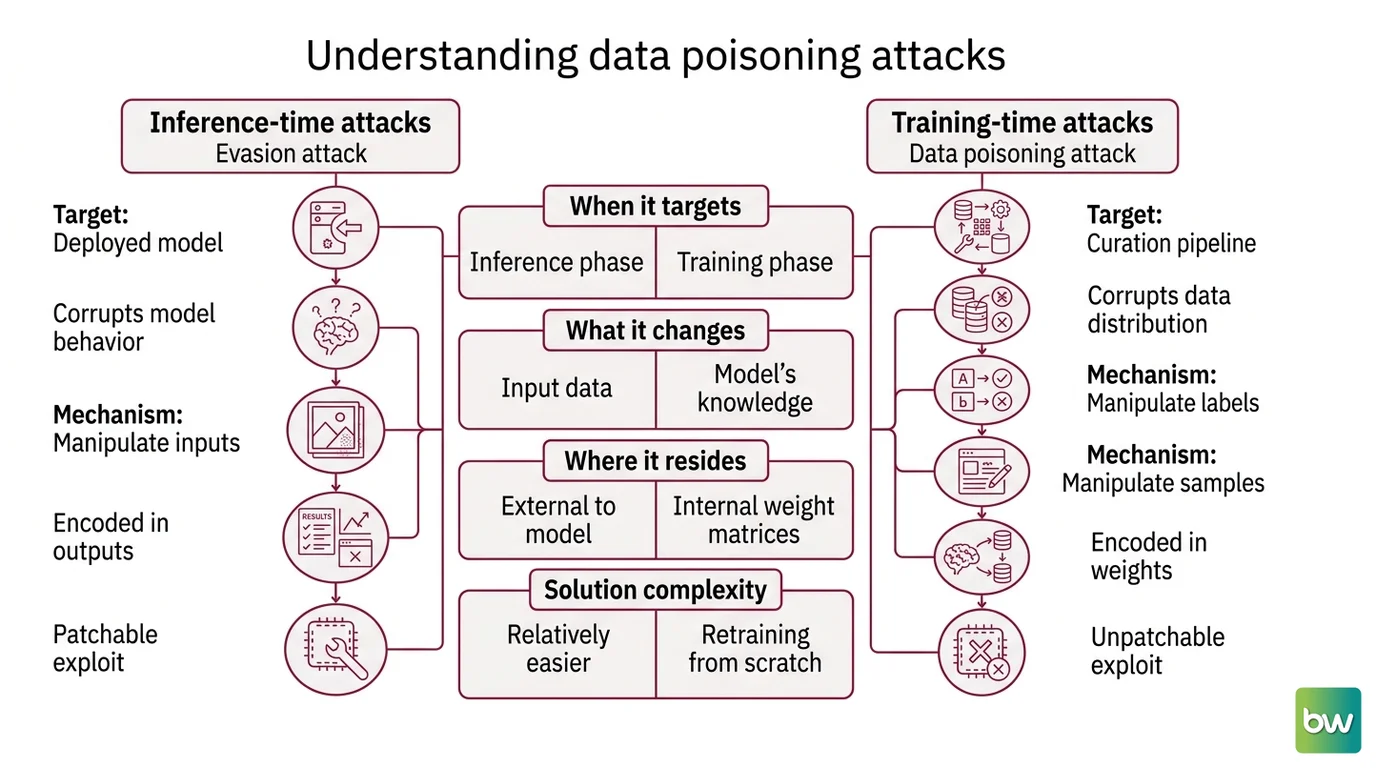
Unlike evasion attacks — which target a deployed model at inference time — poisoning attacks corrupt internal representations before deployment.
Not a runtime exploit. A training-time exploit.
The contamination is encoded into the weight matrices. You can patch an inference endpoint; you cannot easily unpatch a learned distribution. Retraining from scratch on a clean dataset is the closest equivalent to a clean reinstall — viable only if you can first identify which samples were poisoned, which is itself a non-trivial problem.
How do data poisoning attacks manipulate model behavior?
The mechanism exploits a foundational assumption in supervised learning: that training data is a reliable sample of the real distribution the model will encounter at inference.
Gradient descent optimizes model parameters by computing gradients of the loss over training batches. If those batches contain adversarially crafted examples — even a small fraction — the optimizer treats them identically to legitimate samples. It faithfully encodes the adversarial patterns into the learned weight matrices across thousands of gradient updates.
Consider the geometry. In the learned feature space, a clean decision boundary separates classes according to the statistics of legitimate training data. A poisoning attack applies systematic pressure to shift that boundary toward attacker-desired regions — incrementally, using examples that appear locally correct but are globally corrupted. The gradient updates from clean samples dilute the adversarial signal; they do not wash it out.
The attack exploits the optimizer’s obedience.
This is why standard detection fails. Held-out evaluation measures generalization on a clean test set. Backdoor and targeted attacks are specifically designed to look correct on unpoisoned inputs — the model achieves high accuracy on clean data while harboring a dormant corrupted behavior. The defect is invisible until the attacker activates it.
The Taxonomy of Corruption: Six Attack Vectors
The research literature has converged on six distinct attack classes. They differ in the attacker’s required access level, the nature of the corruption, and how difficult the attack is to detect before deployment. The taxonomy matters because the attack class determines where in the pipeline a defense needs to be applied.
What are the main types of data poisoning attacks?
Availability attacks aim to degrade overall model accuracy by injecting noisy or mislabeled samples broadly across the training distribution. The goal is general sabotage rather than precision targeting. Biggio et al. 2012 demonstrated this class against SVMs; it transfers to neural networks. One common mechanism intentionally induces Class Imbalance by flooding minority classes with mislabeled examples — a pattern that mimics routine annotation errors and is difficult to distinguish from natural data quality problems without label auditing.
Targeted integrity attacks are surgical: the attacker redirects a specific test input to a specific incorrect class, while the model behaves normally on all other inputs. Shafahi et al. 2018 (Shafahi et al. 2018) formalized this class for neural networks. The attacker selects a target sample they want to redirect, then crafts poisoned training examples that systematically move the model’s decision boundary until the target falls on the wrong side — while the rest of the decision boundary remains intact.
Backdoor attacks — also called trojan attacks — embed a trigger pattern into a subset of training samples: a pixel patch, a specific phrase, a frequency artifact imperceptible to human reviewers. The poisoned samples are labeled normally. The model learns the trigger as a feature. On clean inputs it behaves normally; when the trigger appears, it activates the attacker-desired behavior. The trigger is a conditional clause only the attacker knows to activate. BadNets, published by Gu, Dolan-Gavitt, and Garg (Gu et al. 2017), was the founding demonstration: a model trained with a small fraction of trigger-embedded samples reliably exhibits the backdoor behavior at inference, across a wide range of trigger placements and network architectures.
Clean-label attacks, introduced by Shafahi et al. 2018, require no label modification. Instead, the attacker perturbs training example features at a level imperceptible to human annotators, but structurally significant in the learned feature space — moving those examples near the target class boundary. The model, seeing correctly labeled training data, encodes the perturbed features as legitimate signal. This attack class is viable wherever the attacker can contribute examples but cannot modify labels: crowdsourced annotation platforms, open dataset contributions, scraped web data.
Nightshade, developed at SAND Lab, University of Chicago and presented at IEEE S&P 2024, is a clean-label poisoning tool applied to text-to-image models as an artist protection mechanism. The paper demonstrated that 50 poisoned images embedded in a training corpus of 100,000 produced measurable degradation in SDXL’s ability to generate the targeted concept (Nightshade Paper). The mechanism is technically identical whether the objective is protecting artistic copyright or degrading a competitor’s model — a symmetry with significant implications.
Label Flipping is the most accessible attack type for adversaries with limited capabilities: training labels are changed directly, either randomly to degrade overall accuracy or strategically to redirect specific class predictions. NIST defines it as “a type of data poisoning attack in which an adversary is restricted to changing the training labels” (NIST CSRC). It requires no feature-space optimization — only write access to the annotation metadata.
RAG Poisoning attacks the retrieval layer of LLM systems rather than the model weights. An adversary injects malicious documents into the retrieval knowledge base; the retrieval system surfaces those documents; the LLM incorporates attacker-controlled context into its response. PoisonedRAG, presented at USENIX Security 2025 (PoisonedRAG), formalized this attack class and demonstrated susceptibility across all major RAG architectures. No model parameter access is required — only corpus write access.
Security & compatibility notes:
- RAG poisoning (active attack surface): PoisonedRAG (USENIX Security 2025) demonstrated that sequential, branching, multimodal, and agent-based RAG architectures remain susceptible to knowledge base injection. Current defenses do not provide robust protection. Treat any production RAG retrieval corpus as an untrusted input surface requiring provenance controls.
- LoRA adapter poisoning (emerging vector): Supply-chain attacks targeting parameter-efficient fine-tuning adapters emerged in 2025 as a related threat. No canonical defense exists yet. Third-party PEFT adapters should be treated as unverified components until provenance is established.
What the Corruption Predicts: Engineering Consequences
The attack taxonomy above has direct engineering implications. Different attack classes enter at different pipeline stages; understanding the entry point is the prerequisite for knowing where your detection and prevention strategies need to operate.
If an adversary controls even a small fraction of training examples, the research record suggests the required contamination rate for a targeted integrity or backdoor attack is lower than practitioners typically assume. Gradient updates from clean samples dilute but do not eliminate a systematic adversarial signal.
If you’re relying on Cross Validation to catch data quality problems, it will not detect poisoning. Backdoor and clean-label attacks are architecturally designed to pass held-out evaluation on clean data. Dataset Bias detection and label consistency audits identify natural mislabeling patterns; they are not sensitive to adversarially perturbed feature vectors that are statistically consistent with their assigned labels. Data Drift monitoring catches distributional shift in production inference traffic — but poisoning happened at training time and won’t surface in production metrics unless triggered inputs appear in live traffic.
The defenses with demonstrated efficacy operate lower in the stack. Data Versioning — maintaining cryptographically hashed, immutable dataset versions with full provenance metadata — enables forensic reconstruction of when a corrupted batch entered the pipeline. Without dataset versioning, tracing the origin of a behavioral anomaly requires re-running training experiments across historical snapshots, which is expensive and often infeasible under production timelines. If you can reproduce a training run from a versioned corpus, you can also isolate the batch that introduced the anomalous behavior.
It’s worth distinguishing poisoning from Data Leakage, since both produce unexpected model behavior in production. Leakage allows test-distribution information into training, which inflates held-out evaluation metrics. Poisoning introduces attacker-crafted signal into training, which degrades or redirects behavior under specific inputs. The remediation paths are different; misdiagnosing one as the other leads to incorrect fixes.
For empirical behavioral testing before deployment, the Adversarial Robustness Toolbox (ART) — a graduated Linux Foundation AI & Data project, originally from IBM Research — provides over 55 attack implementations and more than 30 defense methods covering poisoning, evasion, extraction, and inference attacks, with support for TensorFlow, Keras, PyTorch, and scikit-learn (ART Docs). ART gives practitioners a testing surface for evaluating behavioral robustness under adversarial training conditions before a model enters production.
Rule of thumb: The earlier in the pipeline an attack enters, the harder it is to detect and the more expensive it is to remediate. Annotation-stage attacks can be audited with label consistency checks; training-stage backdoors require behavioral probing under triggered conditions; retrieval-stage attacks require corpus integrity controls.
When it breaks: Standard anomaly detection and held-out validation cannot distinguish a poisoned training sample from a naturally mislabeled one without probing the model’s behavior under adversarially triggered inputs — and trigger discovery itself requires knowing what kind of backdoor was planted.
The Data Says
The research record from Biggio et al. 2012 through PoisonedRAG 2025 is consistent on one point: training data behaves like code. It can be written to specification, and it can be written to exploit. The question isn’t whether your training pipeline has an adversarial attack surface — it does — but whether your provenance, integrity controls, and behavioral testing practices are calibrated to that reality.
AI-assisted content, human-reviewed. Images AI-generated. Editorial Standards · Our Editors