What Is Data Leakage in Machine Learning and How It Inflates Model Accuracy

ELI5
Data leakage happens when a model trains on information it won’t have at prediction time. Validation scores look brilliant, then the model fails on real data. The accuracy was never real — it was borrowed from the answer key.
Take a dataset of pure random noise: feature columns with no real relationship to the label you are trying to predict. Build a classifier on it the careless way, selecting features while looking at the whole dataset, and the model reports roughly 76% accuracy in scikit-learn’s own walkthrough of common pitfalls. There is no signal in that data. The honest accuracy is 50%, a coin flip. So where did the missing twenty-six points come from?
They came from the part of the data the model was never supposed to see while it was learning.
The Information That Should Not Be There
Every supervised model makes a promise: shown inputs it has never encountered, it will predict an output. The accuracy you measure on held-out data is meant to estimate how well it keeps that promise on the next unseen case. Data leakage breaks the promise quietly, by letting the model learn from information that will not exist at the moment it actually has to predict.
What is data leakage in machine learning?
Data leakage is the use of information when building a model that would not be available at prediction time, a definition drawn directly from scikit-learn’s documentation. The older and sharper formulation comes from Kaufman et al., whose ACM TKDD study describes leakage as the introduction of information about the target that should not legitimately be available, and ranks it among the top mistakes in practical data mining.
Not a coding bug in the usual sense. A contamination of the experiment.
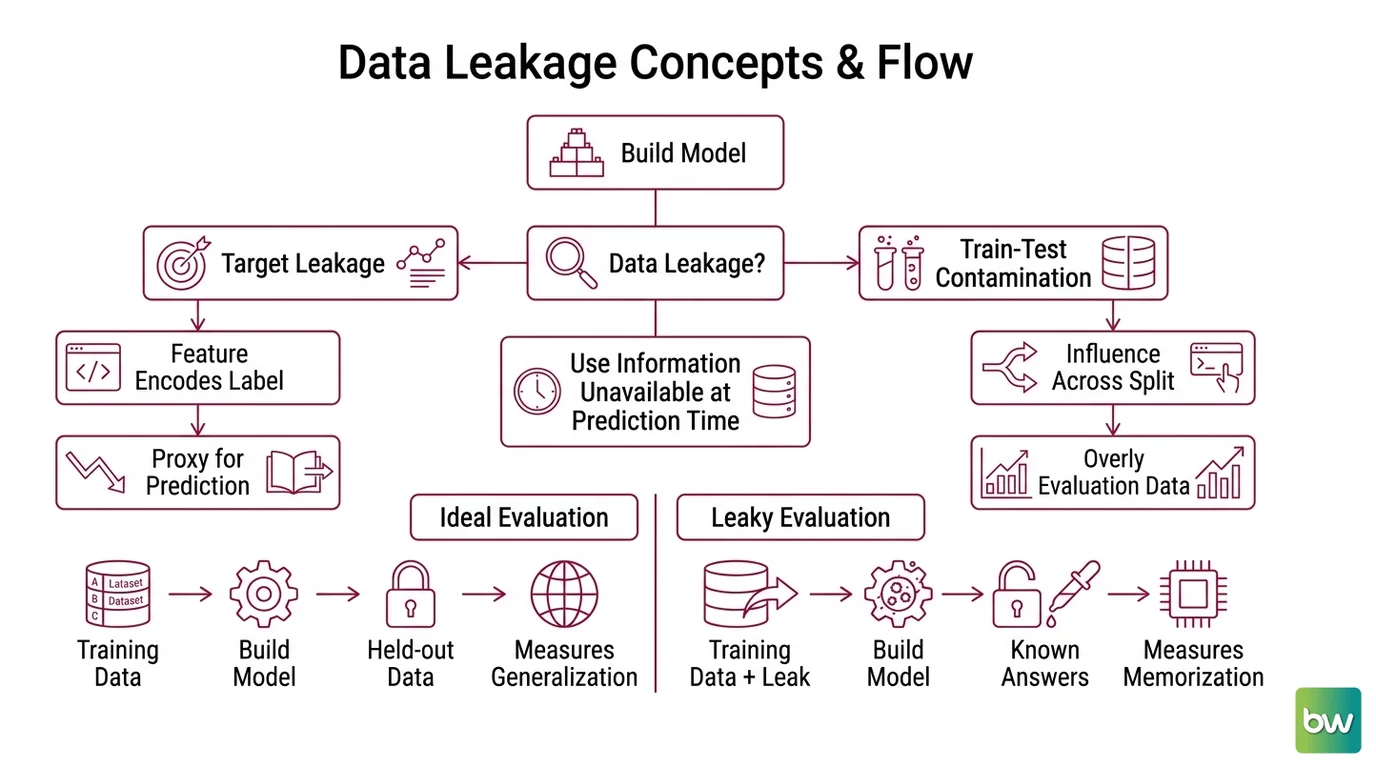
The distinction matters because the code runs without error. Data Preprocessing completes, the model fits, Cross Validation returns a number, and that number is high. Nothing crashes. The failure is epistemic: the score you trust is measuring the wrong thing. It tells you how well the model memorized answers it had already seen — not how well it generalizes to a question it has not.
There are two broad families. Target Leakage is when a feature secretly encodes the label: a proxy or downstream consequence of the very thing you are predicting, something that would only become known after the prediction is needed. The second family is contamination across the Train Test Split, where the evaluation data influences training. Both inflate the same way, for the same reason — the model gets a glimpse of the Ground Truth it is supposed to be guessing.
Why a Leaky Model Flatters Itself
A leaked model does not cheat on every question. It cheats on exactly the questions you use to grade it, which is worse, because grading is the one process you rely on to catch a bad model.
How does data leakage produce misleadingly optimistic model results?
Return to the random-noise example. When feature selection runs across the full dataset — training rows and test rows together — it picks the columns that happen to correlate with the label across all the data, including the rows reserved for testing. Those columns are noise; in a finite sample with many candidate features, some noise tends to correlate with the target by chance. By the time the model reaches the “held-out” rows, it has already been steered toward features chosen with those exact rows in view.
The result is accuracy near 76% on data that contains no learnable pattern. Run the same experiment correctly — select features using only the training fold, then evaluate — and the score falls to 50%, which is the truth. (Both figures come from scikit-learn’s synthetic illustration; they describe random data, not a benchmark.)
The mechanism generalizes. Leakage shifts the probability distribution your evaluation samples from: instead of estimating performance on genuinely novel inputs, your metric estimates performance on inputs that already shaped the model. The estimate is not merely noisy — noise would average out across folds. It is biased in a single direction: upward. Cross-validation, the tool you reach for precisely to get an honest estimate, faithfully reports the inflated number, because the contamination happened before it ever ran.
This is why leakage is more dangerous than it looks. Overfitting usually announces itself: training accuracy soars while validation accuracy lags behind. Leakage hides in the absence of that gap. Training and validation agree, both look excellent, and the disagreement surfaces only in production, where it is expensive.
The Channels Where Test Data Bleeds In
Target leakage is the dramatic case, but the everyday culprit is duller: preprocessing. Most transforms learn something from the data — a mean, a variance, a set of fill values — and if they learn it from the full dataset, they smuggle test-set information into training.
How does information from test data leak into model training?
Consider
Standardization, which rescales a feature by subtracting its mean and dividing by its standard deviation. Compute that mean and standard deviation across the entire dataset, and every training row is now scaled using statistics that include the test rows. The test set has whispered its distribution into the training process. The same trap sits inside
Missing Data Imputation (filling gaps with a column mean drawn from all rows), dimensionality reduction with PCA, and feature selection. scikit-learn’s guidance is blunt about the root rule: never call fit on the test data, and split before any preprocessing touches the data.
The fix is structural, not a matter of vigilance — you cannot reliably remember this at every step of a long notebook. Wrap the transforms and the estimator into a single pipeline, so each transform learns its parameters only from the training fold, automatically, even inside cross-validation. scikit-learn’s Pipeline object exists largely for this reason.
Then there is time. Temporal Leakage occurs when a model trains on data that, in the real world, would only arrive after the moment of prediction — forecasting Monday’s price using Tuesday’s volume, in effect. A random train/test split scatters future and past rows on both sides of the partition, so the model “learns” from tomorrow to predict today. The remedy is not a random split but a chronological one: train on the past, test on the future, the way the model will actually be used. This is well-established practice rather than a single named standard, and it traces back to the same principle Kaufman et al. formalized — information about the target that should not legitimately be available.
What a Clean Split Actually Buys You
Once the mechanism is clear, leakage stops being a mystery and becomes a set of predictions you can test against your own pipeline.
- If you fit any transform — scaler, imputer, encoder, feature selector — before splitting, expect your reported accuracy to overstate production performance, and expect the gap to widen as the dataset gets smaller.
- If a model scores beautifully in validation and then collapses on live data, suspect leakage before you suspect distribution drift; leakage produces a clean validation curve, drift usually does not.
- If one feature dominates importance and looks almost too predictive, check whether it is a proxy for the label that would only be known after prediction time.
Detection tools can catch some of this before it reaches production. Deepchecks, an open-source validation library, ships explicit train-test checks — including Index Leakage and Date Train-Test Leakage Duplicates — that flag rows shared across the split and time-ordering violations, according to its documentation.
Tooling note:
- Deepchecks (open-source): The tabular and vision validation library includes Index Leakage and Date Train-Test Leakage Duplicates checks, but its most recent open-source release (0.19.1) dates to December 2024 and the project has slowed as the company shifted toward a separate LLM-evaluation product. Still functional — verify the install before pinning to a specific version.
Rule of thumb: Split first, then let every transform learn only from the training side; if a value was computed using even one test row, it has already leaked.
When it breaks: The hardest leaks are semantic, not procedural — a feature that is legitimately present in your training table but, in deployment, only gets populated after the outcome is already known. No split discipline catches that. It requires understanding what each feature means and when its value becomes available in the real world, which a pipeline cannot reason about on your behalf.
The Data Says
Data leakage is not an exotic failure; it is the default outcome of preprocessing before splitting, and it bends accuracy in one consistent direction — upward. The discipline that prevents it is simple to state and easy to violate: hold the test set in quarantine until the model is fully built. A score is only as trustworthy as the separation that produced it.
AI-assisted content, human-reviewed. Images AI-generated. Editorial Standards · Our Editors