What Is Context Window Management and the Token Limits That Shape Every LLM Interaction
ELI5
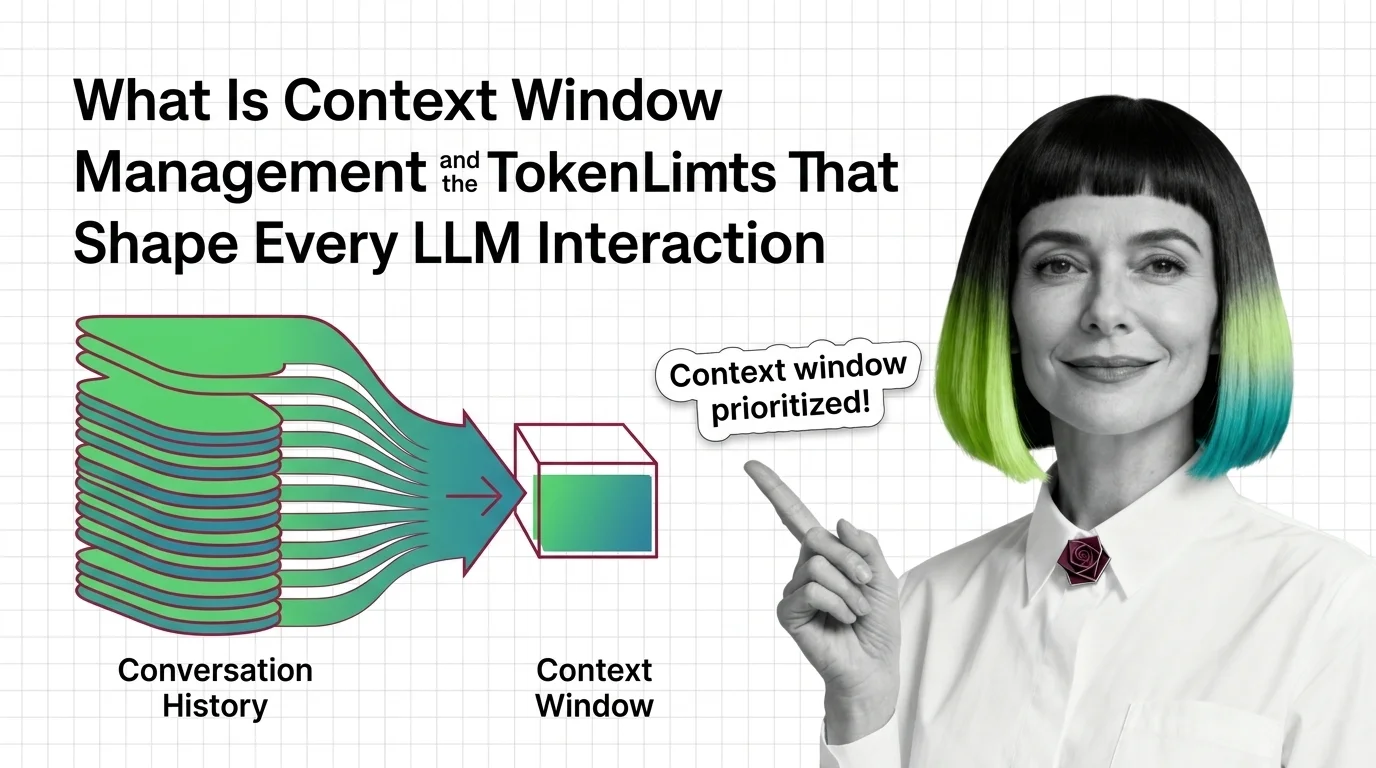
Context window management is the discipline of deciding which tokens an LLM processes at inference time. Conversations, documents, and instructions compete for a finite slot — the system picks winners, and the losers simply disappear.
Developers who benchmark language models tend to obsess over parameter counts and leaderboard scores. The variable that actually explains production failures is older, quieter, and easier to miss: what information the model was given, in what order, and whether the most relevant part was buried in the middle of a long, expensive prompt. The window is not simply large or small — it is position-sensitive, geometrically structured, and entirely indifferent to what you assumed it would recall.
What a Context Window Actually Costs You
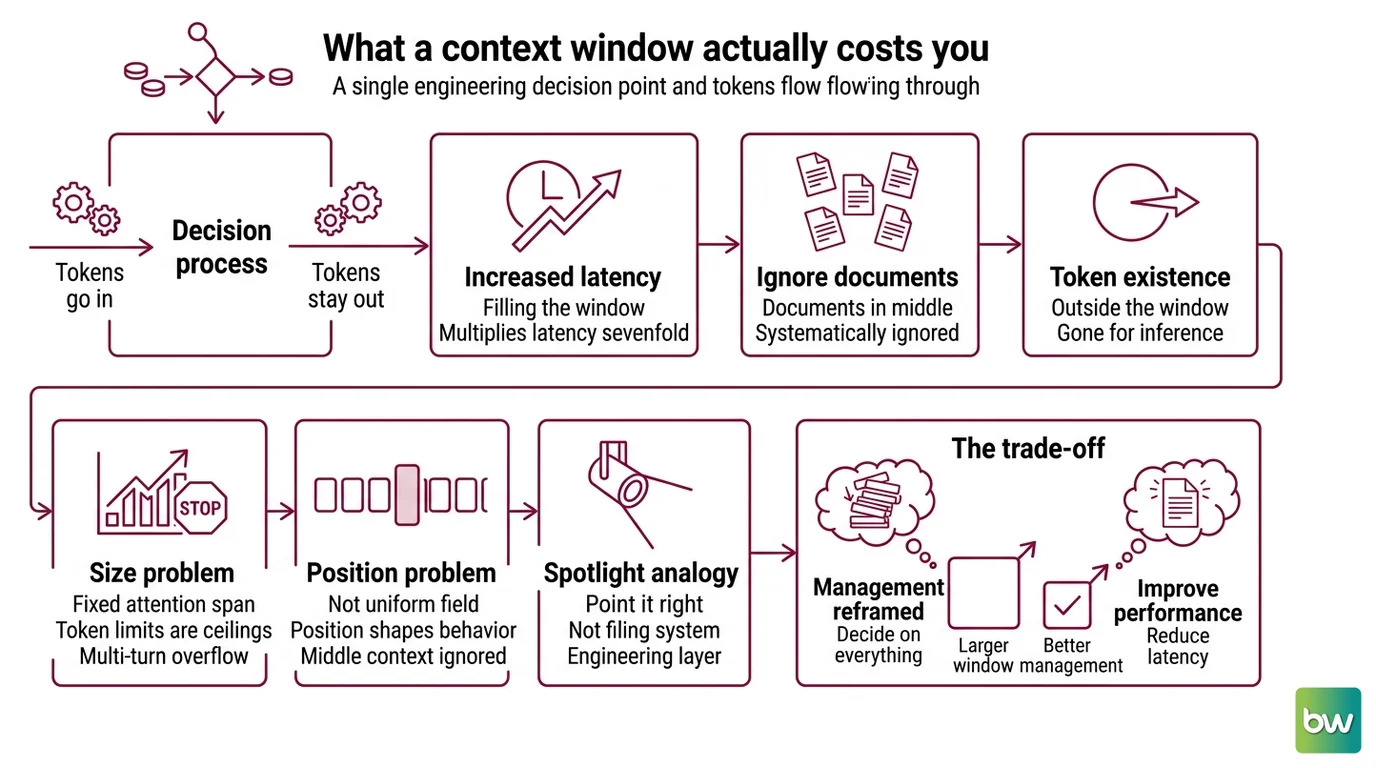
Every request to a large language model resolves to a single engineering problem: which tokens go in, and which do not. That decision looks trivial when you’re querying a model with a million-token window — until you discover that filling even a fraction of it can multiply your latency sevenfold, or that the model will systematically ignore the document you placed in the middle of your retrieval results.
What is context window management in large language models?
The Context Window is the fixed attention span an LLM operates within during a single inference pass. Everything the model processes during that pass — prior conversation turns, system instructions, retrieved documents, tool outputs — must fit inside this window, measured in tokens (roughly 0.75 words each in English). Once a token is outside the window, it does not exist for that inference. Not archived, not compressed. Gone.
Context window management is the layer of engineering that governs what occupies that span. It is distinct from simply having a large window. A million-token window does not dissolve the management problem; it reframes it. You now have room to include nearly everything, which means you must decide whether you should.
Think of it as a spotlight rather than a filing system. Everything inside the spotlight is equally real to the model during inference; everything outside it never happened. The engineering problem is not how to make the spotlight bigger — it is how to point it at the right things.
The challenge divides into three distinct subproblems.
The size problem: token limits are hard ceilings. A model cannot process a prompt that exceeds its maximum context length. Conversations that accumulate unboundedly — common in multi-turn agent workflows — eventually overflow, and the system must decide what to drop.
The position problem: context windows are not uniform attention fields. Position in the window shapes what the model actually retrieves. The research behind “Lost in the Middle” (arxiv 2307.03172, Liu et al., 2023) documented a U-shaped recall pattern — models recover information reliably from the beginning and end of the context, but performance degrades significantly when relevant content sits in the middle, even in models explicitly designed for long-context processing.
The cost problem: input tokens are not free. Claude Sonnet 4.6’s context window runs to 1M tokens at $3 per million input tokens (Anthropic Docs). Sending that full window with every request becomes arithmetically prohibitive at scale within hours of real production traffic.
Not a storage problem. An attention geometry problem.
The Mechanics of Forgetting
Once you accept that the window is position-sensitive and expensive, the engineering question becomes concrete: which signals go in, in what order, and how do you compress or discard the rest? Production systems combine several overlapping strategies, and the optimal mix depends on workload characteristics — task type, conversation length distribution, and how much the downstream application tolerates precision loss.
How does conversation history get prioritized and compressed in production LLM systems?
Truncation and sliding windows. The simplest strategy: when accumulated context exceeds a threshold, drop the oldest tokens while always preserving the system prompt and the most recent exchanges verbatim. The sliding window approach — formalized architecturally in the Longformer (Beltagy, Peters, Cohan, 2020 — Longformer paper) — restricts attention to a local neighborhood, reducing quadratic O(n²) complexity to linear O(n·w). In practice, production implementations apply a softer version: hard-truncate the oldest turns while anchoring the system prompt permanently at the beginning of the context.
Summarization buffers. Rather than discarding old turns outright, a separate model pass summarizes them. The active context then contains recent turns verbatim plus a compressed summary of earlier history. LangChain’s conversation memory patterns implement this approach — though given LangChain’s ongoing modularization toward langchain-core and langgraph as of 2026, verify which classes remain stable before wiring specific API names into production code.
Prompt compression. Microsoft Research’s LLMLingua-2 (arxiv 2403.12968) compresses prompts 2×–5× before inference, processing 3×–6× faster than its predecessor through data distillation rather than per-token scoring — making the compression task-agnostic (Microsoft Research). The trade is a small performance delta for dramatically reduced input size; whether that trade is acceptable depends entirely on the precision your downstream task requires. A customer-service summarization pipeline tolerates more compression loss than a legal contract analysis pipeline.
Semantic caching. Repeated or near-identical queries can be satisfied without a full model call. Caching systems store prior completions indexed by embedding similarity; a sufficiently close query retrieves the cached response. Redis’s developer guide cites cost reductions up to 73% and response times up to 15× faster on cache hits (Redis Blog). Their LangCache product was in preview as of June 2026 — confirm production availability before adoption.
Retrieval augmentation. Rather than including all candidate documents, retrieve only the top-k most relevant chunks via vector search or hybrid retrieval. Relevant context outperforms maximal context — and selecting carefully keeps the most useful content near the start or end of the window, precisely where recall is most reliable.
The Infrastructure Before the Algorithms
Context window management does not operate in isolation. It is a runtime behavior that sits downstream of your model selection, routing policy, and observability stack. The compression strategies above only function correctly if the infrastructure layer beneath them is configured to support them — and most teams reach for compression tools before they have that layer in place.
What do developers need to understand before implementing context window management?
Model selection sets your ceiling. Different models carry different effective context lengths — not just advertised maximums. A Model Routing layer determines which model handles which request category, and that decision carries implicit context budget implications. A production API Gateway or dedicated LLM Gateway — such as Openrouter — provides a common interface across models but does not abstract away per-model context constraints. Virtual Keys issued per team or per use case let you enforce token-budget policies at the routing layer, before requests reach the model at all.
Token counting is not optional. Before compression or truncation can be applied, the system must know precisely how many tokens the current context occupies. Tokenizer-accurate counting is not a luxury; word-splitting estimates undercount in code-heavy and multilingual content, producing hard failures when a request hits the model’s ceiling. Libraries built around the actual tokenizer vocabulary are the correct tool here.
Latency and context size are tightly coupled. Attention mechanisms scale quadratically with sequence length under standard architectures. One study found latency increasing more than sevenfold at 15,000 words of context compared to short-context requests (Redis Blog). If your application is latency-sensitive, context size is a performance variable, not just a correctness variable — and it must be treated as such in capacity planning and SLA definitions.
Fallback and retry patterns change under long contexts. A LLM Fallback And Retry Patterns strategy that works cleanly for short prompts may break under long ones: if the primary model refuses an oversized context, the Fallback Strategy must route to a model with a larger effective window — or the system must truncate before retrying. Rate Limiting interacts here directly: high-volume long-context requests exhaust token-per-minute quotas faster than raw request counts alone suggest, so quota estimation must account for average tokens-per-request, not just requests-per-minute.
Observability precedes optimization. Before implementing any compression strategy, instrument your pipeline to track token counts per turn, per phase, and per model call. A LLM Load Testing pass over your expected workload distribution surfaces where context bloat actually occurs. Most teams discover it concentrates in tool-call chains and retrieval outputs, not conversation history — which means summarization buffers solve the wrong problem if those aren’t your bottleneck.
Rule of thumb: position your most critical instructions and hard constraints near the beginning or the end of the total context. Mid-context placement systematically reduces recall on long prompts, a pattern documented in long-context tasks across model families.
When it breaks: context window management fails in two characteristic modes. Silent truncation — the system drops conversation turns without surfacing this to the caller, producing a model that appears confused but is actually amnesiac. Attention dilution — the model receives the full context but recovers the wrong pieces, typically content from the mid-context zone Liu et al. identified as lowest in reliable recall. Neither failure is loud. Both require active monitoring: sampling output quality on long-context requests, alongside token-count logging per call, is the only reliable detection mechanism.
The Data Says
The million-token window is now a baseline specification among frontier models — Claude Fable 5, Sonnet 4.6, and GPT-4.1 all reach that threshold, while Gemini 1.5 Pro extends to 2M tokens (Anthropic Docs, Redis Blog). The race for raw window size has largely plateaued; the engineering challenge has shifted to effective recall within those windows and cost per useful token. Liu et al.’s U-shaped attention finding means that a larger window does not automatically mean better performance — it means more opportunities for the model to attend to the wrong thing. The questions that matter in production are not “how large is the window?” but “where is the relevant information positioned, how much does it cost to send it, and how do you know if the model actually used it?”
AI-assisted content, human-reviewed. Images AI-generated. Editorial Standards · Our Editors