What Is Constitutional AI Prompting and How Critique-Revision Loops Replace Human Feedback
ELI5
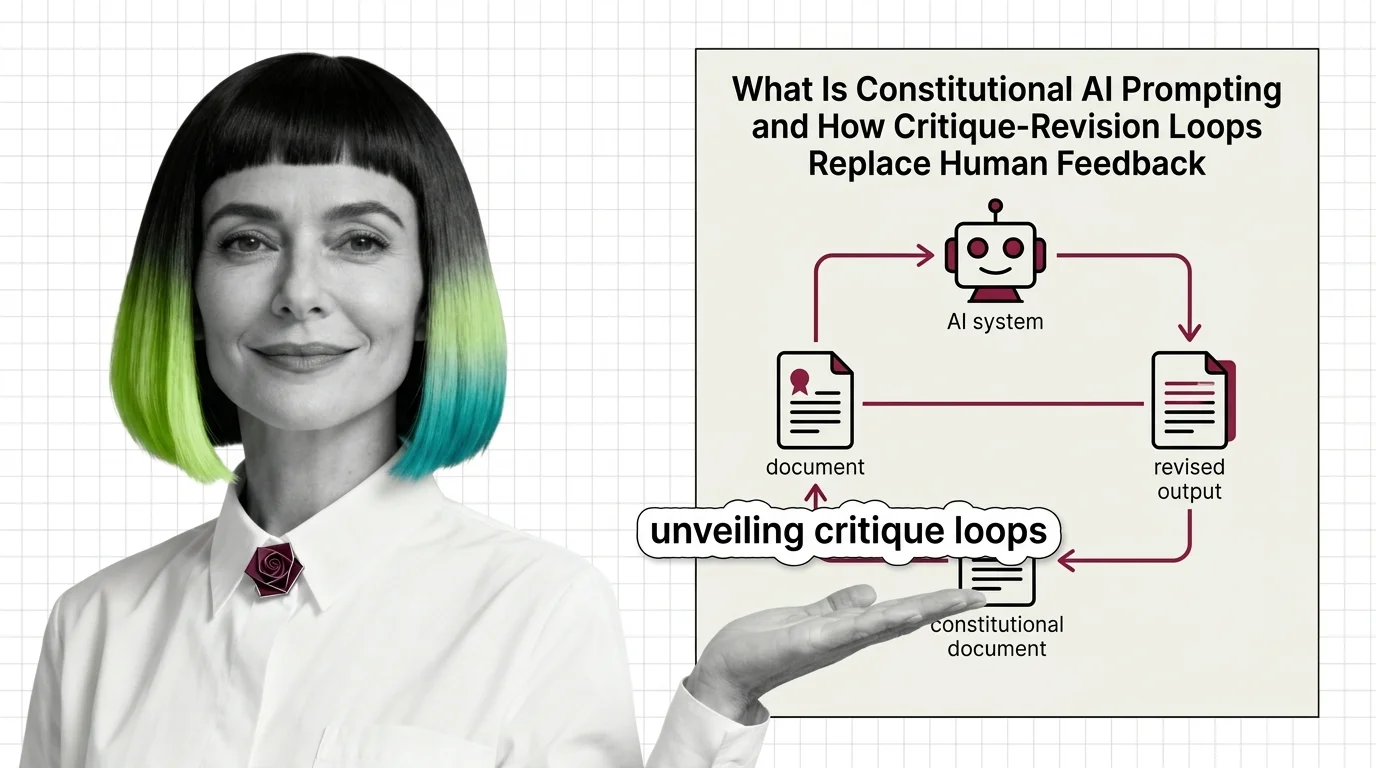
Constitutional AI prompting is a framework where a language model evaluates its own outputs against a short document of principles, then revises — creating a critique-revision loop that replaces, or augments, human feedback on model behavior.
The recipe for aligning a language model once required human annotators in the thousands — contractor pools rating responses, flagging harm, providing the labeled preference data that signals what “safe” looks like. RLHF, the technique that dominated alignment work before 2022, depended on tens of thousands of comparisons just for the harmlessness portion of training. The process was expensive, slow, and contingent on human raters whose judgments disagreed with each other more than the field liked to acknowledge.
Constitutional AI started with a question that appears circular on the surface: what if the model evaluated its own outputs instead?
Not self-awareness performing quality control. Distributional separation doing the same job.
When a model generates a problematic response, it does so by sampling from one probability distribution shaped by the prompt, context, and current decoding state. When asked to evaluate that same response against a stated principle — “does this content present risks of harm?” — it samples from a different distribution. The task structure is genuinely different. The apparent circularity dissolves when you look at the mechanism.
When the Model Becomes Its Own Editor
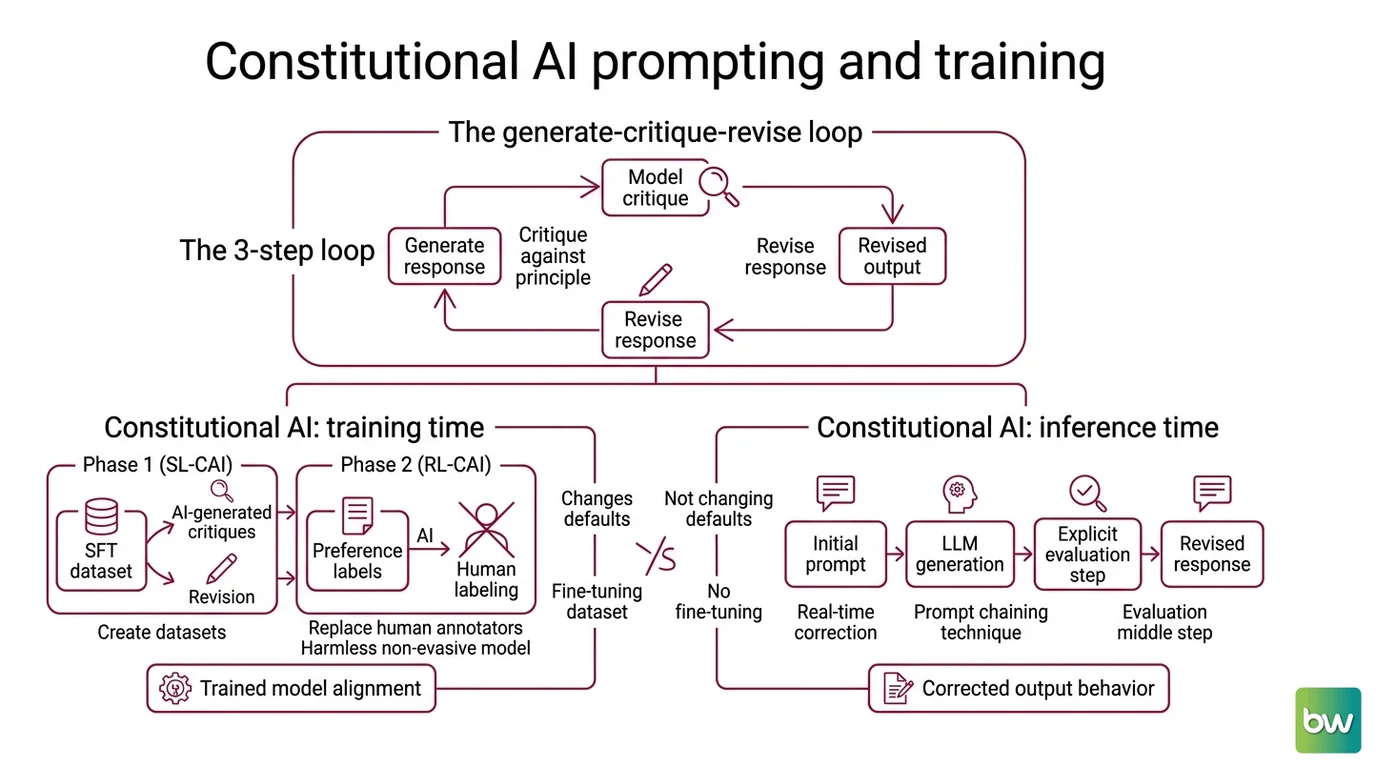
Anthropic introduced Constitutional AI in December 2022, in a paper led by Yuntao Bai and 48 collaborators (Bai et al. 2022). The core architecture is less complicated than the surrounding discussion makes it sound: generate a response, ask the model to critique that response against a specific principle, then ask it to revise based on the critique. Fine-tune on the revised outputs.
That three-step loop — generate, critique, revise — replaced human harmlessness labeling in Anthropic’s training pipeline. The judgment call no longer required a room of annotators; it ran inside the same model, measured against a written document of principles.
what is constitutional AI prompting
Constitutional AI prompting is the application of the generate-critique-revise loop as a structured technique — whether at training time, with subsequent fine-tuning, or at inference time, without it.
The term covers two distinct contexts that the literature frequently conflates. First, there is the training-time methodology Anthropic developed: a two-phase process where Phase 1 (SL-CAI) uses AI-generated critiques and revisions to create a supervised fine-tuning dataset, and Phase 2 (RL-CAI) uses AI-generated preference labels — RLAIF — to replace human harmlessness labeling during reinforcement learning. This process yielded what Anthropic called a “harmless but non-evasive” assistant: one that explains objections rather than deflecting (Anthropic Research).
Second, there is the inference-time implementation practitioners build: using the same critique-revision pattern without fine-tuning, as a form of Prompt Chaining with an explicit evaluation step in the middle. The behavior this produces resembles the trained model’s alignment behavior but does not reproduce it. The model is correcting a specific output in real time; it is not changing what it would generate by default.
The distinction has concrete engineering implications. Training-time CAI shapes the model’s dispositions across all future inference. Inference-time CAI shapes a specific response. If you build a system that uses critique-revision loops at generation time, you are producing a better output from the current generation — not a model that produces better outputs the next time it is called.
how does a constitutional AI critique and revision loop work
The loop has four moving parts: an initial response, a critique step, a revision step, and a termination rule.
The initial response is whatever the base model produces for the input — unconstrained and intentionally raw at this stage. The framework does not ask the generate step to self-censor; that would remove the violations the critique step needs to identify.
The critique step presents the response alongside a specific principle from the AI Constitution and asks the model to identify any tension between them. The critique prompt is directive and specific: “identify specific ways in which the following response is harmful, unethical, or dangerous.” The output is a natural-language description of the violation — targeted enough to inform what the revision step should do.
The revision step presents the original response, the critique, and a directive to produce a revised version that addresses the identified problem while preserving useful content. The revision prompt specifies that the output should be genuinely helpful — explaining limits rather than stonewalling, engaging rather than evading.
The termination rule is typically a fixed number of rounds. Implementation guidance from AI Wiki suggests two to four revision passes per prompt, beyond which returns diminish. Subsequent revision rounds do not improve outputs linearly — the model may begin flagging non-violations as problems, or introduce new constraint violations while resolving old ones.
The critique-revision loop shares structural lineage with Tree of Thoughts: both generate candidate outputs and evaluate them before committing to a final response. But where tree-of-thoughts branches in parallel — generating and scoring multiple candidates simultaneously — the CAI loop is sequential. Single candidate, multiple targeted passes. It trades breadth for depth on one output at a time.
Self Consistency takes a different approach: sample multiple independent answers and select by majority vote. CAI loops sample once and refine iteratively. Neither dominates the other; they address different failure modes. Self-consistency handles models that are probabilistically inconsistent; CAI handles models that are consistent but misaligned against a stated principle.
The Constitution Behind the Loop
The loop is only as precise as the document it checks against. The constitution — a prioritized list of normative principles — is the single most design-sensitive component of the system. Anthropic’s original implementation drew principles from sources including the Apple Terms of Service and the UN Declaration on Human Rights. Implementation guidance from AI Wiki suggests 10–20 principles as a practical range — enough coverage across primary risk dimensions without creating a document so long that the model loses specificity during the critique step.
Three patterns emerge when you study where constitution-based critique fails rather than where it succeeds.
Principles must be specific enough to trigger a critique. “Be helpful” generates no useful gradient — nearly every model output satisfies it, and the critique step produces nothing actionable. “Do not provide detailed synthesis routes for dangerous substances” produces a clear violation signal when triggered.
Principles must not conflict without a resolution ordering. A constitution that says “always answer the user’s question” and “refuse requests that could enable harm” without specifying which takes precedence will produce inconsistent revisions — the critique and revision steps resolve the conflict differently depending on small phrasing variations between rounds.
Priority ordering outweighs any individual principle. Claude’s constitution, updated January 22, 2026, encodes a four-tier resolution hierarchy: broadly safe > broadly ethical > compliant with Anthropic’s guidelines > genuinely helpful (Anthropic Blog). This is not documentation of policy — it is the algorithm the model applies when stated principles collide.
what are the key components of a constitutional AI prompting system
A functioning implementation requires five elements:
The constitution itself — a prioritized list of principles, typically ten to twenty, covering the primary harm categories and behavioral expectations relevant to your deployment context. The ordering within the document functions as the resolution rule when principles conflict; it is not cosmetic.
The generate prompt — the initial prompt to the model, designed to permit the full range of outputs without constrained prefixes. Constraining the generate step aggressively produces outputs that satisfy the critique trivially, which removes the loop’s value. The generate step should allow violations to surface; that is the mechanism’s point of entry.
The critique prompt — a prompt that presents the generated output alongside one or more principles and directs the model to identify violations explicitly. Single-principle critique produces more targeted findings than all-principles-simultaneously critique. Asking the model to evaluate against everything at once yields broader, less actionable output.
The revision prompt — a prompt that presents the original output, the critique, and an explicit directive to address the identified issues while preserving utility. The phrasing here determines whether revisions are substantive or merely evasive. “Rewrite to address the identified harm while remaining genuinely helpful” performs differently than “rewrite to avoid harmful content.”
A loop controller — the orchestration logic that manages pass count and exit conditions. Frameworks like DSPy can handle this structurally, turning each revision pass into a typed pipeline stage with verifiable output schemas. Pydantic AI adds schema-level validation to each revision step, catching structural failures before they compound across multiple rounds.
Unlike ReAct Prompting, which interleaves reasoning steps and tool calls in a single forward pass, constitutional AI prompting separates the evaluation phase from the generation phase by design — the critique runs as a dedicated pass on the complete output, not inline with producing it. The consequence: the critique can be targeted at the full response rather than at intermediate tokens.
When a revision pass resolves one principle violation and introduces another, additional rounds produce oscillation rather than convergence. This may require Backtracking to an earlier revision state, or resetting with a more targeted critique prompt focused on the newly introduced conflict. The signal that you are oscillating: successive revisions that look qualitatively similar but trigger different violation findings.
What the Loop Predicts About Its Own Failures
Constitutional AI prompting has a structural implication most practitioners encounter by collision rather than anticipation: the model’s critique capacity is bounded by its training distribution.
A principle like “do not assist with dangerous synthesis routes for chemical weapons” works because the model has sufficient training signal to recognize content in that class. A principle like “ensure all pharmacological dosage claims are accurate” does not work the same way if the model lacks reliable pharmacological knowledge — the critique step produces syntactically valid language while failing to catch actual errors. The loop converges. The output is still wrong.
More revision rounds degrade already-correct outputs. When applied to a response that already satisfies the constitution, additional passes introduce unnecessary hedging, strip specific claims in favor of vaguer language, and add qualifications that reduce rather than improve quality. The revision step does not distinguish “this response had a genuine violation” from “this response was already optimal.” It applies the same corrective pressure regardless.
If/then predictions from the structure of the loop:
- If your critique prompts trigger a violation finding on nearly every response, your principles are too vague or your generate step is under-constrained. Tighten the principle wording, or relax the initial prompt.
- If successive revision rounds produce outputs that are more similar than different, the loop has converged — further rounds add noise, not signal.
- If the loop oscillates — fixing violation A in round two and re-introducing it in round three — the conflict is between principles, not within a single principle. Constitution redesign addresses this; more revision rounds do not.
Rule of thumb: treat the critique step as a filter, not an oracle. It identifies patterns consistent with violations given the model’s training distribution; it does not verify whether a specific claim is factually accurate or contextually harmful in ways the model cannot access.
When it breaks: the critique step reliably fails when harm is pragmatic rather than semantic — when an output is technically compliant with every stated principle but still causes harm through omission, implication, or context the model cannot access. Anthropic’s Constitutional Classifiers, released February 2025, address part of this gap by extending the CAI framework to inference-time Guardrails; they reduced jailbreak success rates from 86% to 4.4% on Claude 3.5 Sonnet (Anthropic Research), at a cost of 23.7% inference overhead — a figure that clarifies what genuine robustness at this layer actually requires.
The inference-time version of the loop also lacks what the training-time version provides: feedback into the model’s weights. Self Refine — the inference-time critique-revision method developed independently by Madaan et al. in 2023 (Madaan et al. 2023) — demonstrated roughly a 20% absolute improvement across seven diverse tasks using the same generate-critique-revise structure, with no fine-tuning required. The gain is real. It is also task-level: outputs improve; the model generating them does not. Practitioners who want better responses can implement the loop today. Practitioners who want a model with different default behavior need the training-time process that closes feedback into weights.
The Data Says
Constitutional AI’s generate-critique-revise loop replaced human harmlessness labeling in a real production training pipeline — that is the primary claim, and it holds from the 2022 paper (Bai et al. 2022). The inference-time variant shows measurable output improvement across diverse tasks without fine-tuning, but does not modify what the model produces by default. The critical choice for practitioners: apply the loop at inference time for per-output improvement, or invest in the training-time process for dispositional change. Both are valid engineering decisions; they are not substitutes for each other.
AI-assisted content, human-reviewed. Images AI-generated. Editorial Standards · Our Editors