What Is Class Imbalance and Why a 99% Accurate Model Can Be Useless
ELI5
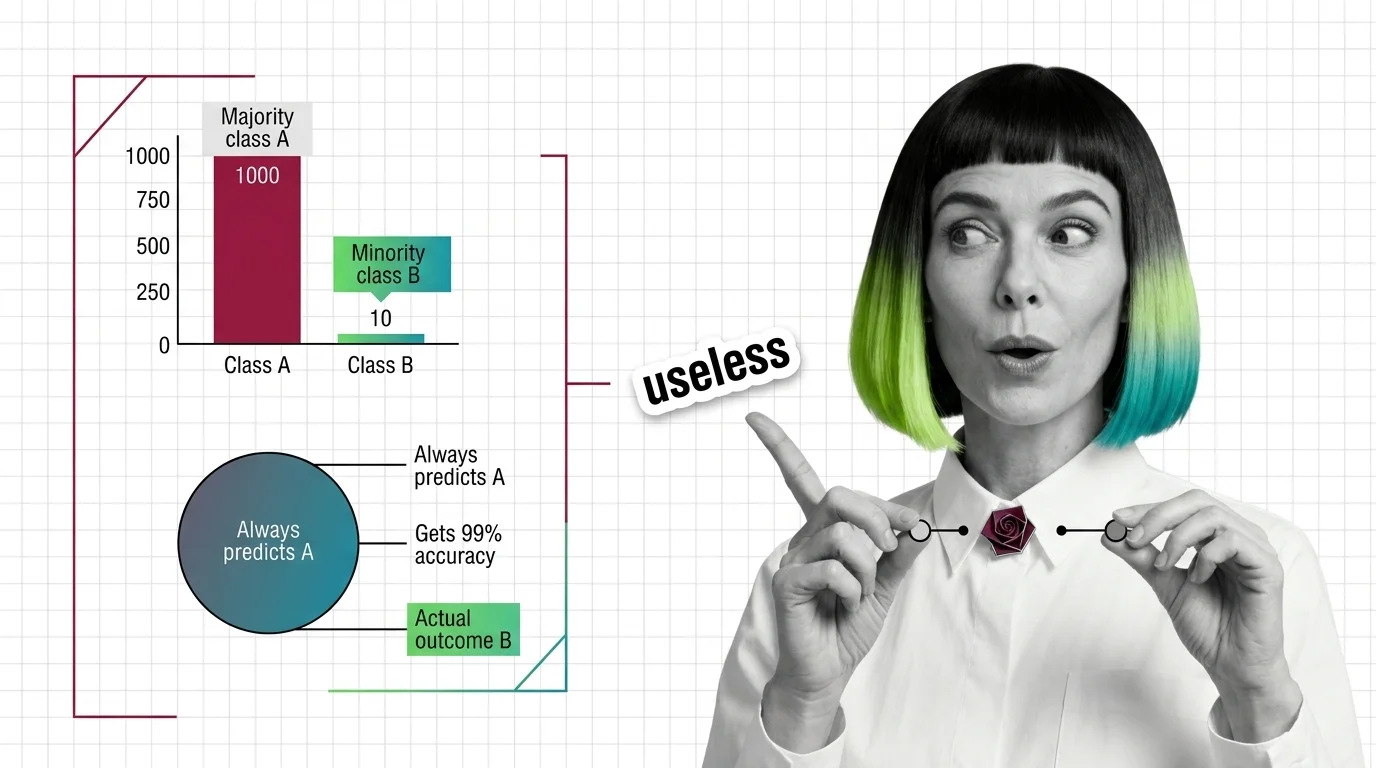
Class imbalance is when one outcome vastly outnumbers another — ninety-nine routine transactions for every fraud. A model can hit 99% accuracy by quietly ignoring the rare class, the exact class you built it to catch.
A fraud detector goes live at 99% accuracy. The dashboards are green, the demo lands, and three weeks later the fraud team is still buried, because the model has never once flagged a fraudulent transaction. Nothing crashed. The accuracy was real. The metric was simply measuring the wrong thing.
Not a bug. A measurement artifact.
When Accuracy Becomes a Sleight of Hand
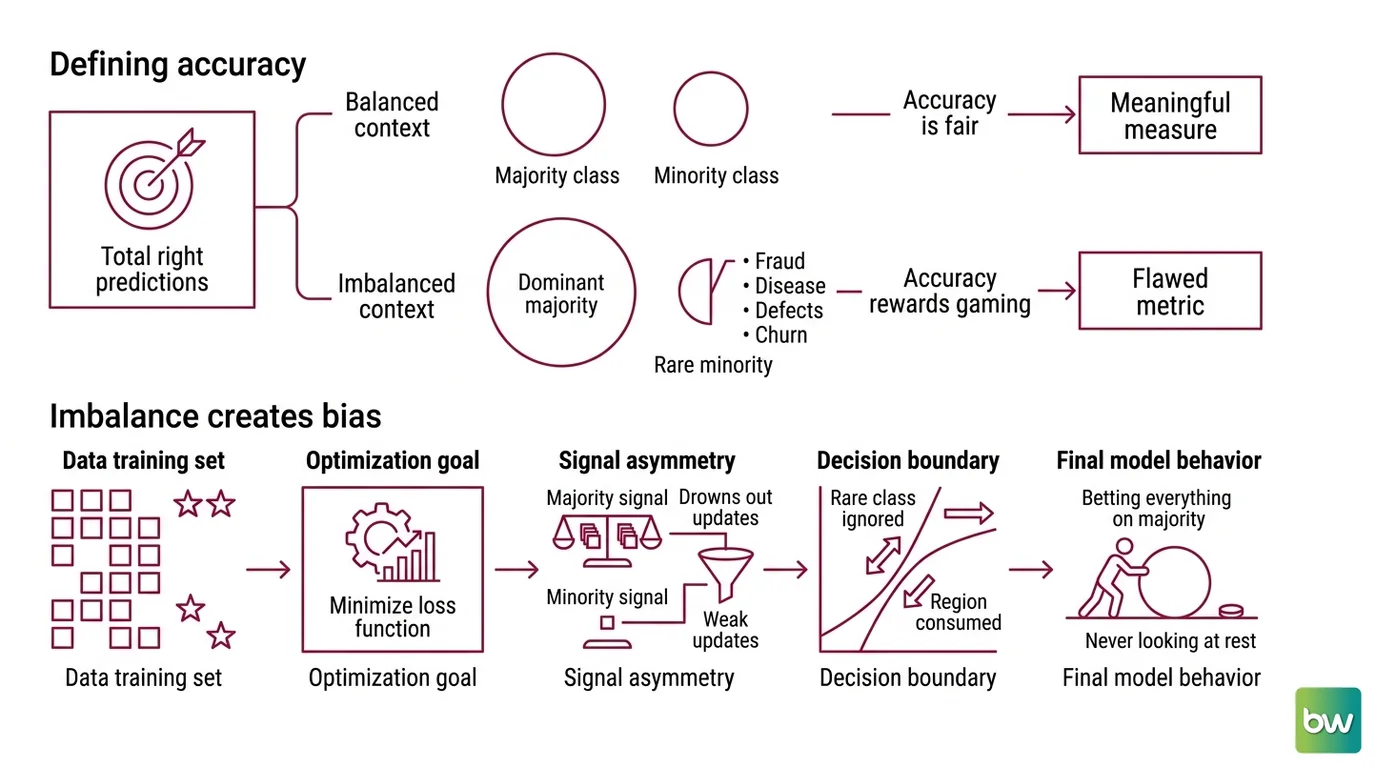
Accuracy answers one narrow question: of all predictions, how many were right? That question is only fair when the classes it counts over are roughly balanced. The moment one class dominates, accuracy starts rewarding a model for the one behavior it should never adopt, which is betting everything on the majority and never looking at the rest.
What is class imbalance in machine learning?
Class imbalance describes a training set where the target label is heavily skewed: one class, the majority, accounts for most of the examples, while the class you actually care about, the minority, is rare. Fraud, disease, manufacturing defects, churn, intrusion attempts. In every one of these, the interesting event is the exception, not the rule.
There is no single ratio at which a dataset officially becomes “imbalanced.” It is a spectrum. Mild skews sit around four-to-one; extreme cases run past a hundred-to-one, where the minority is a thin sliver of the data. What stays constant across that range is the asymmetry of stakes: the rare class is usually the one whose errors are expensive, and it is also the one the model has the least incentive to learn.
How does class imbalance make a model biased toward the majority class?
Training is an optimization problem. The model adjusts its parameters to minimize a loss function, typically cross-entropy, averaged across every example. When one label covers the overwhelming bulk of the data, the cheapest way to drive that average down is to predict the majority confidently and treat the minority as statistical noise.
The gradient signal tells the story. Each minority example contributes a tiny share of the total loss, so the updates that would help the model recognize the rare class are drowned out by the flood of majority examples pulling the decision boundary the other way. The boundary drifts until the rare region is swallowed whole.
The model is not cutting corners. It is minimizing exactly the quantity you told it to minimize, and that quantity never said the rare class mattered. Change the objective and the bias moves with it.
Not laziness. Optimization.
The 99% Trap, Decomposed
To see why the headline number lies, you have to stop trusting the summary and look at the table it came from. A Confusion Matrix splits every prediction into four buckets, true and false positives, true and false negatives. Accuracy collapses all four into one ratio, and in doing so it hides the only cases that justified the project.
Why can a model have 99% accuracy but still fail on the minority class?
Take the canonical illustrative case: 10,000 transactions, of which 100 are fraudulent and 9,900 are legitimate, a one-percent positive rate. Build the laziest possible classifier, one that labels everything “legitimate.” It is correct on all 9,900 routine transactions and wrong on all 100 frauds. That is 9,900 right out of 10,000, or 99% accuracy, with zero fraud caught.
Decompose it and the illusion dissolves. Recall on the fraud class, the share of real frauds the model actually flags, is zero. Precision is undefined, because the model never makes a positive prediction at all. This is exactly what Precision, Recall, and F1 Score is built to expose: per-class measures that refuse to let the majority’s easy wins paper over the minority’s total failure. The single number was high precisely because it averaged over a question nobody asked.
Metrics That Refuse to Be Fooled
Accuracy fails on skewed data for one structural reason: it weights every example equally, so the majority votes itself a passing grade. The fix is to measure each class separately and then refuse to average away the result you care about.
Precision and recall are the starting pair. Recall asks how many real minority cases you caught; precision asks how many of your alarms were genuine. F1, their harmonic mean, punishes a model that wins on one by sacrificing the other.
Balanced Accuracy goes further by averaging recall across classes rather than across examples; in scikit-learn’s implementation, the adjusted=True option rescales it so that random guessing scores zero instead of an inflated baseline, per scikit-learn docs.
There is also a lever most accuracy reports ignore: the Classification Threshold. A classifier outputs a probability, and the default cutoff of 0.5 is arbitrary on imbalanced data. Lower it and recall rises while precision falls; raise it and the trade reverses. The threshold is a dial you tune to the cost of each error, not a constant handed down by the library.
Tipping the Scales Back
Once you accept that the objective is the problem, the fixes sort into three layers, each intervening at a different point in the pipeline.
At the data layer you rebalance before training. Undersampling discards majority examples until the classes are closer in size; oversampling repeats or synthesizes minority ones. The most-taught synthesis method is SMOTE, which, as Chawla et al. (2002) introduced it, creates new minority points by interpolating between a minority sample and its k nearest minority neighbors rather than duplicating existing rows. ADASYN, from He et al. (2008), adapts that idea by generating more synthetic samples around the minority points that are hardest to classify. Both are implemented in Imbalanced Learn, which as of version 0.14.2 requires scikit-learn 1.5 or newer and NumPy 2.0+, per imbalanced-learn docs. One caution: SMOTE is widely taught but not a guaranteed win, and recent literature questions its value on high-dimensional tabular data, so treat it as a hypothesis to test, not a default to trust.
At the algorithm layer you leave the data alone and reweight the loss. Class Weighting and Cost Sensitive Learning make a minority error cost more than a majority error, so the optimizer can no longer buy a low average by ignoring the rare class.
At the loss layer, Focal Loss, from Lin et al. (2017), reshapes cross-entropy to down-weight the easy, already-correct examples and concentrate learning on the hard ones, a design built for extreme foreground-background imbalance.
One trap spans all three: resample only inside the training fold. If you rebalance the whole dataset before splitting it for Cross Validation, synthetic minority points leak from training into validation, a form of Data Leakage that quietly inflates your scores. (It is a cousin of Target Leakage, where a feature smuggles in the answer.) Fit the resampler on each training fold alone.
What the Imbalance Predicts
The mechanism turns into predictions you can check against your own runs.
- If you rebalance the training data, expect recall on the minority to climb and precision to drop, because you are trading false negatives for false positives.
- If you only ever report accuracy on a skewed test set, expect the failure to stay invisible until production surfaces it for you.
- If the minority ratio is extreme, beyond roughly one in a hundred, expect resampling alone to underperform loss-level methods that were designed for that regime.
Rule of thumb: On imbalanced data, optimize and report a per-class metric such as recall or balanced accuracy, and never let raw accuracy be the headline.
When it breaks: Rebalancing distorts the base rate the model sees, so its output probabilities stop matching real-world frequencies. If you need calibrated probabilities rather than just a ranking, resampling can quietly make calibration worse, and you may have to recalibrate the model after training.
The Data Says
Accuracy is a weighted average that silently assumes your classes matter equally, and on imbalanced data they never do. The rare class is usually the entire reason the model exists. Measure per class, weight the cost of the errors you actually fear, and treat any single headline number with suspicion.
AI-assisted content, human-reviewed. Images AI-generated. Editorial Standards · Our Editors