What Is AI Avatar Generation and How Talking-Head Synthesis Works
ELI5
AI avatar generation turns a photo, short clip, or text prompt into a moving, speaking digital face — either by predicting new mouth and head pixels frame-by-frame from audio, or by reconstructing an entire 3D head from scratch.
Feed HeyGen’s newest model a fifteen-second selfie clip and it returns a studio-grade video of you saying anything typed into a text box — lips synced, head tilting, blinking on cue. Feed a real-time 3D avatar pipeline a prompt instead, and it never touches a single real pixel; it sculpts geometry, paints a surface, and renders a head that can be lit and rotated from any angle, live. Same marketing category. Not one technology. Two.
One Marketing Word, Two Unrelated Pipelines
Strip away the branding and “AI avatar” resolves into two genuinely separate engineering problems. One borrows a real human’s recorded face and modifies only what new audio demands. The other builds a head that never existed, mesh by mesh, material by material. Both fall under the umbrella term Digital Human, but the math producing them barely overlaps.
What is AI avatar generation?
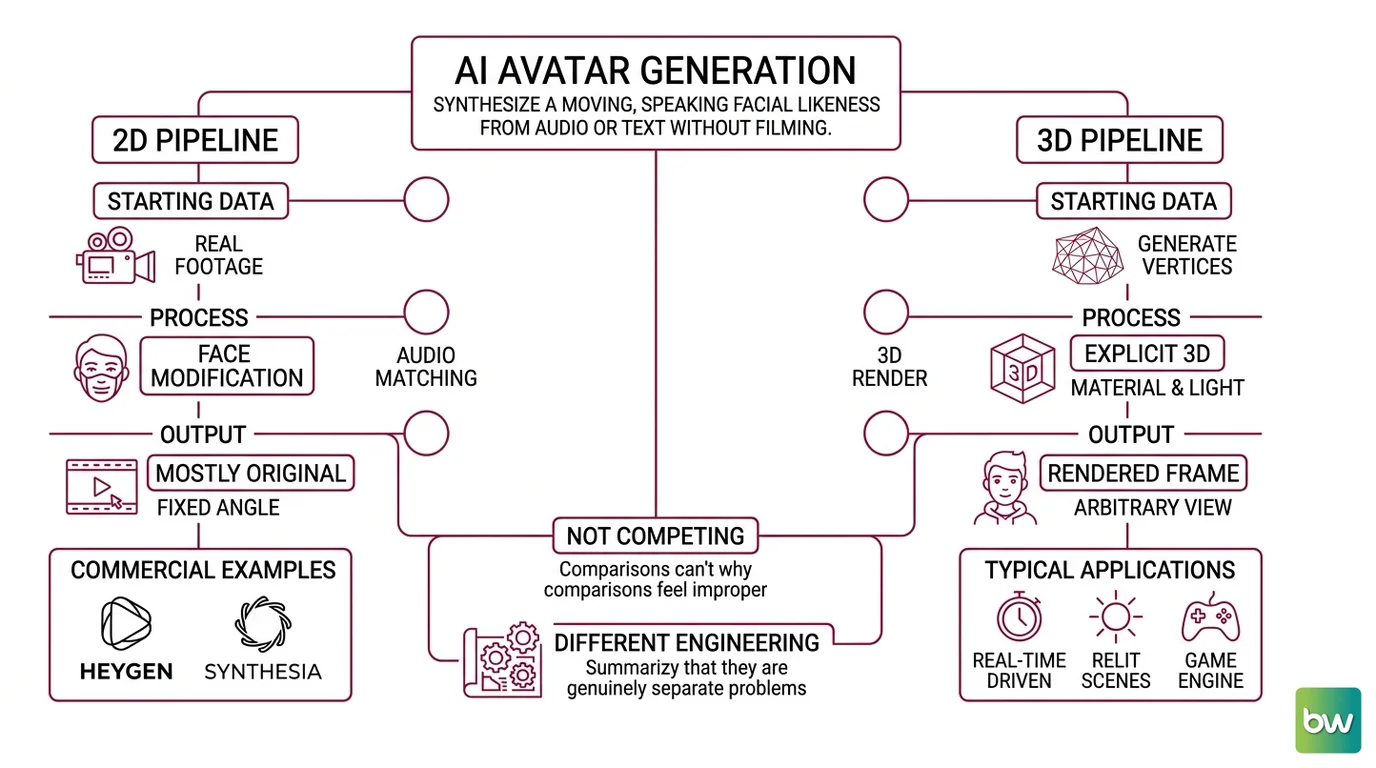
AI avatar generation is the umbrella term for any system that synthesizes a moving, speaking facial likeness from audio or text, without that motion ever being filmed. The category splits along one structural line: where does the pixel or vertex data actually come from?
The first family — the 2D pipeline — starts from real footage. A camera once recorded a real face from one or more angles, and the avatar tool keeps that footage almost entirely intact, regenerating only the region around the mouth, and sometimes the head pose, to match new audio. The output is, geometrically speaking, still mostly the original recording. HeyGen and Synthesia both build commercial products on this approach, even though their underlying models differ.
The second family — the 3D pipeline — never references a captured frame at all. It generates an explicit three-dimensional representation, textured and lit independently of any one camera angle. Nothing in the output frame was ever photographed; it was rendered. This is the approach behind real-time avatars that need to be viewed from arbitrary angles, relit for different scenes, or driven live by a game engine instead of baked into a fixed video file.
Treating these as one technology explains why comparisons between avatar tools so often feel apples-to-oranges. They are not competing on the same axis.
Inside the 2D Pipeline: Borrowing a Real Face to Say New Things
The 2D pipeline’s core trick is narrow by design: it doesn’t generate a face, it generates a correction to one. That constraint is also its strength — because most of the frame is real, lighting and skin texture stay photographically consistent. The harder question is how a system maps an audio waveform onto the exact muscle deformation around a mouth, frame by frame.
How does AI avatar generation work?
Mechanically, this pipeline runs as a constrained generation problem, not a free one. Lip Sync models take two inputs — a window of audio and a window of video frames — and output a modified mouth region matching the audio’s phonemes for that instant. Wav2Lip, the method most commercial tools trace their lineage to, trained its generator against a separate “lip-sync expert” network whose only job was scoring how well a generated mouth matched a given audio clip (Prajwal et al.). That adversarial scoring signal, not a table of phoneme-to-shape rules, is what taught the generator which mouth shapes belong to which sounds.
Notice what this mechanism does not do: it does not understand language, and it does not plan ahead. Each frame’s mouth shape comes from a local audio window, conditioned on surrounding video context. The system represents correlation, not meaning.
Head motion and blinking, when present, usually come from a separate layer on top: a compact numeric description of head rotation, pose, and expression, applied to a single still photo so the whole head animates, not only the mouth. That’s what makes one-photo avatar generation possible — the system never needs multiple frames of you, only one image and a model of how heads move while speaking.
The probability framing matters here. The lip-sync generator isn’t retrieving the “correct” mouth shape for a phoneme — there is no single correct shape, since the same sound looks slightly different on every face. It samples from a learned distribution over plausible mouth shapes, conditioned on audio and identity. That’s also why these systems fail in predictable ways: feed them phoneme transitions rare in the training distribution, and the sampled shape drifts toward an average that satisfies no specific sound well.
This is also where current commercial products sit. As of April 2026, HeyGen’s newest model, Avatar V, needs only a fifteen-second recording to produce a multi-angle-stable studio video, confirmed in HeyGen’s own announcement post — a sharp drop from the longer studio sessions earlier avatar generations required. The company’s earlier Avatar IV model, built around image-to-video lip-sync and gesture generation, remains available alongside it.
Building a Head That Was Never Filmed
The 3D pipeline answers a completely different question: not “how do I modify this footage,” but “how do I synthesize a coherent surface that looks correct from any viewpoint, under any light.” That requires geometry, not just pixels, plus a way to project a believable texture onto that geometry. Three layers typically combine to make it possible.
What are the main components of an AI avatar generation system?
The first layer is geometry synthesis. One route is Text-to-3D generation, producing a 3D asset directly from a text description rather than a scanned reference. The dominant technique is Score Distillation Sampling, which repurposes a pretrained 2D image model as a critic: render a candidate 3D shape from a random viewpoint, score how convincing that 2D render looks to the image model, then nudge the underlying 3D representation to score higher next time. Run that loop across thousands of random viewpoints, and a coherent 3D object emerges — without the system ever training on real 3D scan data.
The second layer is scene representation — how geometry and appearance under light actually get stored and rendered. NeRF represents a scene as a continuous function, queried repeatedly along camera rays to produce each pixel: accurate, but slow enough that real-time rendering was impractical (Mildenhall et al.). Gaussian Splatting solved the speed problem by replacing that continuous function with an explicit set of small 3D Gaussians — each with a learned position, shape, color, and transparency — rendered through direct rasterization instead of ray-by-ray querying, a real-time alternative to NeRF fast enough for live, interactive heads (Kerbl et al.).
The third layer is materials and texture. A raw 3D mesh carries no surface-appearance data; UV Mapping unfolds that surface into a flat 2D coordinate space so a texture image can be painted onto it accurately, the way a world map unfolds a globe. Once unfolded, PBR Materials define how the surface physically responds to light — separate channels for base color, roughness, and reflectivity — so skin reads correctly whether the avatar sits under studio lighting or a dim video call.
A 3D avatar is assembled, not captured.
What Pipeline Choice Predicts About Where Each Avatar Breaks
The architecture you pick predicts its own failure mode before a single frame renders.
If the use case is a real, identifiable person speaking on camera — training content, a sales pitch, a localized dub — the 2D pipeline is close to the only sane choice; it inherits real lighting and skin texture for free, while a 3D pipeline would have to synthesize both from nothing. If the use case needs a head approached from an angle never captured on film, relit for a different scene, or driven live inside a 3D environment, only the volumetric pipeline applies — it stores an actual spatial structure, not a flat sequence of frames. Ask a 2D lip-sync system for an angle absent from its source clip, and expect visible distortion around the jaw and neck: extrapolation outside training data, not interpolation within it.
Rule of thumb: if the output must look like one specific real person on camera, default to the 2D pipeline. If it must be viewed, lit, or driven from angles you can’t predict in advance, default to the volumetric one.
When it breaks: 2D lip-sync models hallucinate mouth shapes at rapid phoneme transitions and extreme expressions the training data rarely covered, producing the blur-and-smear artifact that detection benchmarks like FaceForensics++ exist specifically to catch (Rössler et al.). Volumetric pipelines fail the opposite way — Gaussian splats trained under one lighting setup tend to float or smear under a different one, because the model learned a fixed light-surface relationship rather than a relightable one.
Security & compatibility notes:
- HeyGen account takeover technique (March 2026): A documented exploit chained a password or MFA change with insufficient session invalidation, letting an attacker retain account access after the legitimate owner reset credentials. Treat avatar-platform accounts with the same session hygiene as any other production credential.
- EU AI Act deepfake disclosure (Article 50(4)): Starting August 2, 2026, operators of avatar-generation tools must label AI-generated or manipulated content as such; non-compliance carries fines up to €15 million or 3% of global turnover (European Commission).
Generation and Detection Are Reading the Same Distribution
FaceForensics++ exists as a research benchmark, not a curiosity: synthesized mouths aren’t pixel-perfect even when they look convincing to a glancing eye. Rössler and colleagues built it from a thousand real videos and four thousand manipulated ones because manipulation methods — lip-sync among them — leave statistical traces that differ from camera noise, compression artifacts, and natural skin micro-texture (Rössler et al.).
That’s the same probabilistic mechanism that makes the 2D pipeline work, read from the opposite direction. A model trained to generate the statistically most plausible mouth shape for a given sound is, by construction, generating something slightly too smooth and too consistent — free of the small asymmetries a real face produces under muscular strain. Generation and detection read the same distribution backwards.
Whether that gap survives the next generation of avatar models is an open question. Every detection benchmark eventually becomes training data for the system it was built to catch.
The Data Says
AI avatar generation is not one mechanism wearing two names. It’s two unrelated synthesis problems — pixel correction on real footage versus geometry built from nothing — that converged on the same product category because both end in a moving, talking face. Knowing which one is running predicts exactly where it will fail.
AI-assisted content, human-reviewed. Images AI-generated. Editorial Standards · Our Editors