What Is a System Prompt and How It Controls LLM Behavior Before the First User Message
ELI5
A system prompt is a block of text the developer writes before the conversation starts. The LLM reads it first, before your first message, and uses it to decide how to behave — what persona to adopt, what topics to refuse, what format to follow.
A strange thing happens the moment you open ChatGPT, Claude.ai, or any consumer AI product: the model already knows who it is. It already knows not to help with certain requests, to respond in a particular style, and in some cases to maintain a fictional identity. You haven’t typed anything yet. The model is already configured.
That configuration lives in the system prompt — a layer of instruction that runs before the conversation begins, that shapes everything that follows, and that most users never see.
The Invisible Layer That Runs Before You Do
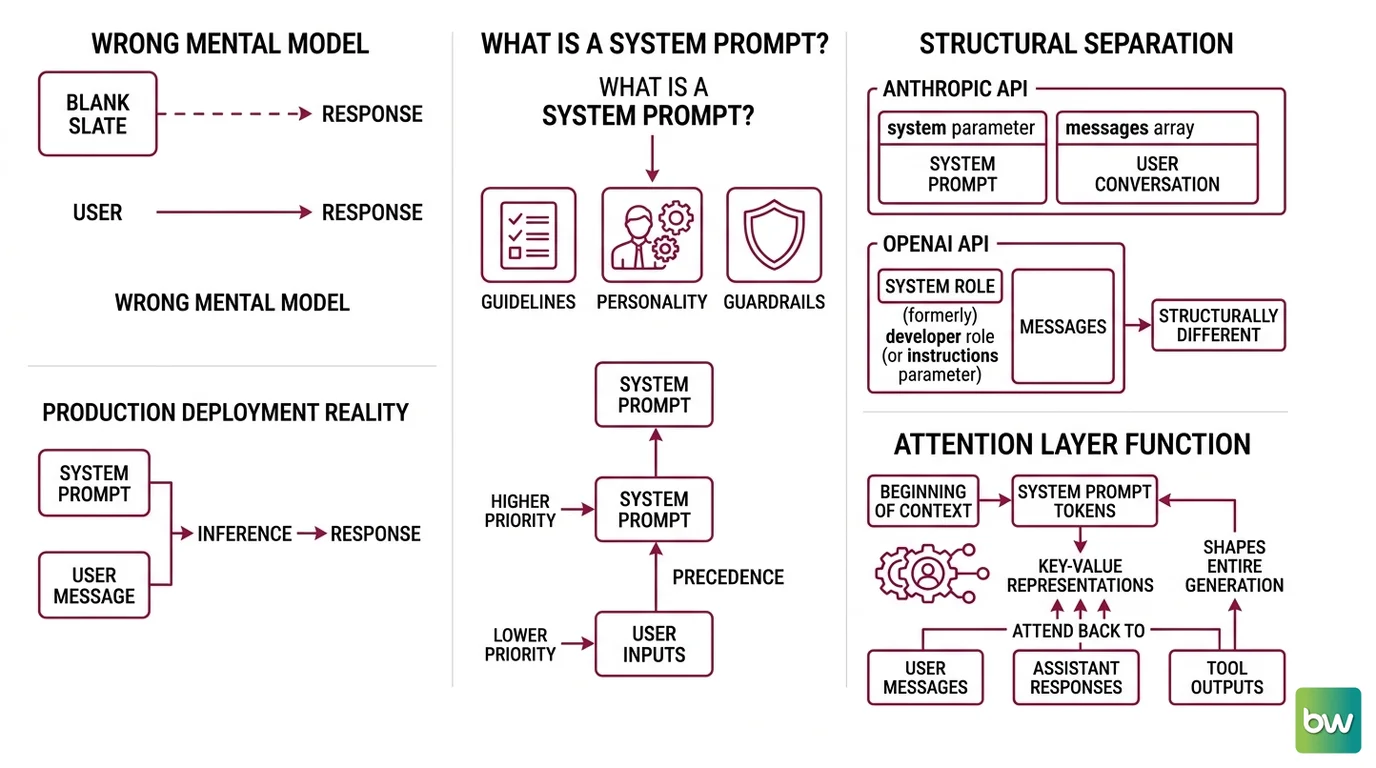
The simplest mental model is wrong here. Most people imagine an LLM as a blank slate that responds to whatever the user types. That picture is accurate for raw API calls with no configuration — but almost nowhere else. Every production deployment, every consumer product, every AI agent built on top of a foundation model starts with a system prompt that arrives at Inference time before the user’s first message.
Understanding what that prompt actually does — mechanically, not metaphorically — requires looking at how the model processes it.
What is a system prompt?
A system prompt is a block of text that provides “context, instructions, and guidelines to Claude before presenting it with a question or task,” as Anthropic’s official documentation describes it (Anthropic Docs). More precisely, it defines the model’s guidelines, personality, and guardrails — and critically, it takes precedence over user inputs in the processing hierarchy (CHI 2026 paper).
The API implementation varies by provider. In Anthropic’s Messages API, the system prompt occupies a dedicated system parameter, separate from the messages array where the user conversation lives. OpenAI’s newer APIs moved in a similar direction: what was formerly a system role in the messages array is now a developer role, or an instructions parameter in the Responses API (OpenAI Docs). The separation is not cosmetic — it signals that this text occupies a structurally different position than conversational input.
That structural difference matters because of what happens at the attention layer. The system prompt tokens sit at the beginning of the context. Everything that follows — user messages, assistant responses, tool outputs — attends back to those tokens. The model doesn’t “read” the system prompt once and move on; its influence is encoded into the key-value representations that the attention mechanism consults during every subsequent generation step. The system prompt shapes the probability distribution the model samples from, for the entire conversation.
Not a separate brain. A permanent prior.
How does a system prompt control LLM behavior at inference time?
The mechanism runs through the instruction hierarchy. OpenAI’s research on this — “The Instruction Hierarchy: Training LLMs to Prioritize Privileged Instructions” (OpenAI Research, arXiv 2404.13208) — formalized what practitioners had observed empirically: different instruction sources are not treated equally. The priority order, as described in the OpenAI Model Spec (2025-12-18), places safety and binding constraints at the top, then developer/system instructions, then user instructions.
This hierarchy is not simply a matter of which text appears first in the context. It reflects training-time conditioning: models are specifically trained to defer to system-level instructions over user-level ones, and to treat certain safety constraints as non-negotiable regardless of how either layer is written. The system prompt is privileged, not just chronologically, but epistemically — from the model’s learned perspective, it represents a more authoritative instruction source.
A concrete example clarifies the difference. If a system prompt says “respond only in formal English” and a user asks “can you answer in French?”, the model trained with instruction hierarchy will typically refuse the user’s request. The system prompt doesn’t just set a default; it establishes a constraint the user cannot override. The same model, without a system prompt, might happily switch to French.
Instruction Following at inference time is therefore a two-layer process: the model first assimilates the system-level constraints, then processes the user message within the space those constraints define.
What Production System Prompts Actually Contain
There is a significant gap between the toy example (“respond formally”) and what a production system prompt actually looks like. Anthropic’s published system prompts for Claude’s web and mobile interfaces are structured with XML tags — <claude_behavior>, <critical_child_safety_instructions>, tool discovery sections, conditional reminders (Anthropic’s system prompt release notes). They can run to thousands of tokens. This is not unusual for mature deployments.
The engineering principle behind this complexity comes from what Anthropic’s engineering team describes as “right altitude” — the system prompt should be “the minimal set of information that fully outlines your expected behavior,” neither so specific that it becomes brittle, nor so vague that the model falls back on defaults you didn’t intend (Anthropic Engineering Blog). Over-specification creates rigidity: the prompt breaks on edge cases the author didn’t anticipate. Under-specification creates drift: the model fills the silence with its own training-data priors, which may not match what the developer intended.
What are the core components of a production-grade system prompt?
The structure varies by use case, but several elements appear consistently across production deployments.
Identity and persona. This is Role Prompting at its most explicit — the system prompt tells the model who it is, what domain it operates in, and what tone it should adopt. A customer service bot for a software company needs to know it is a customer service bot for that software company, not a general-purpose assistant. The identity constraint shapes the model’s output register, the vocabulary it draws from, and the range of topics it treats as in-scope.
Behavioral guardrails. These are the refusals and constraints. The model should decline requests about competitor products, avoid medical diagnoses, never provide specific legal advice. These constraints interact with the model’s existing safety training: the system prompt adds application-specific restrictions on top of the training-level constraints that the hierarchy places above system prompts. The interaction can be subtle — a system prompt that tries to override training-level safety constraints will often fail or behave erratically.
Output format and style. Response length, markdown usage, code block conventions, citation formats. Format instructions in the system prompt condition the model’s token generation toward specific structural patterns. A model prompted to “always respond with bullet points” will assign higher probability to bullet-point-initiating tokens at the start of each response, because the system context makes that structure statistically more likely.
Tool and context awareness. In agentic deployments, the system prompt often includes descriptions of available tools, the environment the model is operating in, and what the current date or user context is. This is the domain of Meta Prompting and Context Engineering for agents — structuring the system context so the model can reason accurately about what resources it has access to.
Conditional behavior. More sophisticated system prompts encode if-then logic: if the user asks for a refund, follow this escalation path; if the user mentions a competitor, respond with this framing. These conditional structures work because the model’s attention to the system context persists throughout the conversation — conditional instructions don’t need to be repeated; they remain available in the key-value cache.
What the Instruction Hierarchy Predicts
If you understand the mechanism, you can make accurate predictions about system prompt behavior — including its failure modes.
If a system prompt is poorly written, expect the model to hallucinate defaults. Where the prompt is silent, the model fills the gap with its training-time priors. A customer service bot without an explicit “don’t discuss competitors” instruction may discuss competitors, not because it’s ignoring the system prompt, but because the system prompt left the question open.
If a user constructs a message specifically designed to make the model ignore its system-level constraints, you’re looking at Prompt Injection. OWASP classifies this as LLM01:2025 — the top-ranked vulnerability in their LLM risk framework — because it’s widespread and consequential (OWASP Gen AI). The attack works by exploiting the attention mechanism: a sufficiently crafted user message can shift the probability distribution enough that the model samples tokens that violate its system-level instructions.
If a user asks the model to reveal its system prompt, the risk is Prompt Leakage — OWASP LLM07:2025. Most platforms instruct models to conceal their system prompts, and CHI 2026 research found that system prompts “are generally not made public and most platforms instruct models to conceal them” (CHI 2026 paper). But concealment via instruction is not cryptographic protection; it raises the extraction difficulty, it doesn’t eliminate the attack surface.
The causal chain is important to hold precisely here. The instruction hierarchy is a trained behavior, not a hard technical constraint. A model trained with strong instruction hierarchy will resist user attempts to override system instructions. A model without that training, or with a weaker version of it, may not. This is why instruction hierarchy research (OpenAI Research) matters practically: it’s about training models that maintain the priority order reliably, not about engineering a system where it’s mathematically impossible to violate.
Rule of thumb: treat the system prompt as your most important prompt engineering decision, because it determines the probability distribution that every subsequent user message samples from.
When it breaks: the primary failure modes are prompt injection attacks that successfully shift the model’s attention away from system constraints, and specification gaps that cause the model to fall back on training-data defaults in ways the developer didn’t anticipate — particularly in edge cases the system prompt doesn’t address.
The Transparency Problem
One aspect of system prompts rarely examined technically is their epistemic status for users. The CHI 2026 research found that most platforms instruct models to conceal their system prompts from users — creating a situation where the user is interacting with a model that has been substantially configured by instructions they cannot see (CHI 2026 paper).
This is not an abstract concern. A role-prompting instruction that tells the model to behave as an enthusiastic advocate for a company’s products will produce responses with a systematic bias the user cannot correct for if they don’t know the bias exists. A guardrail that prevents the model from recommending competitor products is invisible unless the user happens to probe the boundary.
The technical community has an interest in this beyond ethics. From a testing and debugging perspective, a system prompt that isn’t visible is a black box in your evaluation pipeline. Two models that appear to give different answers to the same question may simply have different system prompts — and if you’re not controlling for that variable, your comparisons mean less than you think.
The Data Says
System prompts are not a wrapper around LLM capabilities — they are an active participant in the inference process, shaping token probabilities across the entire conversation via the key-value attention mechanism. The instruction hierarchy that places system prompts above user instructions is a trained behavior, not a hard constraint, which is why both prompt injection and careful prompt design remain engineering problems rather than solved problems. Production-grade system prompts tend to be longer and more explicitly structured than most practitioners expect — the “right altitude” principle requires enough specificity to prevent unintended defaults, without enough rigidity to break on the edge cases you didn’t anticipate.
AI-assisted content, human-reviewed. Images AI-generated. Editorial Standards · Our Editors