What Is a Generative Media Pipeline and How Generation, Gating, and Publishing Connect
ELI5
A generative media pipeline is the queue, gating, and storage logic that turns an async image or video API call into a published asset — without it, generated files expire or reach readers unreviewed.
Call a generation endpoint, get back a URL, and most teams assume the job is finished. It isn’t — Replicate deletes prediction outputs after a single hour, a detail confirmed in its own webhook documentation, which means a perfectly good render can vanish before anyone has even looked at it. That’s not a bug in the API. It’s a clue about what a generative media pipeline actually has to do, and generation turns out to be the smallest part of it.
The Three Jobs Hidden Inside One API Call
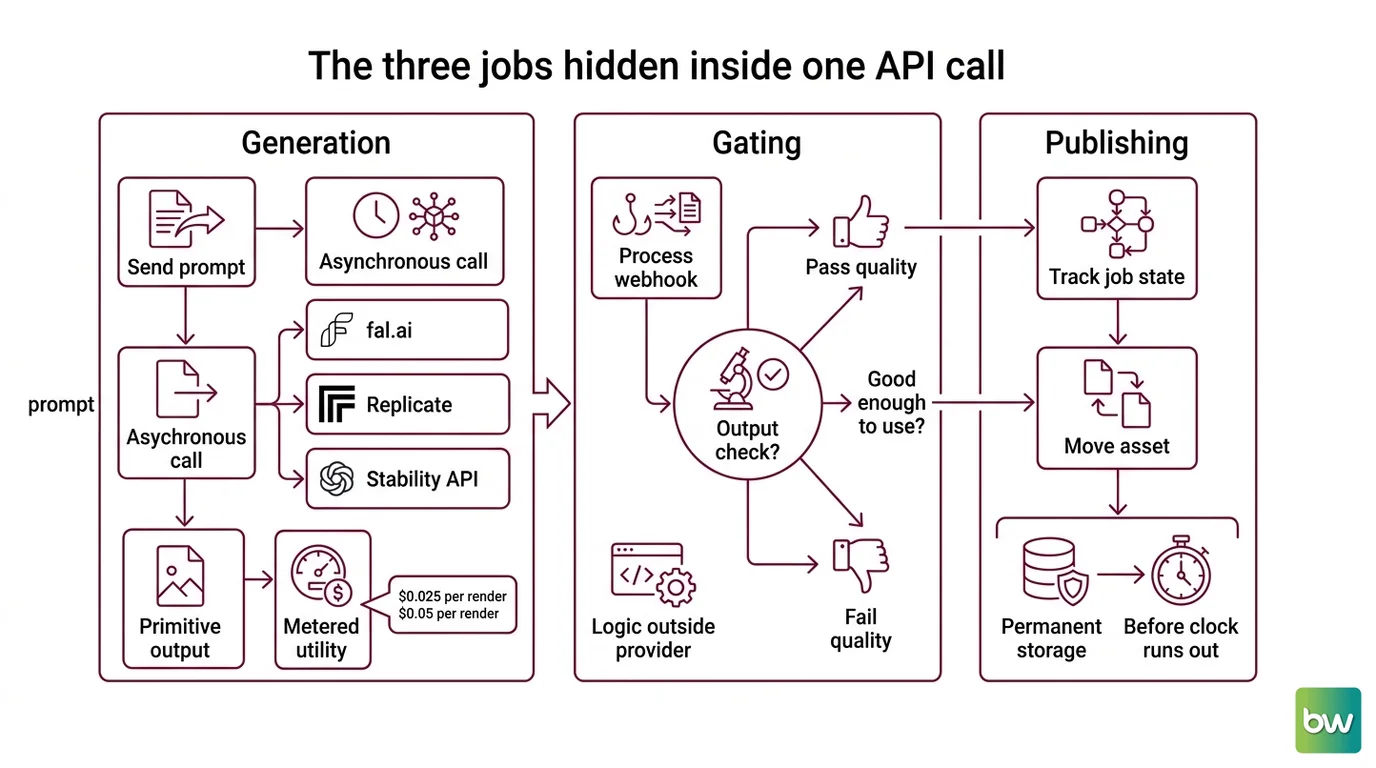
Strip away the marketing and a Generative Media APIs call is just one step in a longer chain. The render itself — the diffusion or video model doing its work on fal.ai, Replicate, or Stability AI’s platform — is asynchronous and disposable by design. What actually makes a pipeline a pipeline is the layer wrapped around that call: a queue that tracks the job, a gate that decides whether the output is good enough to use, and a publishing step that moves it somewhere permanent before the provider’s storage clock runs out.
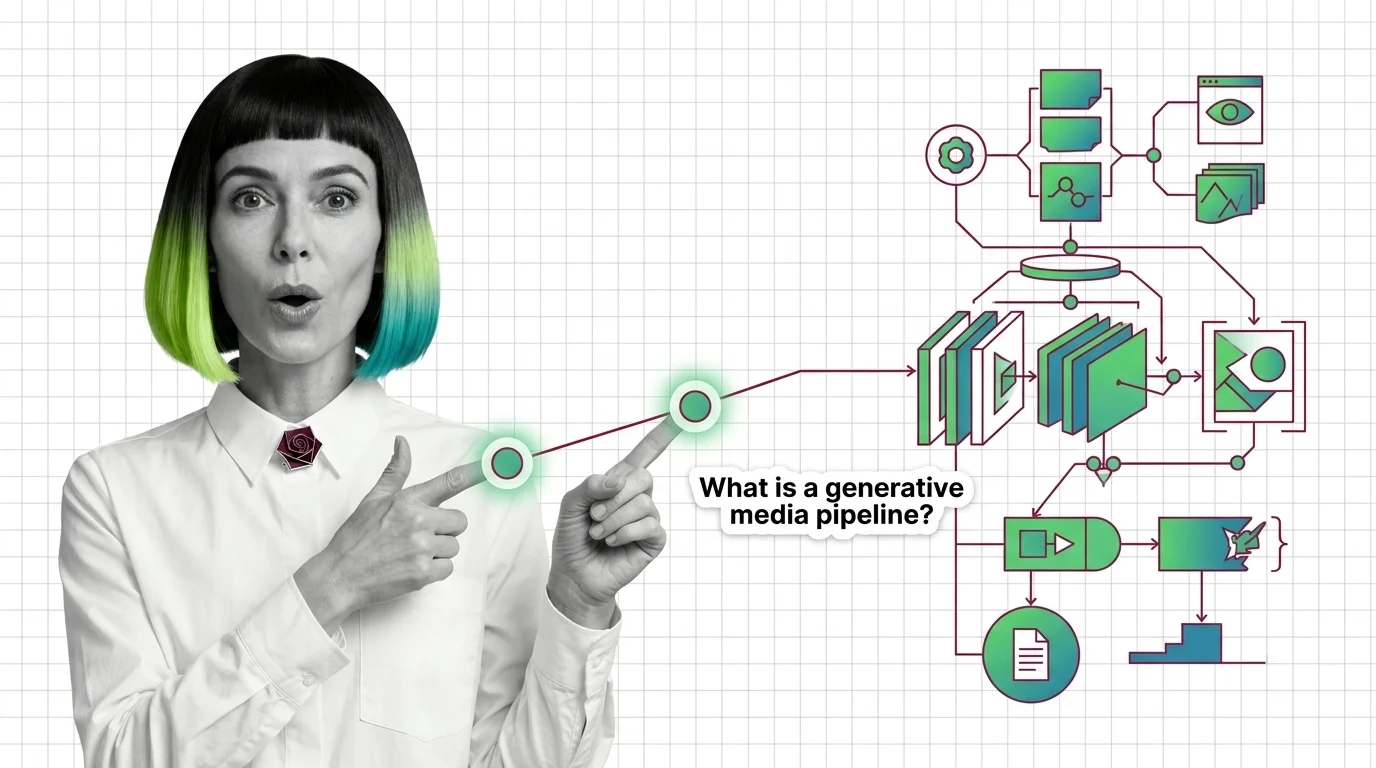
What is a generative media pipeline?
A generative media pipeline connects three jobs that no single vendor sells as one product: generation, gating, and publishing.
Not a product. A pattern.
Fal AI, Replicate, and Stability API compete on the same primitive: send a prompt, get back a rendered file, pay per output. That’s why the term describes a pattern, not a trademark — three vendors sell the same raw primitive, and none of them sell the gate or the publish step that turns it into a working system. That logic has to live somewhere else — usually a thin Multi Provider Abstraction layer wired through Webhook calls, sitting between the generation call and wherever the asset finally lives.
Each provider prices the generation step differently, but the shape is consistent: Cost Per Generation billing, not a flat subscription. fal.ai meters by model unit — a Flux Schnell render runs $0.025, a Flux Pro render $0.05 — and queue wait time itself is free (fal’s pricing page). Replicate bills by hardware-second or a flat per-output rate; Stability AI runs on a prepaid credit system. Generation, in other words, is metered like a utility. Gating and publishing are not — they’re the part a team has to build.
From Prompt to Published Asset: The State Machine Underneath
Generation, gating, and publishing aren’t three sequential steps so much as three states a single asset moves through, and the transition between each state is where pipelines actually break. Once a prompt leaves your system, you’re tracking a job, not a file — and the job’s state changes on a clock you don’t control.
How does a generative media pipeline work from prompt to published asset?
On fal.ai, the mechanics are explicit: a Queue Based Processing call to submit() returns a request_id immediately, and the job cycles through three states — IN_QUEUE, IN_PROGRESS, COMPLETED. A pipeline either supplies a webhook URL and waits for fal to POST the result back, or polls the status endpoint, or holds a server-sent-events stream open (fal Docs). Replicate’s version of the same idea fires HTTP events at created, updated, and finished — and Replicate’s own documentation describes chaining one prediction’s output directly into the next model as input, calling the result a “model pipeline” (Replicate Docs). That’s the generation half of the system: asynchronous by necessity, because diffusion and video models take seconds to minutes, not milliseconds.
The gating step sits in the gap the webhook just opened. An automated check — content moderation, a resolution or duration check, a brand-safety filter — clears the obvious cases instantly. What it can’t clear gets routed to a human reviewer, because full-automation review produces errors and full-manual review is too slow to keep pace with a queue (Tredence). That hybrid split is the established shape of the gating layer, not a one-off design choice.
Publishing is the deadline-driven step. Because Replicate deletes prediction outputs after a single hour, the webhook handler has to pull the file into permanent storage — a CMS, an object store, a database row — inside that window, or the render is gone and the only fix is paying for generation again. A pipeline that treats the webhook as a notification instead of a trigger for immediate storage loses assets quietly, with no error message to point at.
If You Build One, Expect These Failure Modes
The three-state split predicts its own failure modes, and they tend to show up in a fairly fixed order:
- If the webhook payload is treated as fire-and-forget instead of a storage trigger, expect silent data loss once the provider’s retention window closes.
- If the gating step is fully automated with no human escalation path, expect either good output blocked by an over-cautious filter, or bad output published because nothing caught it.
- If the pipeline is wired directly to one provider’s SDK instead of through an abstraction layer, expect a rebuild whenever pricing, model availability, or ownership changes. Replicate folding into Cloudflare in December 2025 is a concrete instance of that last risk — the API didn’t have to change for who owns it to change, and a pipeline hard-wired to one vendor’s client library absorbs that risk directly (Cloudflare Blog).
Ownership risk hides in the wiring, not the weights.
Rule of thumb: if a render outlives the API response that created it, something downstream has to own that file before the provider’s clock runs out.
When it breaks: the gating step is the part teams skip first under deadline pressure, and it’s also the part that fails silently — a pipeline with no review step doesn’t throw an error when it publishes something wrong, it just publishes it.
Self-Hosting the Compute, Outsourcing the Risk
Hosted APIs aren’t the only option for the generation step. Teams running high-volume or highly customized workloads sometimes self-host a model on a serverless GPU platform instead, trading the per-output convenience of fal.ai or Replicate for per-second compute billing and direct control over retry and timeout logic.
The orchestration layer that wires generation, gating, and publishing together carries its own version of that trade. n8n is a common choice for this — its webhook trigger nodes map cleanly onto the queue-to-gate-to-publish flow — but a pipeline that calls into a self-hosted instance inherits that instance’s patch level, not just its workflow logic.
Security & compatibility notes:
- n8n self-hosted RCE chain (CVSS 10.0): A critical unauthenticated remote-code-execution vulnerability (“Ni8mare,” CVE-2026-21858) affected self-hosted n8n instances, fixed in version 1.121.0. A follow-up critical flaw (CVE-2026-25049, CVSS 9.4) was fixed in 1.123.17 / 2.5.2. n8n Cloud was patched automatically; self-hosted instances had to be upgraded manually.
Patch before wiring a self-hosted n8n instance into a pipeline that handles anything sensitive — the gating layer is a bad place to inherit an unrelated vulnerability.
The Data Says
A generative media pipeline isn’t the API call — it’s everything that has to happen in the hour after. fal.ai and Replicate’s queue states, Replicate’s hour-long retention clock, and the hybrid human-AI gating pattern all point the same direction: generation is metered; gating and publishing aren’t. Build the state machine around the render, not just the render itself.
AI-assisted content, human-reviewed. Images AI-generated. Editorial Standards · Our Editors