What Is a Generative Media API and How Hosted Inference Endpoints Work
ELI5
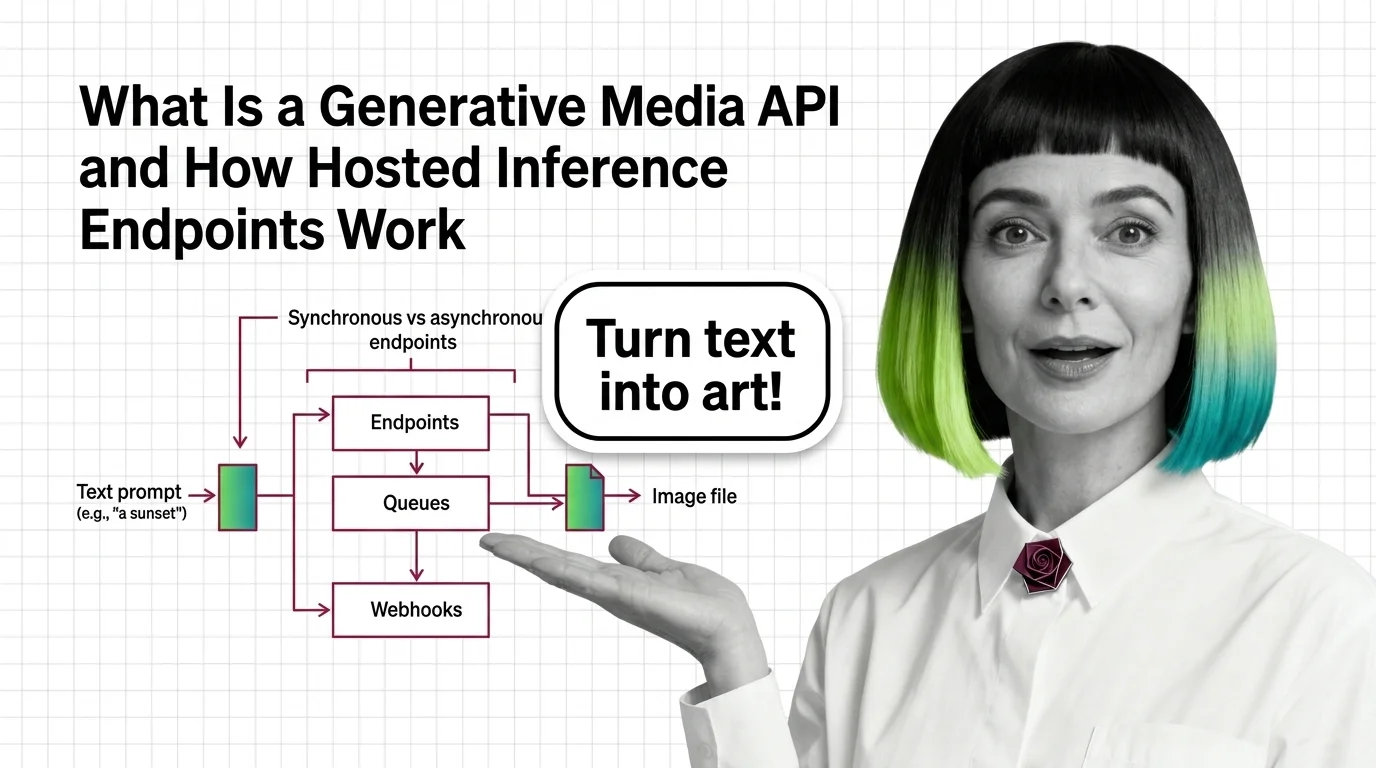
A generative media API is a hosted endpoint that turns a text prompt into an image, video, or audio file by running Inference on someone else’s GPUs and handing back a file or a job ID.
Send a request to a typical REST API and the response lands almost immediately. Send a request to generate a video clip and the connection can stay open far longer than any client expects — long enough that load balancers, serverless functions, and most HTTP client libraries simply give up and time out first. Not a faster GPU. A different shape of API — built around queues and callbacks instead of request-response.
Why a Render Job Doesn’t Fit Inside an HTTP Request
Most API design assumes the work finishes fast enough that the client can simply wait. Generative media breaks that assumption at the hardware level: a diffusion or autoregressive video model can take anywhere from a few seconds to several minutes per request, depending on resolution, duration, and denoising steps. That mismatch between expected and actual latency shaped the entire architecture these APIs are built on.
What is a generative media API?
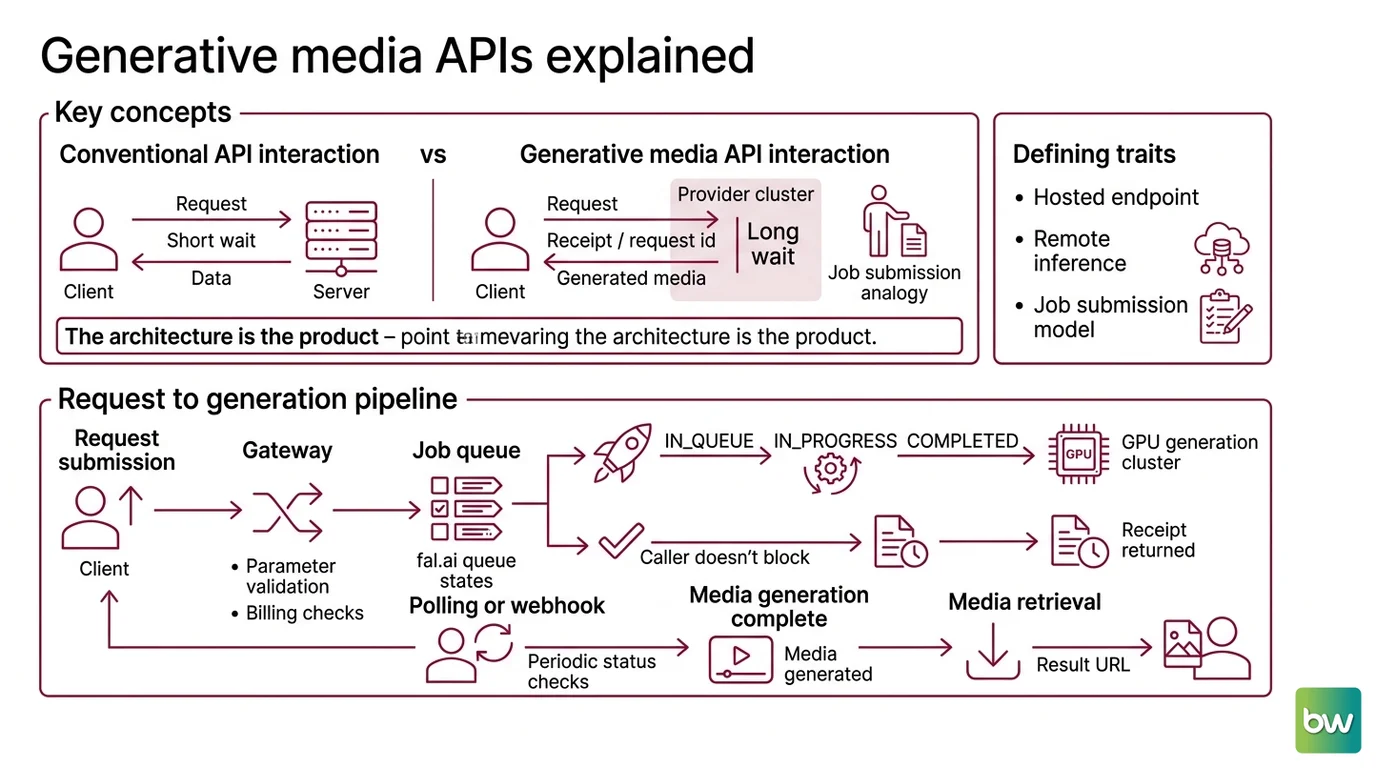
A generative media API is a hosted endpoint — usually a REST interface fronting a queue — that accepts a prompt, sometimes alongside a reference image or audio clip, and returns generated media without the caller running any model weights locally. The defining trait isn’t the media type; image, video, and audio APIs share one architectural skeleton even though the models underneath are mathematically distinct. Heavy, GPU-bound inference moves off the client and onto a provider’s cluster, accessed through a contract that looks like a normal API but behaves like a job submission system. The architecture is the product, not the model.
Think of it less like calling a function and more like dropping a print job at a print shop. You hand over the request, you get a receipt, and the actual printing happens on hardware you never see, on a schedule the shop controls.
How do generative media APIs turn a text prompt into an image, video, or audio file?
The pipeline behind the receipt has a consistent shape across providers, even when the model architecture changes. A request hits a gateway, which validates parameters, checks billing, and pushes the job into a queue rather than handing it straight to a GPU. fal.ai’s queue moves every job through three explicit states — IN_QUEUE, IN_PROGRESS, COMPLETED — and returns a request ID and status/result URLs the moment the job is accepted, not when it finishes (fal Docs). The caller doesn’t block waiting for pixels; it gets an address to check later.
Once a worker picks up the job, generation happens essentially the way it would on a local GPU — the same inference pass, the same denoising or token-sampling loop — except on hardware sized and scheduled by the provider. The provider’s value isn’t a different algorithm. It’s the orchestration layer around it: routing, retries, and elastic capacity a single developer’s GPU budget can’t match. fal.ai automatically retries failed jobs up to 10 times and scales its runner pool with demand, with no documented queue size ceiling (fal Docs).
The Architecture Built Around Waiting
Once the queue model is in place, three structural pieces have to exist around it: a way to submit work, a way to track it, and a way to get notified when it’s done. How a provider implements those pieces, and which one it makes the default, determines how an integration actually behaves in production.
What are the core components of a generative media API stack — endpoints, queues, and webhooks?
Strip away vendor branding and a generative media API stack reduces to four components. A submission endpoint accepts the prompt and parameters and returns a job identifier — not media. A queue holds accepted jobs and exposes their state, whether through a status field or a small state machine like fal’s IN_QUEUE → IN_PROGRESS → COMPLETED flow. A result endpoint serves the finished file once the queue marks the job complete. And a notification mechanism — most commonly a
Webhook — lets the provider push a completion event to the caller’s own server instead of forcing the caller to keep asking.
fal.ai supports all three ways of finding out a job is done: polling a status() call, holding a streaming connection open with server-sent events, or registering a webhook_url that the provider POSTs to once the result is ready (fal Docs). Replicate’s billing model reveals the same architecture from a different angle — public models are billed only for active processing time, setup and idle time free, while private deployments pay for setup and idle time too, and a failed run is never charged at all (Replicate Docs). That distinction only makes sense once you picture the job sitting in a queue, occupying infrastructure, before and after the GPU does anything.
What is the difference between synchronous and asynchronous generation endpoints?
Every provider that supports both patterns ends up offering some version of the same two endpoints. fal.ai’s subscribe() call is synchronous from the caller’s point of view — it submits the job and blocks, polling internally on the caller’s behalf, so the calling code reads like a normal function call (fal Docs). The raw submit() → status() → get() sequence is the asynchronous version: the caller owns the polling loop, or wires up a webhook instead, and the request returns instantly rather than blocking.
Synchronous wrappers trade visibility for convenience.
A sync call is easier to write and harder to debug — if a render that should finish quickly instead drags on, the caller can’t tell “still rendering” from “about to time out” until it actually times out. An async integration with a webhook callback has none of that ambiguity: the job either completes and POSTs a result or it doesn’t, and the queue state stays inspectable throughout. For anything beyond a short demo, async is what production systems converge on — not because it’s more elegant, but because render times for video and high-resolution image models are too variable to bet a held-open connection on.
What the Queue Architecture Predicts
Understanding the queue-first design turns into a set of concrete expectations for anyone integrating one of these APIs.
If a model’s expected render time exceeds a few seconds, treat the synchronous wrapper as a development convenience only — production traffic should default to async plus webhook, because a held-open connection is one timeout away from silently dropping a paid generation job. If a provider doesn’t expose a webhook, the integration has to own a polling loop with backoff, and that loop becomes part of the failure surface.
If the provider bills by GPU-time rather than output, idle queue time costs money even when nothing renders — which is why providers that bill per output, like fal.ai’s fal-ai/flux/dev at $0.025 per image (fal Docs), shift that idle-time risk onto themselves.
Rule of thumb: if a render can plausibly take longer than a typical page load, build the integration async-first and reserve the synchronous wrapper for demos and internal tooling.
When it breaks: queue-based architectures assume the provider keeps the job’s state machine durable across retries — a worker crash mid-render, or a webhook delivery that silently fails because the caller’s endpoint was briefly down, can each leave a caller polling for a job that never resolves. Most SDKs don’t expose a hard timeout on synchronous wrapper calls by default, so a stalled job can hang an integration unless the caller sets one explicitly.
Why the Generative Media Market Looks Nothing Like the LLM Market
The queue-and-webhook pattern explains how a single provider’s API behaves. It doesn’t explain why the generative media market looks so different from the market for text models. Enterprise teams running production image and video pipelines use a median of 14 different models, against a market where OpenAI, Gemini, and Anthropic hold 89% of enterprise wallet share combined (a16z / fal). Generative media hasn’t consolidated the way text has, because models are hosted as separate endpoints, each with its own queue semantics, pricing unit, and webhook payload shape.
That fragmentation is expensive to integrate against directly, which is why a layer of Multi Provider Abstraction platforms exists on top of the raw provider APIs. Runware’s inference engine, for instance, fronts a large catalog of models behind one unified endpoint and reroutes workloads across third-party GPU clouds when its own capacity tightens — hiding that the caller is actually talking to several different providers behind a single contract. Cost is the dominant reason teams reach for that layer: 58% of organizations cite cost optimization as their primary infrastructure selection driver (a16z / fal), and routing a prompt to whichever backend is cheapest that hour only works if the abstraction can paper over provider-specific differences.
Not every media type even has an endpoint to abstract. Udio ships no official public developer API — access runs entirely through unofficial third-party wrappers, an arrangement the vendor has never documented itself. And the endpoints that do exist aren’t permanent: OpenAI shut down its Sora consumer app in April 2026 and is fully retiring the developer Videos API by September 2026 (OpenAI Help Center), while Stability AI discontinued the Stability API’s original Stable Video and Stable Diffusion 1.6 endpoints in mid-2025, migrating customers to newer model lines (Stability AI). A hosted generative media API is infrastructure you rent, not own — the contract can change schedule, pricing, or existence on the provider’s timeline, not yours.
Platform & compatibility notes:
- OpenAI Sora (Videos API): Consumer app discontinued April 26, 2026; developer API shuts down September 24, 2026. Don’t start new integrations against it.
- Stability AI API: Stable Video API and Stable Diffusion 1.6 endpoints discontinued July 24, 2025. Migrate to SDXL, Stable Image Core/Ultra, or SD 3.5.
- Udio: No official vendor API exists. Integrations depend on unofficial third-party wrappers that can break without notice.
One research thread is worth flagging without overstating it: DPO, the preference-alignment technique that reshaped text-model fine-tuning, is now being explored for video and image diffusion models, targeting the motion artifacts and flicker video generation is still prone to. No major hosted provider has publicly confirmed shipping DPO-aligned models in production — as of mid-2026 the evidence sits in early research, not vendor changelogs.
The Data Says
The architecture isn’t an accident of vendor preference — it’s a direct response to render times that make synchronous HTTP a bad bet. Queue-first design with webhook notification is the convergent solution wherever GPU-bound generation takes longer than a connection can comfortably stay open, which is true for most video and increasingly for high-resolution image and audio output. The market built around that constraint stays fragmented and rented rather than consolidated and owned — and that, more than any single model’s output quality, is the fact worth building an integration around.
AI-assisted content, human-reviewed. Images AI-generated. Editorial Standards · Our Editors