What Are LLM Fallback and Retry Patterns and How Exponential Backoff Prevents API Cascade Failures
ELI5
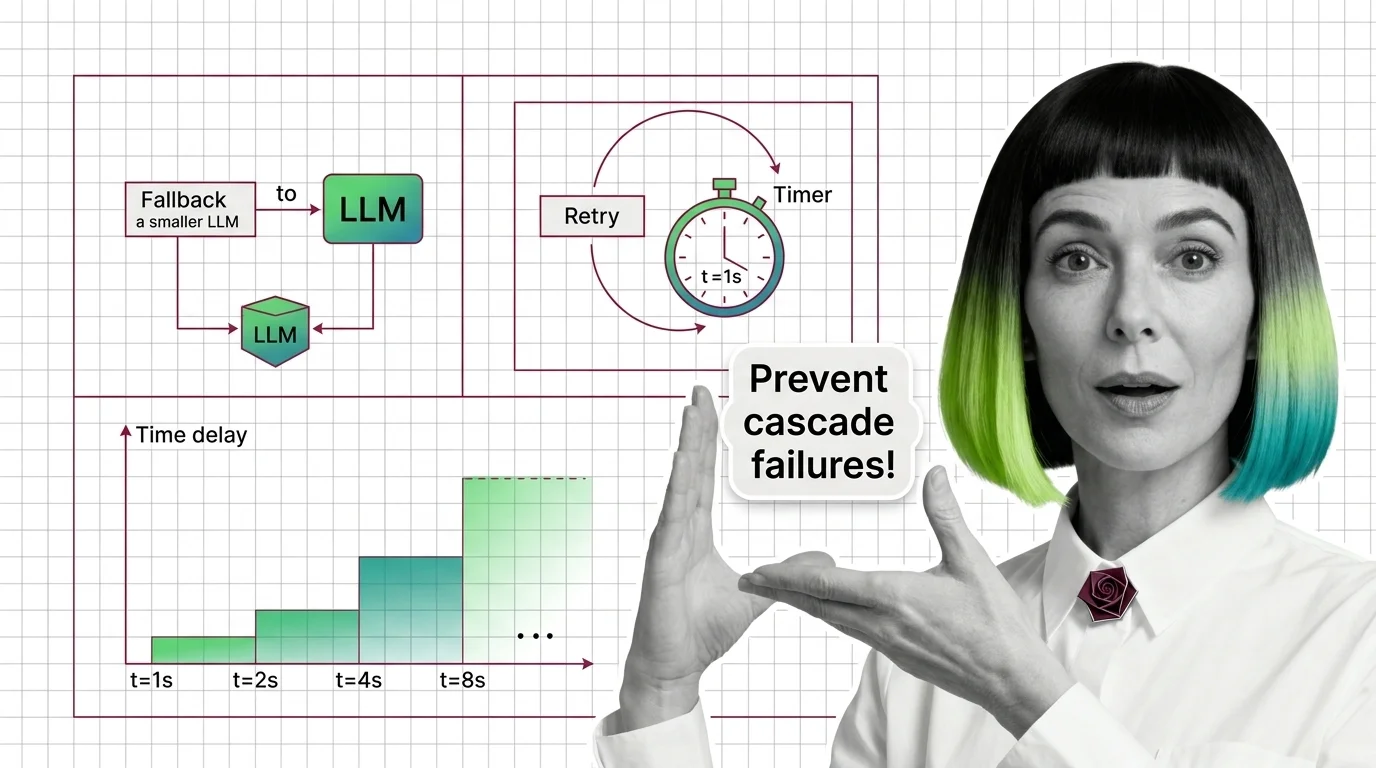
LLM fallback and retry patterns are error-handling strategies that keep production AI apps running through API failures. When a model returns a 429 or 503, retries wait with increasing delays; if the model stays unavailable, traffic routes automatically to a backup.
Ten thousand concurrent requests hit a rate limit at 14:23:07. Every client receives a 429 and waits exactly two seconds before retrying. At 14:23:09, all ten thousand requests arrive simultaneously — a load spike larger than the one that triggered the rate limit. The provider returns 429 again, to a now-synchronized cohort that has grown, not shrunk.
This is not a failure of retry logic.
It is a consequence of retry logic applied without understanding the interference pattern it creates. The thundering herd problem — where the cure amplifies the disease — is the most reliable way to diagnose retry code written as a reflex rather than as a mechanism.
The Taxonomy of Resilience
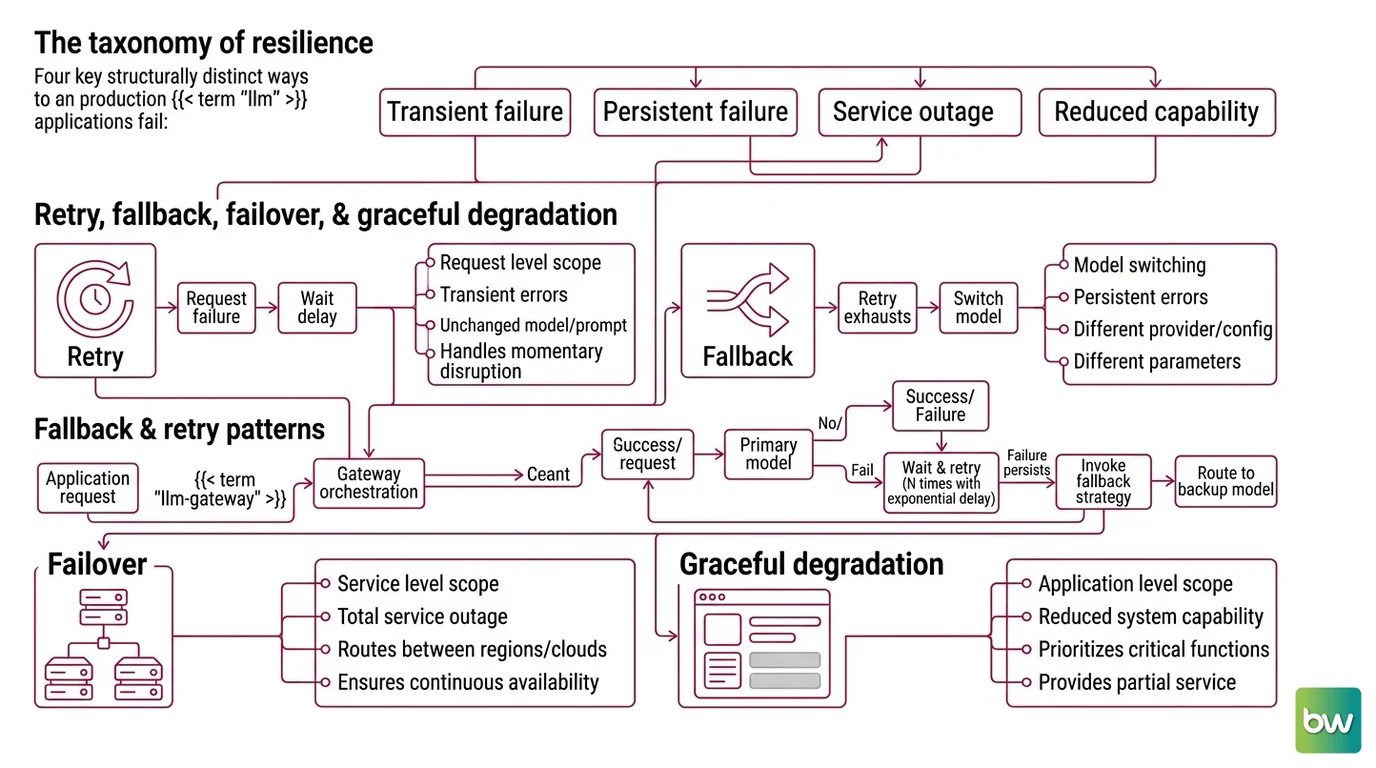
Production LLM applications fail in at least four structurally distinct ways, and treating them as interchangeable produces error-handling code that looks correct under a test harness but cascades under load. The vocabulary matters before the implementation does — retry, fallback, failover, and graceful degradation name specific mechanisms, not synonyms for the same idea.
What is an LLM fallback and retry pattern?
A retry pattern re-submits a failed request to the same model and provider after a timed delay. The assumption is that the failure is transient — a momentary rate limit, a temporary service disruption, a network timeout. The prompt and the model are unchanged.
Fallbacks involve model switching; retries do not. A LLM Fallback And Retry Patterns combines these two behaviors: retry handles the transient case by waiting and repeating on the same endpoint; fallback handles the persistent case by routing to a different model. The LLM Gateway typically orchestrates both in sequence — retry the primary model N times with exponential delays, then invoke the Fallback Strategy if retries exhaust without success.
This distinction determines the implementation. A retry shares the same API client, the same configuration, the same prompt format. A fallback requires a different model endpoint, potentially different provider authentication, and possibly different parameter constraints. Conflating them produces a single catch block that either retries context window errors indefinitely (cannot help) or routes to a backup model for a transient network timeout (unnecessary overhead).
What is the difference between LLM fallback, failover, and graceful degradation?
Three concepts, three layers of scope:
Retry operates at the request level — same model, same provider. It handles transient errors where the underlying endpoint will recover without intervention.
Fallback operates at the model level — different model, possibly different provider. It handles persistent single-model failure. The API Gateway or gateway middleware orchestrates this routing.
Failover operates at the provider level — all traffic shifts from one provider’s infrastructure to another’s. This is what Model Routing logic handles when an entire provider fleet degrades simultaneously, not just an individual model.
Graceful Degradation operates at the feature level — the application continues at reduced capability rather than returning an error to the user. A chat interface that routes to a smaller, faster model under sustained load degrades gracefully. One that surfaces a timeout error to the user does not.
The failure mode determines which layer must respond. A single-model 429 calls for retry or model-level fallback. A provider-wide outage calls for failover. Persistent capacity saturation calls for graceful degradation. The wrong layer responding produces characteristic failure signatures: routing all traffic to a new provider for a transient rate limit is over-reaction; retrying a context window error that cannot resolve because the prompt exceeds the model’s maximum length is under-reaction, indefinitely.
The Interference Pattern in Your Retry Queue
The failure mode most production engineers don’t anticipate isn’t the one that breaks their application — it’s the one their retry logic generates. To see it, look at the timing structure of retry attempts across a population of concurrent clients under load.
How does exponential backoff work for LLM API rate limit errors?
Fixed-interval retry logic has a structural flaw: every client that received a 429 at time T retries at time T + fixed_delay. If that delay is constant across clients, all retries arrive simultaneously, producing a spike that often equals or exceeds the original load. The provider returns 429 again; the synchronized cohort retries again.
Exponential Backoff addresses this geometrically: delay = base_delay × 2^attempt. Starting with a base delay of 1–2 seconds and doubling each retry, stopping after 5–7 attempts, produces the sequence 2s, 4s, 8s, 16s, 32s — enough elapsed time for the provider to recover through most transient Rate Limiting events (fast.io). The delay grows faster than the client’s patience, which is the intent.
But exponential backoff alone still preserves coherence across clients. If ten thousand clients all received a 429 at the same timestamp, they compute identical backoff sequences and retry simultaneously at every step — just with longer gaps between synchronized spikes.
Jitter breaks the synchronization retry logic creates. By adding a random component to each delay — typically a uniform random value between zero and the computed backoff — each client desynchronizes from the others. The retry population distributes across a time window instead of concentrating at fixed points. The constructive interference pattern collapses into noise (fast.io).
The error code determines whether to retry at all. HTTP 429, 500, 502, 503, and 504 responses, and network timeouts, are transient — retrying may succeed once the provider recovers. HTTP 401, 403, and 400 responses indicate permanent failures: invalid credentials, insufficient permissions, a malformed request. Retrying a 401 is deterministically futile.
Not a recoverable failure. A configuration error.
How does a circuit breaker pattern prevent cascade failures in LLM production systems?
Exponential backoff manages the timing of retries against a responsive provider. The Circuit Breaker pattern addresses a different problem: a provider that is degraded but not completely down, returning errors slowly rather than immediately.
A degraded provider might take 30 seconds to return a 503. Without a circuit breaker, each retry holds a connection open for the full timeout duration. Under load, connections accumulate, thread pools exhaust, and requests queue behind connections that will never complete. The application degrades under the weight of the retries themselves, not just the original failure.
The circuit breaker models endpoint health as a three-state machine. In the Closed state, requests flow normally; the circuit counts failures. When failures exceed a threshold, the circuit Opens — subsequent requests fail immediately with a synthetic error, without contacting the provider. This converts 30-second timeouts into millisecond failures, freeing resources for requests that can be handled. After a cooldown period, the circuit enters Half-Open state and allows graduated probing — one request, then three, then ten — testing whether the endpoint has recovered before resuming normal traffic volume.
The cascade failure mechanism this prevents is mechanical. A slow dependency holds connections upstream. Upstream callers queue requests waiting for connections that never free. Thread pools exhaust. New requests cannot be accepted. A single degraded LLM provider can propagate failure across unrelated parts of an application — not because the provider is down, but because it is failing slowly. The circuit breaker cuts this feedback loop by converting slow failures into fast ones, giving the rest of the system room to operate.
What the Error Map Predicts
Understanding the mechanism makes the gateway tool choices predictable. LiteLLM, Openrouter, and Portkey operationalize the same underlying patterns with different configuration ergonomics; the distinctions between them follow from the mechanism.
LiteLLM distinguishes three fallback types because they require mechanically different routing decisions. A standard fallback — triggered by a RateLimitError or server error on the primary model — can route to any backup model with a compatible API. A context_window fallback must route to a model with a larger context window; routing to a model with the same or smaller limit will reproduce the error. A content_policy fallback routes to a model with different moderation constraints; the error signals that this specific content will not succeed on the primary model regardless of retry count (LiteLLM Docs). By default, LiteLLM configures retries in the range of three attempts per model group before triggering fallback chain, with a cooldown period of around 30 seconds for endpoints that exceed an allowed-fails threshold — these are configurable example values, not fixed defaults.
Error semantics determine which recovery layer fires. A context window error is not transient — the same prompt submitted to the same model will always produce the same error. A gateway that retries a ContextWindowExceededError is producing wasted API calls, not resilience. The error’s semantics, not just its presence, must route the recovery decision.
OpenRouter handles fallbacks through the models array (standard) or the fallbacks parameter (Anthropic Messages API), with fallbacks capped at a maximum of 3 entries — a list longer than 3 returns HTTP 400 (OpenRouter Docs). The constraint is a deliberate design choice: it forces the caller to be intentional about the fallback chain rather than enumerating every available model. Billing applies only to the model that successfully processes the request, which makes the fallback chain cost-neutral for failed attempts.
Portkey supports automatic retry up to 5 times with exponential backoff across 1,600+ LLMs and providers (Portkey Features). Its Virtual Keys layer stores provider credentials in Portkey’s vault, separating credential rotation from fallback configuration. Portkey was acquired by Palo Alto Networks (acquisition closed May 29, 2026, per Palo Alto Networks) and now operates as part of the Prisma AIRS platform — the gateway functionality remains fully operational.
Helicone provides proxy, observability logging, caching, and multi-provider routing. It was acquired by Mintlify on March 3, 2026 and entered maintenance mode; only security patches and bug fixes continue. The experiments feature was deprecated September 1, 2025 (ChatForest). The core proxy remains functional for existing integrations, but Helicone is not a development-stage tool selection for new projects.
If/then predictions this mechanism generates:
- If fixed-delay retries run across concurrent requests, synchronized retry spikes will compound the original rate limit event rather than dissipate it.
- If a context window error arrives, routing to the same model on retry is mechanically futile — the prompt length doesn’t change between attempts.
- If no circuit breaker is present and a provider degrades slowly, connection pool exhaustion will propagate upstream before the failure appears in application error logs.
- If fallback models share the same underlying provider infrastructure, a provider-level outage exhausts the entire fallback chain simultaneously, regardless of how many backup models are configured.
Rule of thumb: Classify before routing. Transient errors call for timed retry with jitter; semantic errors (context window, content policy) call for capability-matched fallback; provider degradation calls for circuit breaking before any routing decision.
When it breaks: Fallback chains fail at the application layer when the backup model has different API parameters, different token limits, or different output format constraints that the calling code doesn’t account for. The routing layer succeeds; the response fails parsing downstream.
The Data Says
LLMOps resilience patterns divide by error semantics: transient failures call for exponential backoff with jitter, semantic failures call for capability-matched fallback, and degraded-but-live providers call for circuit breaking. The three mechanisms are not alternatives — they compose into a defense-in-depth stack. Treating all LLM errors as retryable is the single most common failure mode in production LLM integrations, because it confuses the error type with the recovery action.
AI-assisted content, human-reviewed. Images AI-generated. Editorial Standards · Our Editors