Voice Cloning Without Consent: The Ethical Risks of AI Text-to-Speech
The Hard Truth
Voice cloning does not harm anyone who has not already accepted the terms. Every performer, every journalist, every person who has spoken on record has made their voice a public artifact by their own choice. What synthesis does with that material is not new — it is recording’s promise, finally kept: a voice, preserved and extended beyond what any single performance could carry.
There is something almost convincing about that position — until you notice what it elides. It was written for a world of archives, not factories. It assumes that the consent embedded in a recording event carries forward into every use of the data that recording produces, including uses that did not exist when the recording was made, and could not have been anticipated. That assumption is doing significant work. It deserves examination.
The Unavoidable Archive
The case for voice synthesis without explicit training consent rests on a framework that sounds reasonable on its surface. Every performer who has ever recorded, every podcaster, every public official who has addressed an audience has made their voice accessible. Society has always built on those accessible artifacts — quoting, sampling, imitating, parodying. Technologies built on architectures including Tacotron, VITS, XTTS, and Cartesia Sonic are, on this reading, a more sophisticated extension of what recording always enabled. The archive grows; the tools for working with it improve.
This argument carries genuine weight in one direction. Voice synthesis has opened access that was previously impossible — for people with ALS who recorded their voices before losing them, for authors who can now narrate books without studio infrastructure, for language learners who can hear complex material in a voice they recognize. The same capability that enables impersonation also enables a form of dignity restoration that no prior technology could provide. That consequence matters. It is not a footnote.
Regulations, the argument continues, are simply in lag. The Tennessee ELVIS Act — in effect since July 2024, carrying both civil damages and criminal liability for unauthorized AI voice use (Atlan) — and the federal TAKE IT DOWN Act, signed in May 2025 to criminalize nonconsensual intimate deepfakes (Recording Law), demonstrate that the legal system is adapting. The patterns are familiar. Photography, telephony, and digital sampling all preceded clear law. The law caught up. It will again.
This is a serious argument. It deserves a serious response — starting with the place where it quietly assumes what it should demonstrate.
The Copy That Writes New Lines
The single flaw in the “recordings were always public” argument is small at first sight and structural on inspection.
Recording preserved a performance. voice cloning creates a generative model. These are not the same operation, and the difference is not merely technical.
When early audio technology captured a voice, it could play back what had been said. Nothing more. Digital sampling, which arrived decades later, extended this to excerpts: you could take thirty seconds of someone’s speech, but you could not instruct that voice to say something it had never said. The output set was closed — bounded by the original recording event.
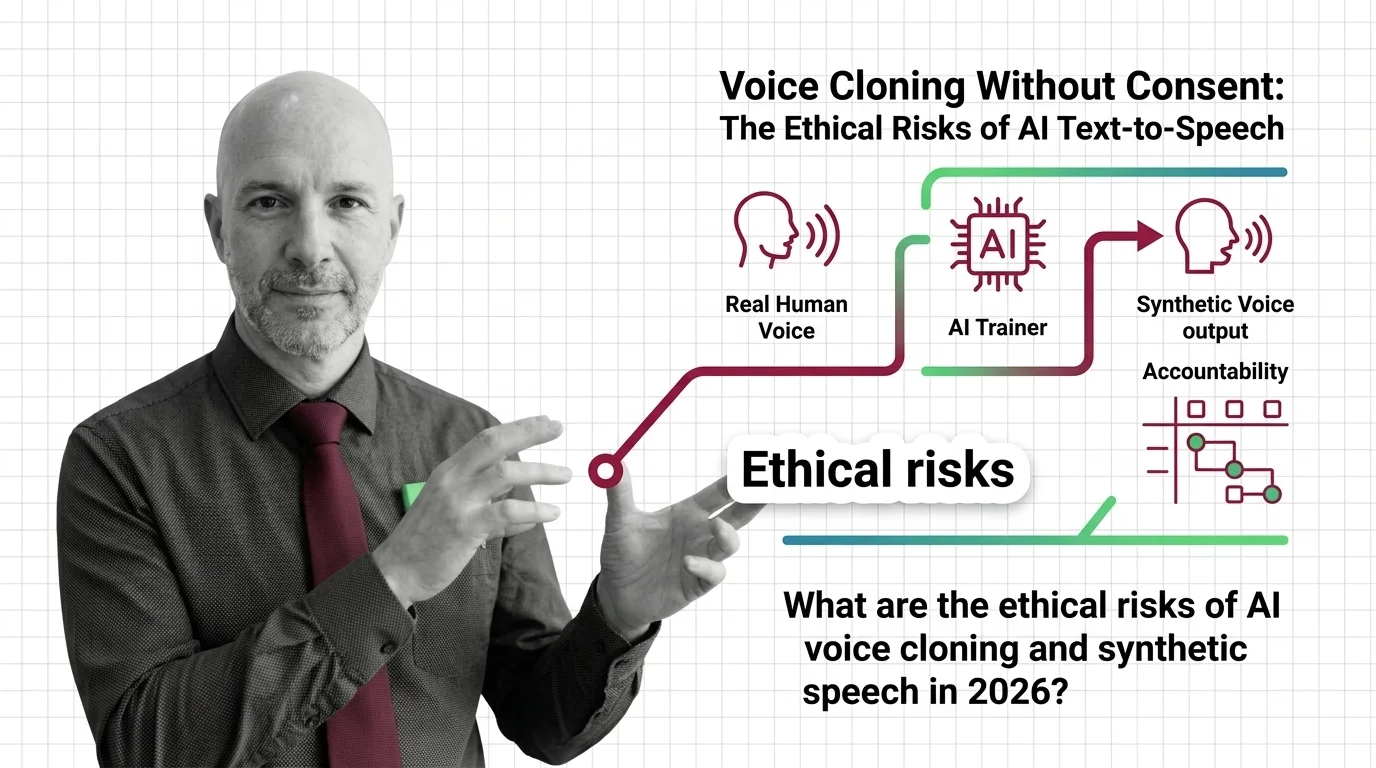
A modern Voice Cloning model trained on as little as one to two minutes of audio — the minimum threshold ElevenLabs documents for its instant cloning feature (ElevenLabs Docs) — is not an archive. It is a production system. The model learns the Mel Spectrogram structure of the voice, its Prosody contours, the Phoneme-level timing patterns that make a voice recognizable, and it encodes these as learned parameters. A Vocoder then reconstructs the waveform on demand from any text input the user chooses to provide. The output set is no longer closed — it is open to whatever a user decides to say.
The consent embedded in a recording covered a performance, not a production factory. The person who agreed to be recorded agreed to have that recording heard. They did not agree to become training data for a Text-to-Speech system that could produce an unlimited number of things they never said. These are categorically different acts — and the argument from public availability does not reach the gap between them.
What the Same Evidence Now Proves
Rebuilding from that crack, the picture inverts entirely.
If voice synthesis creates a generative model rather than preserving a performance, then the ethical question is not about the recording event — it is about the training pipeline. Once you accept that distinction, the argument from public availability collapses under its own weight. Public audio was consent to be heard in the form it was produced; it was not consent to become the training substrate for a system that would render a version of you saying things you oppose, in contexts you did not choose, on behalf of people you do not know.
This inversion is visible in the fraud patterns that have emerged. When enterprises face deepfake impersonation incidents — TechTimes reporting on a March 2026 INTERPOL assessment places average enterprise deepfake losses at $680,000 per incident — the damage does not come from someone playing an old audio file out of context. It comes from a model that generated novel, convincing speech impersonating an authorized voice at a moment requiring trust. The harm is generative. The archive had nothing to do with it.
The same architecture governs political manipulation. California’s attempt to restrict electoral deepfakes through AB 2839 was permanently enjoined on First Amendment grounds in August 2025, leaving a disclosure-only approach as the surviving mechanism (Recording Law). This is not a legal technicality. It is evidence that frameworks built around labeling or disclosure of outputs struggle categorically with a technology that produces infinite outputs at near-zero marginal cost. The threat is not archival misrepresentation of what someone once said. It is continuous generative impersonation of what they might say now.
The Accountability Gap Is by Design
What all of this reveals is not primarily a privacy question, and not only a fraud question, though it manifests as both.
Thesis: Voice cloning without consent does not merely violate privacy — it constructs a governance architecture in which the person who builds and deploys the model bears no liability for the outputs, while the person whose voice was used carries all the exposure.
This asymmetry is structural. The technology as currently designed guarantees it, unless consent is engineered into the training pipeline itself rather than attached as a deployment-time policy. ElevenLabs requires an explicit consent checkbox before a cloned voice can be saved — one of the more visible consent controls in commercial voice synthesis, as the ElevenLabs Use Policy documents. But a consent interface at the point of use does not address how training data was assembled in the first place, or who consented to that assembly.
The No FAKES Act, which advanced the Senate Judiciary Committee on June 18, 2026 but has not yet become law, would introduce a $5,000 per-violation statutory floor and require platforms to remove unauthorized voice replicas within 48 hours (Music Times, Vucense). The EU AI Act Article 50, expected to activate transparency obligations for AI-generated audio in August 2026 pending the code of practice’s finalization, requires labeling and disclosure of synthetic content (EU AI Act). These are real measures. The pattern they share is also consistent: they address the products of synthesis. They leave the training pipeline — where the accountability gap originates — almost entirely ungoverned.
If you follow this logic, the consent gap is not a temporary oversight waiting to be filled by careful drafting. It reflects a design priority. The technology was built as fast as possible, from data that was available, with liability frameworks assembled after the architecture was already set.
The People the Business Case Omits
Who does not appear in the accountability framework the opposing argument describes?
ZeroThreat reports that 1 in 10 Americans have experienced a voice clone scam — a call in which a voice they recognized asked for money, for access, for action, using inflections and cadences that sounded right because they were built from a real person’s acoustic identity. These are not enterprise security incidents with dedicated incident response teams. These are individuals who answered a phone call that sounded like a parent, a supervisor, or a child, and acted on what they heard.
Montana’s HB 513, effective January 1, 2026, provides for up to $50,000 per violation for unauthorized AI voice use (Recording Law). California AB 2602, in effect since January 2024, voids entertainment contracts that deploy AI digital replicas without independent legal counsel (Recording Law). These are genuine legal advances. They reach contracts; they do not reach training data.
They do not reach the voice actor whose vocal style was scraped from a publicly accessible catalogue and was never party to any contract worth voiding. They do not reach the broadcast journalist whose decades of archived audio became training material for a news-reading system without a rights negotiation. They do not reach the estate of a deceased person whose voice was reconstructed from recordings no longer under active protection. The people most exposed to the generative asymmetry are precisely the people with the least standing to address it under existing law — no contract to void, no jurisdiction clearly applicable, no practical enforcement path against a model that may be operating outside any single legal system’s reach.
That asymmetry is not an oversight. It is the condition under which the technology was commercialized.
Where This Argument Is Weakest
This position has a clear point of vulnerability, and it should be named directly.
If consent infrastructure scales alongside synthesis capability — if opt-in training pipelines become the technical and commercial baseline rather than the exception, if the patchwork of state and federal laws converges on something with the scope and enforceability of a training-data framework rather than a disclosure-only regime — then this essay describes a transitional problem, not a permanent one. Governance frameworks for photography, telephony, and digital sampling each took a generation to stabilize after the technology arrived. Voice synthesis in its current accessible form is barely a decade old. The law may catch up faster than critics expect.
The counterargument I find most difficult is not the optimist’s timeline. It is the velocity differential. The interval between a voice synthesis research paper and a publicly available API has compressed from years to months. The No FAKES Act has not yet passed. The NIST AI Risk Management Framework remains voluntary, with no dedicated profile for voice synthesis applications as NIST itself acknowledges. The EU’s Article 50 transparency provisions are still in code-of-practice development. And 1 in 10 Americans have already encountered a voice they trusted being used against them.
Governance and synthesis capacity are not running the same race. One of them has a measurable lead, and it is not the governance.
The Question That Remains
The legislation converging on voice cloning addresses outputs — what may be generated, what must be disclosed, what platforms must remove. The input question, who consented to become a model, remains largely unanswered by any framework currently in force or advancing through committee.
If the accountability gap is structural and architectural rather than incidental — engineered into the training pipeline before any liability framework existed to constrain it — can it be closed by law that never reaches the pipeline? And if that question stays open, what does it mean for the people whose voices are already inside models we cannot audit, trained on recordings that preceded any consent standard, producing outputs that no originating agreement ever authorized?
Ethically, Alan.
AI-assisted content, human-reviewed. Images AI-generated. Editorial Standards · Our Editors