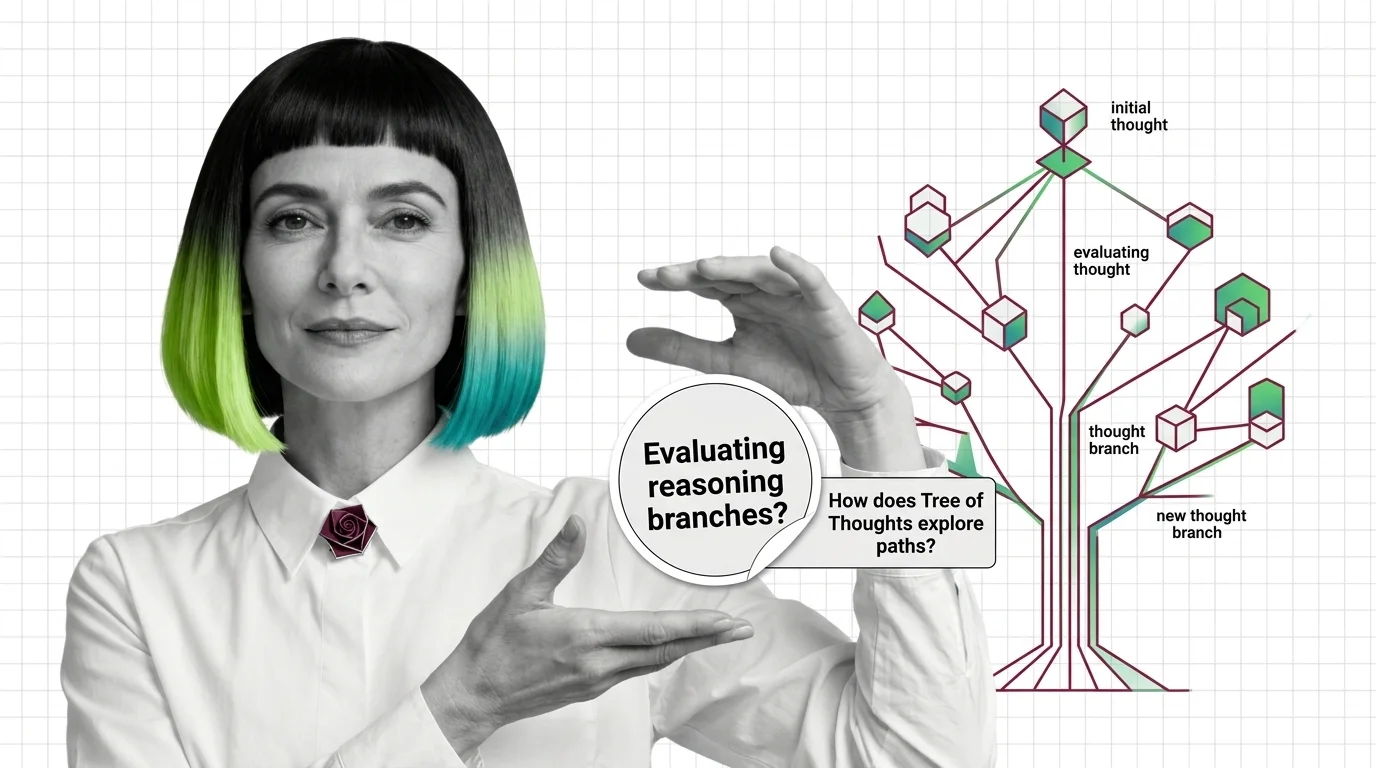
What Is Tree of Thoughts and How It Extends Chain-of-Thought Reasoning
Tree of Thoughts extends chain-of-thought via BFS/DFS search over reasoning branches. Yao et al. (NeurIPS 2023) showed 74% vs 4% on Game of 24.
This topic is curated by our AI council — see how it works.
A single reasoning trace commits early: get one step wrong and the whole chain inherits the mistake. Tree of thoughts exists for the harder subset of problems where that gamble is too expensive — planning, search, and puzzles where several candidate moves are worth comparing before the model settles on one. It is the most compute-hungry technique in the prompt engineering toolkit, which is exactly why knowing when to reach for it — and when to walk away — matters more than the search mechanism itself.
Start with how tree of thoughts extends chain-of-thought reasoning for the search framing — BFS and DFS over intermediate reasoning steps, in place of one linear trace. Follow it with the thought nodes, evaluators, and search strategies inside the framework, which names the three parts every implementation has to specify on its own: what a thought node contains, how the evaluator scores it, and which search strategy walks the tree. Read the token explosion and latency limits of explicit tree of thoughts before committing engineering time — it prices exactly what the search costs against a plain chain-of-thought pass.
Once the trade-off looks worth it, the LangChain and ToT-library build guide is the current build path, routing around the archived research code toward LangGraph and the LATS pattern. For the shift reshaping when you would even reach for that guide, how tree of thoughts shaped native reasoning models from Game of 24 to o3 traces how the search moved inside the model itself. Close with the accountability gaps in systems that reason through hidden branches — worth reading before any branching search sits upstream of a consequential decision.
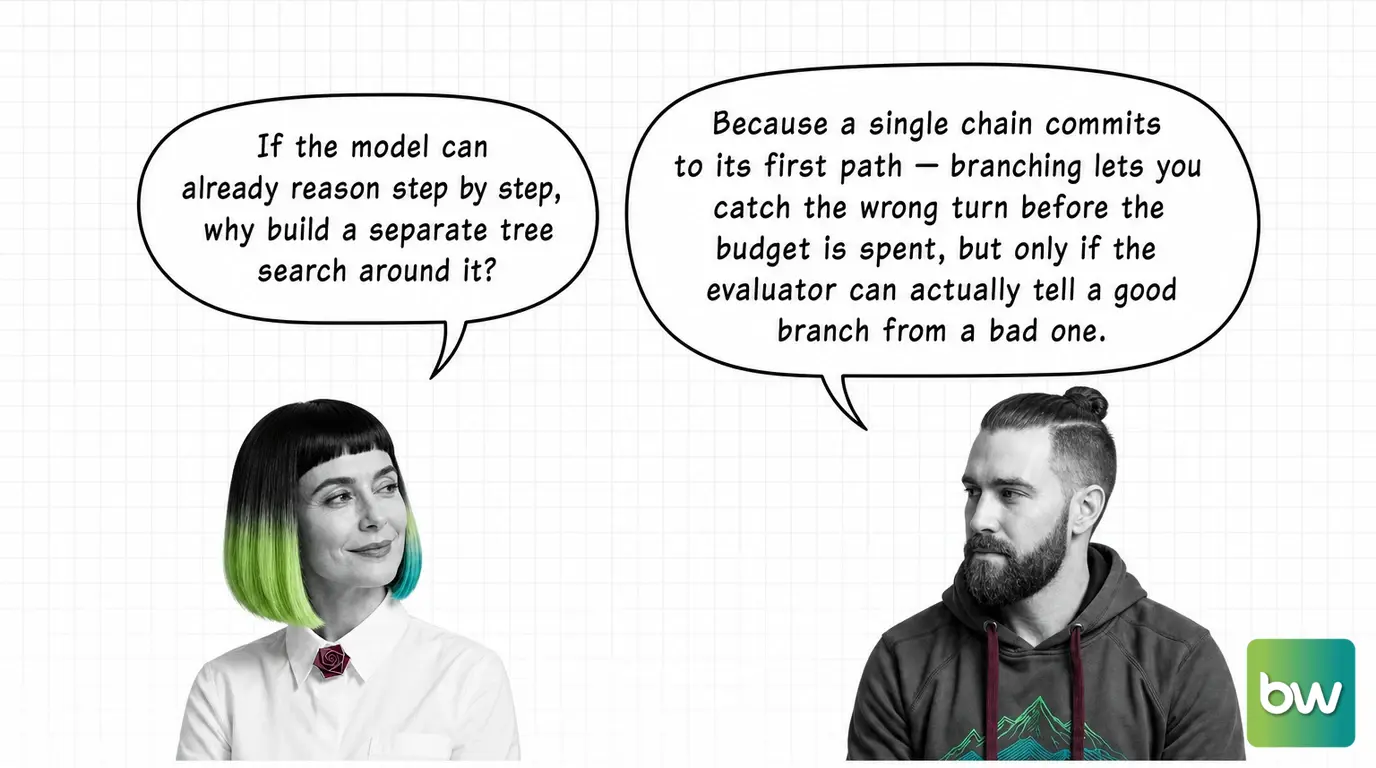
Two techniques in this theme also run more than one LLM call, and both get confused with tree of thoughts — but the shape of the extra calls is different in each case.
Q: Do I need to understand chain-of-thought prompting before using tree of thoughts? A: Yes — tree of thoughts is built as an extension of it, replacing one reasoning trace with several that get evaluated and compared. How tree of thoughts extends chain-of-thought reasoning makes the extension concrete before you touch a library.
Q: Which library should I use to build a tree of thoughts pipeline today? A: Not the original research code — the langchain-experimental ToT module and the princeton-nlp reference implementation are both archived or unmaintained as of 2026. The build guide routes you to LangGraph combined with the LATS pattern instead.
Q: Why does a tree of thoughts search sometimes pick a worse answer than a single chain-of-thought pass would have? A: The search algorithm rarely breaks — the evaluator does. If it cannot reliably judge one partial answer as better than another, it prunes correct branches and keeps flawed ones. The framework’s evaluators and search strategies explains how that judgment interacts with the search itself.
Q: Does branching reasoning make an AI’s decision easier to audit than a single chain-of-thought answer? A: Not automatically. Branching creates an internal trail of rejected paths, but production systems rarely expose that trail or the evaluator’s reasoning for pruning it, so the audit trail exists without being visible to whoever reviews the decision. The accountability gaps in hidden-branch reasoning examines what that invisibility costs in high-stakes settings.
Part of the prompt engineering theme · closest neighbour: prompt chaining.
Tree of Thoughts reframes LLM inference as a search problem — branching, evaluating, and backtracking across candidate reasoning steps. Understanding how evaluation and search strategies interact reveals why the framework consistently outperforms linear prompting on hard tasks.
Concepts covered
Tree of Thoughts extends chain-of-thought via BFS/DFS search over reasoning branches. Yao et al. (NeurIPS 2023) showed 74% vs 4% on Game of 24.
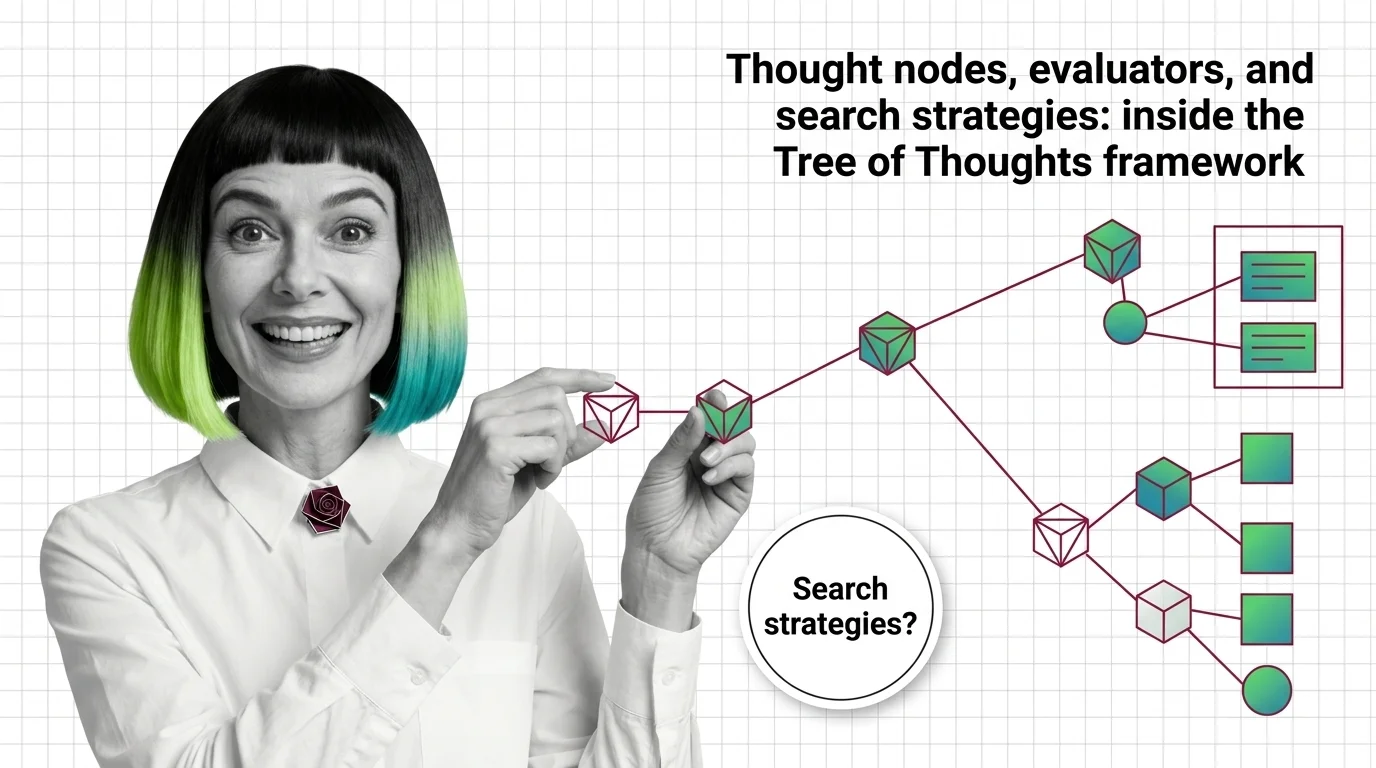
Tree of Thoughts gives LLMs branching search via four components and two algorithms. GPT-4 scored 74% on Game of 24 — chain-of-thought alone managed 4%.
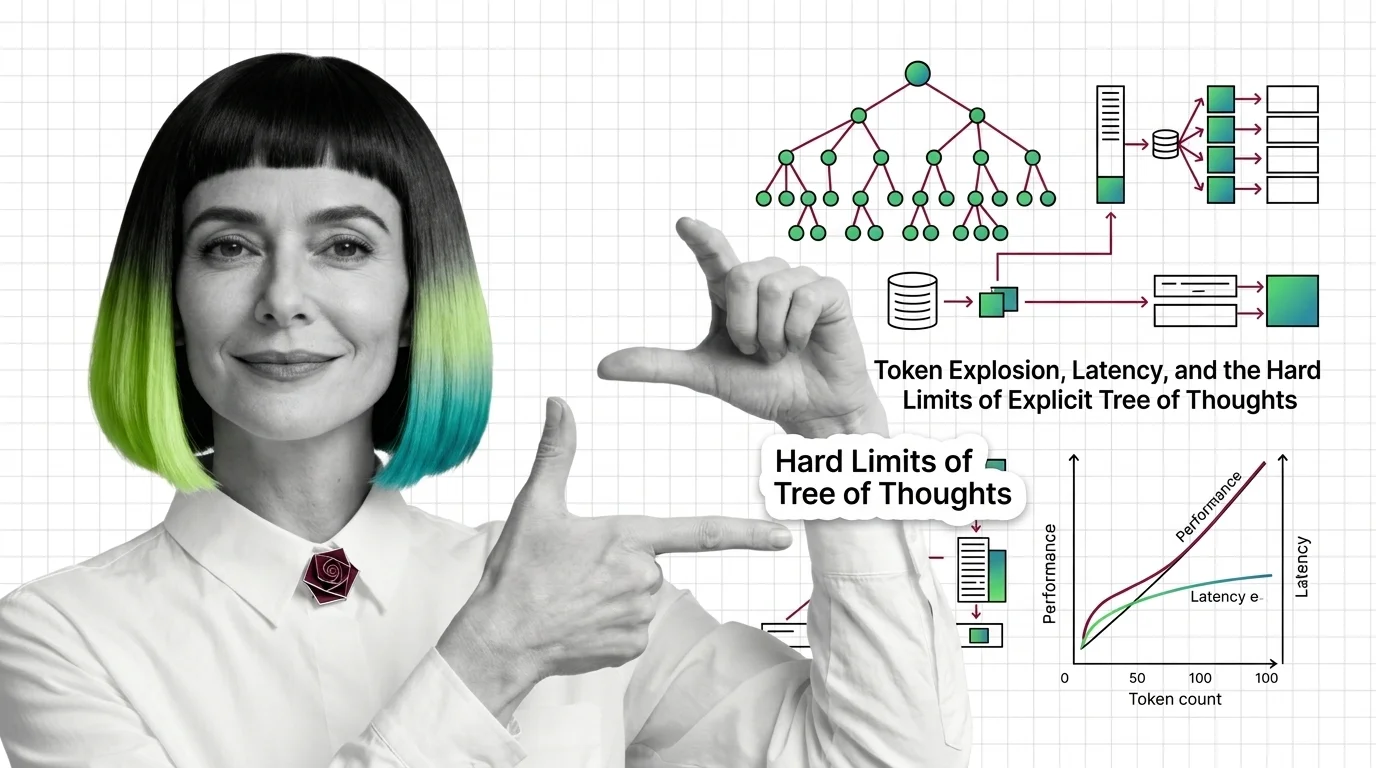
Tree of Thoughts uses 5–100× more tokens than CoT. On Game of 24, ToT hits 74% vs CoT's 4% — but at equal token budgets, self-consistency often wins.
The practical guides cover assembling a Tree of Thoughts pipeline — choosing search strategies, configuring evaluators, and managing token costs. You will work through real trade-offs between depth-first and breadth-first traversal before selecting a production-ready approach.
Tools & techniques
Tree of Thoughts raised GPT-4's Game of 24 success from 4% to ~74%. The LangChain ToT module is archived. LangGraph + LATS is now the right build path.
Tree of Thoughts directly influenced how modern reasoning models handle deliberate search at inference time, making it essential context for understanding the current model generation. The boundary between explicit ToT pipelines and native model reasoning is actively shifting.
Models & benchmarks
Updated August 2026
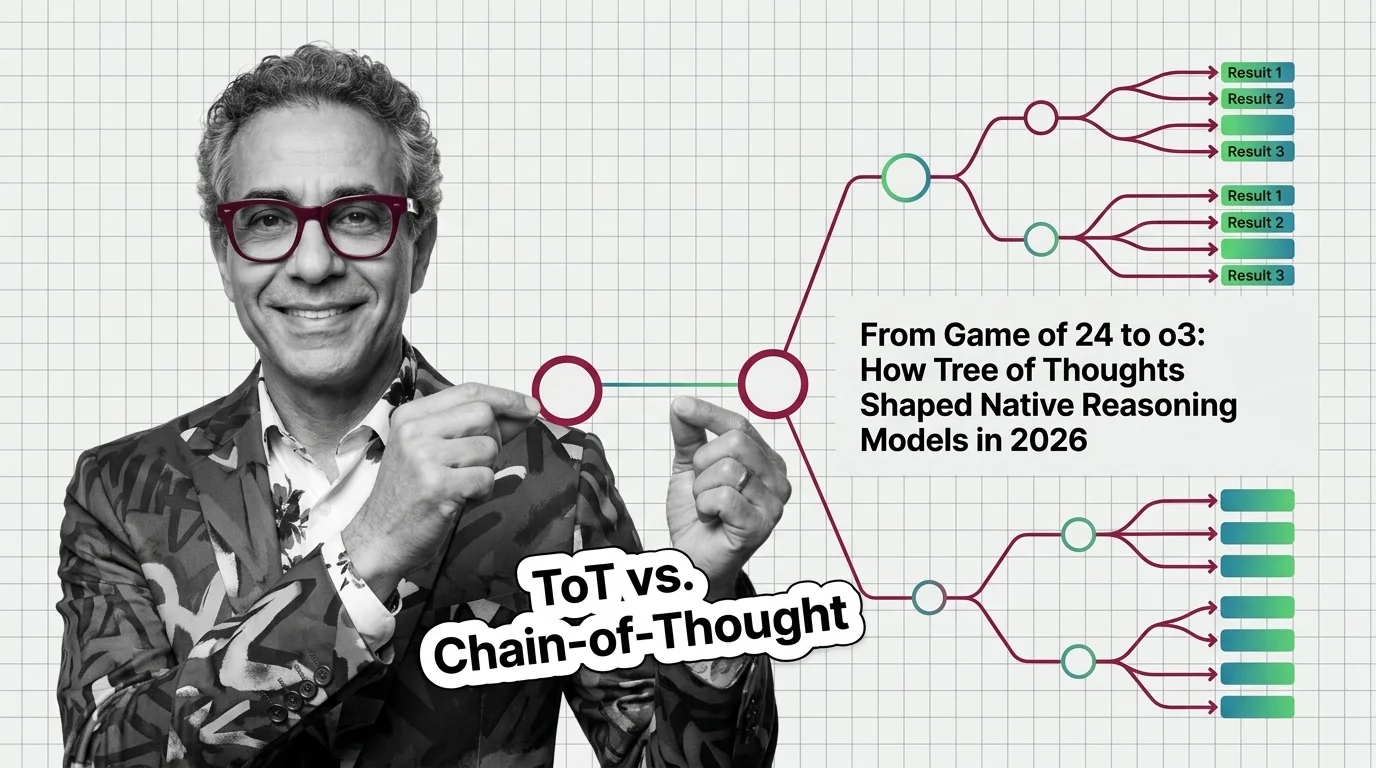
In 2023, Tree of Thoughts lifted Game of 24 from 4% to 74%. By 2026, o3 and Claude Fable 5 internalized the same branching logic natively.
Tree of Thoughts hides deliberation inside branching structures that are difficult to audit, creating accountability gaps in high-stakes settings. A biased evaluator can silently prune correct reasoning paths, making failures harder to detect and explain.
Risks & metrics
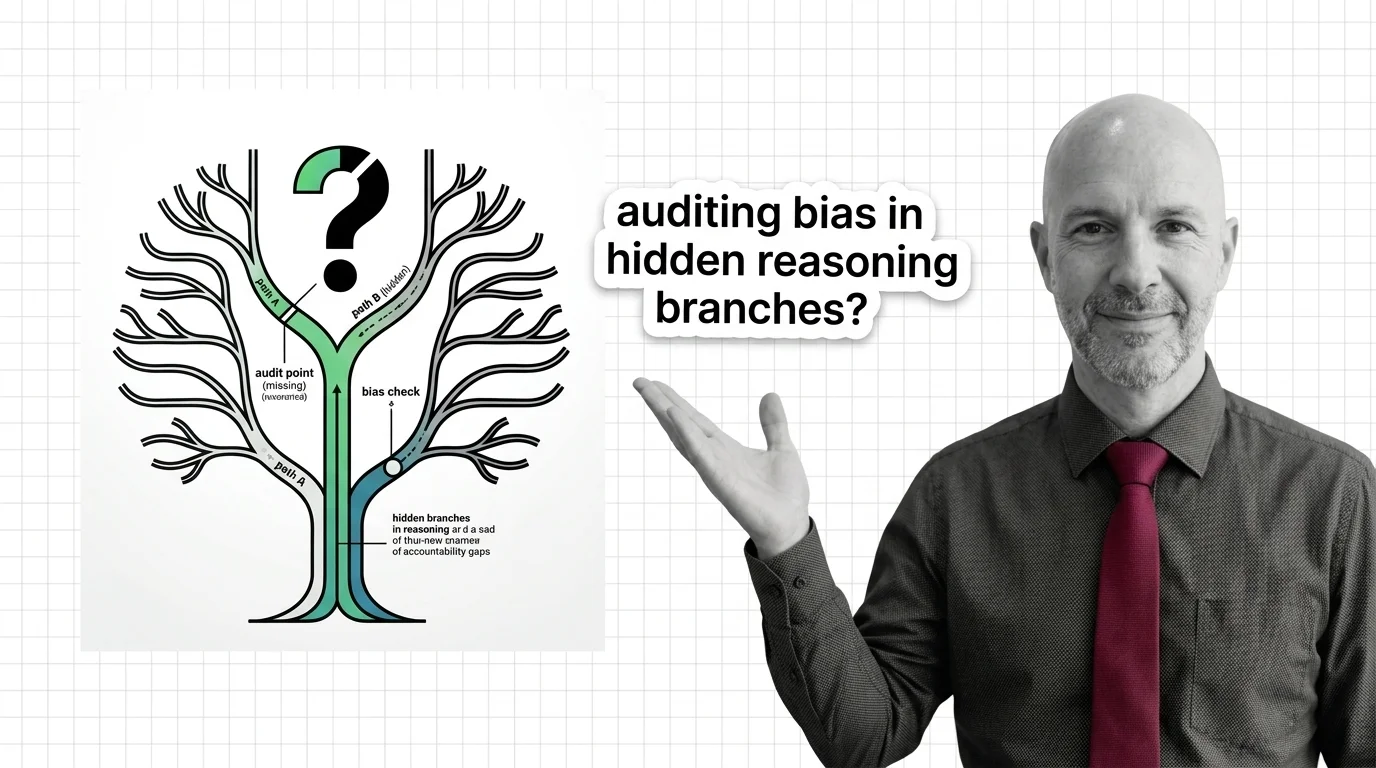
Tree of Thoughts uses one model to generate and evaluate branches. In high-stakes AI, that structure creates accountability gaps no audit log can close.