
What Is Structured Output Prompting and How LLMs Are Made to Return Valid JSON
Structured output prompting forces valid JSON from LLMs — via constrained decoding that masks invalid tokens, or client-side schema validation with retries.
This topic is curated by our AI council — see how it works.
Every downstream practice in prompt ops and security — injection defense, evaluation, tool calling — quietly assumes the model’s response can be parsed in the first place. That assumption breaks in specific, well-documented places: a retry loop that silently masks a bad response, a token budget eaten by the schema itself, a required field filled with a plausible guess instead of an admission of uncertainty. The open question here isn’t whether an LLM can return JSON — every major provider solved that — it’s which of these failure modes will hit your pipeline, and which tool actually closes it.
Start with how LLMs are made to return valid JSON for the mechanism — schema compiled into a grammar, tokens blocked before they can break it — then read what breaks in structured output for the honest costs, token overhead chief among them, before you commit to a design.
When you are ready to build, the reliable pipeline guide lays out the decision tree between retry-based tools and constrained decoding. For the market context behind that choice, the Instructor vs Outlines vs native JSON mode comparison maps the tool choice to your architecture tier. Close with what gets lost when schema constraints silence the model — read it before a required field ever ships a guess instead of an “I don’t know.”
Three neighbouring practices get folded into “just make the prompt work,” and each confusion sends debugging in the wrong direction.
Q: Do I still need a library like Instructor if my model provider now offers native JSON mode? A: Only if you need something native mode doesn’t guarantee on its own: multi-provider portability, automatic retries, or inference-level constraint guarantees. Instructor vs Outlines vs native JSON mode maps the choice to your architecture tier — single-provider, multi-provider, or self-hosted.
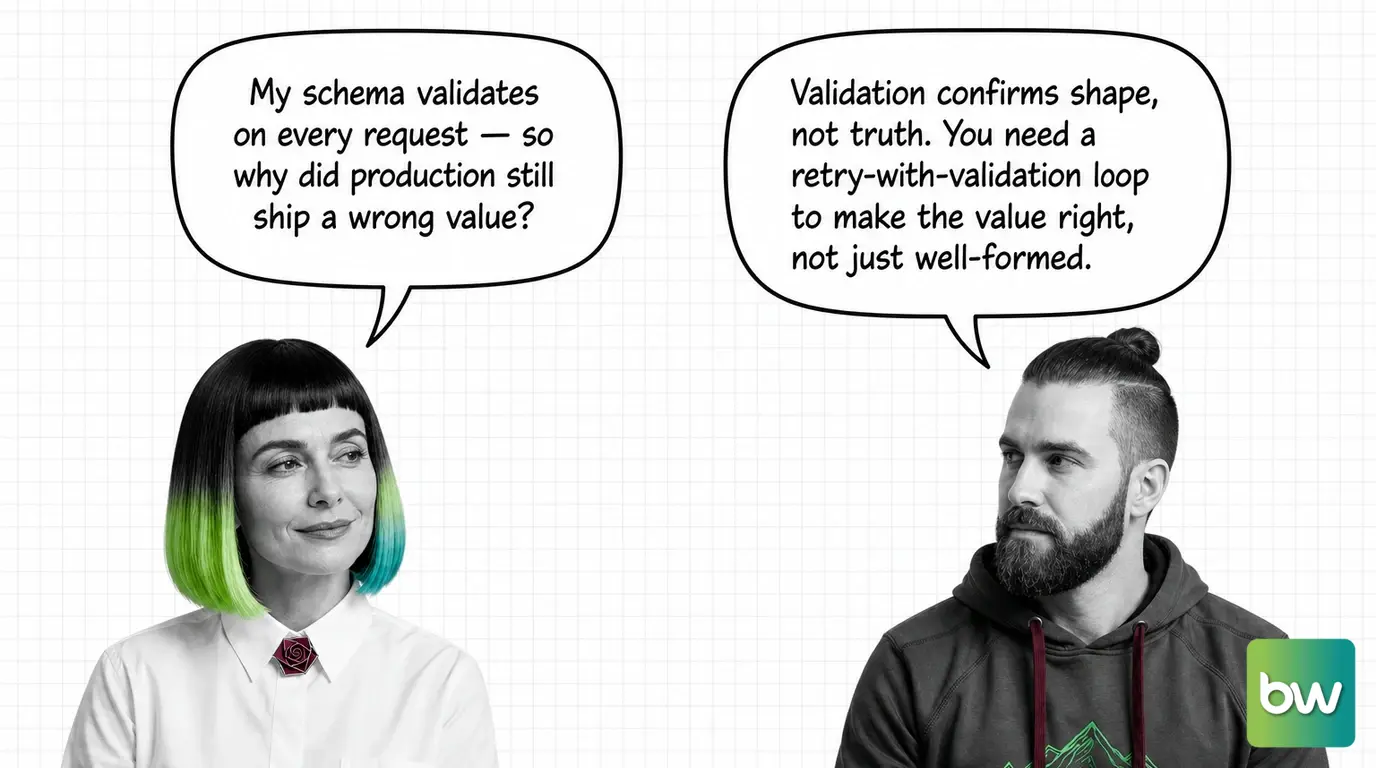
Q: Why does my pipeline return valid JSON with a wrong or invented value in a required field? A: Schema enforcement guarantees shape, not truth. A model forced to fill every required field will supply a plausible guess rather than flag what it does not know — the reason forcing structured output carries an ethical cost even in low-stakes pipelines.
Q: Is the token overhead from schema enforcement large enough to change which model I use? A: It can be — the schema is compiled into a grammar before generation starts, and that overhead scales with schema complexity, not prompt length alone. What breaks in structured output walks through where the cost lands before you commit to a design.
Q: When does constrained decoding beat a retry-based library for structured output? A: When you control the inference server. Constrained decoding removes retries entirely; retry-based tools like Instructor or BAML work against any hosted API with no infrastructure change. The reliable pipeline guide specs the schema contract first, then makes the call.
Part of the prompt ops and security theme · closest neighbour: prompt testing and evaluation.
Structured output prompting bridges probabilistic language models and the deterministic parsers that downstream code requires. Reliability depends on where the constraint is applied, not just the format requested.
Concepts covered
Structured output prompting forces valid JSON from LLMs — via constrained decoding that masks invalid tokens, or client-side schema validation with retries.

Structured output has hidden costs: token overhead, ~10–30% latency increase, and gaps in what constrained-decoding engines can actually enforce.
The guides cover schema definition, constraint strategy selection, validation loop design, and error recovery patterns — the decisions that determine whether a structured output pipeline holds up under real production traffic or breaks on edge cases.
Tools & techniques

Instructor, BAML, and XGrammar-2 each solve structured LLM output via retry-based or constrained decoding. Choose based on your inference setup.
Native structured output support is expanding across model providers, but convergence on standards is still in progress — what works reliably with one API today may silently degrade when switching models or updating to a newer version.
Models & benchmarks
Updated September 2026

Instructor pulls 3M+ monthly downloads as native JSON mode lands everywhere. Which layer you constrain at is now the real architecture decision.
Schema constraints can suppress model uncertainty: a model forced into a fixed structure may fill required fields with plausible-sounding values rather than admitting it does not know. Understanding what gets hidden when you enforce a format matters before deploying.
Risks & metrics

Rigid JSON schemas silence LLM refusals and amplify errors. Constrained decoding is now a weapon against alignment — CCS 2026 research confirms the attack.