Almost every dense-vector RAG pipeline that isn’t calling a proprietary API is running Sentence Transformers underneath it — the open-source framework and training methodology that turns raw transformer output into vectors a nearest-neighbor search can actually use. It sits at the mechanism layer of the retrieval-augmented generation stack: the base model you pick barely matters next to the loss function and training data you pick, and that choice decides whether search returns relevant results or near-misses that only score well on a leaderboard.
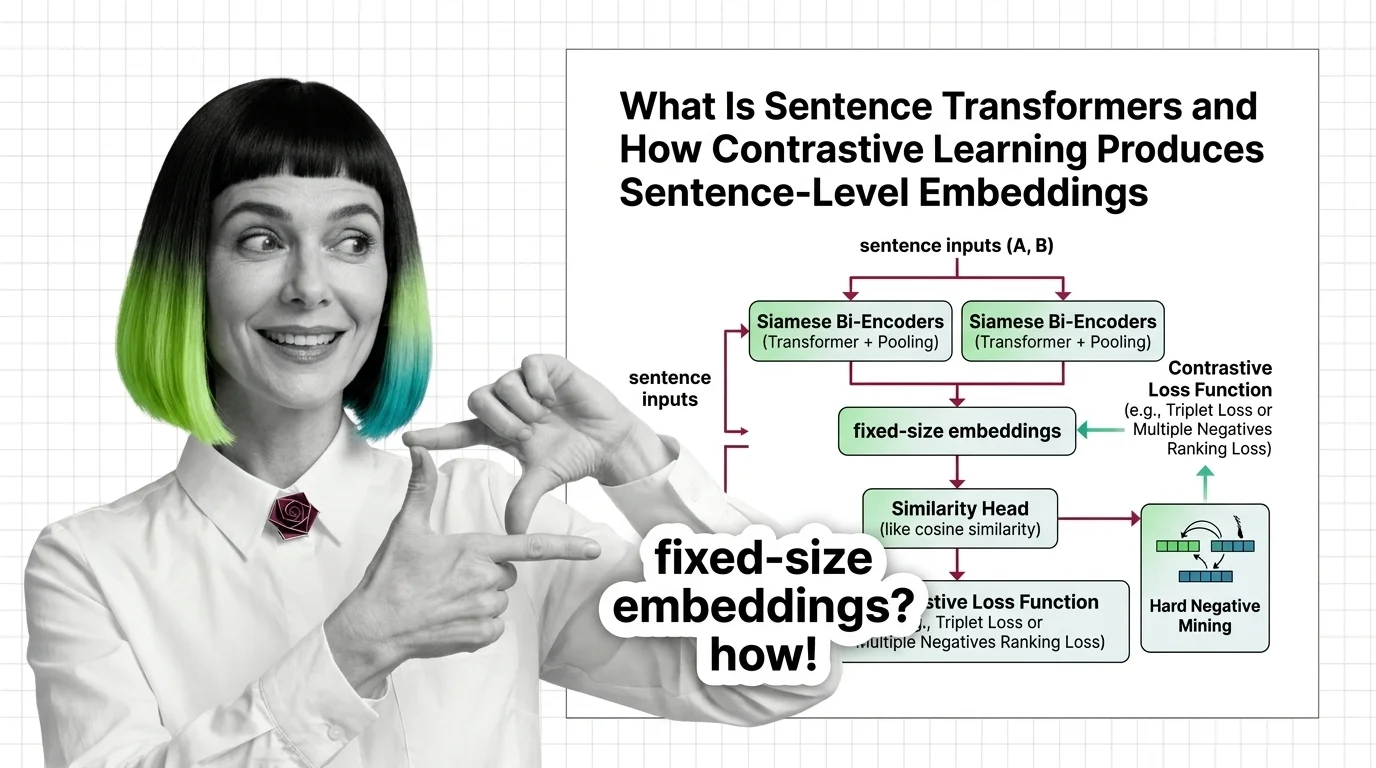
Sentence Transformers turns raw transformer output into fixed-size sentence vectors through contrastive training on siamese bi-encoder networks — without it, comparing sentence meaning needs expensive pairwise inference.
Loss function and pooling strategy, not the base model, decide whether a fine-tuned Sentence Transformers model actually retrieves the right documents.
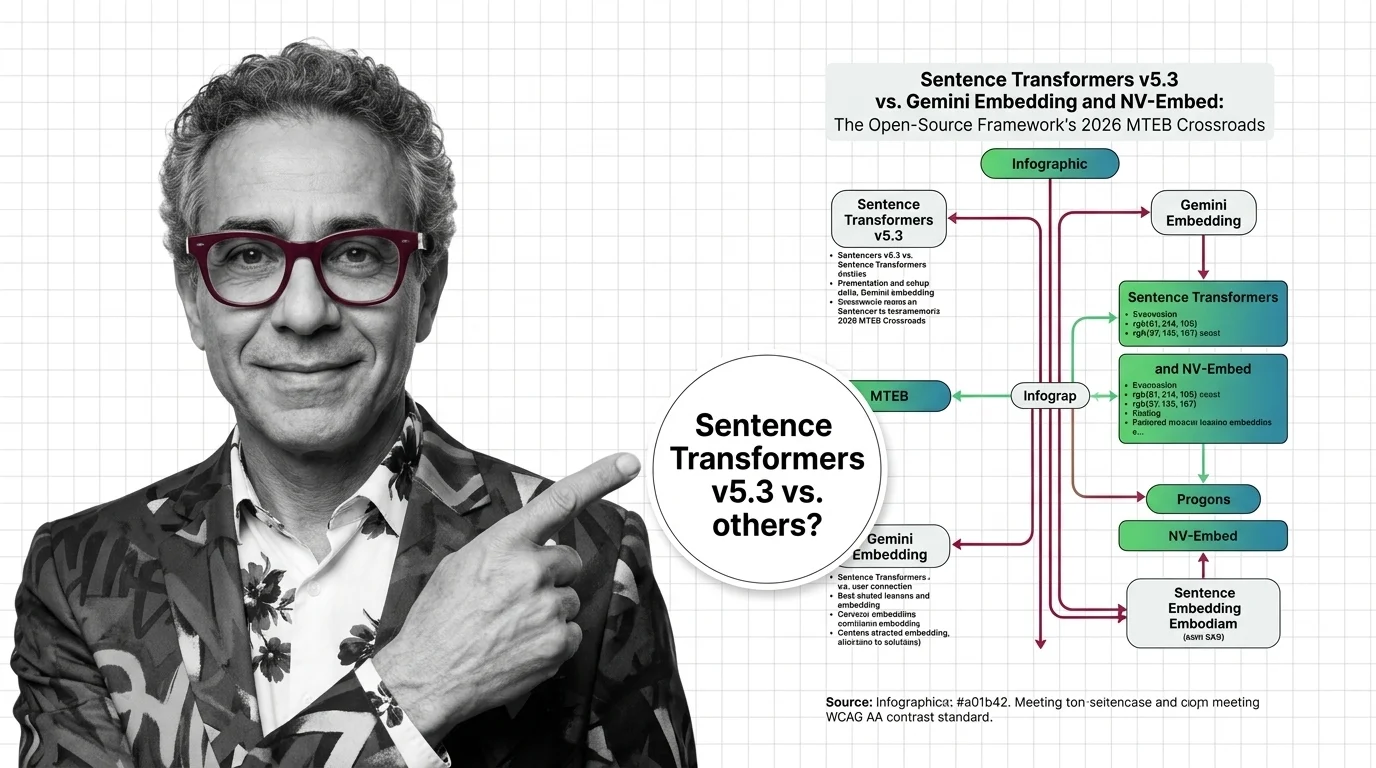
The 2026 embedding market split into two layers — inference APIs like Gemini Embedding and NV-Embed, and open-source training infrastructure — and Sentence Transformers owns the training layer both sides depend on.
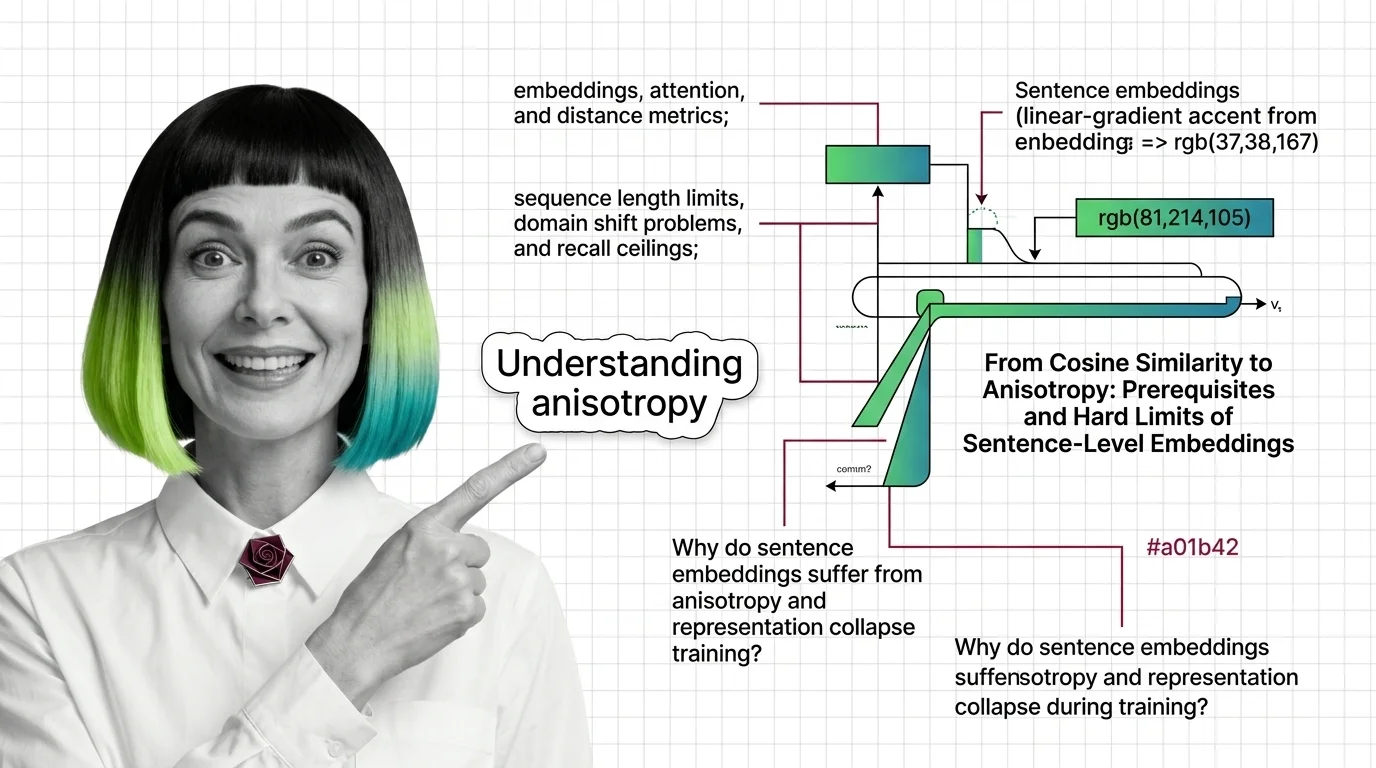
Anisotropy and domain shift cap what these vectors can represent regardless of how strong the base model looks on paper.
The Sentence Transformers reading path: mechanism, limits, then market position
When you’re ready to build, the fine-tuning and deployment guide turns the theory into a four-layer specification — data, loss, model, index — for training and shipping a production model, Matryoshka embeddings included. For where the framework stands in the wider market, the 2026 MTEB crossroads covers what changed in v5.3 and why the embedding market split rather than crowned one winner. Close with the ethical risks of sentence embeddings in automated decision systems — if your vectors will ever rank people rather than paragraphs, read it before you fine-tune a production model, not after.
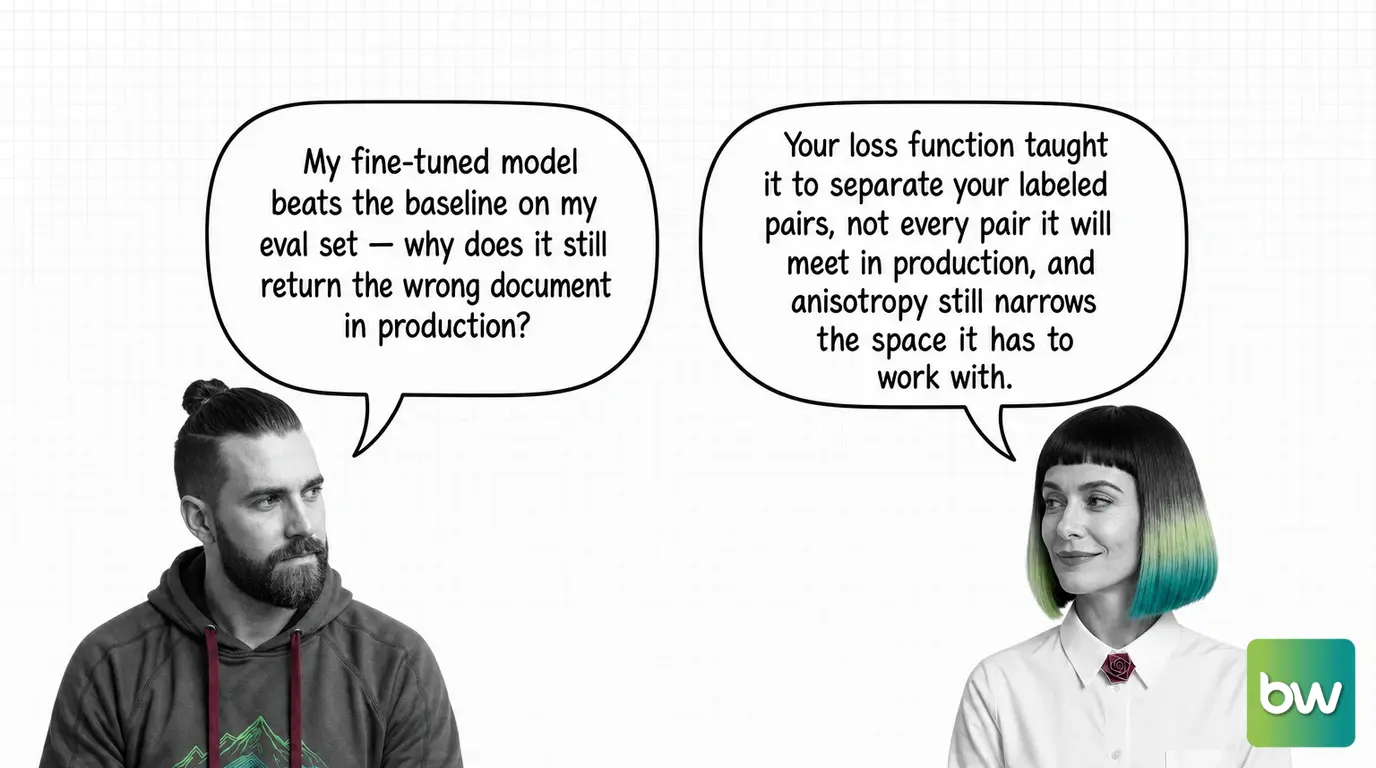
Winning on your eval set is not the same as winning on the geometry you inherited.
How Sentence Transformers differs from raw transformer output and proprietary APIs
Two confusions send debugging in the wrong direction.
A fine-tuned sentence embedding is not a pooled raw embedding. Feeding a sentence through a plain pretrained transformer and averaging its last hidden layer produces a vector, but not a comparable one — nothing in that training objective pulls similar sentences together in the space. Contrastive training on sentence pairs is the actual difference the framework’s name describes: not the architecture underneath, but the training objective layered on top of it.
The framework is not the API. Proprietary services like Gemini Embedding sit in the inference layer — pay per call, no control over training. Sentence Transformers sits in the layer underneath: it is the open-source infrastructure training and fine-tuning runs on, even for teams that serve production traffic through someone else’s API. The 2026 leaderboard reshuffle is that split becoming visible, not one side losing to the other.
Common questions about Sentence Transformers
Q: Why does a Sentence Transformers model fine-tuned on my own data still surface the wrong documents at query time?
A: Usually a symmetry mismatch — a model trained on symmetric pairs (sentence-to-sentence) searched asymmetrically (short query against long document), or a loss function that never saw hard negatives. The fine-tuning guide walks the specification that catches this before training, not after deployment.
Q: Why do Sentence Transformers embeddings cluster close together instead of spreading out across the vector space?
A: This is anisotropy — a known failure mode where representations collapse into a narrow cone during training, shrinking the effective space cosine similarity has to work with. The prerequisites and hard limits explainer traces why it happens and what it silently caps.
Q: Does the bias encoded in Sentence Transformers embeddings matter if I’m only building an internal search tool?
A: The stakes scale with what the ranking decides. For internal document search, encoded bias mostly skews relevance; the moment the same vectors screen résumés or triage cases, it becomes a decision about people with no line of code to hold accountable.
Sentence Transformers bridge the gap between word-level representations and whole-sentence meaning. Understanding how contrastive objectives shape embedding geometry reveals why some similarity comparisons succeed and others silently fail.
Sentence Transformers turns transformers into sentence encoders via contrastive learning. Covers bi-encoders, loss functions, pooling, and hard negative mining.
Sentence Transformers encode meaning as geometry. Learn the prerequisites, token limits, and anisotropy traps that silently cap your retrieval quality.
2
Build with Sentence Transformers
The guides cover fine-tuning embedding models on domain-specific data, selecting loss functions, and deploying inference pipelines that balance latency against recall in real-world semantic search systems.
Fine-tune Sentence Transformers v5.3 for semantic search and clustering. Covers MultipleNegativesRankingLoss, Matryoshka embeddings, FAISS indexing, and validation.
3
What's Changing in 2026
The embedding landscape shifts rapidly as new architectures compete on benchmarks and multilingual coverage. Tracking which training approaches gain traction shapes how teams invest in retrieval infrastructure.
v5.3 introduces new contrastive losses as Gemini Embedding claims MTEB #1. Why framework innovation matters more than any benchmark ranking.
4
Risks and Considerations
Sentence embeddings encode social biases from training data into vector geometry, making discrimination invisible and hard to audit. Automated systems using these representations require careful fairness evaluation.
Embeddings freeze gender, racial, and cultural bias from their training data. These frozen geometries then shape all consequential automated decisions.