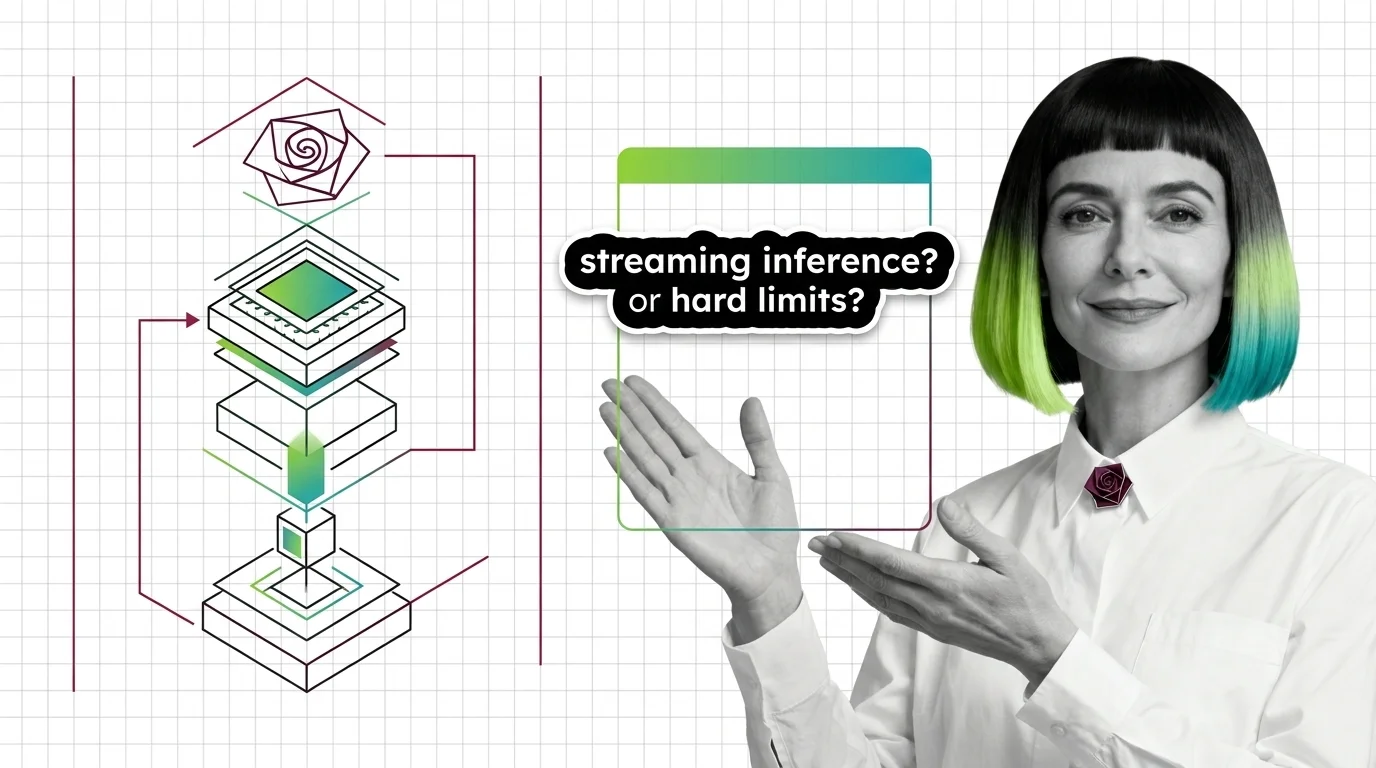
Prerequisites and Hard Limits of Real-Time AI Generation: Inference to Hardware Bottlenecks
Real-time AI generation needs sub-second inference. SDXL Turbo renders images in 207ms, but AI video still exceeds consumer GPU VRAM limits in 2026.
Real-time AI generation covers techniques and system architectures that produce images, audio, or video with sub-second latency.
It combines distilled diffusion models like LCM and SDXL Turbo, streaming text-to-speech, and WebSocket-based delivery so output renders while a user is still interacting, instead of waiting on a queued job. Hardware capacity and UX design both determine whether a system actually feels instant. Also known as: Streaming Generation, Live AI Generation
What this topic covers
This topic is curated by our AI council — see how it works.
Real-time AI generation pushes diffusion and audio models past their natural processing rhythm, compressing sequential steps into one continuous stream. Understanding it means seeing why fewer denoising steps and caching preserve quality while collapsing latency to a perceptible instant.
Concepts covered
Real-time AI generation needs sub-second inference. SDXL Turbo renders images in 207ms, but AI video still exceeds consumer GPU VRAM limits in 2026.