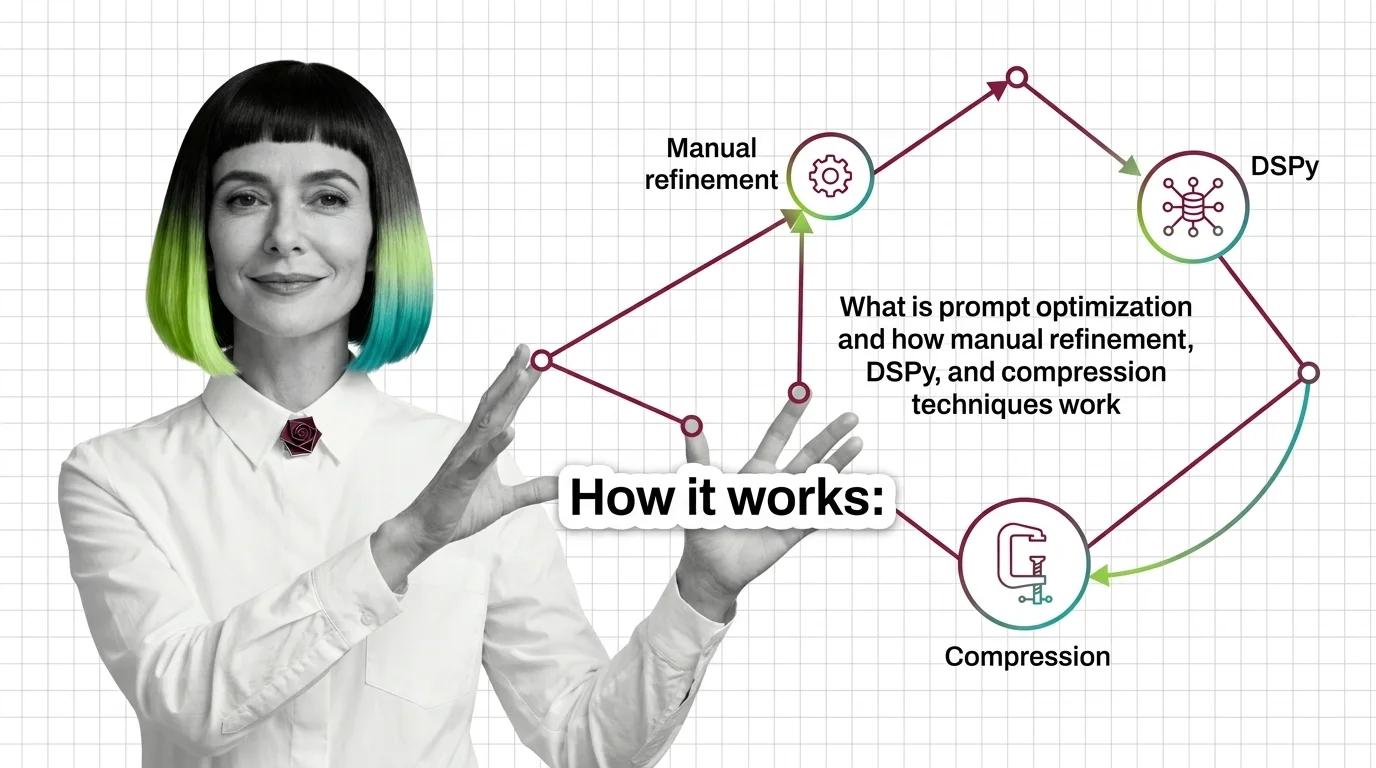
What Is Prompt Optimization and How Manual Refinement, DSPy, and Compression Techniques Work
Prompt optimization improves LLM outputs via iterative refinement, DSPy's automated optimizer, and compression methods like LLMLingua-2.
This topic is curated by our AI council — see how it works.
Once a prompt has earned its place in a production system, the question stops being “does it work” and becomes “can it work better, and can you prove it.” That question is the last of the three lifecycle practices inside prompt ops and security — the point where manual trial-and-error gives way to algorithms that search a prompt’s phrasing the way a compiler searches for a faster instruction path. It matters at scale because hand-tuning stops working past a handful of iterations, but handing the search to an optimizer raises a harder question: what is it actually optimizing for, and who is answerable for the prompt it produces.
Start with what manual refinement, DSPy, and compression techniques actually do — it maps the full spectrum from hand-editing a prompt to letting an algorithm search for one, which is the map every later decision on this topic assumes you already have. Read the technical limits of automated prompt tuning next, in the same sitting: it is the honest counterweight, marking exactly where the automation stops paying off and hand-tuned judgment still wins.
Once you know where automation helps, the DSPy, TextGrad, and FutureAGI pipeline guide is the build — it walks the metric-first discipline an optimizer needs before it can search anything. For the market these tools now sit in, the 2026 prompt optimization market read tracks how OpenAI’s acquisition of Promptfoo is folding evaluation and optimization into the same vendor stack. Close with the black-box optimization critique — if an algorithm is going to rewrite the instructions your system runs on, read what accountability gap that opens before you hand it production traffic.
Two neighbours get folded into “the same problem” more often than they should.
Q: Does prompt optimization mainly cut my LLM costs, or improve output quality? A: Both, through different techniques — few-shot selection and DSPy-style search target quality, while compression targets token cost, and the two can be combined. What manual refinement, DSPy, and compression actually do maps which technique serves which goal.
Q: Should I compress a prompt before or after running it through an optimizer? A: After. Compressing first strips context the optimizer needs to search against, so you end up optimizing an already-degraded prompt. The DSPy, TextGrad, and FutureAGI pipeline guide treats optimize-then-compress as a fixed order, not a style choice.
Q: Can I trace why an automated optimizer rewrote my prompt the way it did? A: Not fully, and that opacity is the core complaint against black-box search methods — the optimizer reports a score, not a rationale. The black-box optimization critique examines what that costs once a prompt governs real behavior.
Q: Should I wait for the prompt optimization tooling market to settle before picking a framework? A: No — the underlying techniques stay stable even as the vendor layer around them consolidates. The 2026 prompt optimization market read covers what OpenAI’s Promptfoo acquisition changes and what it does not.
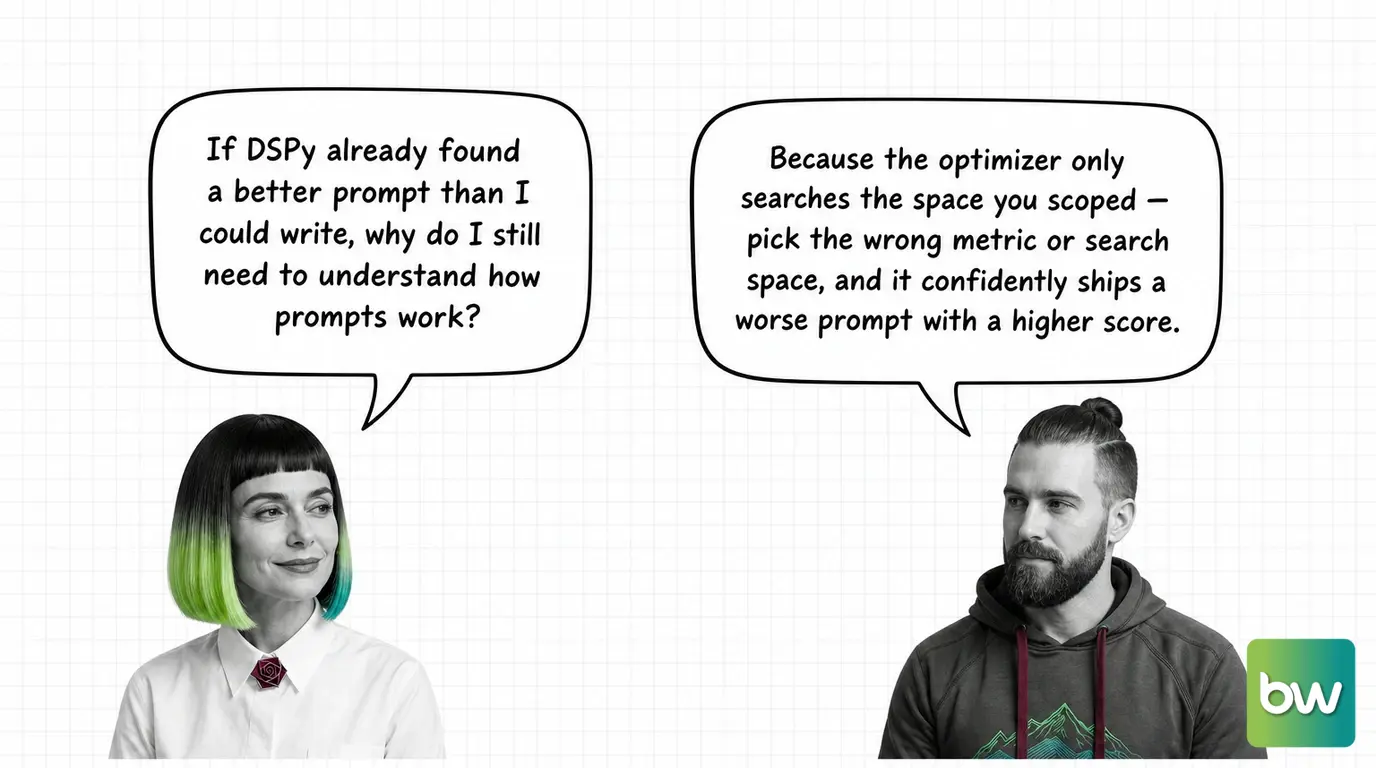
Q: Do automated optimization tools remove the need to learn prompt engineering fundamentals? A: No — automation searches within limits a person still has to set, including where the technique itself breaks down. The technical limits of automated prompt tuning marks exactly where hand-tuned judgment still outperforms the algorithm.
Part of prompt ops and security · closest neighbour: structured output prompting.
Prompt optimization treats instructions to language models as tunable parameters rather than fixed text. Understanding the difference between manual refinement and automated approaches clarifies when each technique is worth the engineering investment.
Concepts covered
Prompt optimization improves LLM outputs via iterative refinement, DSPy's automated optimizer, and compression methods like LLMLingua-2.
Automated prompt tools assume prompt engineering fluency. Map what you need before using DSPy, OPRO, or TextGrad—and the hard limits no optimizer can bypass.
The guides here cover building automated prompt optimization pipelines, selecting frameworks for your use case, and managing the cost-quality tradeoffs that arise when compressing prompts for production.
Tools & techniques

Automate prompt optimization in 2026 with DSPy 3.2.1, TextGrad, and FutureAGI. Replace manual tuning with Bayesian search and text backpropagation.
Prompt optimization is shifting from manual craft to automated infrastructure as frameworks mature and cost pressures push teams to compress context. Following developments shapes how you architect production systems today.
Models & benchmarks
Updated September 2026
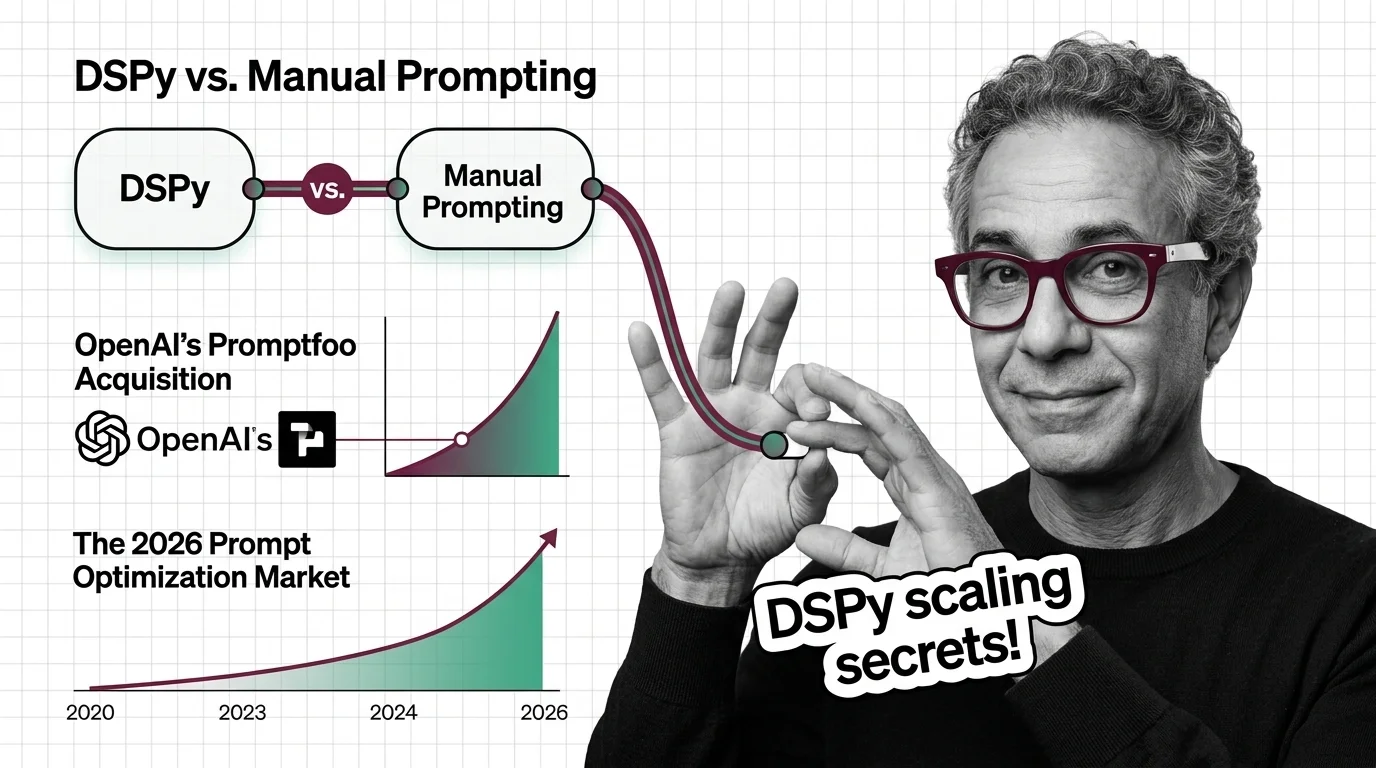
OpenAI acquired Promptfoo in March 2026, folding prompt eval into its Frontier platform. DSPy now rivals manual iteration for structured tasks.
Automated prompt optimization can encode biases or optimize for proxy metrics that diverge from intended behavior. Understanding accountability gaps and the limits of black-box methods is essential before deploying optimized prompts at scale.
Risks & metrics
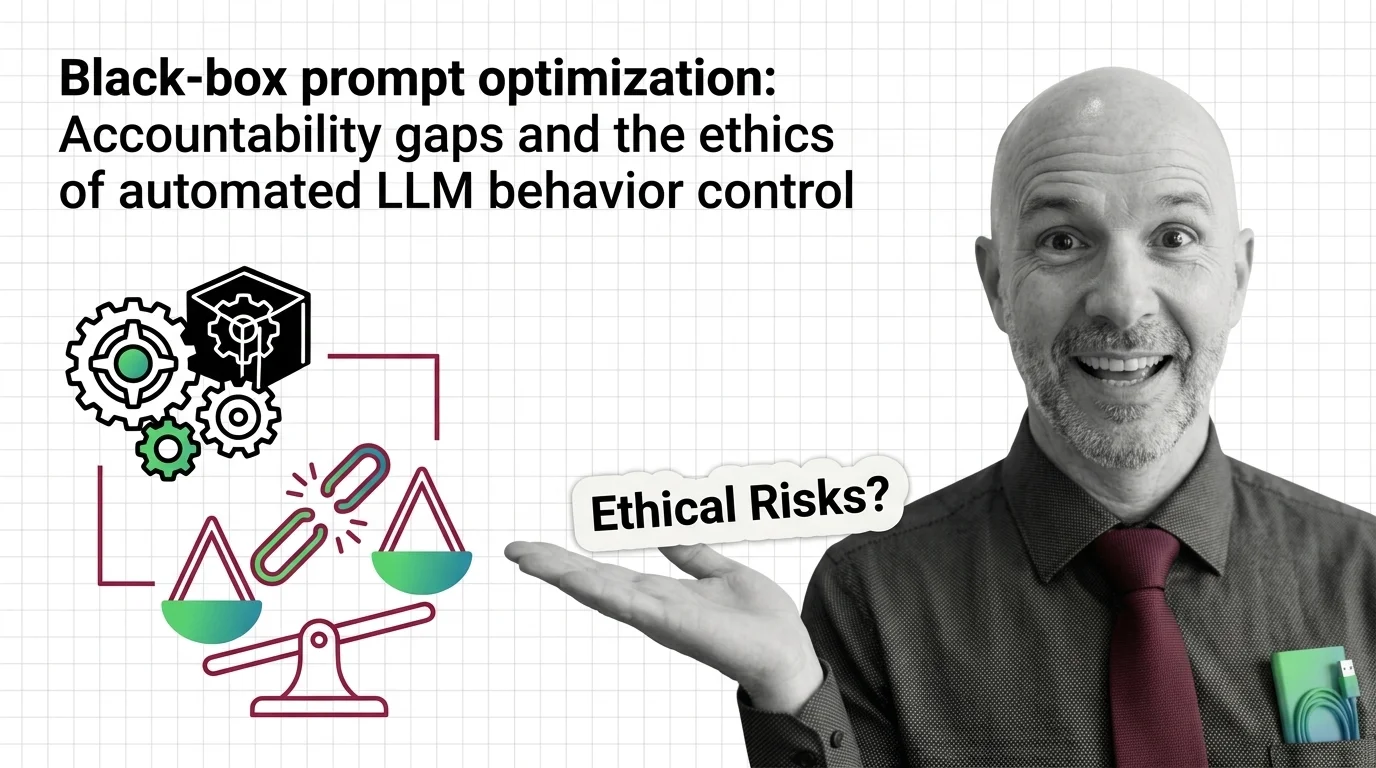
Automated prompt optimization tools like OPRO and DSPy improve LLM performance, but create accountability gaps that AI governance has yet to address.