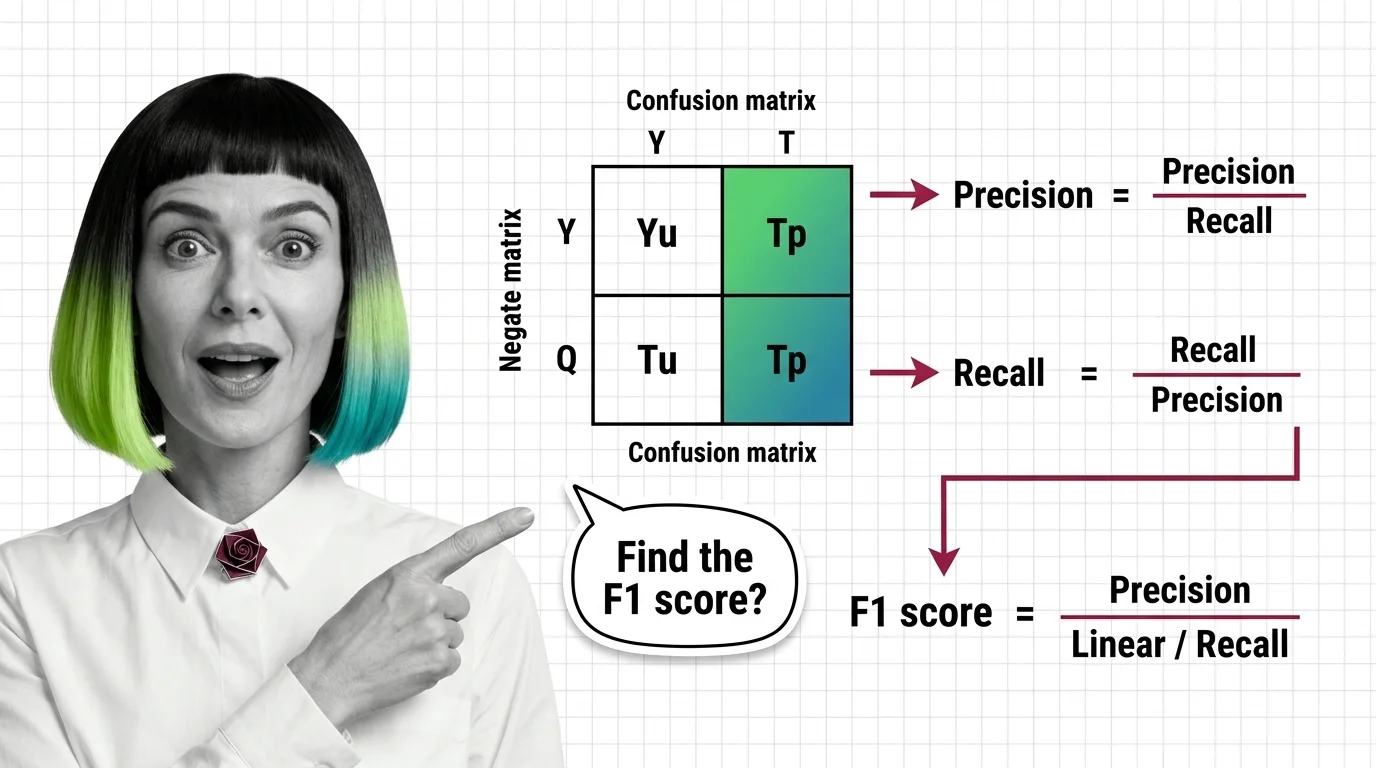
Precision, Recall, F1 Score: What the Confusion Matrix Reveals
What accuracy won't show: precision, recall, and F1 score expose true classifier performance. The confusion matrix explains why the harmonic mean matters.
This topic is curated by our AI council — see how it works.
A classifier’s accuracy score can look strong right up until it fails the one prediction that actually mattered — which is exactly the failure precision, recall, and F1 score were built to expose. Together they turn a single “how often is it right” number into three separate questions about correctness, coverage, and their trade-off, and they sit as the oldest, most durable layer inside the model evaluation theme: the same arithmetic that graded a 2005 spam filter still grades a classification head today. Read the three metrics together, not in isolation — each one alone tells a partial, sometimes misleading story.
Start with how the confusion matrix drives classification evaluation — it introduces the four-cell table these three metrics are built from, the same table that anchors the confusion matrix itself, so you get both readings in one sitting. Then read the building blocks behind precision, recall, and F1, which extends the binary case into multi-class problems and settles the vocabulary — true positive, macro average, weighted average — every later article assumes you already have.
Once that vocabulary is fixed, why F1 score fails on imbalanced datasets is the read that stops you trusting a high score on skewed data, and the scikit-learn and TorchMetrics guide turns that caution into a working threshold-tuning workflow you can run before a model ships.
For the stakes once a model is live, F1 score in production tracks how medical, moderation, and fraud teams each weight the metric differently, and optimizing for the wrong number closes the path with the case for checking F1 by subgroup, not only in aggregate, before a high-stakes classifier ships.
Two neighbours get folded into “classification metrics” when they measure something else entirely.
Precision, recall, and F1 score a classifier against ground-truth labels it was built to predict. The MMLU benchmark scores a model’s answers against a fixed multiple-choice answer key — the same idea of comparing output to a correct answer, but MMLU grades general knowledge, not a deployed classifier’s error trade-off.
Precision, recall, and F1 also require a bounded label space and a labeled test set. LLM-as-a-judge exists for the opposite case — open-ended text with no fixed label space — by having another model grade the output instead of counting matches against a key. Reach for LLM-as-a-judge only once a task stops being a classification problem with a countable confusion matrix.
Q: Is a single F1 score enough to sign off on a classifier before it reaches production? A: No — F1 alone hides both the class-imbalance problem and any subgroup disparity. On skewed data a near-useless classifier can still post a high F1, which is why MCC and PR-AUC read the confusion matrix more completely before you trust the number enough to ship.
Q: Why does the same F1 score mean something different in a fraud model than in a medical one? A: Because F1 assumes precision and recall matter equally, and production teams rarely agree that they do — a missed fraud case and a missed diagnosis carry different costs. How medical AI, moderation, and fraud detection choose their metrics maps which industries weight which error.
Q: Can two classifiers with identical F1 scores still treat groups of people differently? A: Yes — an aggregate F1 score is computed across the whole dataset, so it can average away an error rate that is far worse for one subgroup than another. Optimizing for the wrong number traces exactly how that averaging hides disparate impact.
Q: Which averaging method should I report — macro, micro, or weighted F1? A: State whichever you use, because each tells a different story about the same model: macro treats every class equally, weighted respects class frequency, and reporting a bare “F1 score” without naming one is not reproducible. The scikit-learn and TorchMetrics guide covers the code-level trade-off.
Q: Do precision and recall only apply to binary yes/no classifiers? A: No — both extend to multi-class problems once you decide how to combine per-class scores, which is exactly where macro versus micro averaging comes in. From true positives to macro averaging builds that extension from the binary case.
Part of the model evaluation theme · closest neighbour: the confusion matrix. Coming to metrics from a software-testing background? Start with the story: Model Evaluation for Developers: What Maps and What Misleads.
Precision, recall, and F1 score quantify different facets of classification accuracy. These articles explain why a single metric never tells the full story and how the confusion matrix connects them.
Concepts covered
What accuracy won't show: precision, recall, and F1 score expose true classifier performance. The confusion matrix explains why the harmonic mean matters.
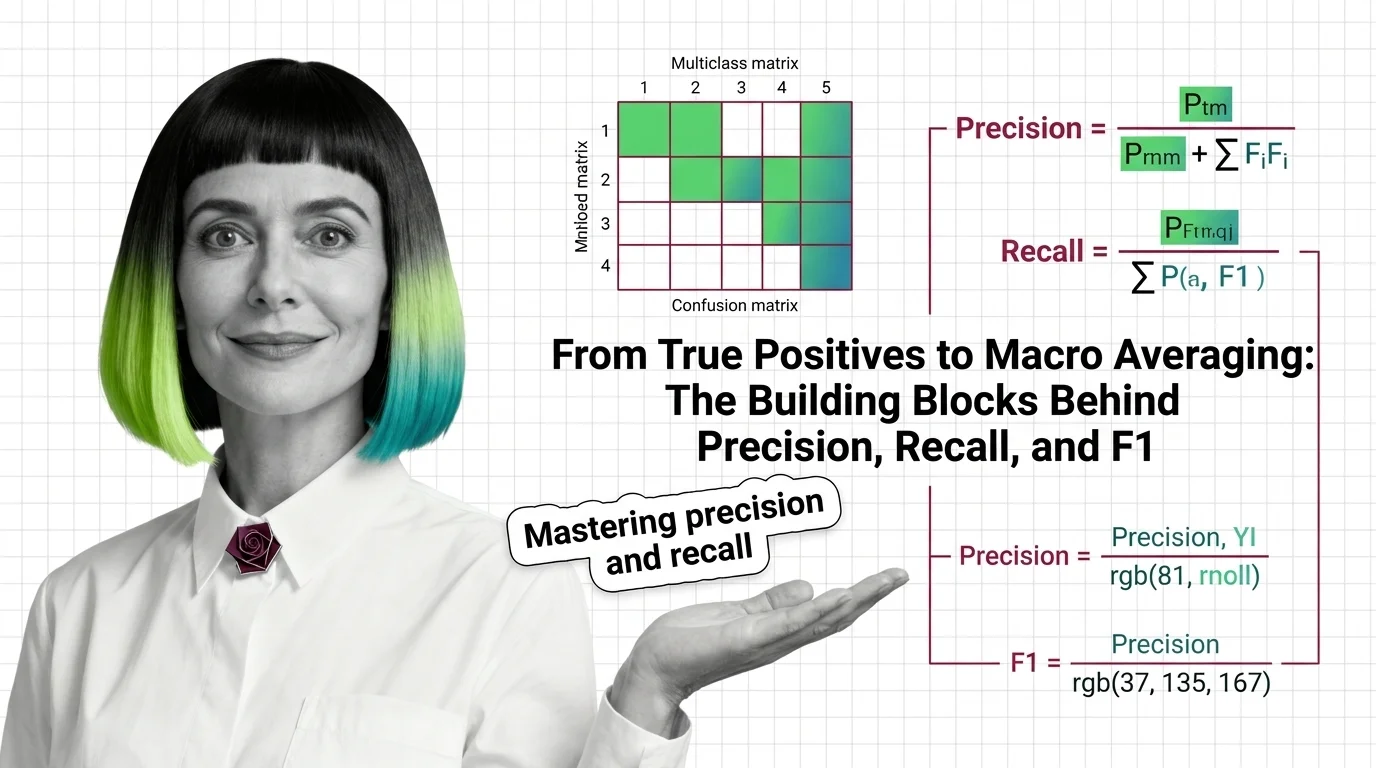
Precision, recall, and F1 score measure what accuracy hides. Learn how true positives, confusion matrices, and macro averaging reveal classifier performance.
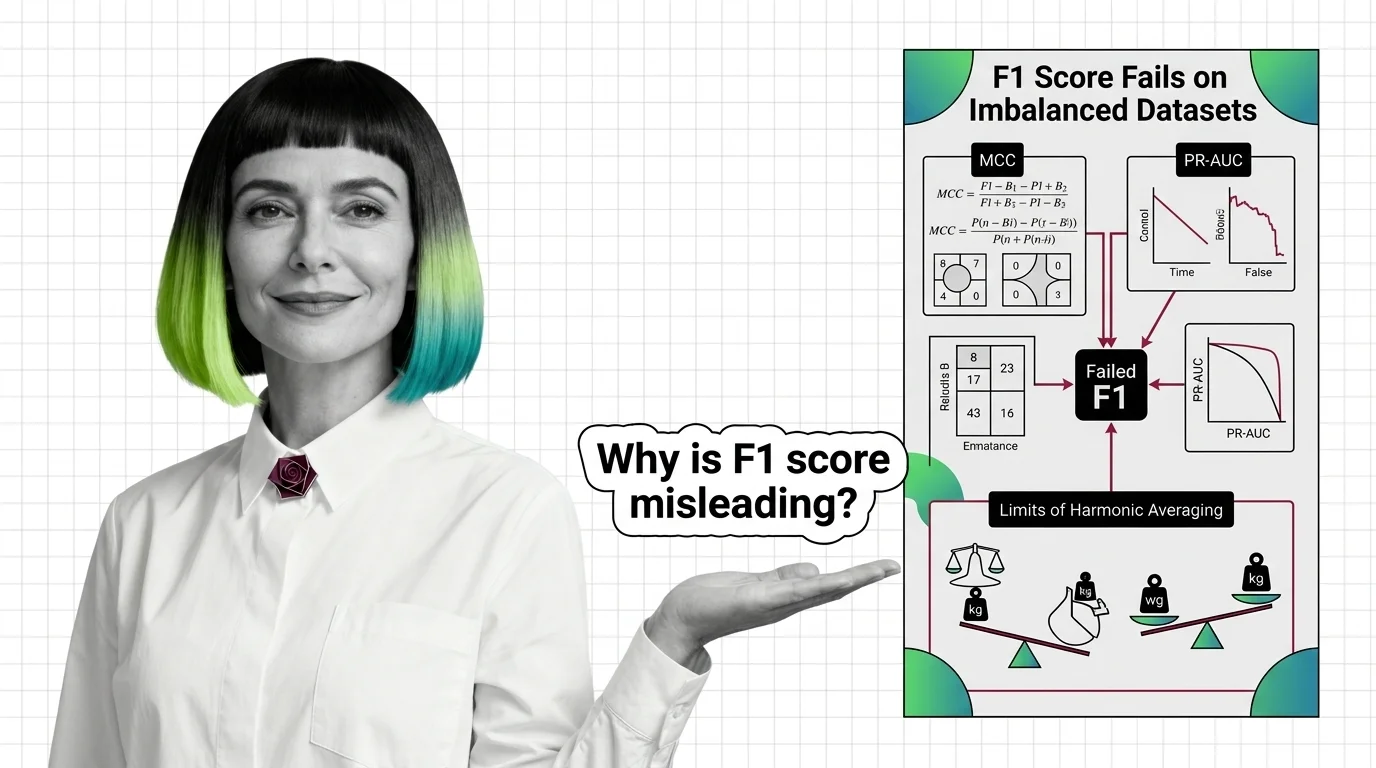
F1 score hides classifier failures on imbalanced datasets by ignoring true negatives. Learn why MCC and PR-AUC reveal problems that harmonic averaging conceals.
The practical guides cover choosing between precision and recall for your use case, calculating F1 variants in code, and tuning classification thresholds to match real-world trade-offs.
Tools & techniques
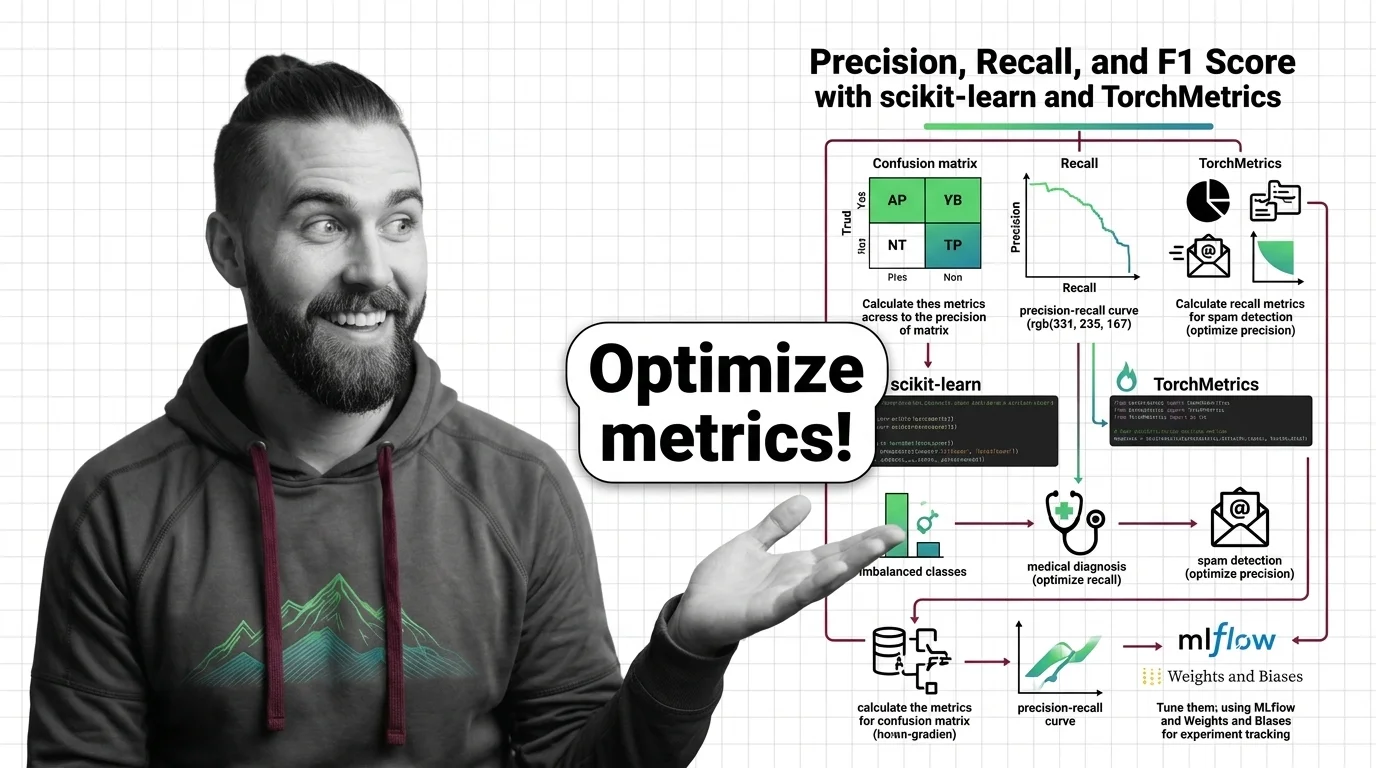
Specify precision, recall, and F1 score evaluation in scikit-learn 1.8 and TorchMetrics 1.9. A framework to prevent metric blind spots before production.
Classification metrics evolve as models face harder tasks and messier data. Tracking how the field handles imbalanced datasets and multi-class scoring keeps your evaluation strategy ahead of the curve.
Models & benchmarks
Updated March 2026
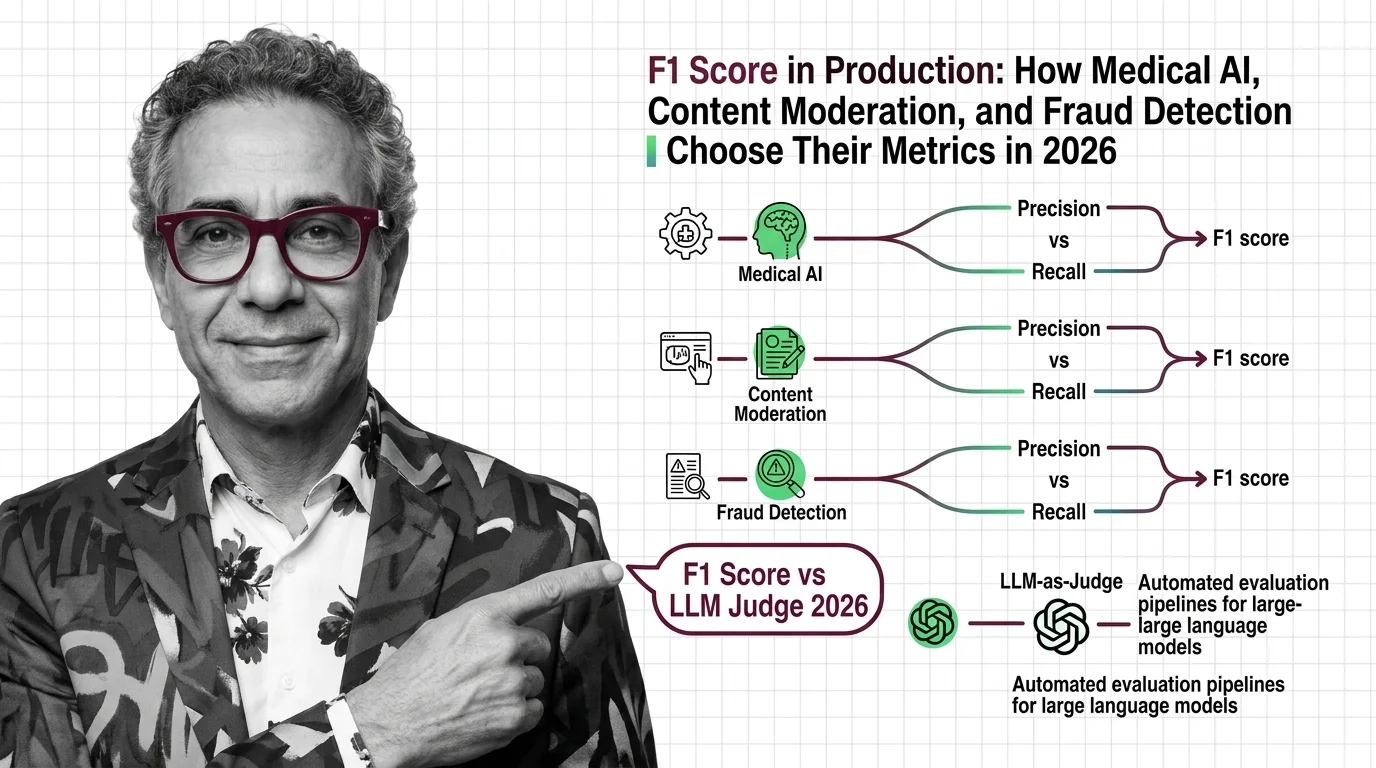
F1 score is no longer the default in production. Medical AI, fraud detection, and content moderation each prioritize different metrics in 2026.
Optimizing for F1 score without examining subgroup performance can hide bias and cause real harm. These articles explore what goes wrong when a single aggregate number drives high-stakes decisions.
Risks & metrics
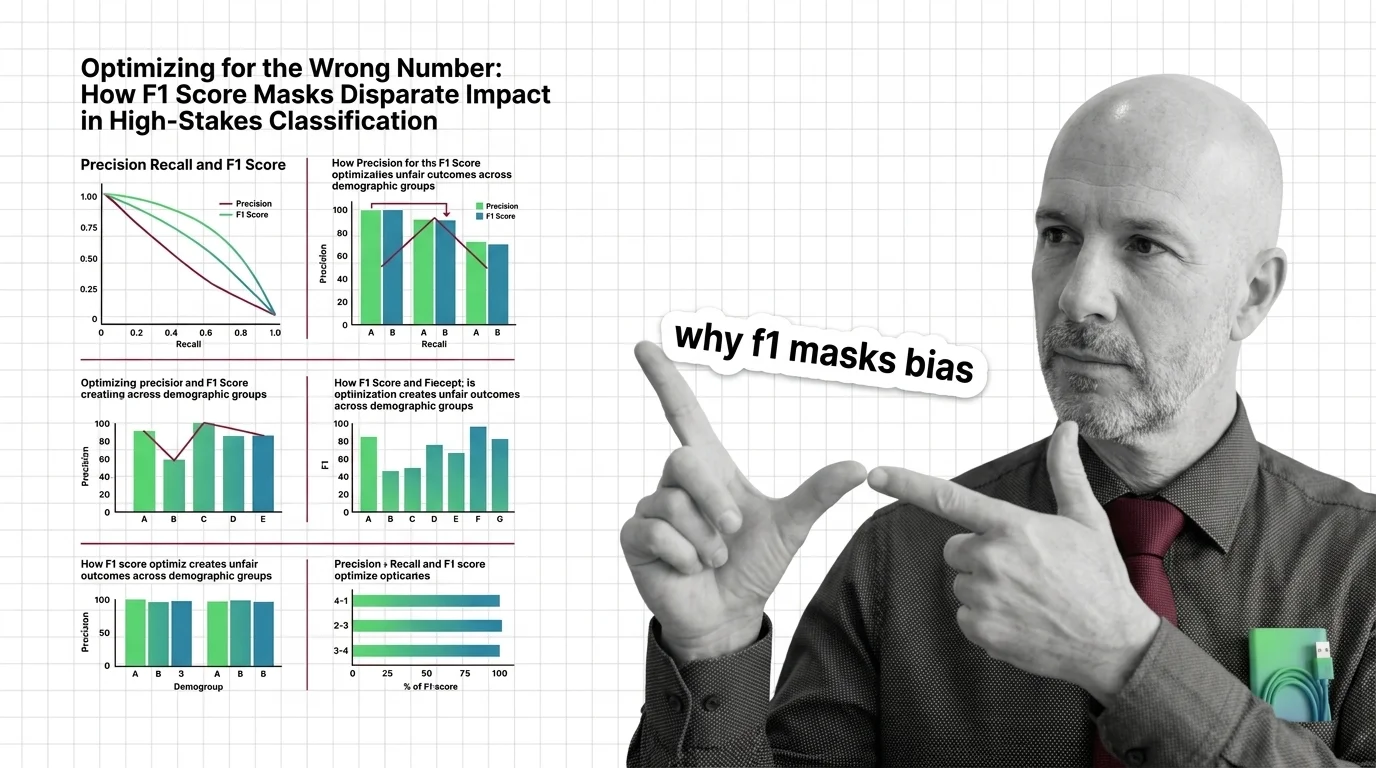
F1 score can mask racial and gender bias in hiring and criminal justice. Learn why aggregate metrics fail fairness and what disaggregated evaluation reveals.