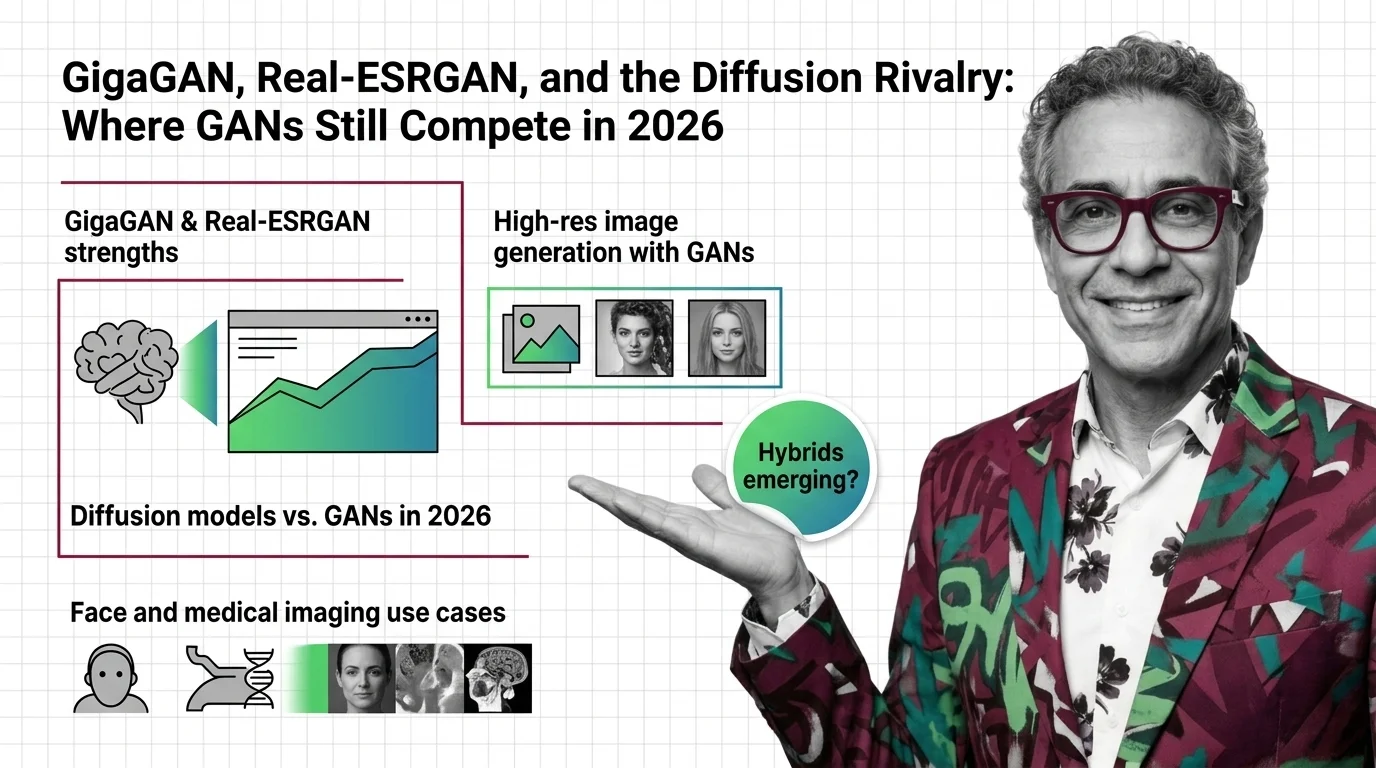
Every real-time upscaler running in a production video pipeline, every synthetic dataset built to replace data nobody could collect, and most of the “AI-generated face” coverage before 2022 trace back to this architecture — one of two generative directions inside the neural network architectures theme, and the one that traded training stability for output sharpness. Diffusion models have since taken over the general image-quality conversation, so the live question in 2026 is not whether generative adversarial networks still work, but where their one-forward-pass speed still beats diffusion’s dozens of denoising steps. This topic reads best in the order the field learned it: architecture first, failure modes second, build third, then the current state of that rivalry.
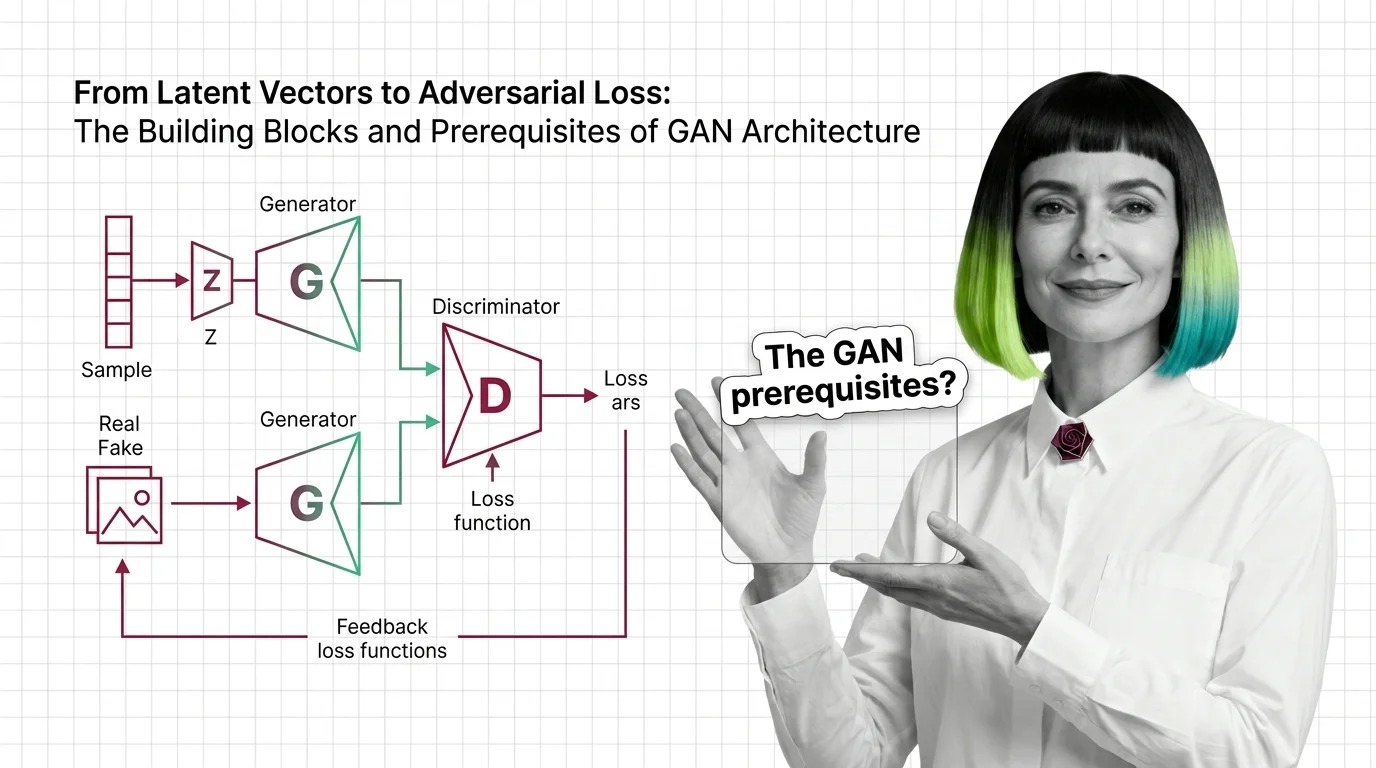
A GAN’s real specification surface has four separable parts — generator, discriminator, training loop, data pipeline — and most “my GAN won’t converge” bugs trace to treating them as one.
GANs ceded the general image-quality race to diffusion models, but still win wherever latency decides: real-time video, medical imaging, and production upscaling run one forward pass instead of dozens of denoising steps.
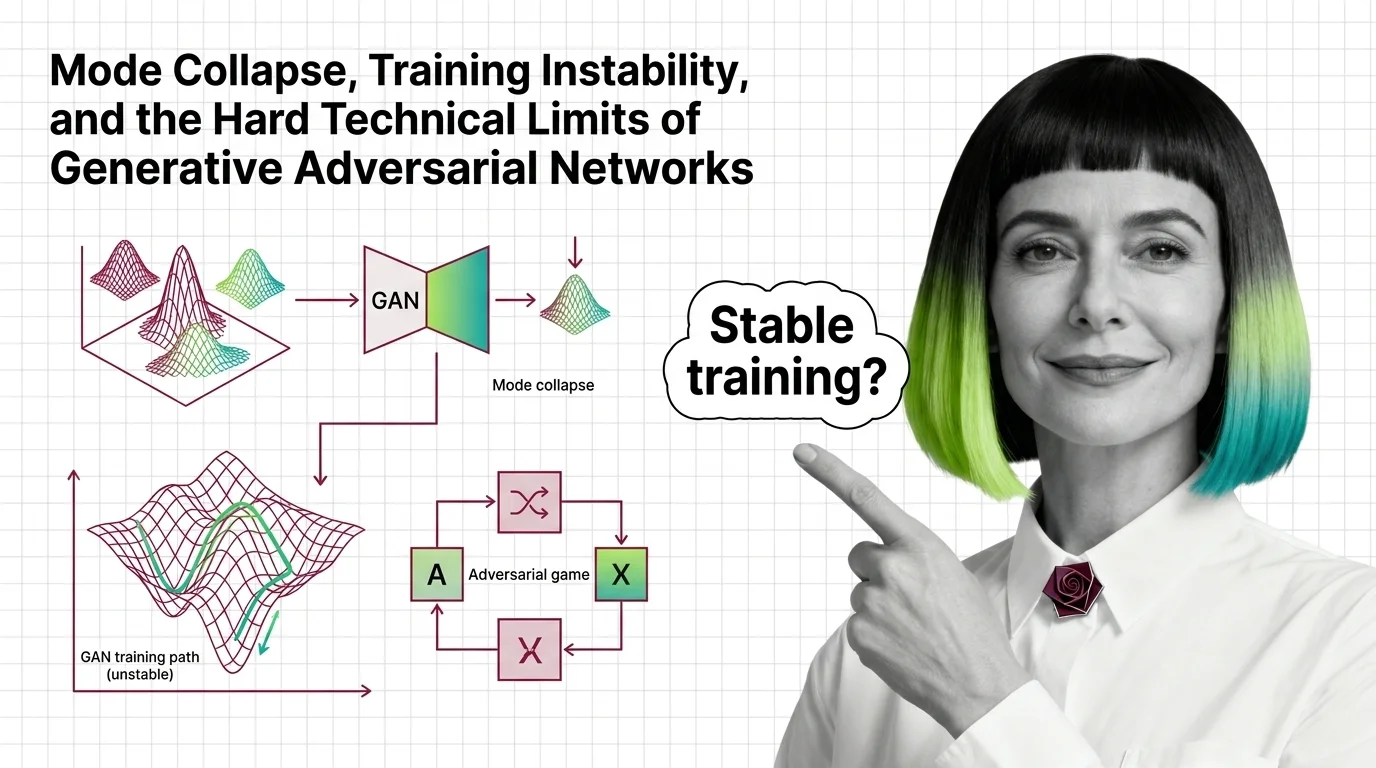
Mode collapse and training instability are not implementation bugs you eventually squash — they are structural properties of the adversarial objective, with mitigations but no full fix.
Hybrid Diffusion-GAN architectures are already blurring the rivalry, pointing toward convergence rather than a clean winner.
The GAN reading path: architecture first, market last
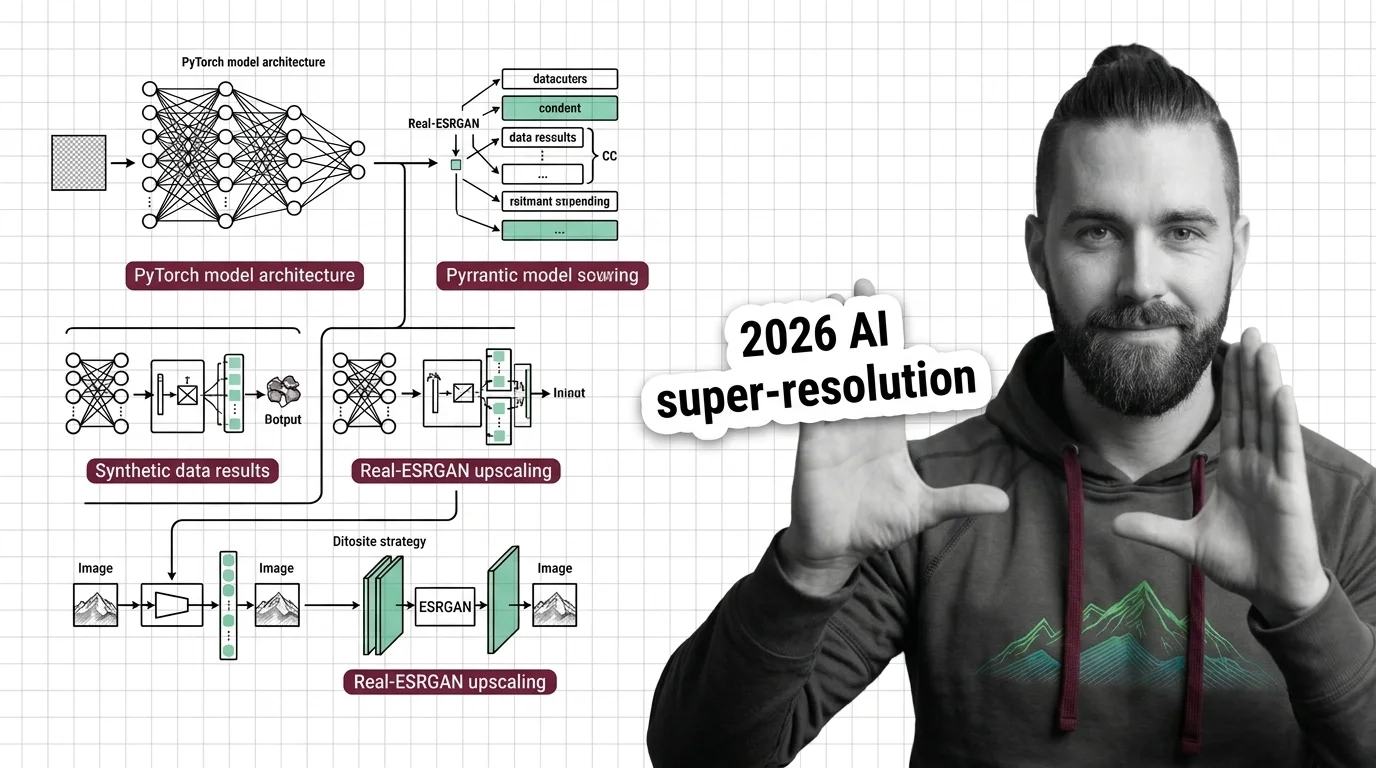
When you are ready to build, the PyTorch guide to super-resolution and synthetic data turns the architecture into a working training loop, with the learning-rate and dimension specifics that prevent the instability the previous read warned about. Close with where GANs still compete against diffusion in 2026 to check whether your use case sits in one of the latency-bound niches this architecture still wins, or in the territory diffusion has already taken.
The GAN-vs-diffusion question is really a latency budget question.
How GANs differ from diffusion models and their own CNN backbone
Two neighbours get folded into this topic that are not actually part of it.
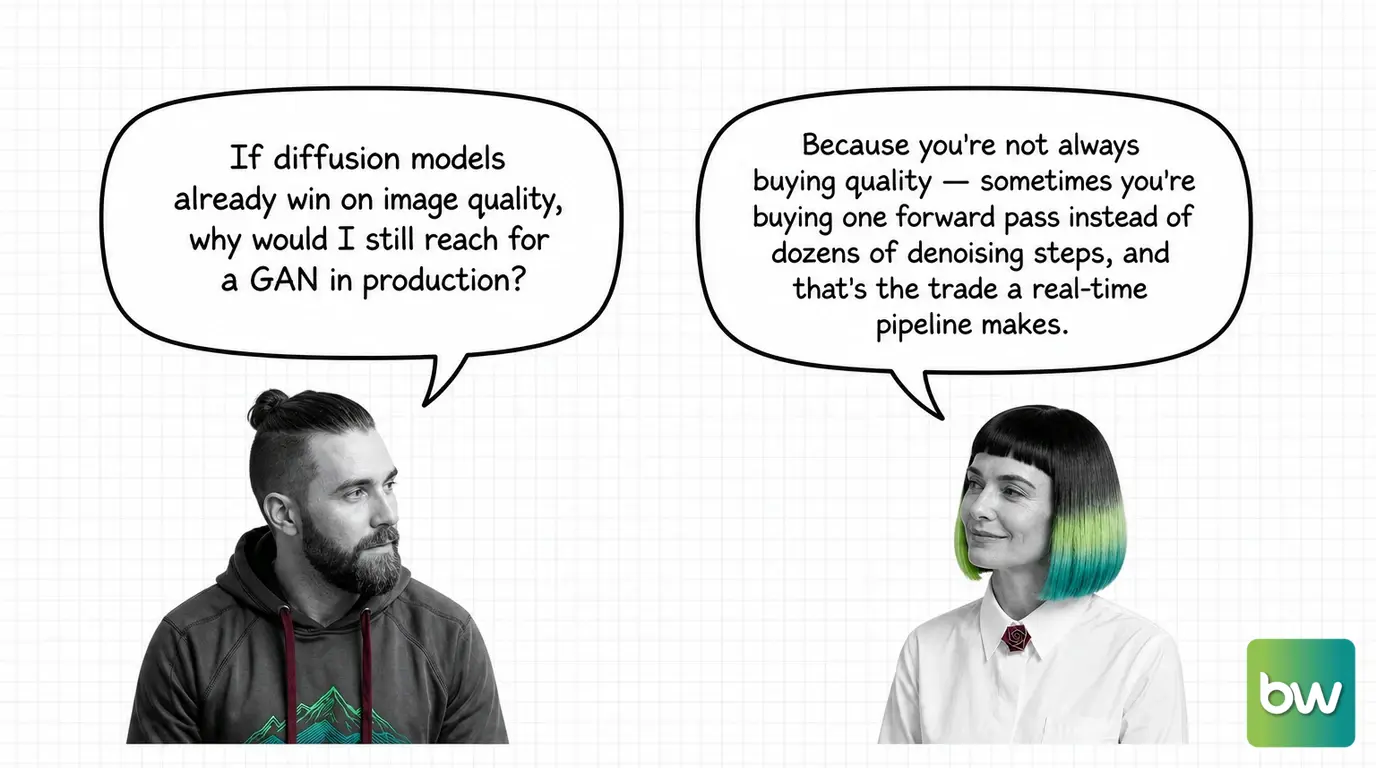
A GAN is not a diffusion model wearing a different name. Both generate images, but a GAN produces one in a single forward pass through the generator, trained by a discriminator that never runs at inference time; a diffusion model runs a denoising network dozens of times per image, at inference too. That single-pass property is the entire reason GANs still ship in latency-bound production — not because the underlying image quality wins.
A GAN is a training paradigm, not a network architecture. Its generator and discriminator are usually built from convolutional layers, which is why the two get conflated — but the adversarial objective, two networks competing on one fooled-or-not verdict, can wrap almost any backbone. Swapping the CNN backbone for something else does not stop it being a GAN; changing the adversarial training loop does.
Common questions about GANs
Q: Should I train a GAN from scratch or fine-tune a model like Real-ESRGAN?
A: Training from scratch only pays off when your data or output domain genuinely differs from what pretrained models already cover — the PyTorch build guide covers Real-ESRGAN, which already solves general-purpose super-resolution well. Reserve from-scratch training for synthetic data generation or domain-specific outputs no checkpoint covers.
Q: Is a GAN still worth building in 2026, or should I default to a diffusion model?
A: Default to diffusion for general image quality — it has won that race. Reach for a GAN when you need real-time or single-pass generation, which is exactly where GANs still compete: live video, medical imaging, and production upscaling under latency budgets diffusion cannot meet.
Q: My discriminator accuracy jumped to 100% almost immediately — is my GAN broken?
A: It is failing, not broken in the code sense. A discriminator that wins outright stops sending the generator a useful gradient, which is one face of mode collapse and training instability — a structural risk in the adversarial objective itself, not a bug in your script.
Q: Do I need to understand variational autoencoders before learning GANs?
A: No — GANs and VAEs are independent generative approaches built on different math, and the GAN building-blocks article assumes only general deep-learning prerequisites. Understanding both matters once you’re actively comparing which architecture fits a project.
Generative adversarial networks introduced a fundamentally different training paradigm — two networks locked in competition rather than cooperating toward a shared objective. Understanding this adversarial dynamic reveals why GANs produce such sharp, realistic outputs.
Understand GAN architecture from the ground up: generator, discriminator, latent space, and the adversarial loss that ties them together. Prerequisites included.
Mode collapse and training instability aren't GAN bugs — they're structural limits of adversarial training. Learn the mechanisms and the diffusion trade-off.
2
Build with Generative Adversarial Network
These guides walk through building and training GANs for practical tasks like super-resolution and synthetic data generation, covering the architectural decisions and training pitfalls you will actually encounter.
Build a GAN in PyTorch by decomposing the architecture into generator, discriminator, and training loop specs. Covers Real-ESRGAN super-resolution and CTGAN synthetic data.
3
What's Changing in 2026
The generative landscape is shifting fast as diffusion models challenge GAN dominance, but adversarial architectures continue to carve out niches where speed and output sharpness matter most.
GANs aren't dead — they're specializing. GigaGAN, Real-ESRGAN, and R3GAN prove adversarial networks still dominate speed-critical AI pipelines in 2026.