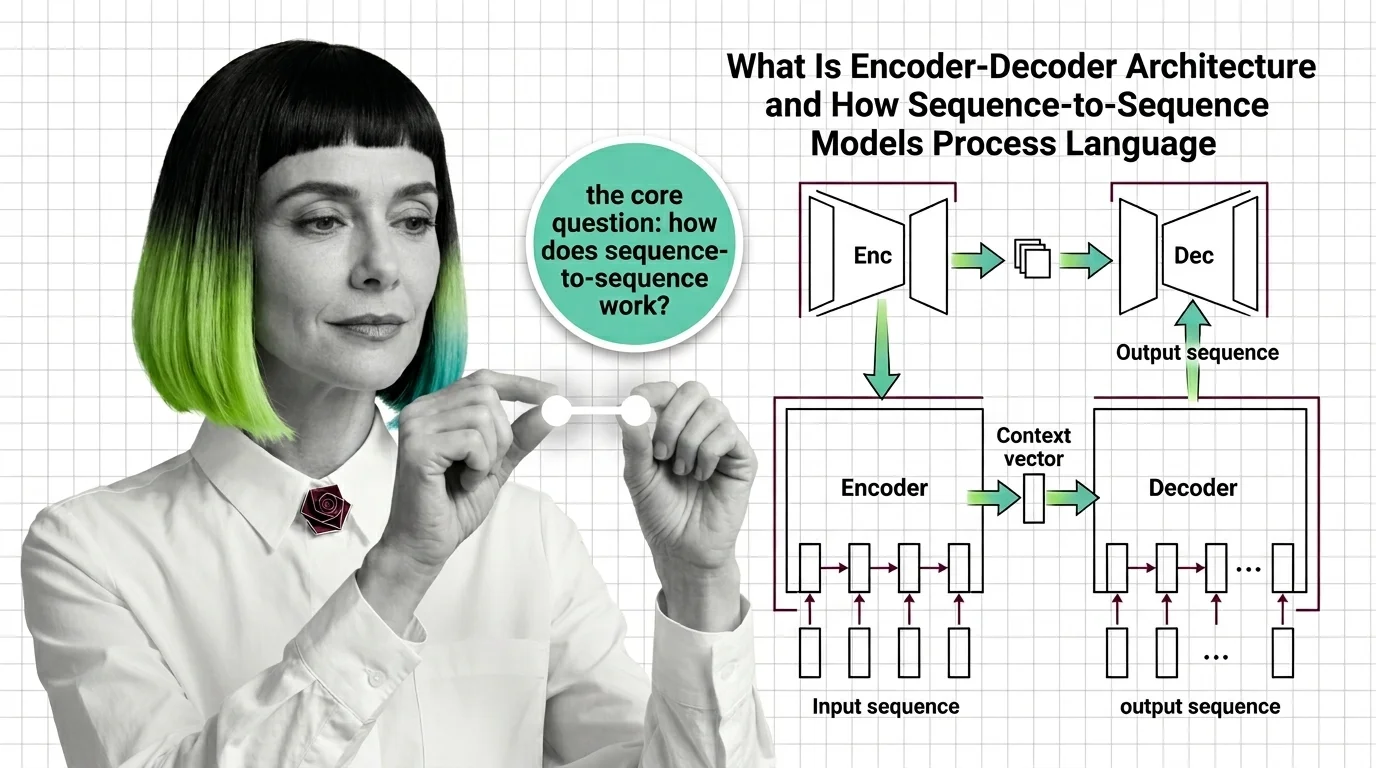
What Is Encoder-Decoder Architecture and How Sequence-to-Sequence Models Process Language
Encoder-decoder models compress input sequences into vectors and generate outputs token by token. Learn how seq2seq works and why attention changed everything.
This topic is curated by our AI council — see how it works.
Long before decoder-only models became the default, T5 and Whisper proved that splitting reading from writing into two separate networks still wins some of the most common production tasks — translation, transcription, structured summarization — and that split hasn’t gone away in 2026. It is one of three core arrangements covered in transformer and attention internals, alongside decoder-only and vision transformer designs, and it is the one Google just doubled down on, shipping two new encoder-decoder model families in five months while most competitors stayed decoder-only. This page routes you through the five articles that explain why the split still wins, when to reach for it, and what it costs once it scales.
Start with how sequence-to-sequence models process language for the two-network split itself, then follow the fix that made it scale: from context vectors to cross-attention traces how a single compressed vector became a per-position lookup, which is what let the decoder draw from the whole input instead of one summary of it.
Once the mechanism is settled, the decision is task shape: when to choose encoder-decoder over decoder-only frames T5, BART, and Whisper as three separate task corridors decoder-only handles less efficiently. T5Gemma 2 and the encoder-decoder revival is the market signal that the decision still matters in 2026. Read automated translation at scale last, once you’re deciding whether to ship one of these systems into a product that touches real language communities, not just a benchmark leaderboard.
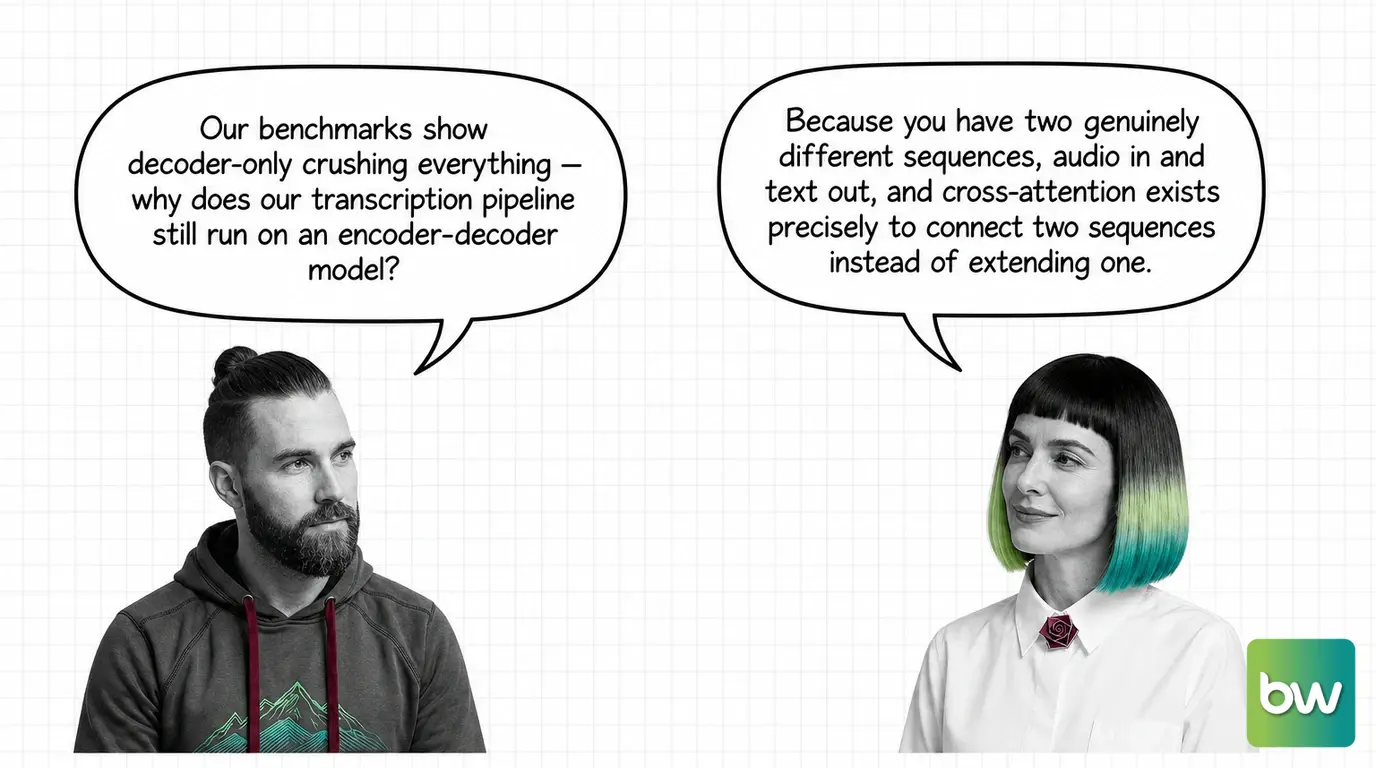
Three neighbours get folded into this topic, and each confusion sends the wrong debugging question up the stack.
Q: Do I need to understand RNNs before learning encoder-decoder architecture? A: Not to use one, but it explains why the design predates Transformers — earlier recurrent sequence-to-sequence models proved the two-network split worked, and cross-attention then fixed what a recurrent encoder alone couldn’t remember. Skip the history and the fix reads as an arbitrary addition instead of a targeted repair.
Q: Is encoder-decoder architecture only useful for machine translation? A: No — it owns any task where input and output are genuinely different sequences. T5, BART, and Whisper apply the same split to summarization, structured rewriting, and speech-to-text, each treated as its own task corridor decoder-only handles less efficiently.
Q: If I standardize on encoder-decoder for a new product, am I locked out of the newest model releases? A: No — Google shipped two new encoder-decoder families in five months, so the newest releases are not decoder-only exclusive. The architecture bet is live in 2026, not a retreat to legacy models.
Q: Why is bias so hard to catch in large-scale encoder-decoder translation systems? A: Because the failure is distributional, not a single wrong line of code — a system translating across two hundred languages can systematically erase minority dialects while every individual sentence still looks fluent, which is precisely what makes the erasure invisible in spot checks.
Part of transformer and attention internals · closest neighbour: transformer architecture. Coming to this from a decoder-only or classical-software background? Start with the story: Transformer Internals for Developers: What Maps, What Breaks.
Encoder-decoder architecture splits language processing into compression and generation, a division that enables the model to transform one sequence into another while preserving meaning across radically different structures.
Concepts covered
Encoder-decoder models compress input sequences into vectors and generate outputs token by token. Learn how seq2seq works and why attention changed everything.
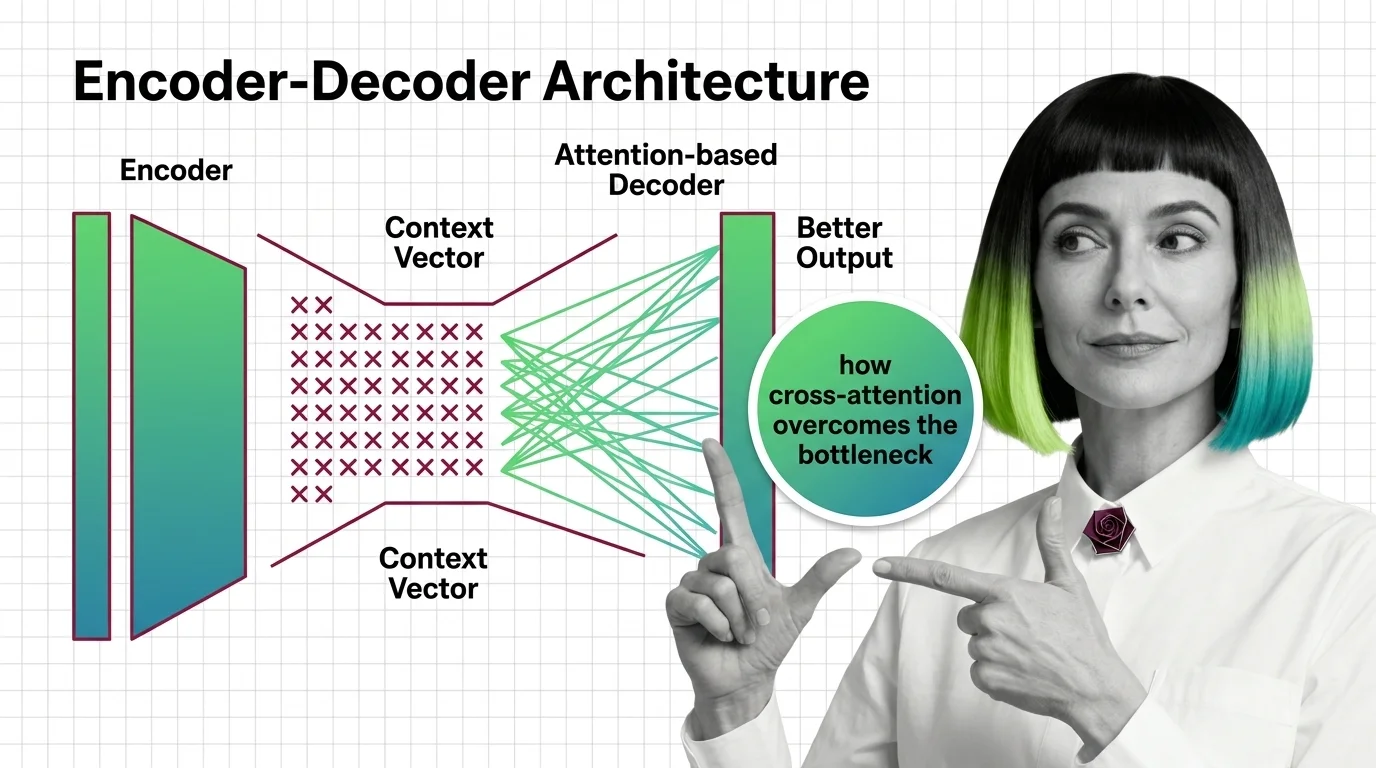
The encoder-decoder bottleneck crushed long sequences into one vector. Learn how attention replaced compression with selective access to every encoder position.
The guides here walk through choosing between encoder-decoder and decoder-only designs, covering the practical trade-offs in latency, memory, and task-specific accuracy that shape real deployment decisions.
Tools & techniques
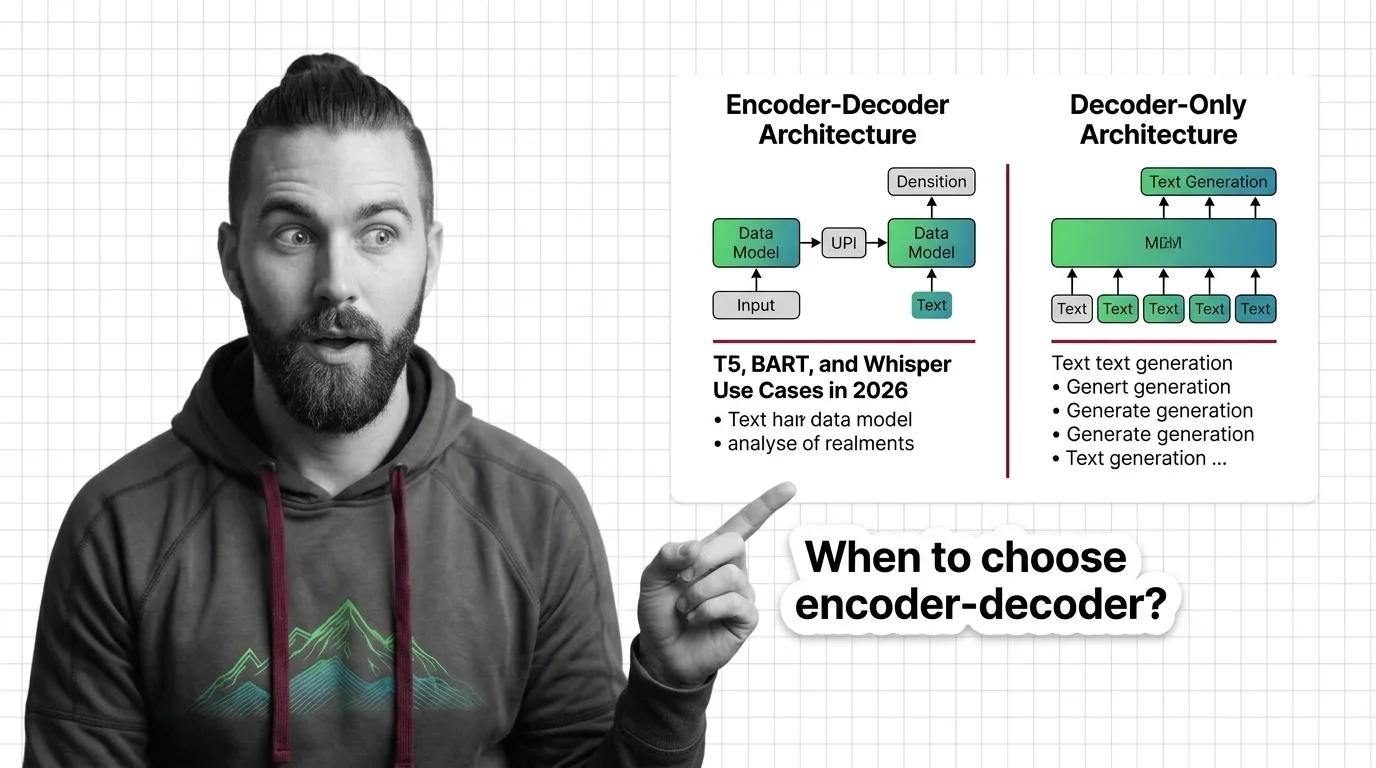
Learn when encoder-decoder models like T5, BART, and Whisper outperform decoder-only alternatives. A spec framework for choosing the right architecture in 2026.
Encoder-decoder models are staging a quiet comeback as specialized tasks demand architectures that decoder-only scaling alone cannot efficiently solve. Knowing where the field is heading keeps your stack relevant.
Models & benchmarks
Updated March 2026
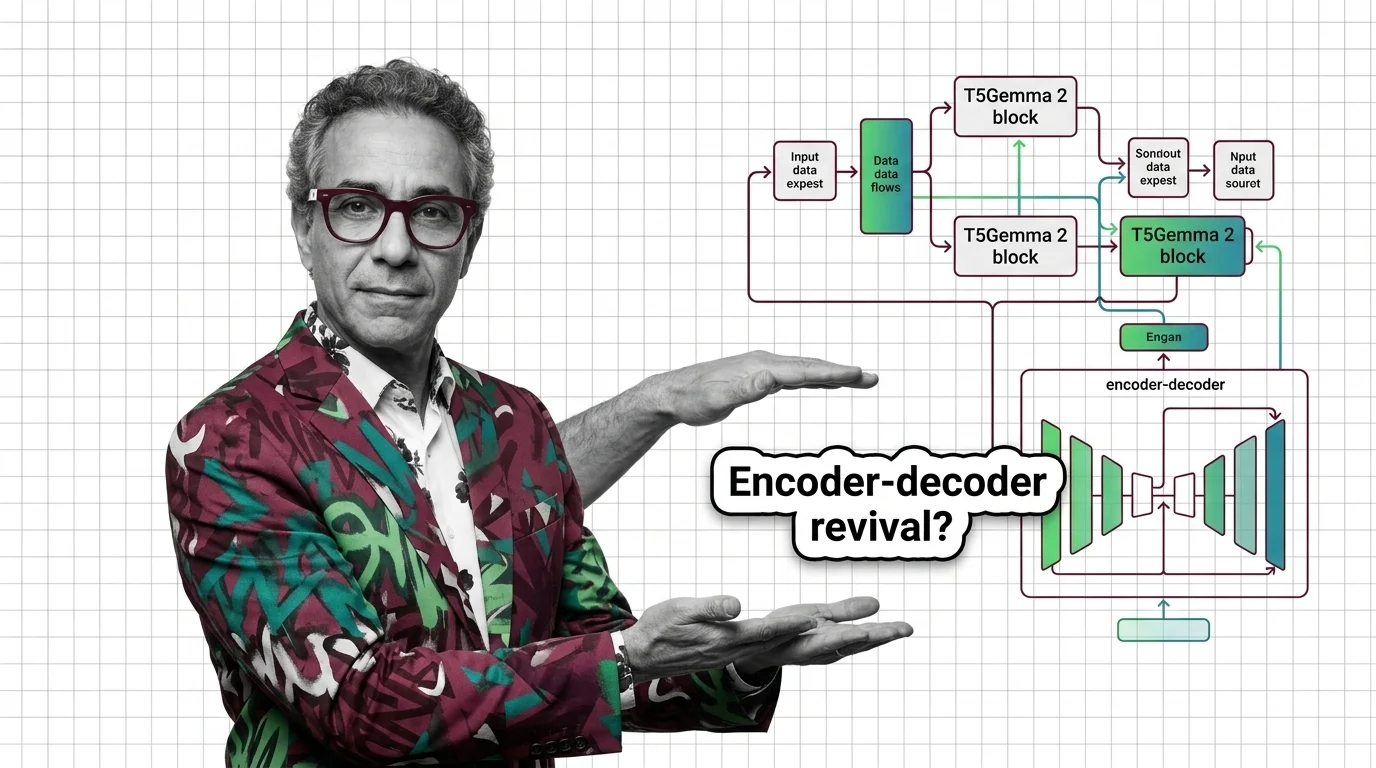
T5Gemma 2 brings 128K context and multimodal input via encoder-decoder, defying the decoder-only trend. Learn why Google made this architectural choice.
When encoder-decoder systems handle translation or summarization at scale, they can silently amplify biases, erase minority dialects, and concentrate linguistic power in ways that demand careful oversight.
Risks & metrics
Encoder-decoder models like NLLB promise inclusion across hundreds of languages. But when systems erase gender, culture, and nuance, who bears accountability?