What Is ELO Rating for LLMs and How Pairwise Human Votes Rank Language Models
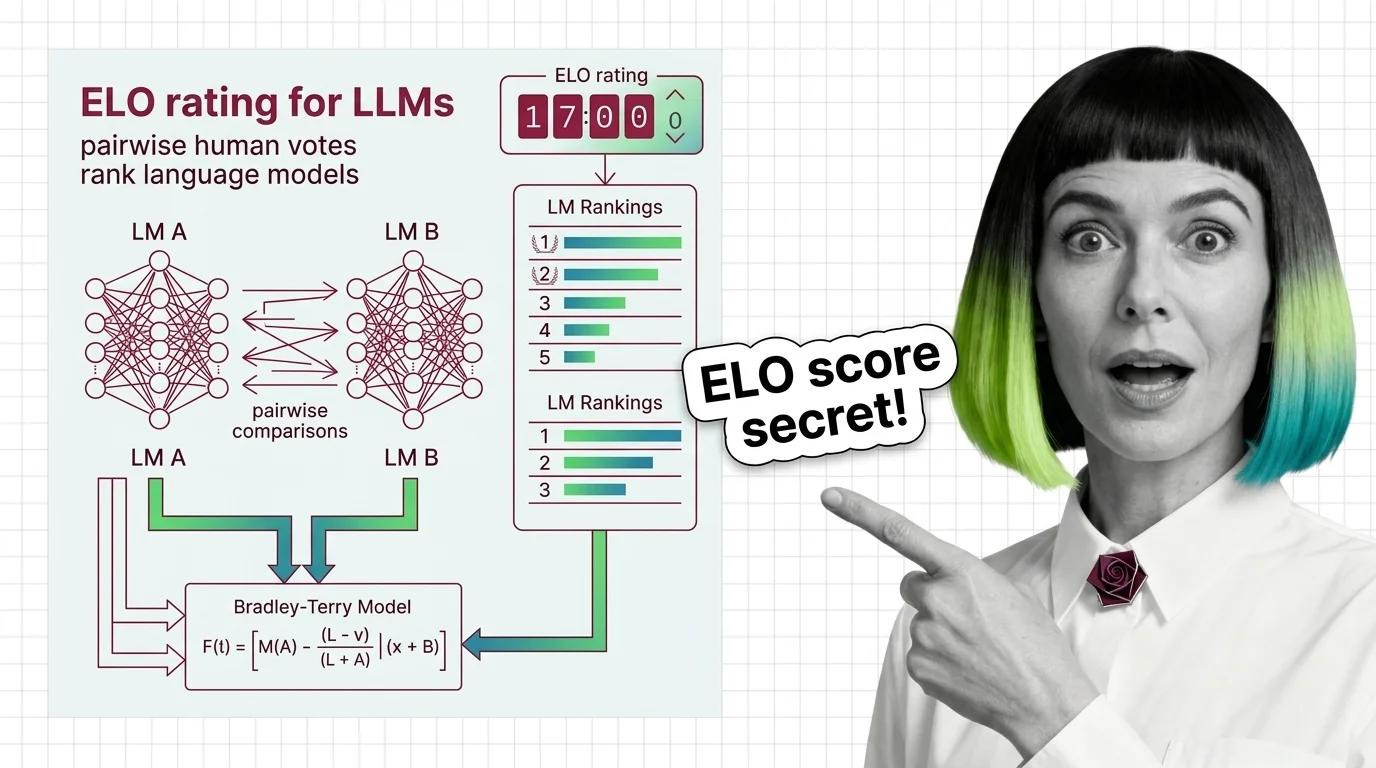
ELO rating for LLMs ranks models by blind pairwise votes. Arena.ai's Bradley-Terry model converts comparisons into scores; 7M+ votes cover 368 models.
Most AI benchmarks measure a model on questions with correct answers — math, coding, factual recall. But conversation quality doesn’t have a single right answer. Asking judges to rate responses on a 1-10 scale introduces inconsistency: people calibrate scales differently, and ratings shift based on what they read immediately before. ELO rating solves this by replacing scales with choices. Two model responses to the same prompt are placed side-by-side, and the judge picks the better one. Pairwise preference produces more consistent judgments than absolute scoring. Run enough comparisons across many judges and prompt types, and the accumulated votes build a reliable ranking that reflects genuine human preference.
The ELO system was developed in the 1950s by chess statistician Arpad Elo as a way to rank players based on match outcomes. The core insight: a player’s score should reflect not just how often they win, but who they beat. Defeat a much stronger opponent and your score jumps significantly. Beat a weaker opponent as expected and your score barely moves. Lose to a much weaker opponent and you drop sharply. The formula calculates the expected probability of each outcome before the match and adjusts scores proportionally based on what actually happened.
For language models, each “match” is a prompt sent to two different models simultaneously. A human judge reads both responses without knowing which model produced which — blind evaluation prevents brand familiarity from influencing the vote. The model that wins gets a score boost proportional to how unlikely that win was. Upset a much higher-rated model and the score jumps. Beat a lower-rated model as expected and the gain is small. The losing model’s score falls by the same logic. Thousands of comparisons across diverse judges and prompts produce a stable ranking.
This mathematical structure is exactly what Chatbot Arena uses: real users interact with two anonymous models simultaneously and vote on the better response. The blind, simultaneous format reduces the chance that name recognition influences the choice. For pairwise human evaluation of language models in the context of ranking them by real user preference, ELO provides the backbone that translates individual votes into a leaderboard.
AI teams track Chatbot Arena ELO scores to benchmark their models against competitors without running their own expensive human evaluation studies. After releasing a new model version, the ELO score shift immediately signals whether real users prefer it — or whether the update made no noticeable difference in head-to-head comparisons.
Product managers evaluating which model to integrate into a product cross-reference ELO rankings with task-specific benchmarks. A model might rank higher on coding correctness benchmarks but lower on Chatbot Arena ELO, meaning it produces more accurate code but less satisfying general responses. ELO scores help calibrate that trade-off by showing what real users chose in direct comparisons across open-ended chat.
ELO scores are relative to the current pool of models in the arena. A model’s raw score shows where it ranks against today’s competition — not some absolute quality level. As new, stronger models enter the arena, the same score represents a weaker relative position. Track rank and trend over time, not the raw number.
Start with how pairwise human votes rank language models — it covers the mechanism the rest of this topic assumes: two anonymous models answer the same prompt, a human picks the better response, and the Bradley-Terry algorithm folds thousands of those votes into one number. Read the chess Elo, blind voting, and confidence-interval prerequisites next — it explains why a five-way tie at the top of the board is the honest answer, not a bug in the math. The leaderboard illusion is required reading before trusting any single rank: it documents the style bias and vote injection that separate a popular answer from a correct one.
Once the mechanics and failure modes are clear, the guide to reading the Chatbot Arena leaderboard turns that into a checklist — filter by task category, check the confidence interval before trusting a rank, and run the same Bradley-Terry methodology on your own pairwise data with the open-source arena-rank package. For the current state of the board, Claude Fable 5’s brief 2026 arena lead shows what a top rank is actually worth when the next several models sit inside statistical noise of it. Close with the ethics of ranking LLMs by human preference — a useful check before treating any arena number as a verdict on which model is smarter.
Three confusions send debugging or decision-making in the wrong direction.
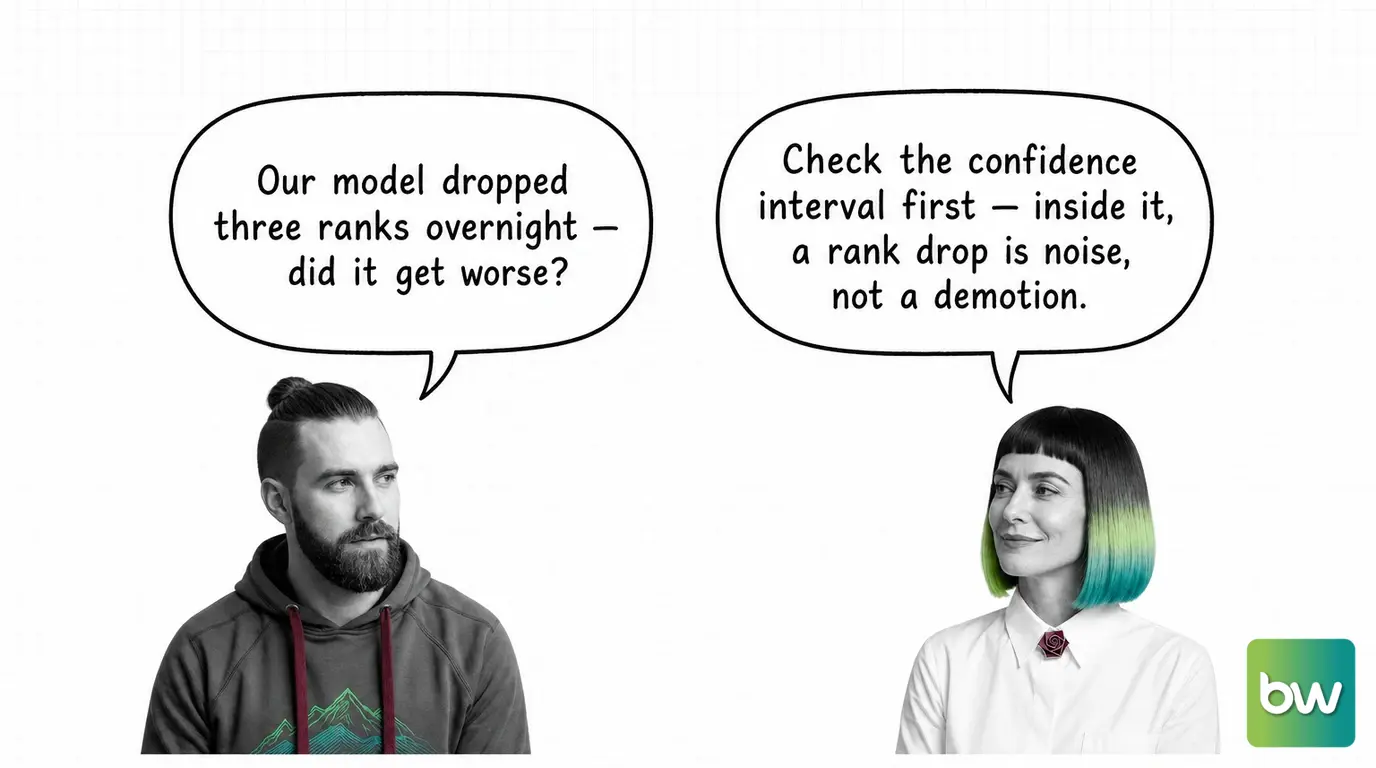
The name still says “Elo,” but Chatbot Arena runs on Bradley-Terry ratings with confidence intervals — a different model from Arpad Elo’s original deterministic chess formula, and one built specifically to say when two scores are not really different. Treating an arena number like a classic chess rating is how teams end up arguing over a rank change the confidence interval already flags as noise.
LLM-as-a-Judge also produces a single quality score for open-ended output, but the mechanism runs the opposite direction from Arena’s: one model grades another against a written rubric, at machine speed and volume, instead of anonymous humans voting in blind pairs. Arena tells you what people preferred to read; a judge model tells you how well an output matched a spec — useful together, not interchangeable.
SWE-bench asks a narrower, harder question: does the model’s patch pass a real test suite on a real GitHub issue. Arena ELO rewards the response a human liked reading in open-ended chat; SWE-bench rewards code that actually works. A model can lead one leaderboard and lag the other, so picking a coding agent by arena rank alone skips the test that matters.
| Scenario | Use | Avoid |
|---|---|---|
| Comparing models on open-ended tasks where quality is subjective (helpfulness, tone, clarity) | ✅ | |
| Evaluating models on tasks with objectively correct answers (math proofs, code unit tests) | ❌ | |
| Building a relative leaderboard across many model versions or providers over time | ✅ | |
| Estimating a model’s absolute capability without a reference comparison pool | ❌ | |
| Running internal human preference studies on your own prompt-response pairs | ✅ | |
| Small evaluation budgets with too few pairwise comparisons to produce a stable score | ❌ |
Q: Why did a model’s arena rank change even though nothing about the model itself changed? A: Usually methodology, not regression. Because top models often cluster inside overlapping confidence intervals, a rank swing between them can be statistical noise rather than a real capability shift. The confidence-interval prerequisites explain why several models tied at the top is the expected answer, not a measurement failure.
Q: Can I score my own model comparisons with the same method Chatbot Arena uses? A: Yes — Arena’s ranking runs a specific, published algorithm rather than a proprietary black box, and the open-source arena-rank package runs that same Bradley-Terry methodology on your own pairwise preference data. The arena leaderboard guide walks through the setup and the version-pinning it needs.
Q: Does topping the Arena leaderboard mean a model is objectively the best? A: Not by itself — leading the arena means human voters preferred that model’s responses in blind head-to-head comparisons, which rewards style and confidence alongside substance. Claude Fable 5 held the top rank for three days in 2026 before an export-control directive pulled it offline, while the next models sat within 7 ELO points of it. Read the full 2026 arena race.
Q: Should a model’s arena rank be treated as evidence it is more intelligent than its rivals? A: Treat it as evidence of preference, not intelligence — the leaderboard aggregates tens of millions of blind human judgments about which answer a person liked reading, a narrower claim than “which model reasons better.” The ethics of ranking LLMs by popularity traces what voting on preference quietly assumes about what intelligence means.
Part of the model evaluation stack · closest neighbour: LLM-as-a-Judge. Coming to model evaluation from a software background? Start with the story: Model Evaluation for Developers: What Maps and What Misleads.
ELO Rating for LLMs borrows a competitive ranking algorithm from chess to measure which AI responses humans prefer. The mechanics are straightforward, but what those scores actually tell us about model quality is more nuanced than the leaderboard suggests.
Concepts covered
ELO rating for LLMs ranks models by blind pairwise votes. Arena.ai's Bradley-Terry model converts comparisons into scores; 7M+ votes cover 368 models.
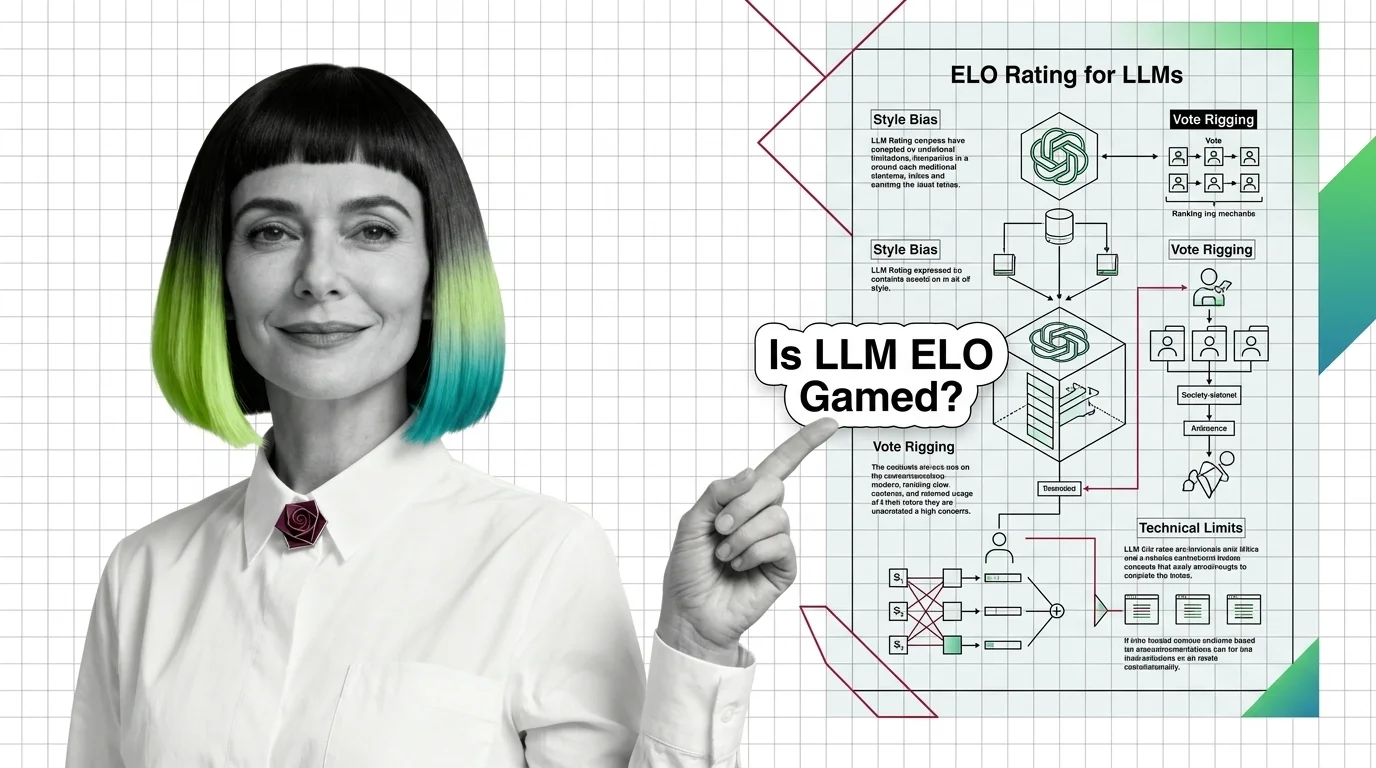
Arena ELO scores measure preference, not LLM capability. Length bias shifts rankings 5+ positions; vote injection can alter top-model standings.
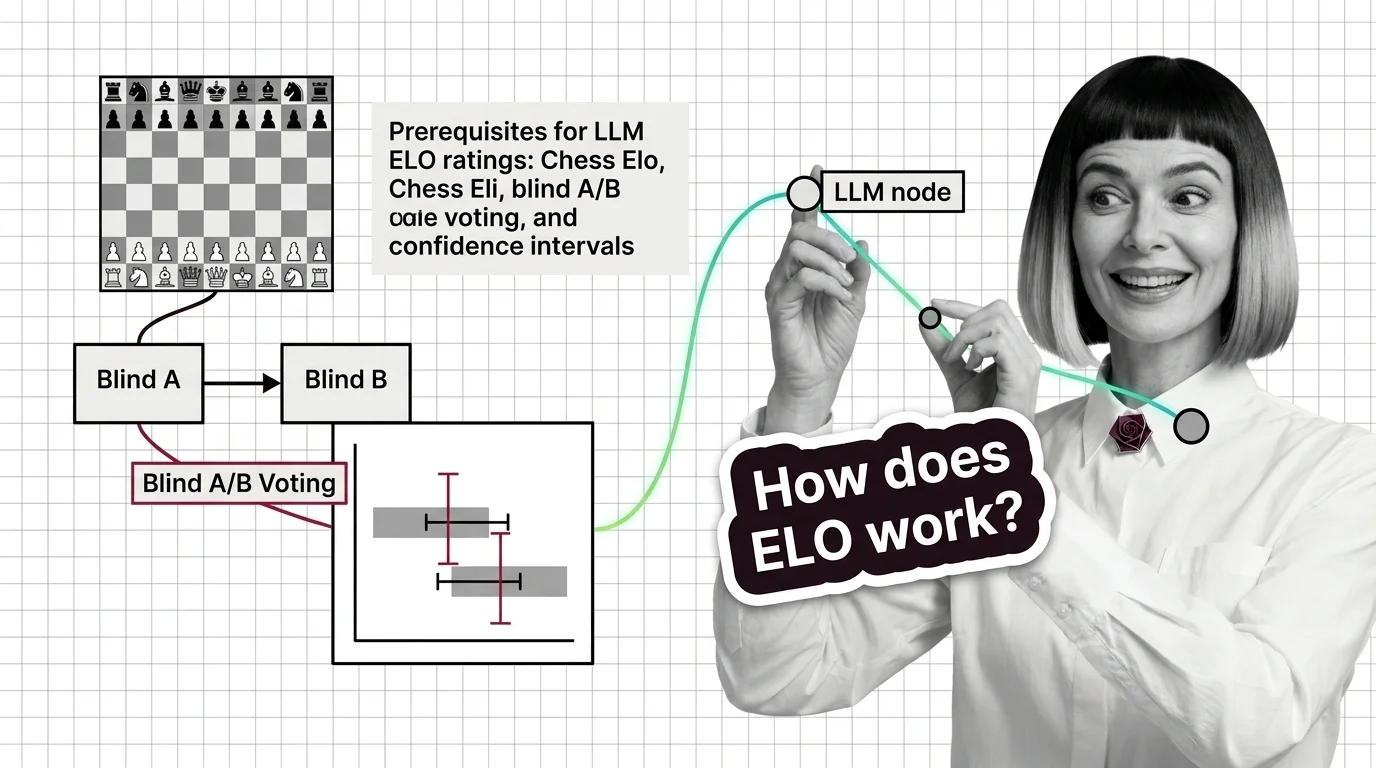
LLM Elo ratings come from blind preference votes. Arena's top models cluster within ~55 ELO points, often within overlapping confidence intervals.
The practical guides cover how to read arena leaderboard scores, interpret confidence intervals, and run your own pairwise evaluations. You will learn when ELO-based rankings are the right tool for model selection and when they mislead.
Tools & techniques
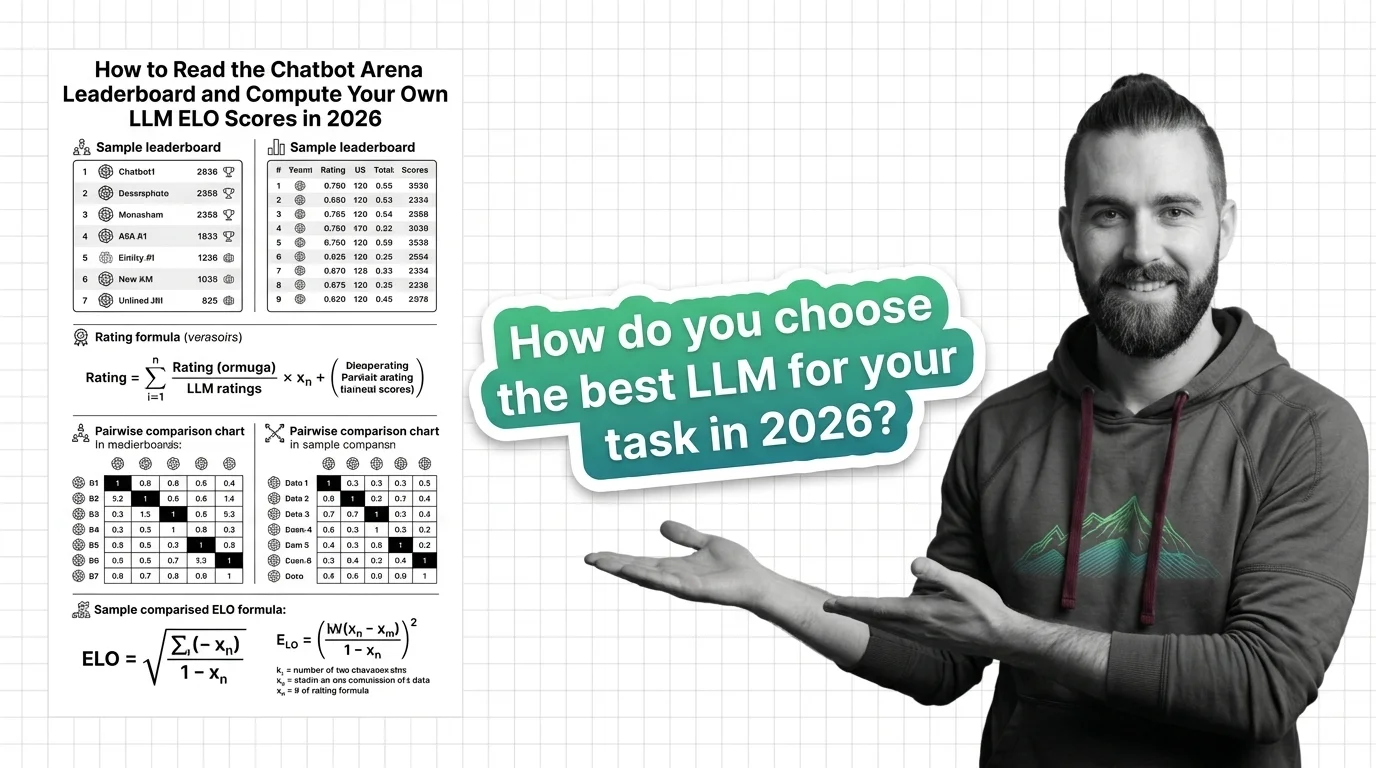
Arena uses Bradley-Terry ratings, not ELO. Top-10 models often statistically tie — use confidence intervals not ranks. arena-rank computes task-specific scores.
The ELO leaderboard shifts every time a major model ships, and those ranking changes drive real product decisions. Tracking who tops the arena and why the standings change tells you where the capability frontier is moving.
Models & benchmarks
Updated October 2026
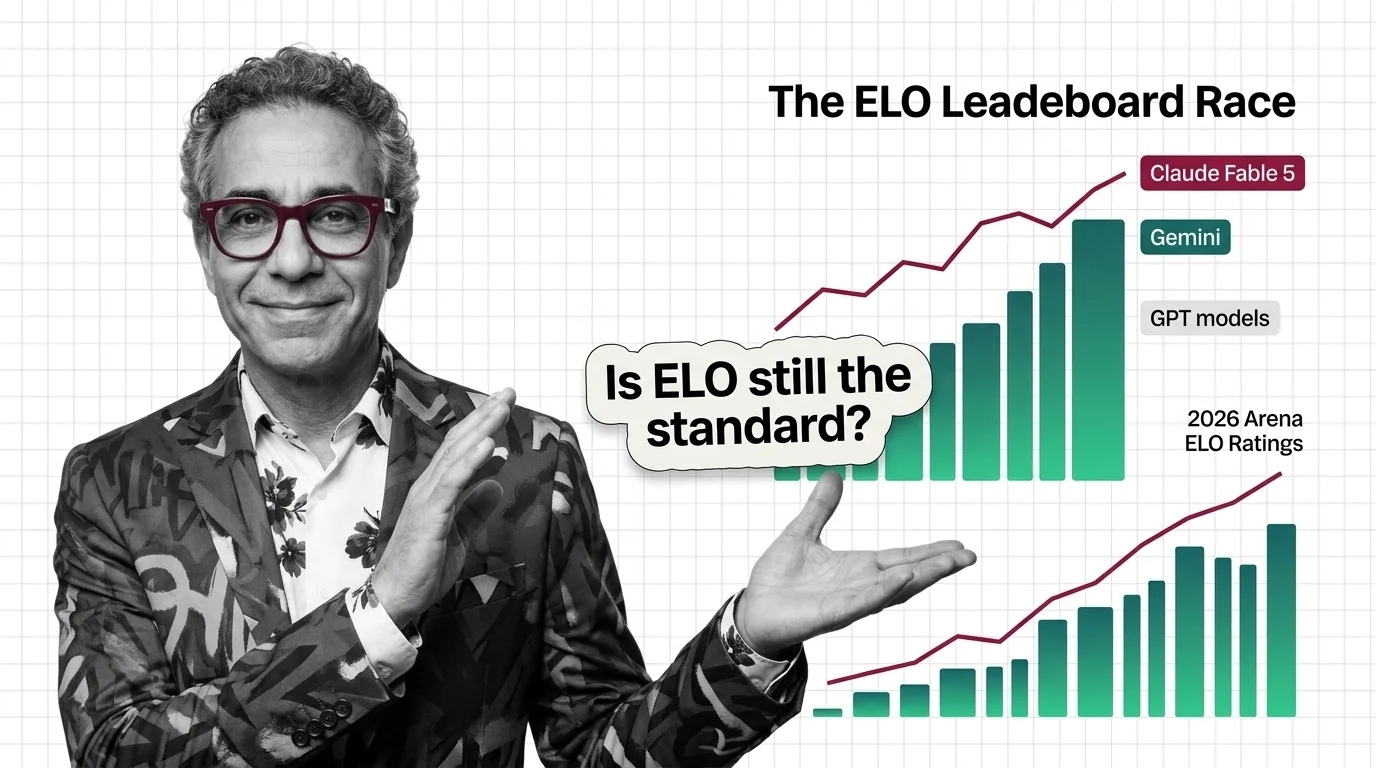
Claude Fable 5 took the top spot on arena.ai in June 2026, then went offline under US export controls. Top models are within 7 ELO points — effectively tied.
ELO scores reflect human preference, not objective capability, and humans can be biased toward verbose, confident-sounding answers. Understanding these distortions matters before using leaderboard rankings to guide high-stakes model selection.
Risks & metrics
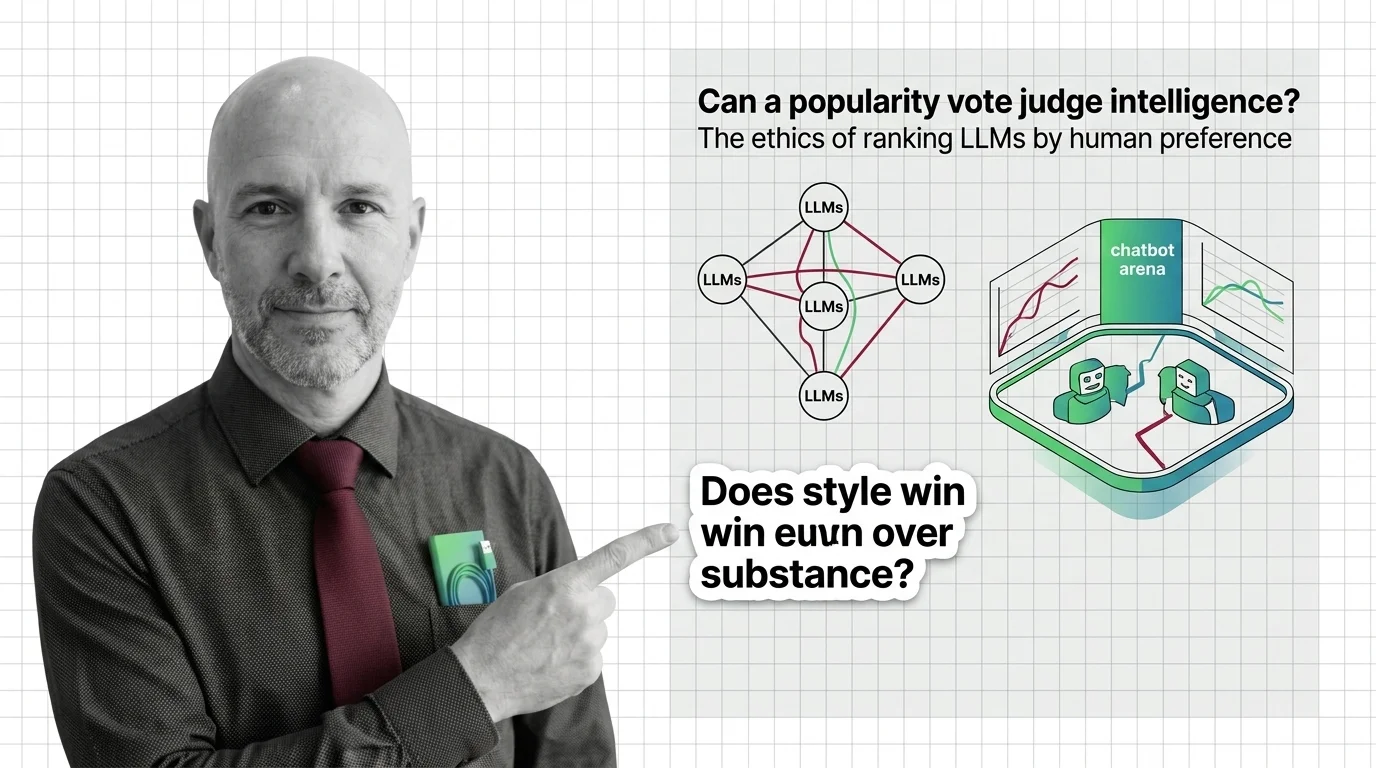
Arena's LLM rankings use millions of votes, but style bias, demographic skew, and Meta's variant gaming show popularity cannot substitute for intelligence.