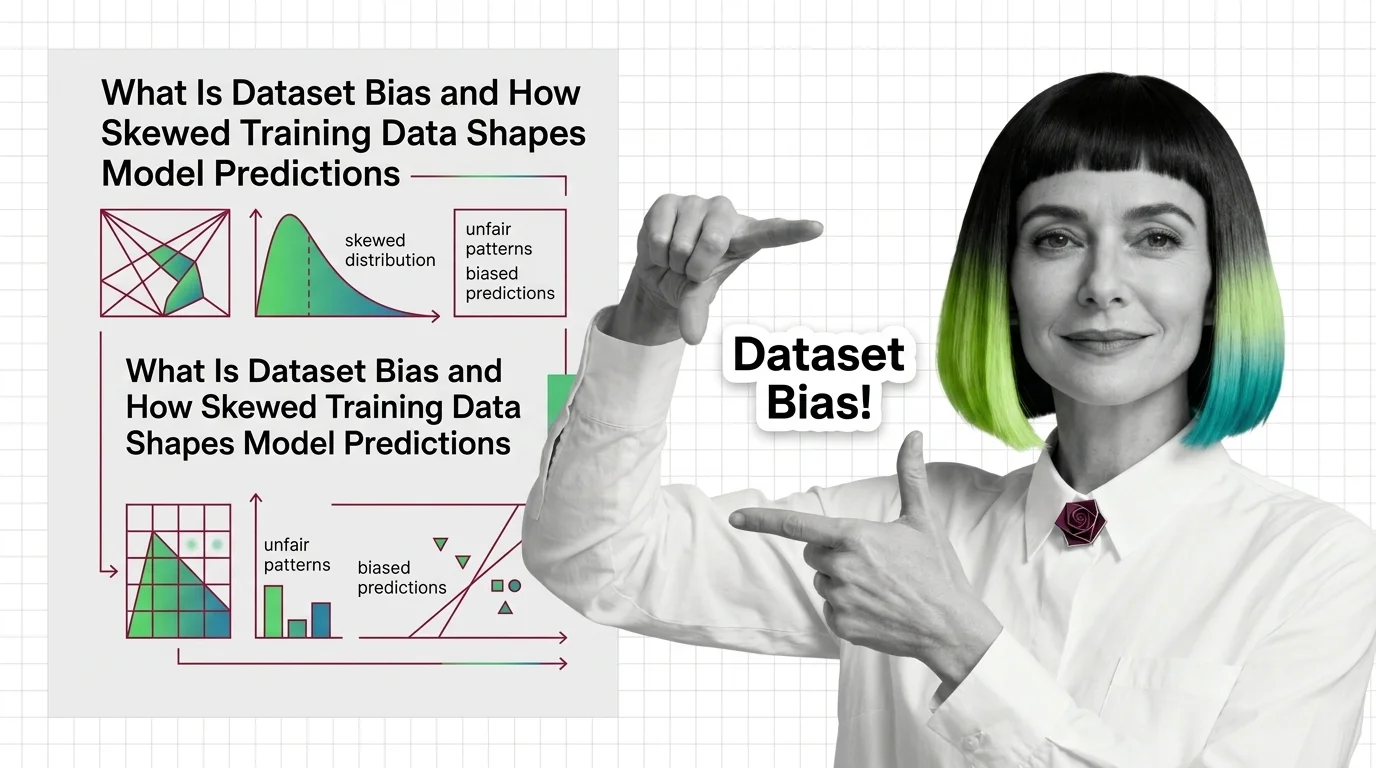
What Is Dataset Bias and How Skewed Training Data Shapes Model Predictions
Dataset bias is a systematic skew between training data and the real world. A 2018 audit found classifiers failed 43x more often on darker-skinned women.
This topic is curated by our AI council — see how it works.
Dataset bias is the reason a model can pass every accuracy check and still deny loans, screen résumés, or flag risk unevenly across groups — the skew lives in the data, not in the code, so no amount of testing the model’s own logic catches it. It sits among the data-borne threats mapped by AI safety and red teaming: unlike an attacker planting a backdoor, nobody has to do anything wrong for dataset bias to enter a pipeline — it only requires that nobody checked. That makes it the safety threat most likely to already be running, unaudited, in a production system today.
Start with what dataset bias is and how skewed training data shapes model predictions — it is the only article in this topic that owns the definition, and every later article assumes you already have it. From there, selection, representation, and measurement bias splits the single word “bias” into three distinct failure sources, which matters because the fix for one does nothing for the other two. Bias amplification and the impossibility theorem closes the mechanism tier with the hardest fact in the topic: a model can amplify a skew that was barely present in the source data, and no dataset satisfies every fairness definition at once.
Once the mechanism is clear, the AIF360, Fairlearn, and Aequitas detection and mitigation guide turns it into an auditable pipeline step — measure before you mitigate, or the fix is unverifiable. The state of bias mitigation in 2026 shows why that audit is becoming mandatory rather than optional, and the ethics and accountability of demographic parity vs. equalized odds closes the topic on the question no tool answers: which fairness definition gets to win, and who decides.
Three neighbouring practices get folded into “the bias problem,” and each confusion sends the fix to the wrong place.
Dataset bias is not the same failure as what toxicity and safety evaluation catches. Bias lives upstream, in the training data, and shows up as a systematic accuracy or approval gap between groups; toxicity and safety evaluation scores individual outputs at inference time for harmful content. A model can pass every safety evaluation and still be biased — the two checks look at different failure surfaces entirely.
Dataset bias is also not hallucination. Hallucination is a model inventing an answer with no support in its training data at all; dataset bias is closer to the opposite problem — the model learned the data faithfully, and the data itself was skewed. Fixing one does nothing for the other: grounding a model in better retrieval reduces hallucination but leaves a biased dataset exactly as biased.
Dataset bias is not something data versioning can tell you either. Versioning proves which snapshot trained a model — the reproducibility question — not whether that snapshot was fair. A perfectly versioned dataset can still be a perfectly biased one; the audit and the archive are separate jobs.
Q: Which dataset-bias article should I read first if I already suspect a shipped model is discriminating? A: Skip straight to the AIF360, Fairlearn, and Aequitas detection and mitigation guide — it starts from measuring the gap on a live model, not from first principles, so you get an auditable baseline before you touch anything else.
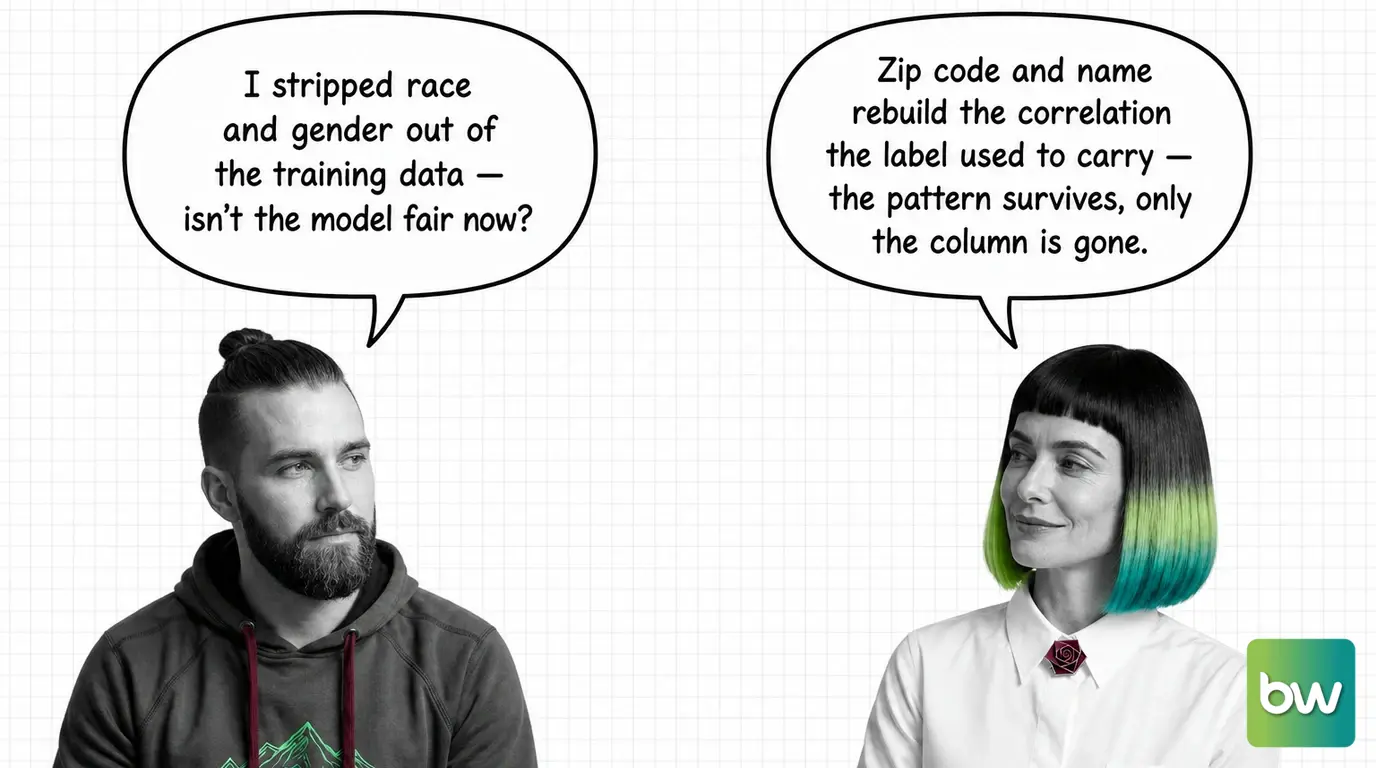
Q: If I remove the protected attribute from my training data, does that remove the bias? A: No. Correlated features — zip code, name, browsing history — carry the same signal forward, so the model reconstructs what the dropped column used to encode. The impossibility theorem explains why that reconstruction is mathematically hard to prevent.
Q: Is bias in my dataset a collection problem or a labeling problem? A: It could be either — dataset bias has three distinct sources, not one. Selection, representation, and measurement bias separates who got sampled, who got represented, and what got measured wrong, because each needs a different fix.
Q: Are open-source tools like AIF360 or Fairlearn enough to catch bias before I deploy? A: They’re necessary but no longer sufficient on their own — 2026 regulation is pushing bias checks from a one-off script into continuous, audit-ready governance. The state of bias mitigation in 2026 covers what that shift requires operationally.
Q: My fairness metrics pass — does that mean the outcome is actually fair? A: Not necessarily. Passing one mathematically valid metric can still produce an outcome that feels unjust to the people affected, because fairness definitions can contradict each other. The ethics and accountability of biased AI data argues the choice between them is a values question, not an arithmetic one.
Part of AI safety and red teaming · closest neighbour: toxicity and safety evaluation. New to this from a software background? Start with the story: AI Safety Testing for Developers: What Maps and What Breaks.
Start here to understand what dataset bias really is: how skews in selection, representation, and measurement quietly enter training data, and why a model trained on it learns the distortion as if it were signal.
Concepts covered
Dataset bias is a systematic skew between training data and the real world. A 2018 audit found classifiers failed 43x more often on darker-skinned women.
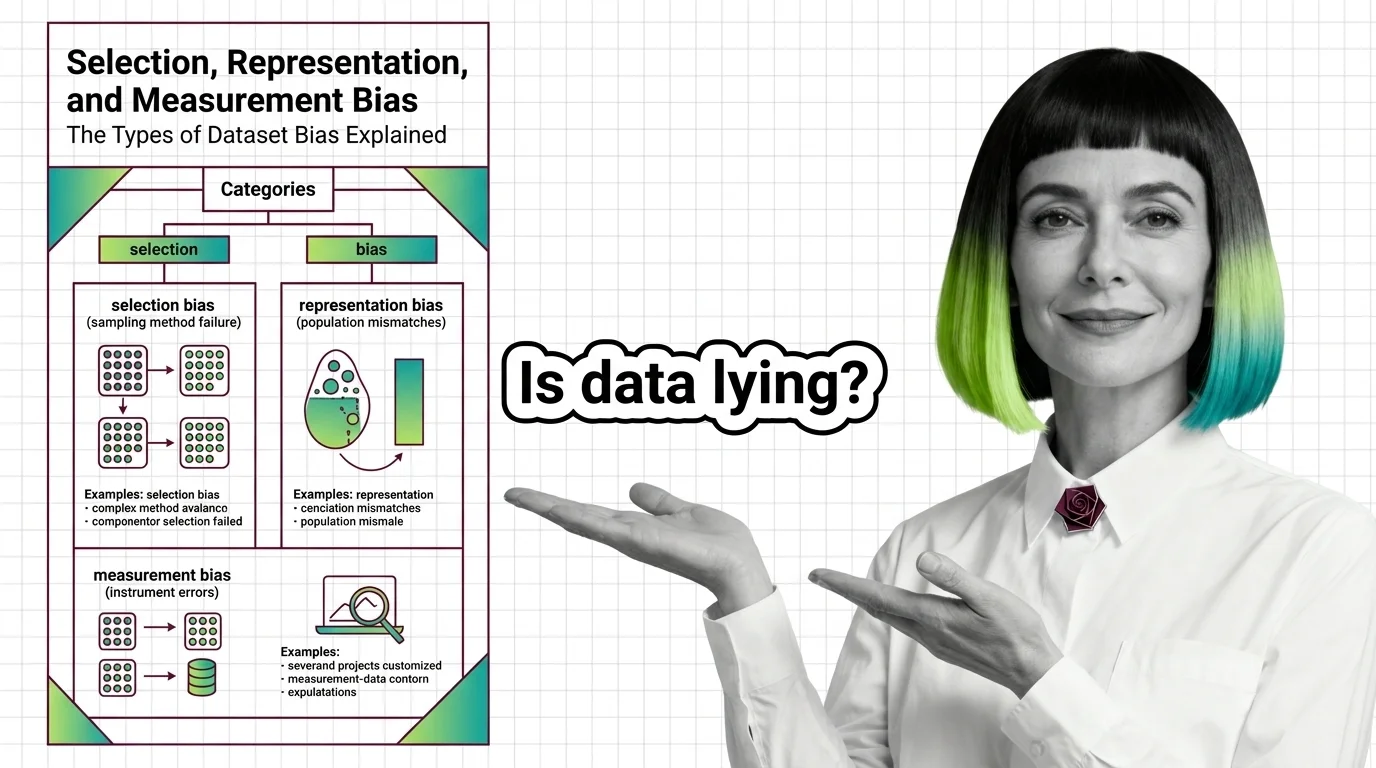
Dataset bias comes in three forms: selection, representation, and measurement. Each enters at a different stage and breaks models in its own way.
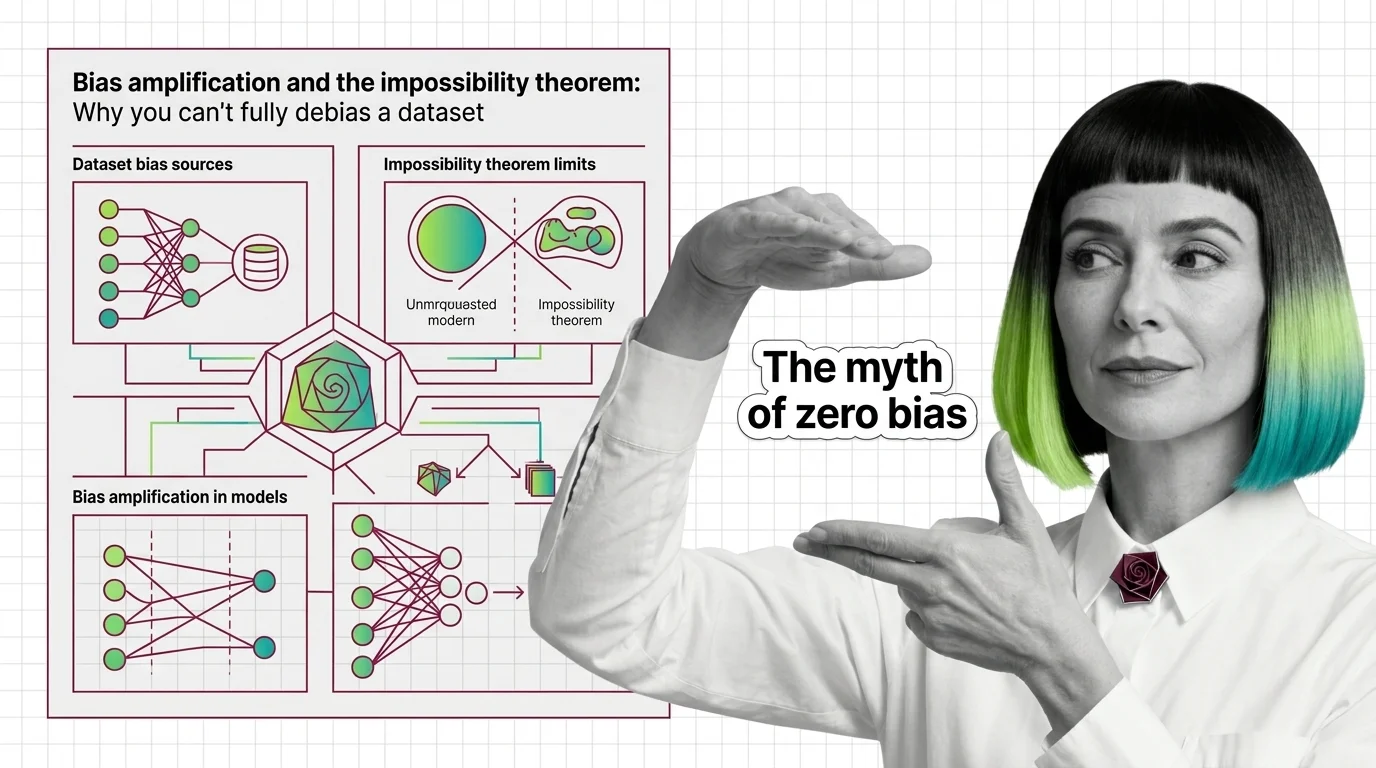
Dataset bias can't be fully removed: it enters at many lifecycle stages, hides in proxy features, and models amplify the rest instead of copying it.
These guides walk through detecting and mitigating bias in practice: auditing your data for skew, applying debiasing techniques during collection and curation, and weighing the trade-offs between fairness, accuracy, and engineering effort.
Tools & techniques
AIF360, Fairlearn, and Aequitas detect dataset bias by measuring disparate impact against the 0.8 four-fifths rule, then mitigate before you ship.
Bias mitigation is moving from research curiosity to governance requirement, and the tooling is maturing fast. Following these developments tells you which approaches regulators, auditors, and serious teams are starting to expect.
Models & benchmarks
Updated August 2026
Bias mitigation moved from one-off academic audits to continuous, governance-grade tooling. Regulation, not research, flipped the switch.
Before you trust a model's outputs, consider what biased data hides: decisions that quietly disadvantage real people, the gap between statistical fairness and lived fairness, and who is accountable when a skewed system causes harm.
Risks & metrics
Demographic parity and equalized odds cannot both hold when base rates differ — a 2016 impossibility result. Choosing one is ethics, not math.