Swap a CNN for a vision transformer in a production pipeline and you trade a free assumption for an expensive one: transformers must learn from data that nearby pixels belong together, while a CNN’s filters get that structure built in before training even starts. That tradeoff is why CNNs still anchor the vision stacks running in radiology suites and autonomous vehicles today, even as hybrid CNN-transformer designs dominate the research conversation — and why this topic sits among the workhorse architecture families that carried deep learning through its first decade. Reading it well means tracing where that spatial shortcut still pays off and where it runs out.
CNNs hard-code the assumption that nearby pixels are related — the exact inductive bias a vision transformer has to learn from data instead, which is why CNNs stay compute-efficient for small-data and edge deployments.
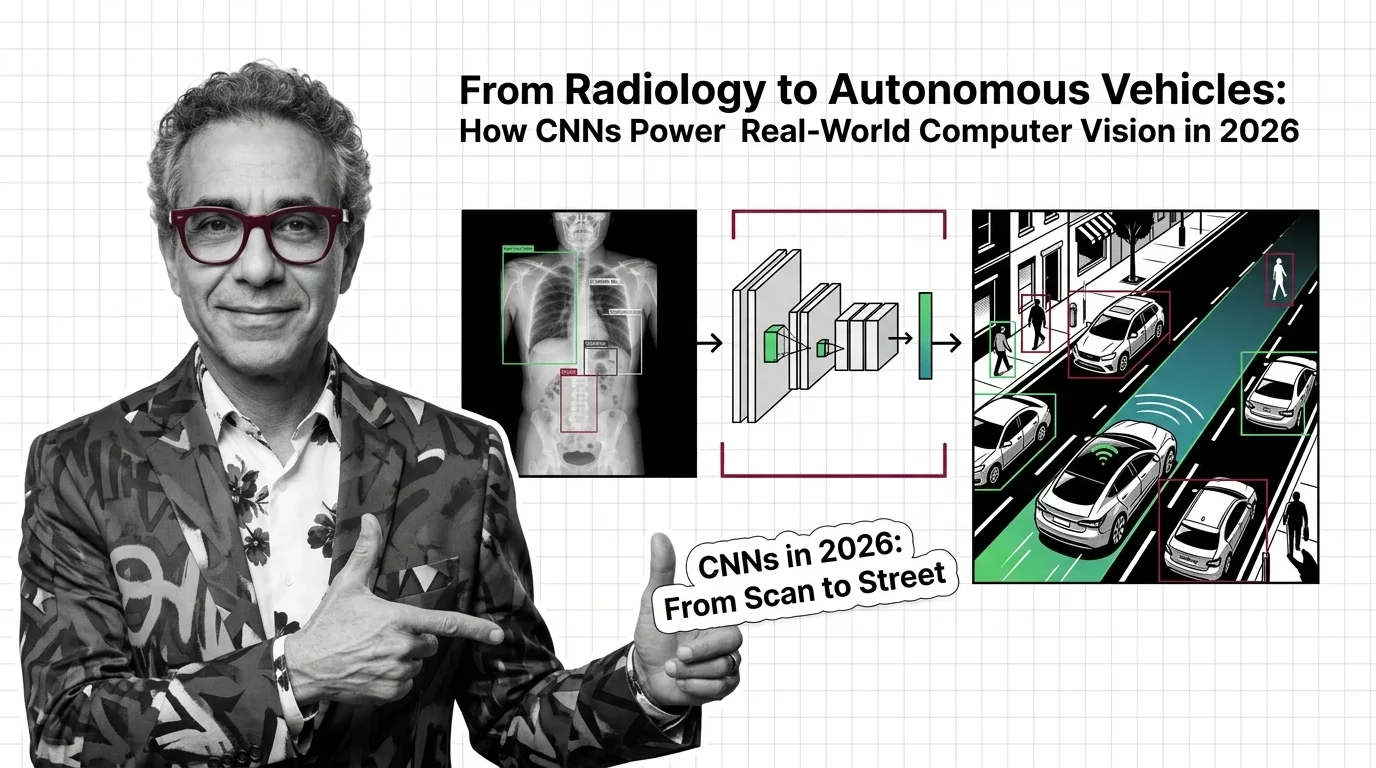
Production has settled the “CNN vs. transformer” debate on “both”: hybrid CNN-transformer architectures now power medical imaging, autonomous driving, and real-time detection systems shipping in 2026.
Backbone choice is a tradeoff, not a single winner — EfficientNetV2 wins on accuracy-per-parameter, ResNet on simplicity, ConvNeXt V2 on raw top-1 accuracy.
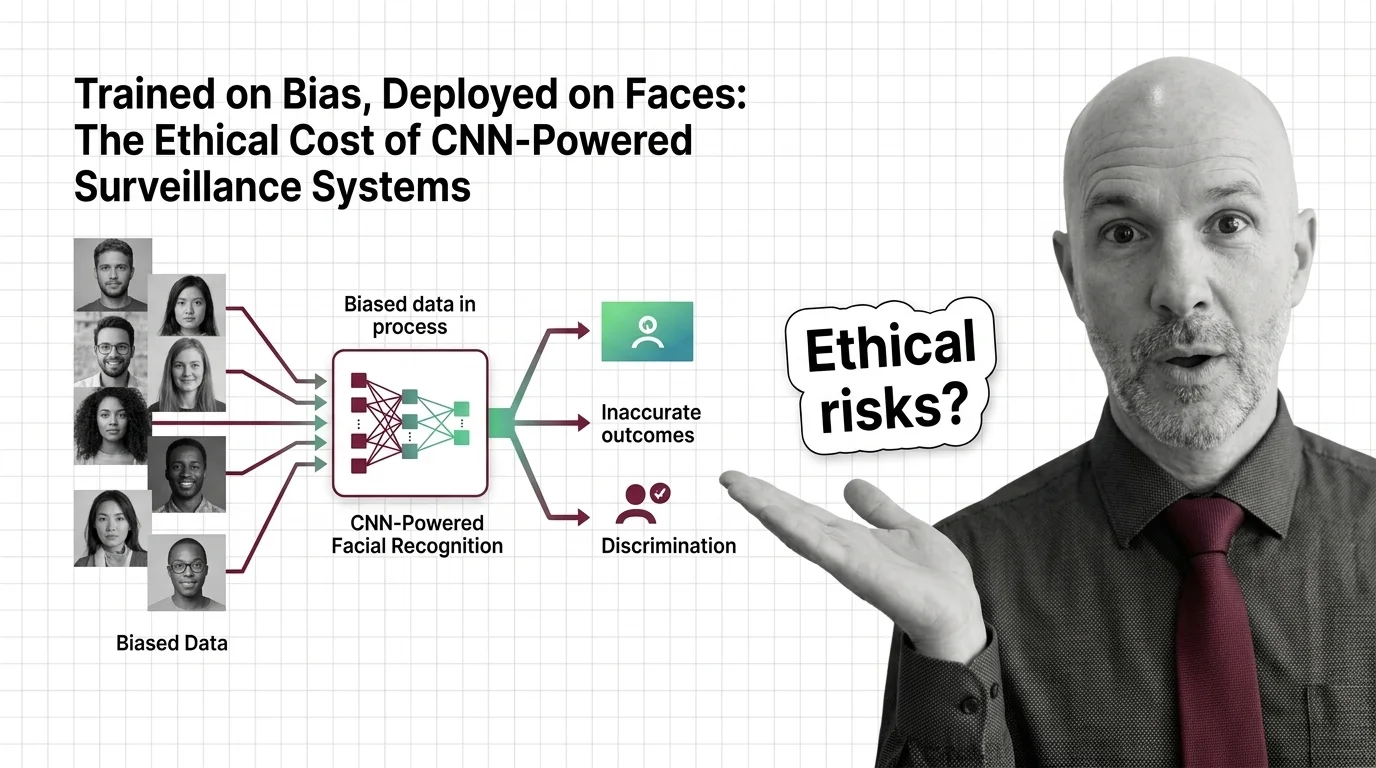
The same filters that make CNNs efficient also inherit whatever imbalance sits in the training data, a cost that lands hardest in facial recognition and surveillance deployments.
The CNN reading path: filters first, deployment tradeoffs last
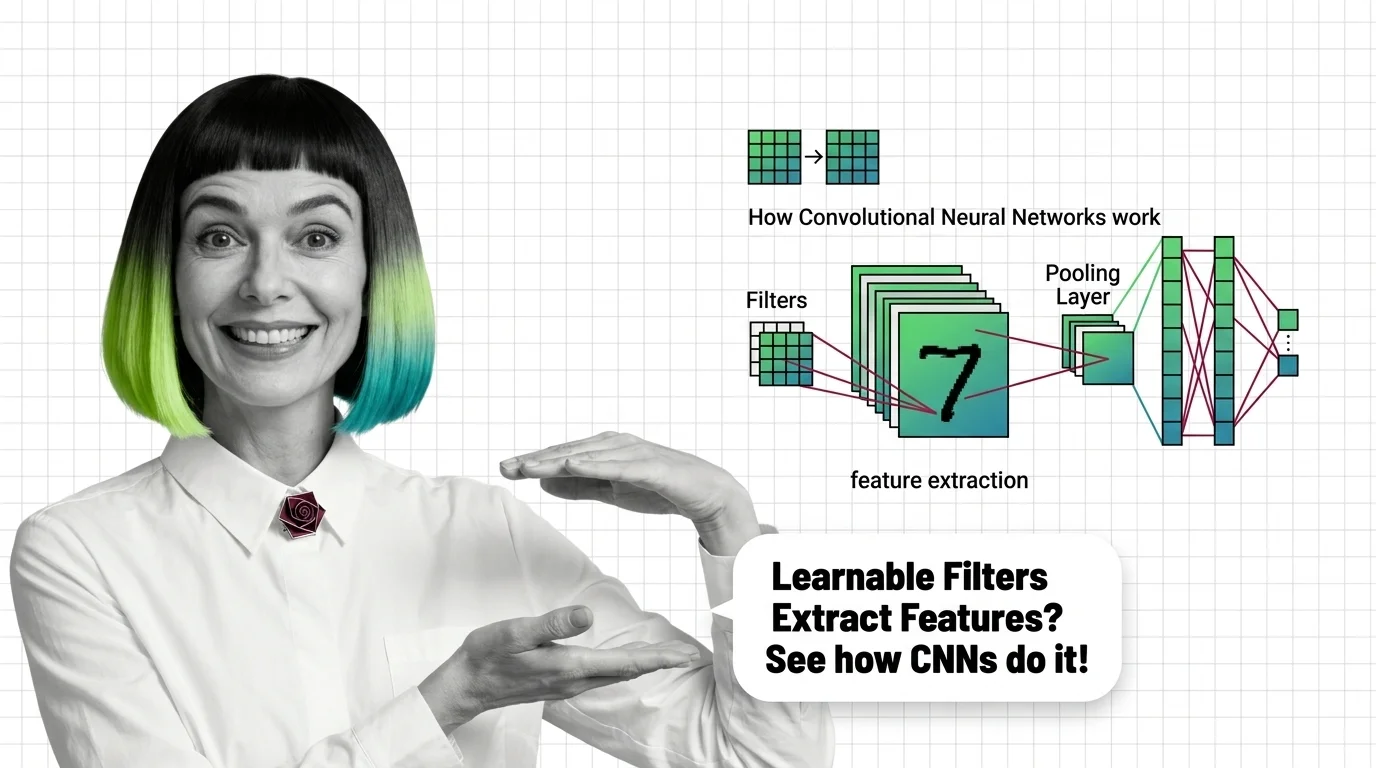
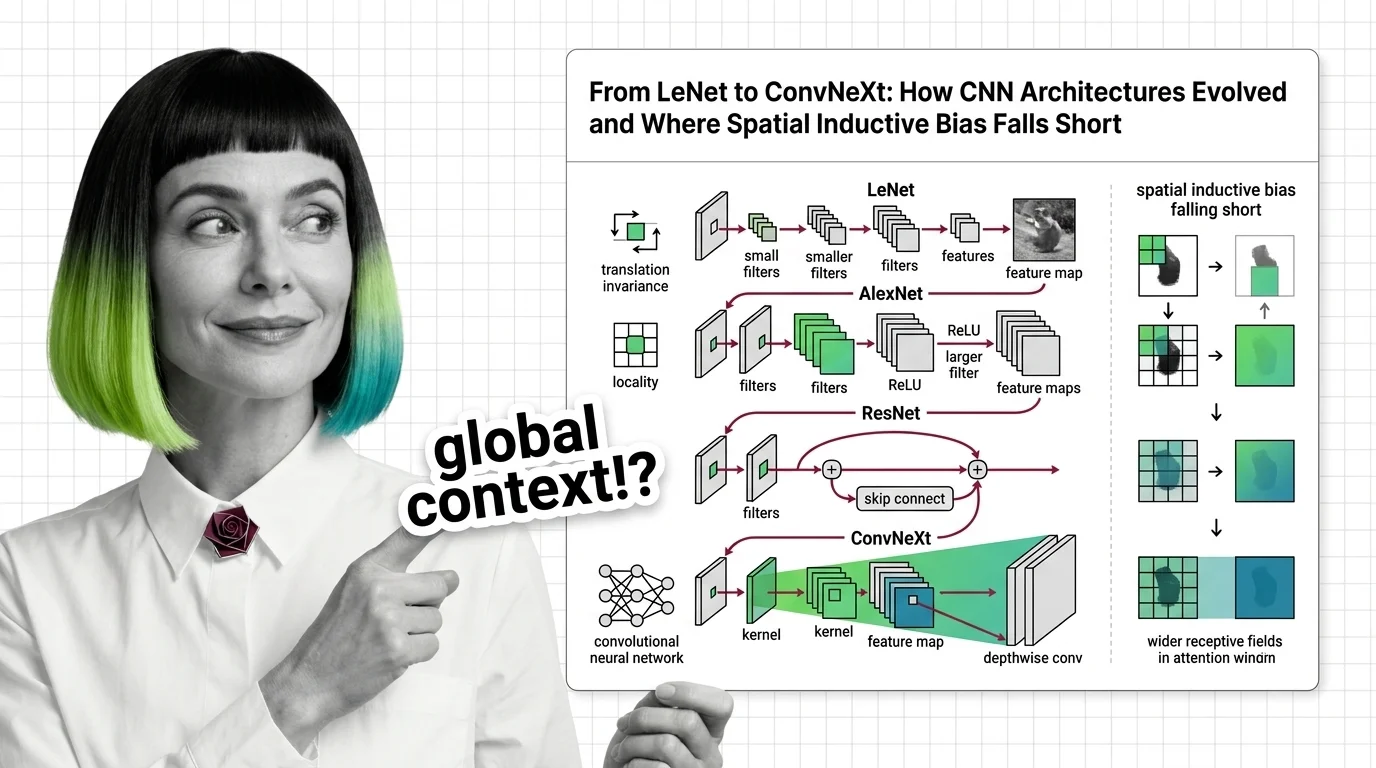
Start with how learnable filters extract visual features — it builds the mechanism every later claim rests on: how filters slide across an image, combine into feature maps, and stack into recognition. Follow immediately with how CNN architectures evolved from LeNet to ConvNeXt, which traces the design decisions that made CNNs practical and names exactly where the spatial shortcut stops seeing the whole picture — the gap vision transformers were built to close.
The right call depends on your data's shape, not the newest architecture.
How CNNs differ from vision transformers, graph networks, and the foundation they build on
Three neighbours get confused with this topic, and untangling them changes what you read next.
CNNs are not vision transformers. A CNN’s filters see local patches first and build global context slowly, layer by layer; a vision transformer’s attention sees the whole image from the first layer. That’s the exact tradeoff from LeNet to ConvNeXt traces, and production has stopped treating it as a contest — hybrid CNN-transformer stacks now dominate deployment instead of one replacing the other.
CNNs are not graph neural networks. A CNN assumes a fixed grid — pixels with regular neighbours; a graph neural network assumes arbitrary connections with no fixed layout, like molecules or social graphs. Neither generalizes to the other’s data shape without redesigning the core operation.
A CNN is not the same layer as general neural network basics. The backpropagation loop underneath every architecture in this theme is shared; what a CNN adds on top is the spatial assumption specifically. Skipping the foundation doesn’t save time — it just moves the confusion from “what is a filter” to “why doesn’t this filter work on my sequence data.”
Common questions about convolutional neural networks
Q: Why does a CNN that scores well in testing produce unreliable results once it’s deployed on real camera or scanner feeds?
A: Usually a mismatch between the training distribution and the deployment environment — a scanner model, lighting condition, or population the filters never saw. CNNs from radiology to autonomous vehicles treats that domain gap as the default production risk, not an edge case, across every 2026 deployment it tours.
Q: Which CNN backbone makes sense when training data or compute is limited?
A: EfficientNetV2 wins on accuracy-per-parameter, which matters most when a large model or dataset isn’t an option; ResNet stays the simpler default when engineering time is scarcer than compute. The PyTorch image classifier guide walks the full backbone tradeoff, including where ConvNeXt V2 wins instead.
Q: Do I need to understand the filter math to use a pretrained CNN in a project?
A: Not to call transfer-learning code — but you do need it to debug when accuracy drops or features look wrong, since tuning a black box wastes far more time than reading the mechanism once. How learnable filters extract visual features covers it at the depth debugging actually requires.
Q: Why do CNN-based facial recognition systems perform worse for certain demographic groups?
A: Because the filters learn whatever patterns dominate the training data, and face datasets have historically skewed toward lighter-skinned, male subjects — so the network sees far fewer examples of other faces during the same training run. The ethical cost of CNN-powered surveillance traces the accuracy gap back to that imbalance, not a model flaw.
Convolutional Neural Networks encode a powerful assumption — that nearby pixels matter more than distant ones. Understanding how learnable filters exploit spatial structure reveals why CNNs dominated vision for a decade.
Convolutional neural networks detect visual features through learnable filters, not pixel matching. Understand the layer-by-layer mechanism from edges to objects.
Trace CNN evolution from LeNet to ConvNeXt. Understand how spatial inductive bias enables efficient vision but limits global context versus vision transformers.
2
Build with Convolutional Neural Network
The guides in this section walk through building CNN-based classifiers from scratch, choosing pretrained backbones, and deciding when a convolutional architecture still outperforms newer alternatives.
Evaluate EfficientNetV2, ResNet, and ConvNeXt. Get a clear decision framework to choose the right PyTorch model for your image classification needs.
3
What's Changing in 2026
Convolutional Neural Networks are far from retired. Tracking how hybrid architectures blend convolutions with attention mechanisms helps you anticipate which vision tasks still favor spatial inductive bias.
CNNs aren't fading — they're merging with transformers and powering FDA-cleared diagnostics, robotaxis, and real-time detection. Here's the 2026 production map.
4
Risks and Considerations
Before deploying a CNN in high-stakes settings, consider how training data bias propagates through learned filters, and why interpretability remains a persistent challenge for convolutional models.
CNN-powered facial recognition hits 98% on benchmarks but fails along racial and gender lines. The ethical cost of biased surveillance at policing scale.