Convolutional Neural Network
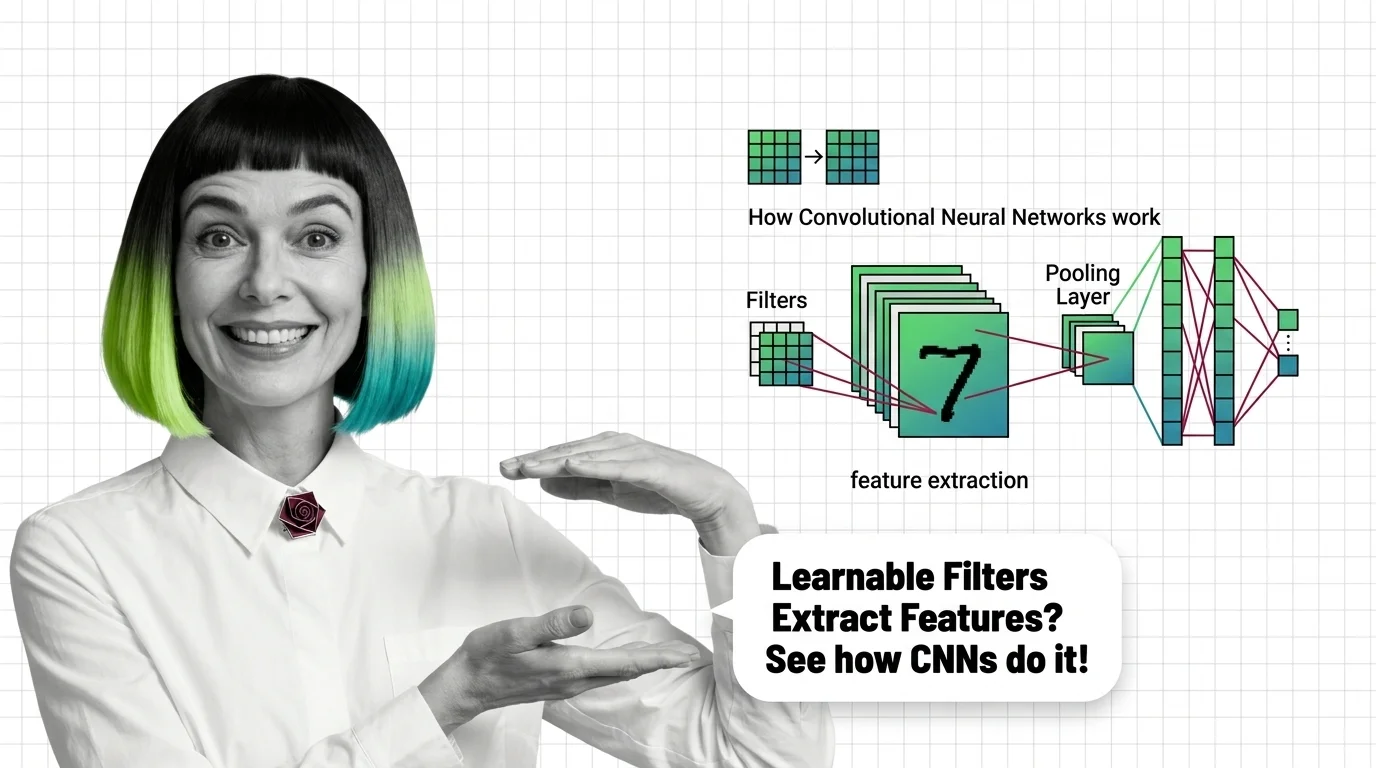
A Convolutional Neural Network is a deep learning architecture that applies small, learnable filters across input data to detect spatial patterns such as edges, textures, and shapes. Developed originally for image recognition, CNNs remain a core building block inside modern computer vision pipelines and increasingly serve as spatial feature extractors within larger multimodal systems that combine vision with language understanding. Also known as: CNN, ConvNet
Understand the Fundamentals
Convolutional Neural Networks encode a powerful assumption — that nearby pixels matter more than distant ones. Understanding how learnable filters exploit spatial structure reveals why CNNs dominated vision for a decade.

Build with Convolutional Neural Network
The guides in this section walk through building CNN-based classifiers from scratch, choosing pretrained backbones, and deciding when a convolutional architecture still outperforms newer alternatives.

What's Changing in 2026
Convolutional Neural Networks are far from retired. Tracking how hybrid architectures blend convolutions with attention mechanisms helps you anticipate which vision tasks still favor spatial inductive bias.
Updated April 2026

Risks and Considerations
Before deploying a CNN in high-stakes settings, consider how training data bias propagates through learned filters, and why interpretability remains a persistent challenge for convolutional models.