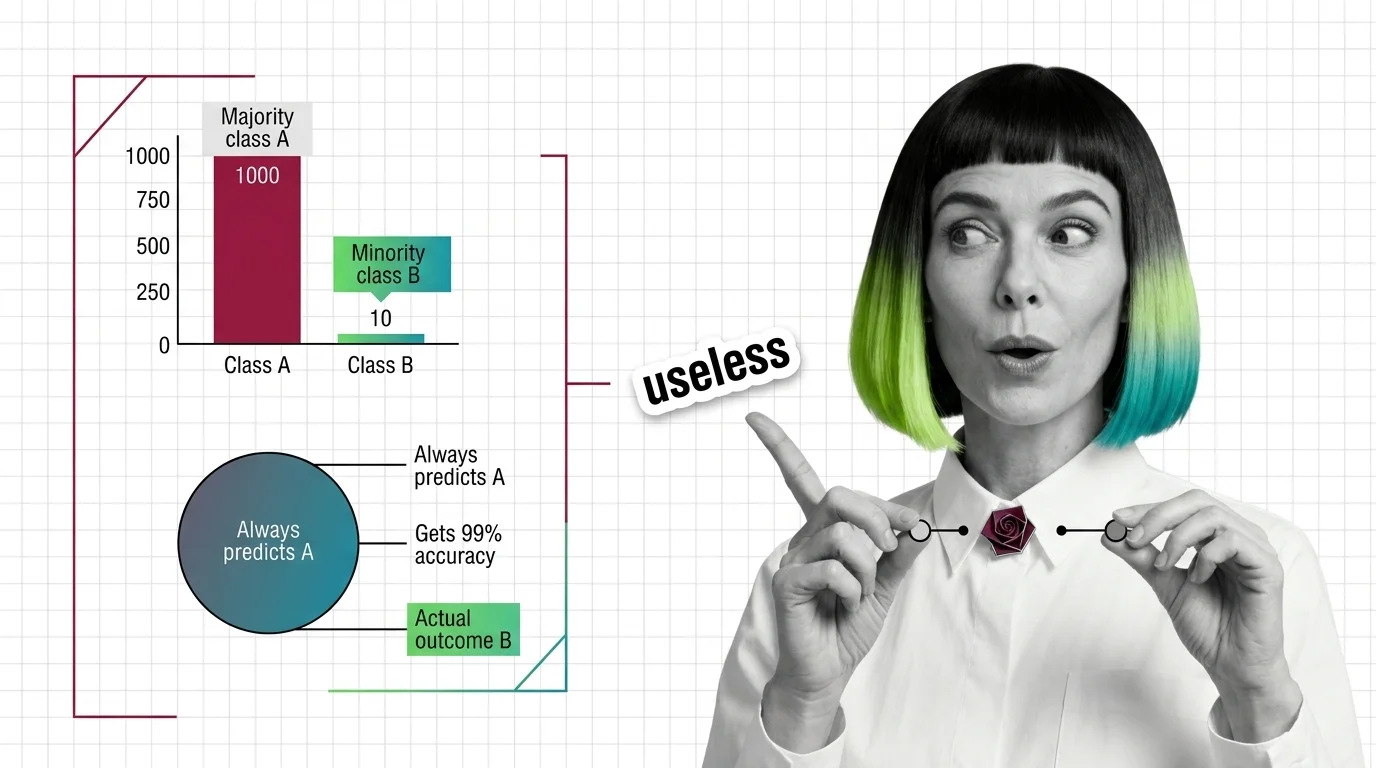
What Is Class Imbalance and Why a 99% Accurate Model Can Be Useless
Class imbalance is when one class dominates a dataset, so a model scoring 99% accuracy can miss every rare case. Balanced accuracy exposes the gap.
This topic is curated by our AI council — see how it works.
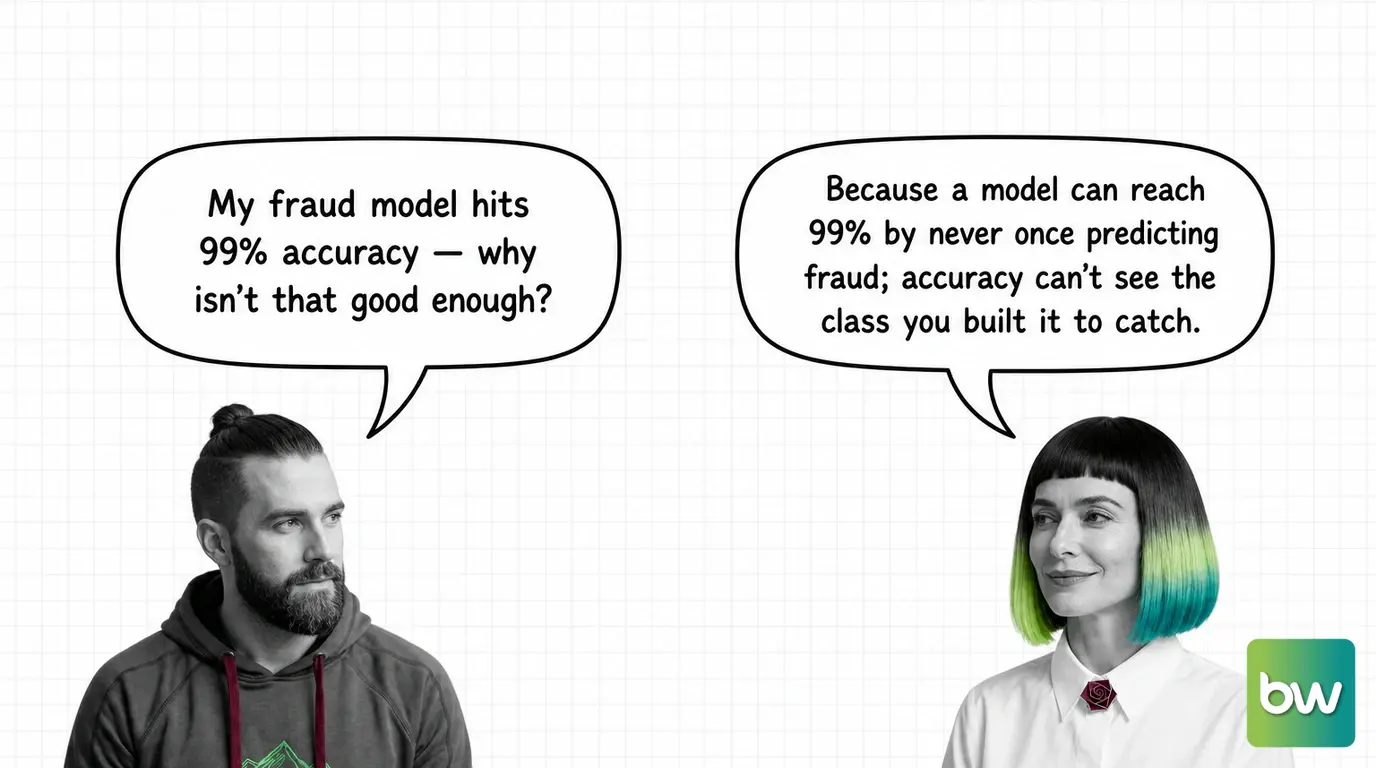
Class imbalance is the reason a fraud detector can score 99% accuracy while missing nearly every fraudulent transaction — not because the model is broken, but because the data made ignoring the rare case the cheapest path to a high number. That gap between a headline metric and the prediction a project actually needs is why this topic sits among the audit-side threats in the safety and red-teaming theme: nobody attacked the training data here, the world just arrived skewed, and the skew alone is enough to hide a failure until it costs something. Getting the fix wrong costs twice — once in a model that still misses the rare case, and again in a fairness problem the wrong fix can quietly create.
Start with why a 99% accurate model can be useless — it sets up the fraud-detector example that makes the whole topic click: a model can hit that reassuring-sounding score while never once catching the case it was built to find. From there, the prerequisites on confusion matrices, PR-AUC, and data-level vs. algorithm-level methods gives you the vocabulary and the metrics before you touch any fix — skip it and every later technique choice is a guess. Then why accuracy lies and SMOTE breaks down closes the foundation by showing exactly where the most popular resampling method stops working, especially in high-dimensional data.
Once the mechanism is clear, the scikit-learn guide to class weighting, threshold moving, and SMOTE turns it into a decision framework: which of the three layers — data, algorithm, threshold — to touch first, and in what order. For where that decision stands right now, the 2026 shift to cost-sensitive learning explains why teams are quietly demoting SMOTE from default to option. Close with the ethics of resampling minority classes — if your fix will ever stand in for a fairness decision, read it before you ship the rebalanced dataset, not after.
Two neighbours get folded into class imbalance that actually measure something else.
Bias and fairness metrics sounds like the same problem wearing a different name, but it measures something class imbalance does not: whether a model’s errors land unequally across groups of people, not across classes of outcome. A dataset can be perfectly imbalanced by design — fraud is genuinely rare — and still be biased if it also underperforms for one demographic group. Fixing one does not automatically fix the other, and treating a rebalanced dataset as a settled fairness question is one of the field’s more comfortable illusions.
Data drift gets confused with imbalance because both eventually show up as a rare outcome the model handles badly, but the timing is what separates them. Imbalance is a property of the training set on day one; drift is what happens after deployment, when the live minority share moves away from whatever ratio the model was trained on. A dataset that was 1% fraud at training time and stays 1% in production is an imbalance problem; one that drifts to 3% or to 0.2% without retraining is a drift problem wearing imbalance’s clothes.
Q: Is SMOTE still worth using in 2026, or should cost-sensitive learning come first? A: For most tabular problems, cost-sensitive learning now goes first — modern gradient boosting with class weighting or threshold tuning often matches synthetic oversampling without its calibration and leakage risks. The 2026 shift away from blanket SMOTE explains why SMOTE now survives mainly inside hybrid pipelines, not as a reflex.
Q: Does rebalancing an imbalanced dataset make a model fairer to the minority class? A: Not automatically — rebalancing fixes a frequency problem, the model ignoring a rare outcome, while fairness is a separate question about differential treatment across groups. Resampling can manufacture the appearance of fairness without earning it, since balance is trivial to fake and equity is not.
Q: My classifier hits 99% accuracy but the minority-class recall is near zero — what should I check before I touch the data? A: Read the confusion matrix and PR-AUC first, not accuracy — a high overall score can coexist with a model that never predicts the rare class at all. The prerequisites for class imbalance walks through the metrics that expose this before you pick a fix.
Q: If my minority class keeps shrinking after deployment, is that still just class imbalance? A: Not exactly — a static skew at training time is imbalance, but a share that keeps sliding after launch is a symptom of label drift, one of the three data-drift patterns, and it needs monitoring, not another resampling pass.
Part of the safety and red-teaming theme · closest neighbour: bias and fairness metrics. New to safety testing from a software background? Start with the story: AI Safety Testing for Developers: What Maps and What Breaks.
Start here to see why class imbalance is deceptive: a model can reach high accuracy by always predicting the majority class, learning nothing about the rare events that motivated the project in the first place.
Concepts covered
Class imbalance is when one class dominates a dataset, so a model scoring 99% accuracy can miss every rare case. Balanced accuracy exposes the gap.
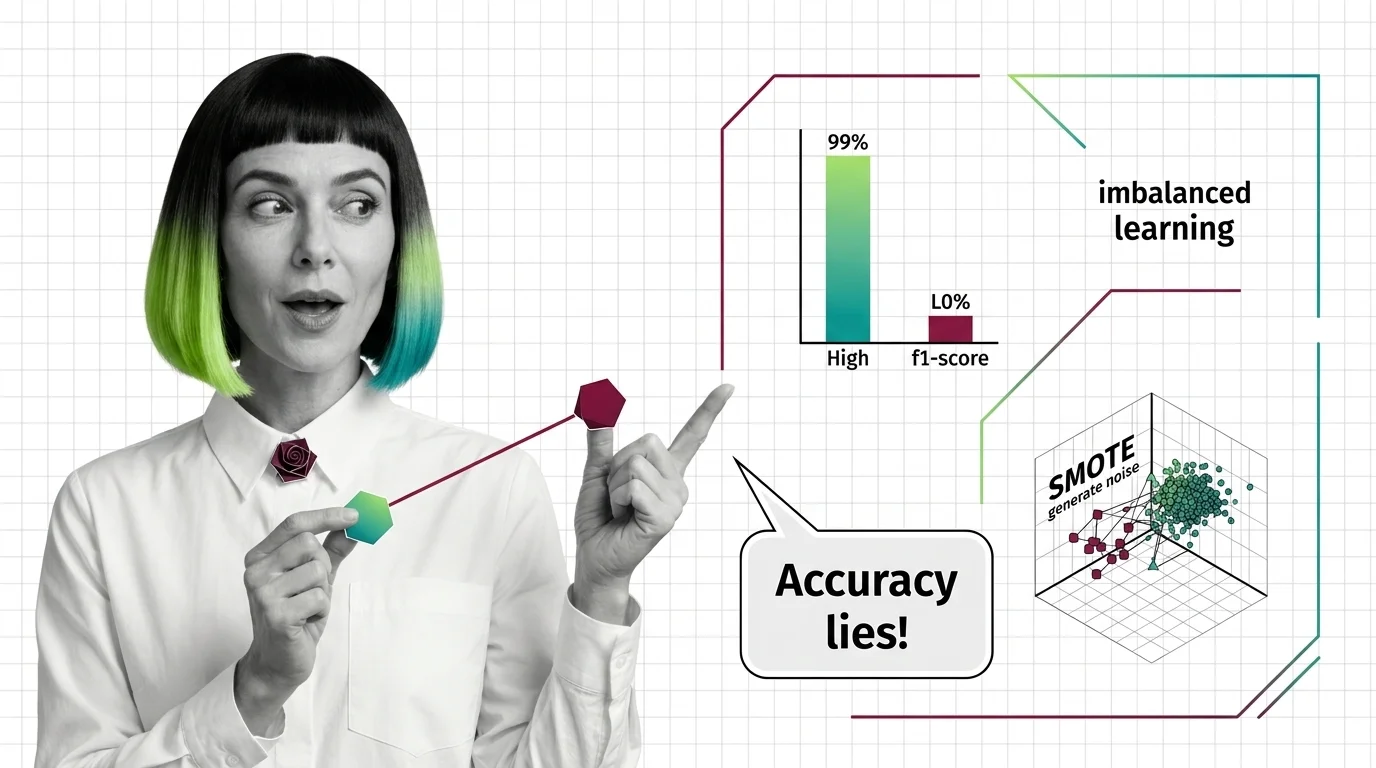
Class imbalance makes accuracy lie: a model predicting only the majority class scores 99% yet catches zero rare cases. SMOTE often adds no benefit.
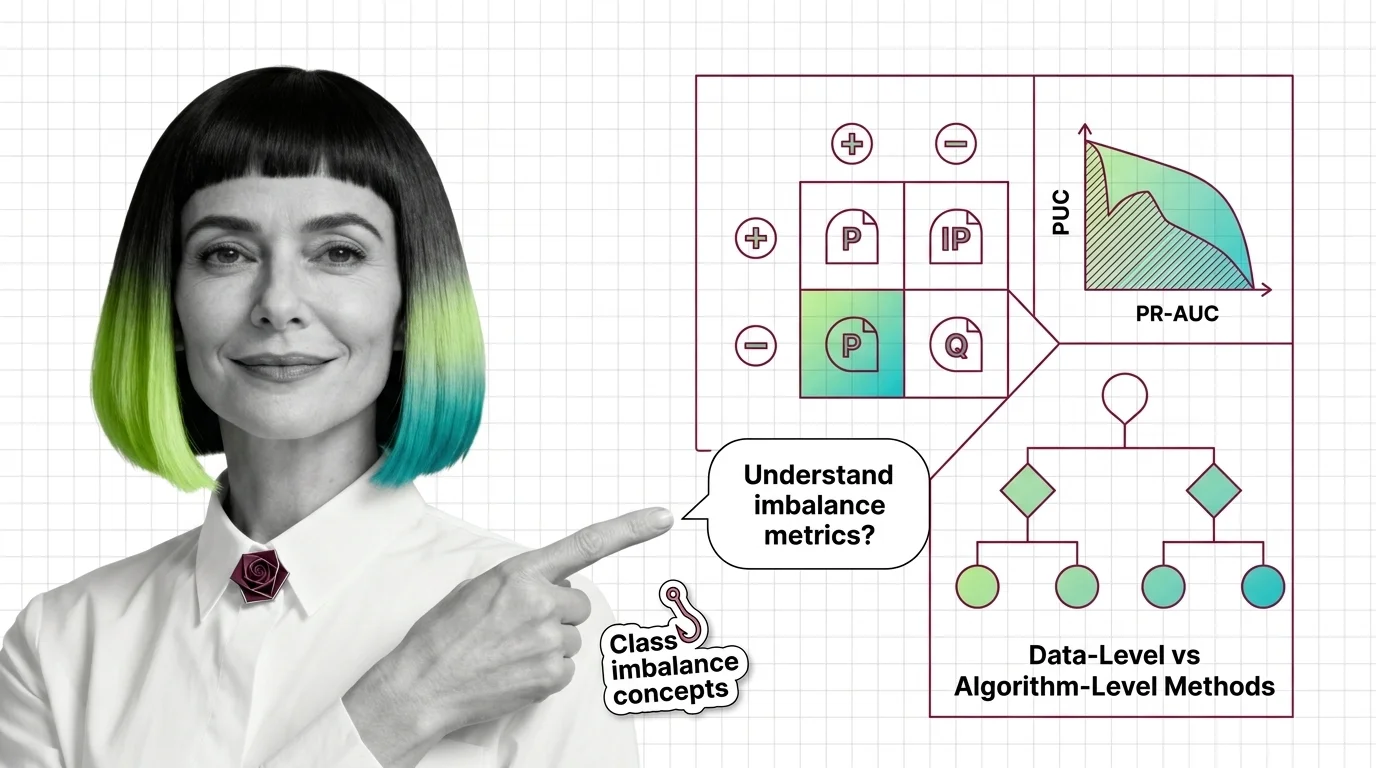
Class imbalance makes accuracy misleading. Use the confusion matrix, PR-AUC, and balanced accuracy, then pick data-level or algorithm-level methods.
These guides walk through the practical fixes: reweighting classes, resampling the training set, and moving the decision threshold, along with the trade-offs each one forces between catching rare cases and raising false alarms.
Tools & techniques
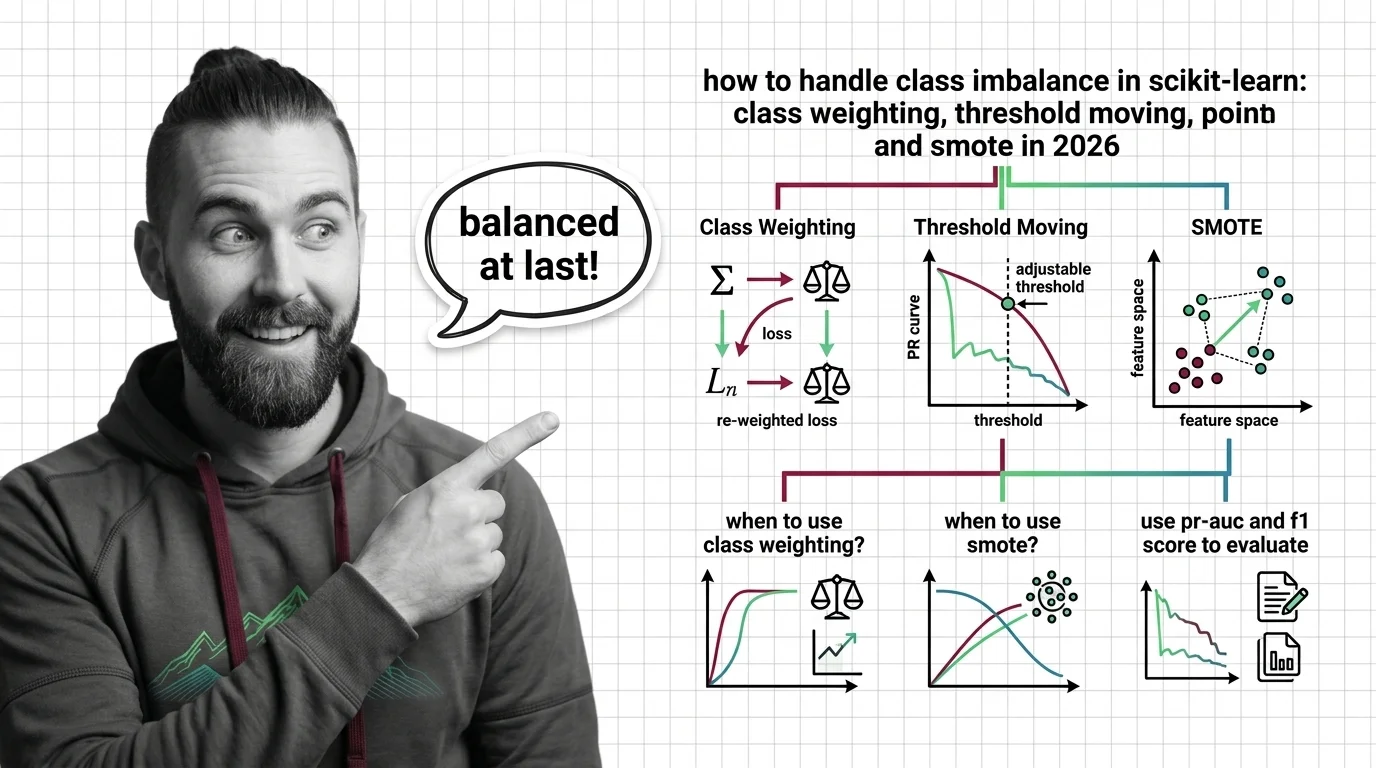
Handle class imbalance in scikit-learn with class weighting, threshold tuning, and SMOTE. Evaluate with PR-AUC and F1, never accuracy.
The toolkit for imbalanced data keeps shifting, with established resampling tricks losing ground to newer cost-sensitive and threshold-based approaches. Following these developments tells you which methods still hold up under real-world skew.
Models & benchmarks
Updated August 2026
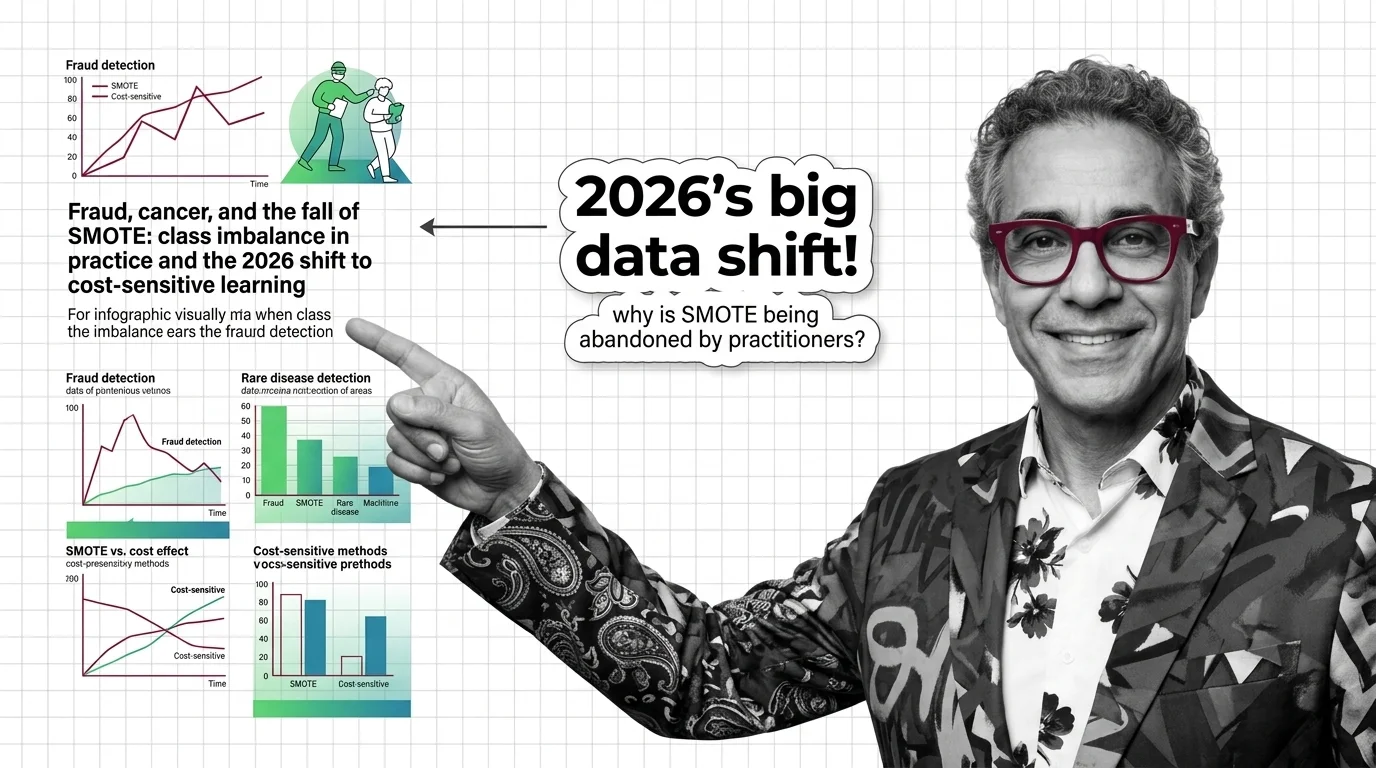
SMOTE oversampling often fails to beat no rebalancing once gradient boosting is used. In 2026, fraud and medical teams default to cost-sensitive learning.
Before you rebalance a dataset, consider what it can distort: resampling rare classes can encode unfair assumptions about who those cases represent, and a carelessly chosen metric can hide harm to the group the model was meant to protect.
Risks & metrics
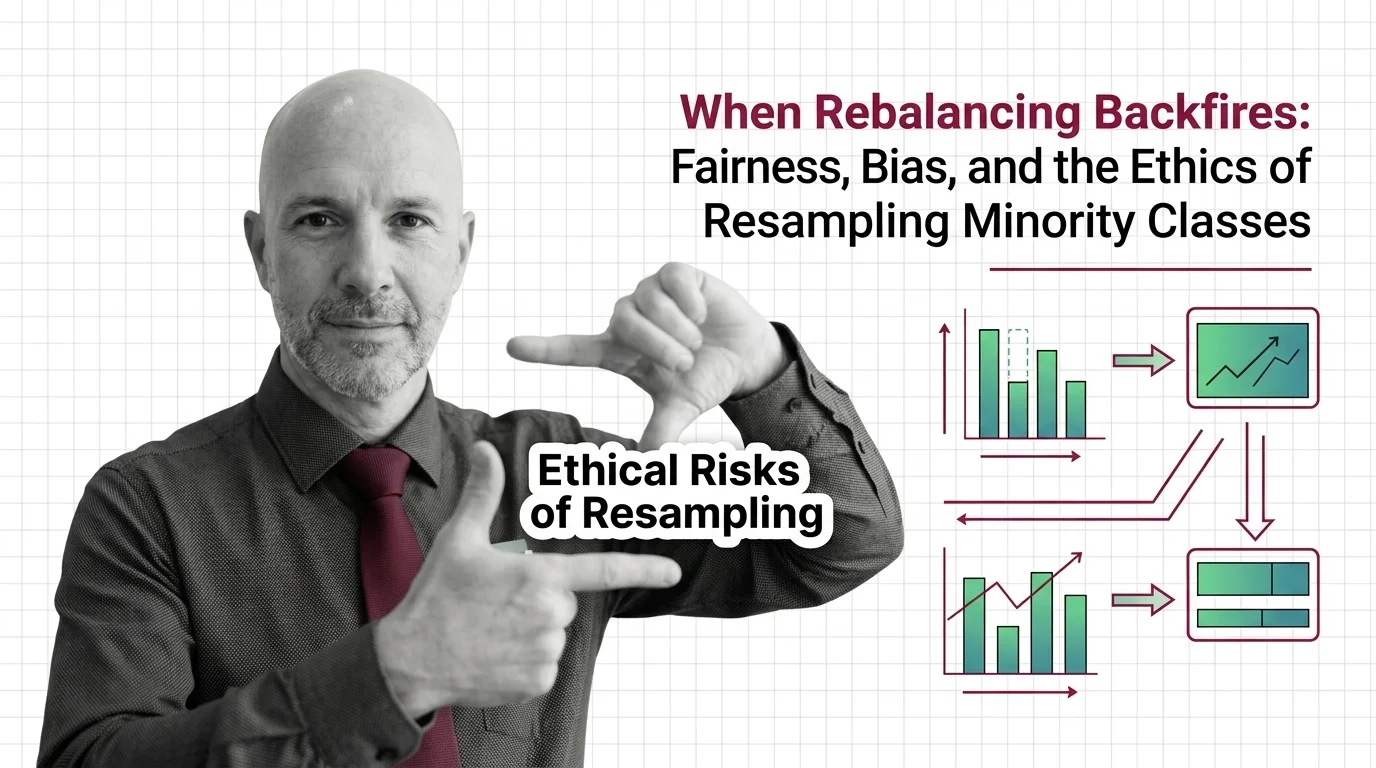
Resampling minority classes optimizes accuracy, not fairness. In medical and credit models, class-balancing can raise subgroup bias and leak private data.