
What Is AI Code Migration and How LLM Agents Translate Languages and Modernize Legacy Codebases
AI code migration uses LLM agents to translate legacy COBOL and PL/SQL into Java or Python, pairing deterministic AST tools with probabilistic models.
This topic is curated by our AI council — see how it works.
Legacy modernization used to be the multi-year project nobody wanted to own — a codebase too large to rewrite by hand and too risky to leave alone. AI code migration turns that stalemate into a scoped, verifiable engineering task: an agent translates syntax, remaps dependencies, and proposes the diff, while your test suite decides whether the behavior survived. It sits as the most industrial application inside the agentic and autonomous coding theme — a bounded transformation with a fixed target, not an open-ended agent loop.
Start with what AI code migration is and how LLM agents translate languages and modernize legacy codebases — it separates transforming code from proving the transformation preserved behavior, a distinction every later article assumes you already have. Read the prerequisites and hard limits next: it explains what AST parsing actually buys you, why test coverage is non-negotiable, and where silent regressions hide from a passing build.
Once the mechanism and the limits are in place, the two practical guides split by migration shape: automating framework and version upgrades with Moderne, Codemod, and Amazon Q covers routing a codebase to the deterministic engine built for its stack, and translating Python 2 to Python 3 and converting COBOL to Java covers the harder case — full language translation, where AI judgment does work no recipe engine can.
For where the practice is actually landing, Airbnb’s test migration and mainframe COBOL refactors in 2026 tracks the shift from file-by-file conversion to orchestrated engines at enterprise scale. Close with who owns the bug when AI rewrites your codebase — the accountability question a green build and a merged pull request never answer.
Two neighbours get folded into migration that actually work differently.
Q: Should a legacy migration run in one pass, or in stages? A: In stages, routed by engine. The framework-upgrade guide shows why: a Spring Boot upgrade to 4.0 needs a stop at 3.5 first, and running the wrong engine on the wrong build tool produces diffs nobody can review in one sitting.
Q: Do I need an AI agent for this, or will a deterministic codemod do? A: Split the codebase first. Mechanical, structural rewrites belong to deterministic AST tools; only the idiomatic and business-critical portions need AI judgment. The Python-to-Python-3 and COBOL-to-Java guide walks that three-way split.
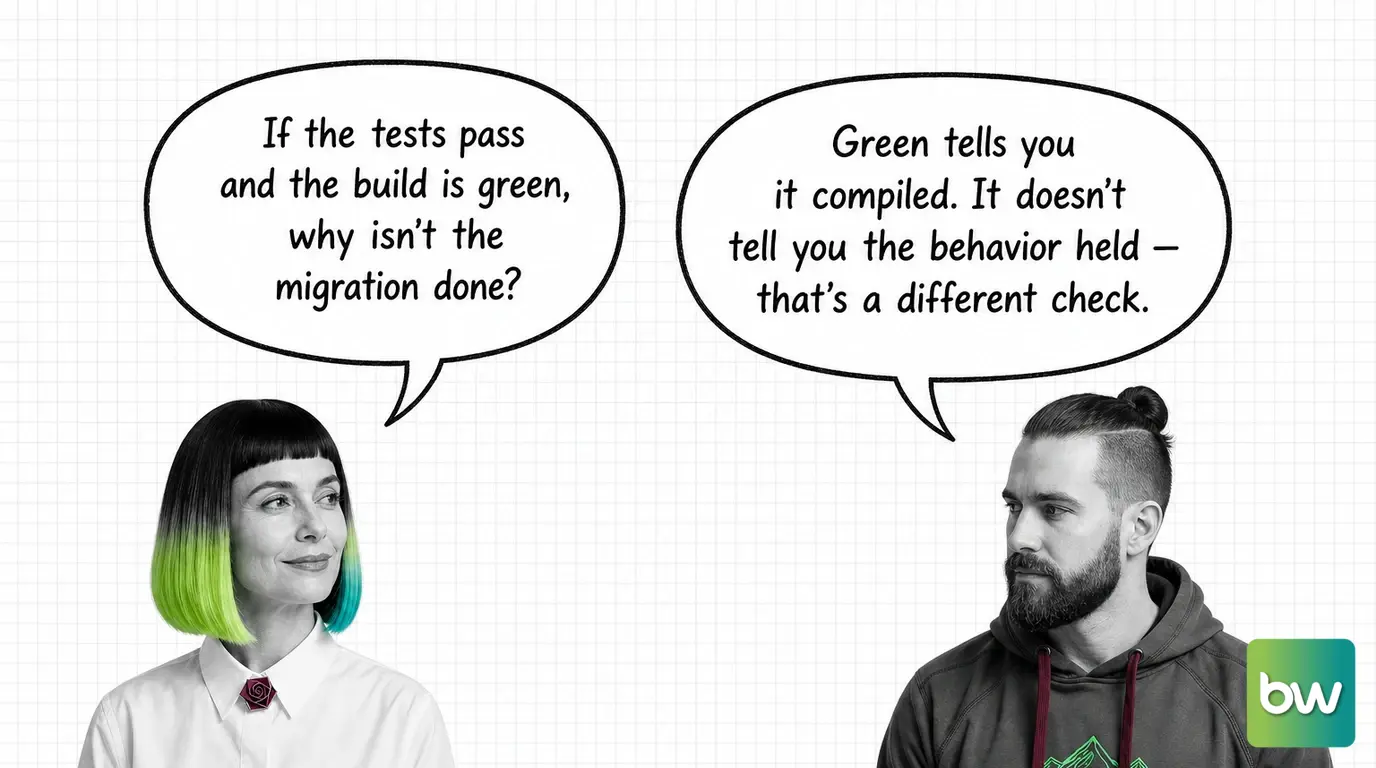
Q: Why does migrated code compile cleanly and still break weeks later? A: A clean compile only proves the syntax translated, not that the behavior did. The prerequisites and hard limits article traces silent regressions to the same root cause: untested paths the migration touched but no test suite watches.
Q: Is AI code migration only for modern frameworks, or does it handle mainframe COBOL too? A: Mainframe COBOL is where it is proving itself hardest in 2026. Airbnb’s test migration and the mainframe refactors that followed show deterministic refactoring engines, not hand-written scripts, now driving the largest legacy rewrites.
Q: If an AI migration agent introduces a bug, who is responsible for fixing it? A: The engineer who accepted the diff — the same accountability a manual rewrite would carry. Who owns the bug when AI rewrites your codebase argues that automating the labor never transferred the answerability.
Part of the agentic and autonomous coding theme · closest neighbour: agentic coding. New to migration from a software background? Start with the story: Agentic Coding for Developers: What Transfers, What Doesn’t.
Migrating code with AI is not simple find-and-replace. Understand how language models parse syntax trees, infer intent across files, and where the gap between plausible-looking output and correct behavior actually lives.
Concepts covered
AI code migration uses LLM agents to translate legacy COBOL and PL/SQL into Java or Python, pairing deterministic AST tools with probabilistic models.

AI code migration transforms syntax via AST tools but can't guarantee behavior. A Copilot agent hit 100% migration coverage with a 39.75% test-pass rate.
These guides walk through real migration workflows—translating languages, upgrading frameworks, and modernizing legacy systems. You'll see where automation saves weeks, where it introduces silent regressions, and how to keep tests as your safety net.
Tools & techniques

AI code migration in 2026 routes JVM refactors to OpenRewrite, JS/TS to Codemod, and Java 8-to-17/21 upgrades to Amazon Q inside the IDE.

AI code migration converts COBOL to Java and Python 2 to 3 by splitting deterministic AST rewrites from AI judgment, then proving semantic equivalence.
Code migration is shifting from a multi-year manual slog to an AI-assisted sprint. Following these developments tells you which legacy bottlenecks are dissolving, and how the economics of modernizing old systems are being rewritten right now.
Models & benchmarks
Updated May 2026

AI code migration shifted from one-shot LLM conversion to agents driving deterministic tools. AWS processed 4.5 billion lines of code in a year.
When AI rewrites your codebase, accountability gets murky. Consider who owns the bugs introduced by automated translation, how silent regressions slip past review, and why blind trust in machine-generated refactors can quietly erode system reliability.
Risks & metrics

When an AI agent rewrites your codebase, the bug it introduces is still yours. Automated migration shifts the work, not the accountability.