The Hidden Cost of Transformer Dominance: Energy, Access, and Concentration of Power
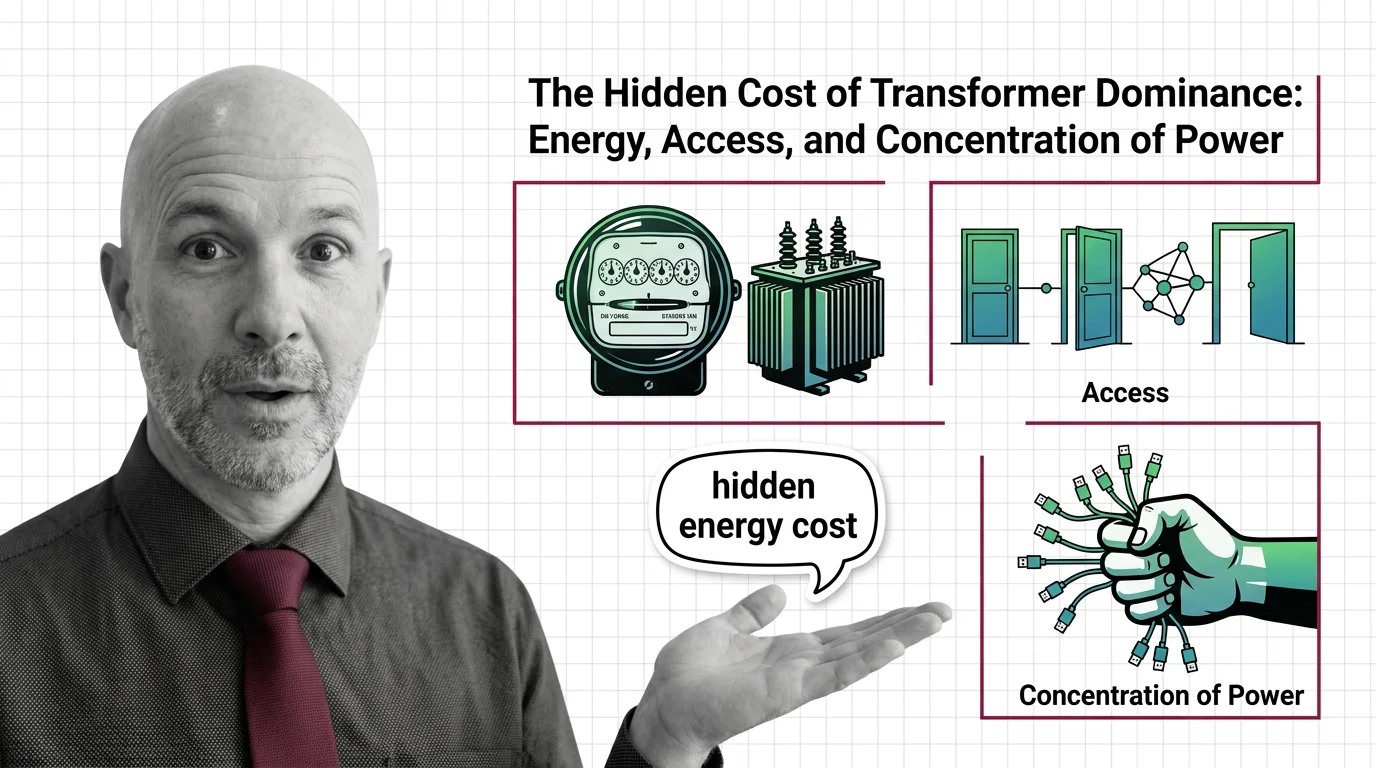
Table of Contents
The Hard Truth
A single training run for GPT-3 consumed enough electricity to power 120 American homes for a year. The architecture behind that run now underpins almost every frontier AI system on the planet. What happens when the foundation of an entire technological era is something only a handful of organizations can afford to build?
The Question We’re Not Asking
We talk about Transformer Architecture as a scientific triumph. And it is one — the “Attention Is All You Need” paper has become one of the most-cited works in the history of computer science. That single paper redefined how machines process language, vision, and sound. But triumph narratives have a habit of crowding out harder questions. The architecture that powers modern AI is not merely a technical choice. It is an infrastructure commitment — one that locks us into particular patterns of resource consumption, economic concentration, and institutional dependency that grow more rigid with every billion-dollar training run.
Who gets to participate in that commitment, and who is simply subject to its consequences?
What We Think We Know
The conventional understanding goes something like this: Multi Head Attention mechanisms and Positional Encoding gave us a fundamentally better way to model sequential data. Transformers replaced recurrent networks because they were faster to train through parallelization, better at capturing long-range dependencies, and amenable to scaling. The architecture won on merit. Its dominance is a natural outcome of superior performance, and the energy costs are a temporary inconvenience that efficiency research and renewable infrastructure will gradually resolve.
This narrative is reasonable. It is also incomplete in ways that matter.
What We’re Missing
The hidden assumption is that architectural merit and social cost are separate conversations — that we can celebrate the engineering while deferring the ethics to some later, more convenient moment. But the costs are not waiting for that conversation to happen. Training GPT-3 required 1,287 MWh of electricity — enough to power roughly 120 American homes for a year (MIT News). That was a model from 2020. Exact training costs for current frontier systems — GPT-4o, Claude, Gemini — remain undisclosed, and companies face no obligation to report them.
The energy footprint extends well beyond training. Every query to a large language model consumes approximately five times the electricity of a standard web search. Global data centers used around 415 TWh of electricity in 2024 — about 1.5% of global consumption — and the IEA projects that figure will reach roughly 945 TWh by 2030, approximately 3% of global electricity (IEA). An estimated 60% of new data center electricity demand draws from fossil fuels, according to a Goldman Sachs projection cited by MIT Technology Review.
The assumption that “efficiency will catch up” deserves scrutiny. The fundamental computational signature of transformer attention is O(n^2) — quadratic in the length of the Context Window. Every token attends to every other token. That mathematical structure is not a bug to be patched. It is the mechanism. And it means that as we push models toward longer contexts and more parameters, energy demand scales faster than capability.
The Blind Spot
Consider a different framing. The history of industrial infrastructure offers a pattern: when a dominant technology requires massive capital investment, it doesn’t just create products — it creates gatekeepers. Railroads in the nineteenth century, telecommunications networks in the twentieth, and now AI compute infrastructure in the twenty-first. The pattern recurs because the economics demand it.
Big Tech’s combined AI capital expenditure reached roughly $410 billion in 2025 (Bloomberg), with projections of $650–700 billion in 2026 (CNBC). These are aggregate infrastructure figures, not exclusively transformer-related, but the direction is unmistakable. Training and serving transformer-based models at frontier scale requires the kind of capital, energy contracts, and specialized hardware that perhaps a dozen organizations worldwide can marshal. The Encoder Decoder paradigm that once promised to democratize sequence modeling has, through the sheer economics of scale, produced the opposite effect.
Research published in PMC found that the United States and China account for over 99% of global generative AI carbon emissions. That geographic concentration mirrors the economic concentration. Organizations without access to large-scale compute can pursue Fine Tuning of existing models or work with open-weight releases through platforms like Hugging Face, but they cannot build from the ground up. They are tenants in an infrastructure someone else owns.
The Tokenization layer, the attention heads, the Mixture Of Experts routing — these architectural decisions shape what questions AI can process and how it processes them. When those decisions are made by a small number of organizations, the architecture is not just a technical artifact. It is a governance structure disguised as engineering.
The Uncomfortable Truth
Thesis (one sentence, required): The transformer’s dominance is not merely a story of scientific progress — it is an ongoing redistribution of computational, economic, and epistemic power toward a shrinking number of institutions.
This is uncomfortable because the architecture genuinely works. The multi-head-attention mechanism remains, as of early 2026, the most effective known approach for modeling complex dependencies across modalities. Alternatives exist — State Space Models achieve up to five times the inference throughput at long contexts with linear context scaling in research settings (Goomba Lab) — but these benchmarks come from controlled experiments, not production frontier deployments. Hybrid architectures are emerging, but transformers still anchor every major commercial system.
The discomfort is that recognizing a problem does not make the alternatives ready. And waiting for alternatives while the current infrastructure entrenches itself means the concentration deepens with every passing quarter.
So What Do We Do?
Not prescriptions — questions. If the architecture demands resources that only a few can provide, what does “open AI” actually mean? If the environmental costs are real but invisible because no company is required to disclose them, who should demand transparency — governments, users, researchers? If state-space models or hybrid approaches offer a less resource-intensive path, what would it take to fund that research at a scale competitive with transformer investment?
And perhaps the most uncomfortable question of all: are we willing to accept slower, less capable systems if the alternative is an AI infrastructure that only a handful of corporations can afford to operate?
What Would Make This Wrong
If renewable energy deployment outpaces data center growth decisively — not incrementally, but structurally — the environmental argument weakens substantially. If architectural alternatives like state-space models prove viable at frontier scale and receive comparable investment, the concentration argument becomes less urgent. And if major AI companies voluntarily adopt binding transparency standards for training energy and emissions, the governance gap narrows. Any of these developments would require me to revise this position. None of them has happened yet.
The Question That Remains
The transformer gave us extraordinary capability at extraordinary cost. The cost is not just measured in megawatt-hours or dollars — it is measured in who gets to build, who gets to decide, and who simply inherits the consequences. We built the most powerful information-processing architecture in history. The question we have not answered is whether the architecture is building us back — into dependencies, concentrations, and environmental debts we did not choose and cannot easily escape.
Disclaimer
This article is for educational purposes only and does not constitute professional advice. Consult qualified professionals for decisions in your specific situation.
AI-assisted content, human-reviewed. Images AI-generated. Editorial Standards · Our Editors