The Ethics of Real-Time AI Generation: Deepfake Risk Versus Accessibility Gains
The Hard Truth
Imagine the voice on the phone is your daughter, crying, saying she has been in an accident and needs money sent within minutes. A generative model can produce that call from under three seconds of her real voice, pulled from a video she posted months ago. By the time anyone could check whether it was really her, the money would already be gone.
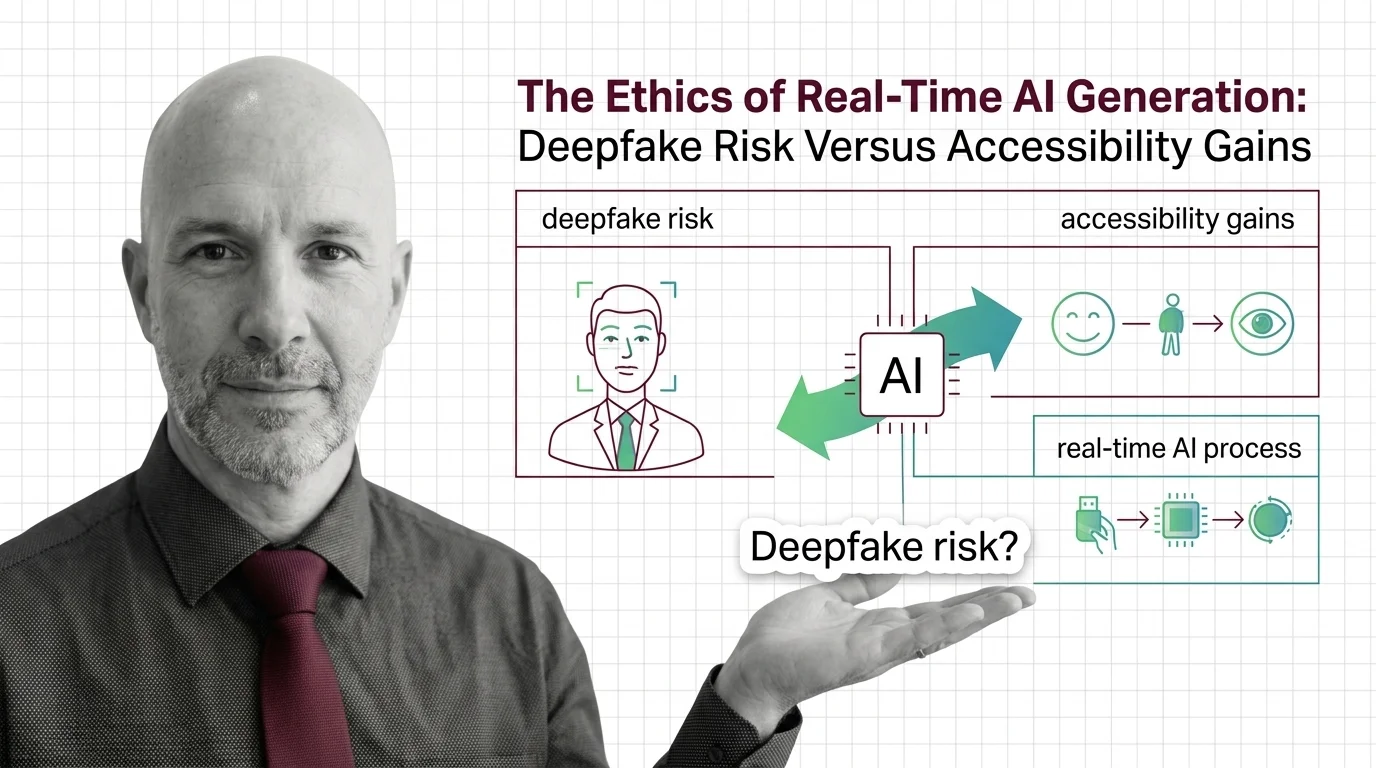
This is not a hypothetical anymore. Real-Time AI Generation has moved from research demos into consumer-facing Generative Media APIs fast enough to carry a real conversation, and the same speed that terrifies fraud investigators is what lets a stroke survivor speak again in something close to their own voice. The two outcomes share one root cause — generation got faster than the human capacity to check it — and almost nobody treats them as the same problem.
The Question a Disclosure Label Can’t Answer in Time
Start with the question regulators, technologists, and worried parents all seem to skip past: what good is a disclosure if it arrives after the decision has already been made? The real-time AI generation systems shipping into consumer apps this year don’t produce a deepfake video file you can pause and scrutinize. They produce a live phone call, a live video chat, a live stream — output arriving fast enough that the moment of doubt and the moment of action collapse into the same instant. If a person needs more than a second to register that something feels wrong, and the system is built to never give them that second, what exactly is a disclosure label protecting?
The Case That the Safeguards Are Already Working
That question deserves a fair answer before it gets picked apart. Under the EU AI Act’s Article 50, organizations operating systems that generate or manipulate audio, image, or video resembling a real person will be required to disclose that fact, with penalties reaching €15 million or three percent of global turnover for those that don’t — a rule set to take effect in August 2026 (EU AI Act Explainer). Alongside regulation, the industry has spent years building a provenance layer: the Content Credentials standard, now ratified as an international standard and backed by more than six thousand member organizations including Google, Meta, OpenAI, Adobe, Sony, Nikon, and Leica, attaches a signed manifest to content showing which tool touched it and when (C2PA Specification). Law and standard, moving in the same direction. A thoughtful person could look at that combination and conclude the problem is being handled, just not finished yet.
The Assumption Hiding Inside Every Disclosure Rule
A single assumption holds that whole structure up: that there is a moment, after the content is made and before it does its damage, when someone can still check it. A disclosure label works if you can read it before you act. A provenance credential works if you can query it before you wire the money. Both were designed for artifacts — a video file, an image, a posted clip — things that sit still long enough to be interrogated. Real-time AI generation does not produce artifacts. It produces a conversation, carried by Streaming Inference pipelines that chunk text and audio and push each fragment over a Websocket connection the instant it’s ready, deliberately removing the pause a disclosure check would need. The provenance standard’s own technical limitation makes the point starkly: it verifies origin only when a credential is attached, and most of today’s fast, real-time-tuned generation tools were never built to attach one (C2PA Specification). Disclosure and provenance rules were built for objects you can pause and inspect. Real-time generation produces something else: a live event, not an artifact.
What Forgers Always Needed That Generators No Longer Do
This is not the first time human trust ran on an assumption about relative speed. A wax seal was never cryptographically secure — anyone patient enough could carve a forgery. What made it work for centuries was that carving one took longer than sending a rider to check the original. A familiar voice on a telephone line was never proof of identity either; it worked because, until recently, faking a stranger’s voice convincingly took a trained impressionist or a recording studio, not the few seconds of public audio that a Voice Cloning model now needs — a figure repeated so often across security research that it functions more as industry consensus than as a single study’s finding. Every authentication shortcut people have relied on — a seal, a signature, a recognizable voice — held up not because it was unbreakable, but because forgery reliably took longer than verification. Real-time AI generation looks like the first technology to invert that ordering this completely: production can now finish before verification has even begun.
Two Outcomes, One Collapsed Clock
Thesis: The deepfake risk and the accessibility gain people keep weighing against each other are not opposite ends of a trade-off — they are the same collapsed production time viewed from two different chairs, and the real ethical question is who has the resources to rebuild a verification window for themselves and who is left without one.
Consider what the same latency drop buys when nobody is lying. Stability AI’s SDXL Turbo, released in late 2023, used a technique called Adversarial Diffusion Distillation to compress a fifty-step image generation process into a single step, rendering a 512-by-512 image in 207 milliseconds on a single A100 GPU (Stability AI Blog). The related Latent Consistency Model approach reached similar territory through a different distillation path. On the voice side, Gradium, a Paris-based real-time voice startup, reported a median Time To First Audio of 155 milliseconds in its own benchmark — a vendor-reported figure, not an independently audited one, but directionally consistent with how far the field has moved (Gradium Blog). That speed is what lets someone who lost their voice to illness speak again in something close to their own register, in the same beat as a real conversation. It is the identical engineering achievement that lets a scammer reconstruct a daughter’s panicked voice from a public video. The mechanism does not know which use it is serving. Only the deployment context does.
Who Inherits the Job of Being Suspicious
Framing this as “democratization versus misuse” is where the argument above starts to look like the wrong question, not just an unresolved one. The accessibility win is real and personal — one person regains a capability. The misuse is also real, but it scales differently: investigators have tracked U.S. exposure to deepfake voice fraud rising more than 250 percent year over year, with the average business loss per incident running roughly half a million dollars (Group-IB). One side of this technology helps an individual. The other extracts from individuals and institutions at scale and on repeat. Calling that a single trade-off to be balanced flattens a real difference in who pays, and how often.
So who ends up doing the work of suspicion that disclosure labels and provenance credentials can no longer do in time? Mostly individuals, right now — expected to develop a private, constant skepticism toward every voice and face that reaches them through a screen or a speaker, with no institutional infrastructure behind that skepticism in the moment it matters. Is that a fair allocation of the cost of a technology that institutions built and will profit from?
Where This Argument Could Fall Apart
The argument above holds only as long as generation keeps outrunning verification, and that gap is not a law of physics. At CES 2026, researchers demonstrated on-device detection — local analysis of audio and video for signs of manipulation, running without sending anything to a cloud server, alongside Intel’s hardware (AI Magazine). If that kind of detection becomes as fast and as cheap to run as the generation it checks, the asymmetry narrows or disappears, and the question shifts back toward something closer to the conventional disclosure-and-detection framing this piece spent its middle arguing against. I would be wrong to treat the current gap as permanent. I am less convinced it closes before a great deal of damage, and a great deal of genuine benefit, both arrive through it.
The Question That Remains
Strip away the disclosure labels and the provenance manifests, and the same underlying shift remains: the time between a fabrication and a person’s ability to question it has, for the first time, reached zero. Every architecture of everyday trust — in voices, in faces, in the people calling our names — was built on the assumption that forging convincingly would always take longer than checking. What happens to that trust once the convincing fake arrives before the question does?
Ethically, Alan.
AI-assisted content, human-reviewed. Images AI-generated. Editorial Standards · Our Editors