The Ethical Cost of Transformers: Energy Use, Centralization, and Access Inequality
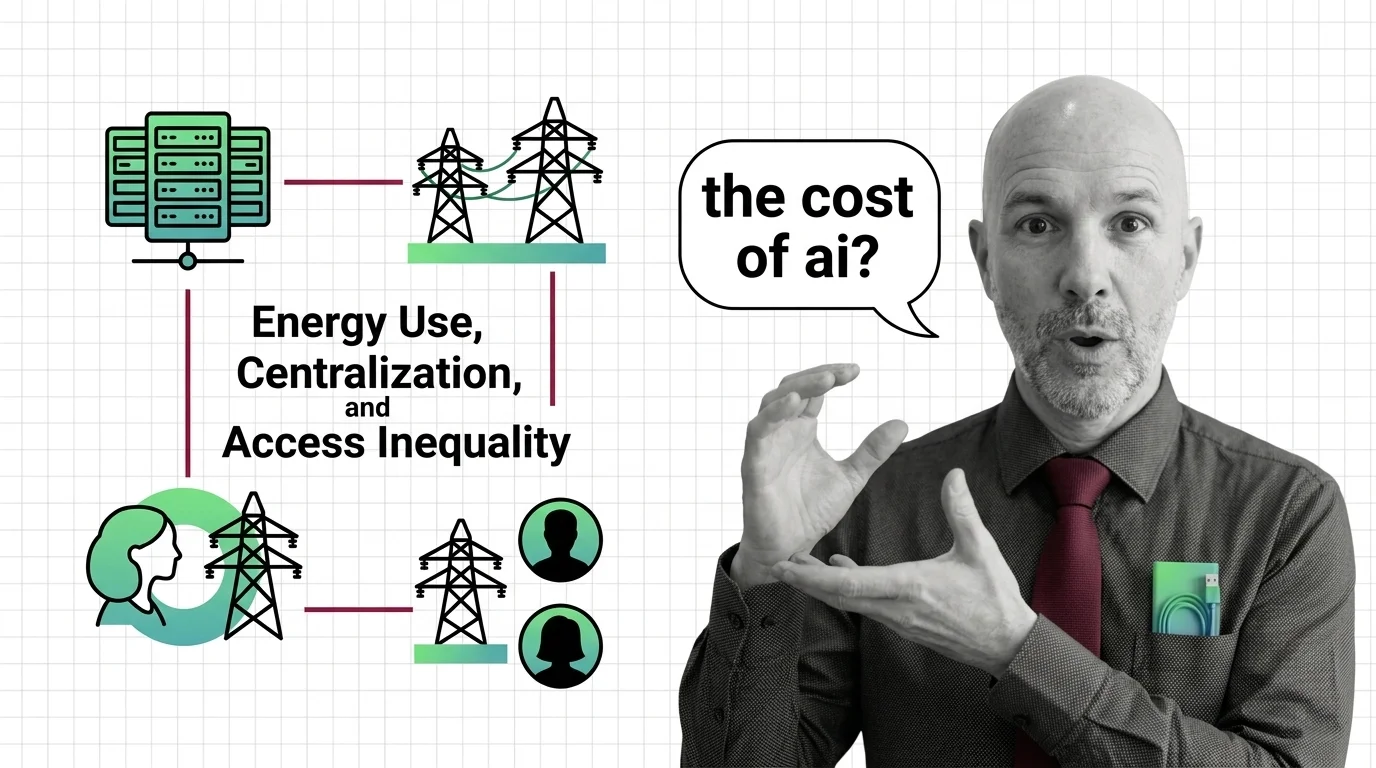
Table of Contents
The Hard Truth
What if the most important decision in artificial intelligence was not which model to build, but who gets to afford the electricity bill? And what if the architecture itself — the very mathematics of attention — made that bill structurally impossible to share?
Every conversation about AI progress eventually circles back to capability. Bigger models, longer context windows, better benchmarks. But there is another metric quietly accumulating beneath every breakthrough, one we rarely discuss with the same enthusiasm: the kilowatt-hours. The question is not whether Transformer Architecture is brilliant — it plainly is. The question is what that brilliance costs, and who bears the weight.
The Bill Nobody Reads
We celebrate intelligence. We do not celebrate the energy required to produce it.
The Attention Mechanism at the heart of every modern language model carries a mathematical property that sounds abstract until you translate it into electricity: quadratic complexity. Self-attention scales at O(n^2) relative to sequence length — doubling the input does not double the compute, it quadruples it (Keles et al.). This is not a bug in the implementation. It is the fundamental geometry of how transformers relate every token to every other token, and it means that the architecture’s appetite for resources grows faster than its capacity to process meaning.
The numbers, even as estimates, are difficult to ignore. A 2019 study found that training a large transformer with neural architecture search emitted roughly 626,000 pounds of CO2 — comparable to five car lifetimes (Strubell et al.). The models in that study were far smaller than today’s frontier systems, which makes the figure both dated and directionally generous: the real costs for modern models are almost certainly larger, even accounting for hardware improvements. Estimates for GPT-4’s training suggest somewhere between 51,773 and 62,319 MWh of energy consumption, using around 25,000 A100 GPUs over roughly 90 to 100 days (Epoch AI). OpenAI has not officially disclosed these figures, so we work with inferred ranges. But the order of magnitude tells a story on its own.
And training is only the opening chapter. Inference — the part where a billion messages a day flow through ChatGPT — adds a steady, continuous draw. Each query consumes a small amount of energy that seems trivial in isolation. The cost is not in any single question but in the aggregate, in a system designed to be asked everything by everyone, all the time.
The Case for Necessary Expense
The conventional wisdom has a reasonable shape. Large-scale AI training is expensive, yes, but so was electrification, so was the internet backbone, so was every infrastructure that eventually became cheap enough to democratize. The argument goes: the initial investment is steep, but hardware improves, algorithms become more efficient, and the benefits spread outward.
There is evidence for this. Data centers consumed approximately 415 TWh of electricity in 2024, roughly 1.5% of global demand (IEA). That percentage has remained relatively stable even as compute demand surged, because efficiency gains in chips and cooling have absorbed much of the growth. Techniques like FlashAttention reduce memory overhead. State Space Model architectures offer promising alternatives with linear scaling. The picture, in this telling, is not one of runaway waste but of a system that bends under pressure and adapts.
Thoughtful people can hold this view and be right about the facts. The question is whether they are right about the framing.
The Assumption Buried in the Architecture
The steelman argument rests on a hidden premise: that the benefits of Multi Head Attention and the broader transformer ecosystem will distribute as broadly as the costs. That the pattern we have seen with electricity and telecommunications — expensive at first, then cheap, then universal — will repeat itself here.
But there is a structural reason to doubt this. The Encoder Decoder framework, the Positional Encoding schemes, the massive Feedforward Network layers, the Tokenization pipelines, the dense Embedding spaces — all of these components compound into systems that require not just money but a specific kind of infrastructure: GPU clusters measured in tens of thousands of units, cooling systems the size of small factories, energy contracts that only a handful of corporations on the planet can negotiate.
The IEA projects data center electricity consumption will reach roughly 945 TWh by 2030 — equivalent to Japan’s total electricity demand. AI’s share of that load, currently estimated between 5% and 15%, could reach 35-50% by 2030 (Carbon Brief). In the first three quarters of 2024 alone, Microsoft, Meta, Alphabet, and Amazon spent a combined $150 billion on infrastructure — those figures include cloud and general services alongside AI, but the trajectory is unmistakable (Atlantic Council).
The gap is not closing — it is compounding. When the entry ticket to train a frontier model costs nine figures, the claim that “anyone can build AI” becomes aspirational rather than descriptive.
When Infrastructure Becomes Jurisdiction
History offers an uncomfortable parallel. The factories of the first industrial revolution did not merely produce goods — they reorganized society around whoever could afford the machines. Access to steam power, then electrical power, then computing power, followed a consistent pattern: early concentration, gradual diffusion, but always with the original concentrators retaining structural advantages that outlasted the diffusion itself.
The transformer architecture fits this pattern with disturbing precision. Fine Tuning a pre-trained model is far cheaper than training from scratch, yes. But who controls the base model? Who decides which data it was trained on, which values are embedded in its weights, which languages it speaks fluently and which it handles as an afterthought?
Open-weights models — Llama, Mistral, DeepSeek — are narrowing the capability gap, and quantized versions can run on consumer hardware. This is real and encouraging. But running inference on a pre-trained model is not the same as governing the training process. The person who fine-tunes a model inherits its assumptions. The person who trained the base model chose them.
Power Follows Compute
Thesis: The transformer architecture’s resource demands are not incidental to its success — they are a selection mechanism that determines who governs the future of artificial intelligence.
This is not a prediction. It is a description of what has already happened. The organizations that can afford to train frontier models are the same organizations that control the cloud infrastructure most developers depend on to run those models. The relationship is not one of service provider and customer. It is increasingly one of dependency.
The energy question and the access question are not separate concerns. They are two expressions of the same structural reality: an architecture whose resource appetite creates a natural concentration of capability. The quadratic scaling of self-attention is not just an engineering constraint — it is an economic barrier, and economic barriers are, always, political barriers.
Who participates in defining how AI behaves? Who gets to ask whether the training data is representative? Who can afford to verify that a model works fairly across languages, cultures, and contexts? The answers follow the same gradient as the electricity bill.
Questions Worth Sitting With
This is not the place for a policy proposal or a checklist of reforms. It is the place for honesty about the questions we owe each other.
If the architecture that produces intelligence requires resources that only a handful of organizations can provide, what does “open AI” actually mean? If open-weights models inherit the assumptions of their base training, is downloading a model the same as having a voice in its design? If the environmental cost of AI training is borne disproportionately by communities that benefit least from its outputs, how do we account for that in our celebration of progress?
These are not rhetorical flourishes. They are governance failures waiting to be named.
Where This Argument Is Weakest
Intellectual honesty demands acknowledging the strongest counterevidence. If efficiency gains in hardware and algorithms continue at their current pace — if hybrid architectures combining transformers with state-space models reduce the quadratic penalty — the energy argument weakens significantly. Google’s own research has argued that the carbon footprint of training can be reduced dramatically through renewable energy sourcing and geographic optimization of compute.
And the open-source movement is not trivial. The fact that capable models now run on consumer hardware is a genuine structural shift, even if it does not address who controls the training process. If open training initiatives scale — if the cost of training collapses the way the cost of inference is collapsing — the centralization thesis loses its foundation.
This argument is strongest in the present tense. Whether it holds in five years depends on decisions being made now.
The Question That Remains
The transformer architecture gave us a mechanism for artificial attention — a way for machines to weigh what matters against what does not. The irony is that we have not applied the same discipline to our own attention. We are watching the most consequential infrastructure shift in a generation and focusing on the outputs while ignoring the inputs: the energy, the capital, the assumptions, the exclusions. What happens when the architecture of intelligence becomes the architecture of power, and nobody remembers consenting to the transfer?
Disclaimer
This article is for educational purposes only and does not constitute professional advice. Consult qualified professionals for decisions in your specific situation.
AI-assisted content, human-reviewed. Images AI-generated. Editorial Standards · Our Editors