The Decoder-Only Monoculture: What the AI Industry Risks by Betting on a Single Architecture
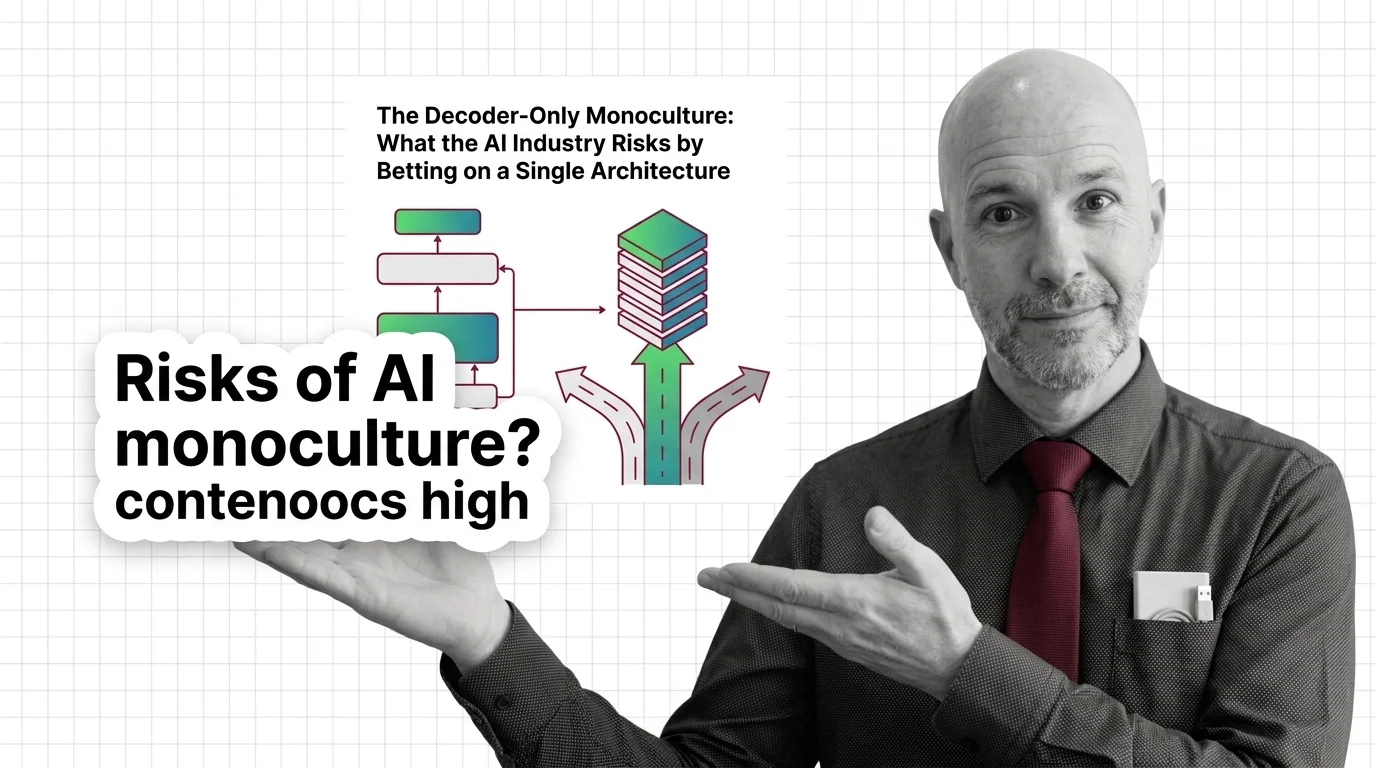
Table of Contents
The Hard Truth
What if the most consequential architectural decision in AI history was never actually a decision — but a default that nobody questioned? Every major language model today shares the same fundamental structure. Not because we compared the alternatives and chose the best one, but because the first version that scaled happened to be built this way.
In 2017, the original Transformer paper proposed an architecture with two complementary halves: an encoder to understand and a decoder to generate. Within a few years, one half won — not through comparative evidence, but through sheer commercial momentum. The question that haunts this outcome is whether that uniformity represents strength or a vulnerability we have not yet been forced to confront.
The Convergence Nobody Chose
The Decoder Only Architecture did not rise to dominance because researchers systematically compared it against alternatives and found it superior. It became the default because OpenAI’s GPT series succeeded commercially — and commercial success in AI generates imitation faster than understanding.
This is worth sitting with. The original Transformer Architecture from Vaswani et al. was an Encoder Decoder Architecture — a design where one component processes input and another generates output. The decoder-only variant strips away the encoder, relying entirely on Causal Masking and Autoregressive Generation to produce text one token at a time. That simplification made scaling easier. It did not make it better.
The shift was driven by GPT’s commercial success, not by rigorous architectural comparison — a distinction a Google DeepMind study makes explicit, finding that encoder-decoder models, after finetuning, match or surpass decoder-only models across scales while achieving meaningfully lower first-token latency and higher throughput on constrained hardware (Google DeepMind). The entire industry then organized its compute, its tooling, and its research agenda around a choice that was never rigorously examined.
The Strongest Case for Uniformity
To be fair, the case for convergence is not unreasonable. Next Token Prediction at scale produces remarkable capabilities. Scaling Laws suggested, for nearly half a decade, that more data and more compute reliably yielded better models. The decoder-only design’s simplicity made it easier to parallelize, easier to optimize for KV Cache efficiency, easier to scale. When something works, you build more of it.
And the results spoke. GPT-4, Claude, Gemini, LLaMA — the models that shape how millions of people interact with AI all share the same fundamental bones. The infrastructure investment followed: Microsoft, Meta, Alphabet, and Amazon spent roughly $150 billion in the first three quarters of 2024 alone, with forecasts approaching $220 billion for 2025 (AI 2027). When that much capital flows in one direction, it creates its own gravity — the architecture becomes the economy.
The honest version of the convergence argument is this: we found something that works, and we scaled it. What more do you want?
The Assumption Underneath the Success
What I want is the conversation that never happened.
The hidden assumption inside the decoder-only consensus is that architectural effectiveness at scale proves architectural optimality. That because GPT-3 worked, and GPT-4 worked better, the underlying structure must be the right one — not merely a sufficient one.
But sufficiency and optimality are very different things. A March 2026 analysis found that across twelve major models — spanning both US and Chinese labs — structural overlap reached nearly ninety percent, with every model sharing the same transformer backbone and the same next-token prediction objective (Symfield AI). The personnel overlap mirrors the structural one — researchers rotate between the same handful of labs carrying assumptions with them, while the same investors fund competing projects built on identical foundations.
This is not diversity performing convergence. This is monoculture. And monocultures have a specific, well-documented failure mode: they are efficient right up until the moment they collapse. Every farmer who has ever lost a crop to a single pathogen understands this. Every financial regulator who studied 2008 understands this. The question is whether the AI industry understands it — or whether it has simply decided the harvest is too good to question.
What Agriculture and Finance Already Taught Us
The most instructive parallel is not technical. It is ecological.
In agriculture, monocultures maximize short-term yield by eliminating variation — efficient until a single vulnerability propagates through the entire system. The Irish Potato Famine was not caused by a bad potato. It was caused by every potato being the same potato.
The 2008 financial crisis followed the same logic — not one bad mortgage, but a system where every institution held the same risk, evaluated by the same models. When the assumption broke, it broke everywhere simultaneously.
The AI industry’s Attention Mechanism monoculture carries the same structural fragility. Nearly all advanced training and inference runs on NVIDIA GPUs — a single-point infrastructure dependency. The scaling paradigm that justified the convergence is itself showing strain: OpenAI, Google, and Anthropic all reported smaller-than-expected improvements in late 2024 (TechCrunch). As Ilya Sutskever put it, “The 2010s were the age of scaling, now we’re back in the age of wonder and discovery” (Platformer). That phrase — the age of wonder — is telling. It is what you say when the old certainty has stopped working.
The Architecture of Concentration
Here is where the ethical question becomes unavoidable. Does decoder-only dominance concentrate AI power in companies with the largest compute budgets?
The answer is structural, not speculative. When the entire field optimizes for a single architecture, the organizations that can afford to scale that architecture the farthest hold disproportionate advantage. As of 2024, Google commanded roughly a fifth of global AI compute, Meta about thirteen percent, while most organizations — including governments, universities, and smaller companies — operated with negligible fractions (AI 2027). The scaling laws that justified decoder-only dominance are not architecture-neutral. They reward whoever has the deepest pockets and the most GPUs.
Alternative architectures tell a different story. Mamba, a state-space model developed by Gu and Dao, achieves linear-time sequence modeling — fundamentally different computational economics than the quadratic complexity of standard transformer attention (Gu & Dao). Mixture Of Experts approaches activate only relevant subnetworks. Hybrid models like Jamba and IBM Granite 4.0 combine attention with state-space layers, suggesting that the future might look less like a single dominant species and more like an ecosystem.
But ecosystems require that alternatives survive long enough to mature. When capital, talent, and infrastructure all flow toward one architecture, the alternatives do not get a fair trial. They get starved — not because they failed, but because nobody funded the experiment.
The Questions We Owe the Field
What are the ethical risks of the entire AI industry converging on decoder-only architecture? They are the risks of any monoculture: correlated failure, concentrated power, and the slow erosion of intellectual diversity that produces genuine breakthroughs.
The scientific community is beginning to notice. Research on AI’s influence on scientific inquiry suggests that the convergence extends beyond architecture into methodology and framing — a kind of epistemic monoculture where everyone asks the same questions using the same tools and measures success by the same benchmarks (Nature Comms Psych).
This is not a call to abandon decoder-only models. They work. The question is whether “it works” is sufficient when the stakes include who gets to build AI, who benefits from it, and what kinds of intelligence we never discover because we stopped looking.
Where This Argument Is Weakest
I should name the vulnerability in my own position. If decoder-only architecture continues to improve — if test-time compute or architectural refinements within the paradigm find a second wind — then the monoculture argument weakens considerably. A monoculture that never encounters its pathogen is, functionally, just efficiency.
It is also possible that the market will diversify on its own. Hybrid models are already emerging. If Mamba-style alternatives find commercial traction, the concentration I describe may prove temporary — a phase, not a permanent condition.
The Question That Remains
We built the most powerful information technology in human history on a single architectural pattern that was never rigorously chosen. The pattern works. The returns are real. But so is the silence — the missing conversation about what we might have built differently, and who we left out by never asking.
What happens to a civilization that entrusts its most consequential technology to an architecture nobody chose, everybody copied, and no one can afford to question?
Disclaimer
This article is for educational purposes only and does not constitute professional advice. Consult qualified professionals for decisions in your specific situation.
AI-assisted content, human-reviewed. Images AI-generated. Editorial Standards · Our Editors